
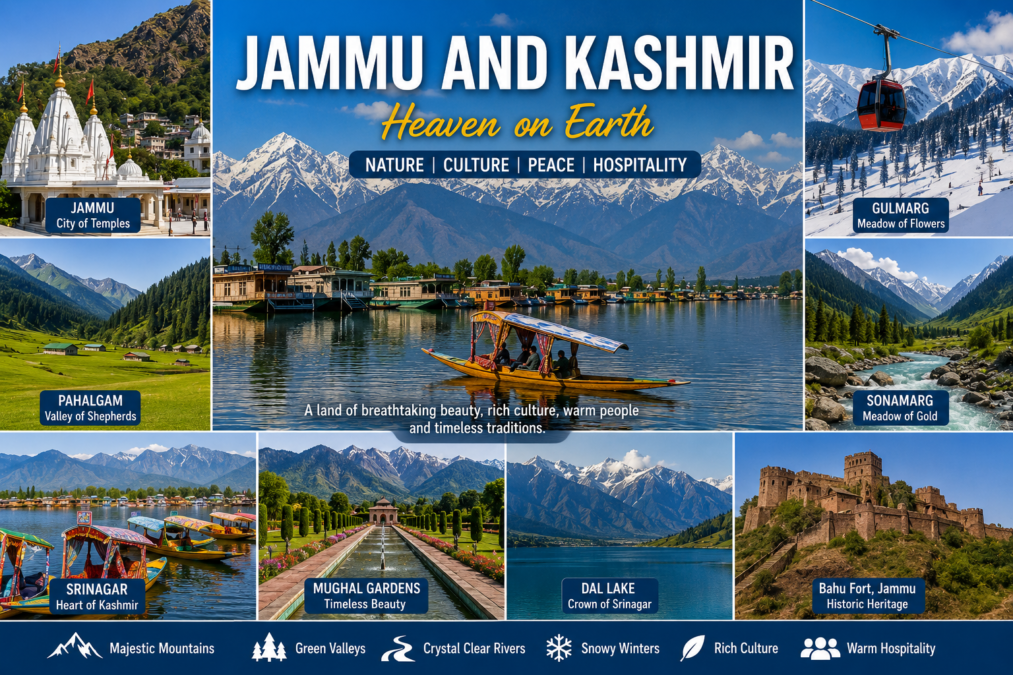

jammu and kashmir is one of the most geographically beautiful, culturally rich, and historically significant regions of South Asia. Located in the Himalayan region, it is known for high mountains, green valleys, rivers, lakes, forests, gardens, traditional crafts, religious sites, and a long and complex history.
Today, the Union Territory of Jammu and Kashmir is administered by India, following the reorganisation of the former state in 2019. Under the Jammu and Kashmir Reorganisation Act, 2019, Jammu and Kashmir became a Union Territory with a legislature, while Ladakh became a separate Union Territory without a legislature.
At the same time, it is important to understand that the wider Kashmir region remains internationally disputed. The United Nations describes the final status of Jammu and Kashmir as unresolved and notes that a Line of Control is used between India- and Pakistan-administered areas.
This article looks at the region in a balanced and informative way. It explores its geography, history, people, culture, tourism, economy, agriculture, education, environment, and future opportunities.
Geography of jammu and kashmir
Geography is one of the defining features of jammu and kashmir. The region is situated in the northern part of the Indian subcontinent and contains dramatic changes in elevation, climate, landscape, and vegetation.
The official Jammu and Kashmir Trade Promotion Organization describes the Union Territory as being located in the extreme north of India, with Ladakh to the north and east, Punjab and Himachal Pradesh to the south, and Pakistan to the west.
The landscape includes:
- Himalayan mountains
- Green valleys
- Forested hills
- Alpine meadows
- Rivers and streams
- Lakes
- Snow-covered peaks
- Agricultural plains
- High-altitude areas
This variety creates different climates within relatively short distances.
The Jammu region generally experiences warmer conditions than the Kashmir Valley, while the higher mountain areas can experience severe winter weather.
In other words, the region isn’t just one type of landscape. It is a fascinating mixture of mountains, valleys, forests, rivers, and settlements.
Jammu and Kashmir as a Union Territory
One of the most important modern developments in the region occurred in 2019.
The Government of India enacted the Jammu and Kashmir Reorganisation Act, 2019. The law provided for the reorganisation of the former state and established the Union Territory of Jammu and Kashmir with a legislature. It also created the Union Territory of Ladakh without a legislature.
The official framework also provides for the administration and representation of the Union Territory.
This change is important because the political and administrative structure of the region is different from the structure that existed before 2019.
For readers researching jammu and kashmir, this distinction matters. Older books, websites, and articles may use the term “state of Jammu and Kashmir,” while current Indian administrative references generally refer to the Union Territory of Jammu and Kashmir.
Jammu: The Southern Cultural Gateway
Jammu is an important city and regional center. It is often associated with temples and pilgrimage tourism and is sometimes called the “City of Temples.”
The city is located along the Tawi River and provides an important gateway toward the Kashmir Valley and other mountain destinations.
Jammu’s importance comes from several factors:
- Religious tourism
- Business activity
- Transportation
- Education
- Government services
- Cultural heritage
- Trade
The Jammu Master Plan documentation describes Jammu as a Himalayan city with distinctive geographical and environmental features and identifies the Tawi River as an important part of its physical setting.
For many travelers, Jammu is also an important starting point for journeys toward places such as Katra, Patnitop, and the Kashmir Valley.
Srinagar and the Kashmir Valley
Srinagar is one of the best-known cities in jammu and kashmir.
It sits in the Kashmir Valley and is famous for Dal Lake, traditional houseboats, gardens, waterways, handicrafts, and mountain scenery.
The city has a long cultural history and remains one of the major tourism and commercial centers of the region.
Among the attractions associated with Srinagar are:
- Dal Lake
- Nigeen Lake
- Shalimar Garden
- Nishat Garden
- Chashma Shahi
- Pari Mahal
- Hazratbal
- Old-city markets
- Traditional houseboats
The Jammu and Kashmir Tourism Development Corporation lists Srinagar, Dal Lake, Nigeen Lake, the Mughal gardens, and several religious and cultural attractions among the region’s tourism destinations.
Srinagar’s traditional houseboats and shikaras have become recognizable symbols of Kashmir tourism.
A calm ride across Dal Lake, surrounded by mountains and reflections, is one of those experiences travelers often remember for years.
The Natural Beauty of jammu and kashmir
The phrase “heaven on Earth” has long been associated with Kashmir because of its extraordinary scenery.
Although such descriptions are subjective, it’s easy to understand why the region attracts visitors.
Its scenery changes dramatically with the seasons.
Spring
Spring brings flowers, fresh greenery, and pleasant temperatures.
Summer
Summer can be especially attractive for travelers seeking relief from hotter plains.
Autumn
Autumn is famous for golden and reddish foliage, particularly among the region’s trees and forests.
Winter
Winter transforms many mountain destinations into snow-covered landscapes.
This seasonal variety gives jammu and kashmir a special character.
The same destination can look completely different at different times of the year.
Gulmarg: Mountains, Snow, and Adventure
Gulmarg is one of the most famous tourist destinations in the region.
Located in the Baramulla district, Gulmarg is known for its meadows, mountains, winter sports, golf course, and gondola.
The Jammu and Kashmir Tourism Development Corporation describes Gulmarg as a hill resort about 52 kilometers southwest of Srinagar and highlights attractions such as Apharwat Peak, the golf course, Khilanmarg, and winter sports.
During winter, skiing becomes a major attraction.
Visitors may also enjoy:
- Snowboarding
- Gondola rides
- Hiking
- Golf
- Horse riding
- Photography
- Mountain sightseeing
The Gulmarg gondola provides access toward higher mountain areas and is one of the best-known attractions in the region.
Of course, mountain activities require proper planning. Weather can change quickly, and visitors should follow local safety guidance.
Pahalgam and the Lidder Valley
Pahalgam is another major destination in jammu and kashmir.
The Jammu and Kashmir Tourism Development Corporation describes Pahalgam as the “Valley of Shepherds.” It lies at an elevation of around 2,130 meters and is associated with the Lidder River, surrounding mountains, forests, and nearby valleys.
Popular attractions around Pahalgam include:
- Aru Valley
- Baisaran Hills
- Tulian Lake
- Lidder River
- Pahalgam Golf Course
- Surrounding mountain trails
Pahalgam also has religious significance because it has historically served as an important starting point for the Amarnath pilgrimage route.
The area’s combination of natural beauty and religious importance makes it significant to different types of visitors.
Sonamarg and High Mountain Landscapes
Sonamarg, meaning “Meadow of Gold,” is another well-known destination in Kashmir.
It is surrounded by mountains and is popular for scenic views, trekking, and access to high-altitude landscapes.
The wider Kashmir tourism network also highlights destinations such as Gurez, Doodhpathri, Yusmarg, Aharbal, Lolab Valley, and Warwan Valley.
These destinations demonstrate that tourism in the region isn’t limited to the most famous cities.
There are quieter valleys and mountain areas that offer a different experience for visitors who want nature, peaceful surroundings, and outdoor activities.
Lakes and Rivers of the Region
Water is central to the landscape of jammu and kashmir.
The region contains numerous rivers, lakes, springs, and streams.
Important water bodies include:
- Dal Lake
- Nigeen Lake
- Manasbal Lake
- Jhelum River
- Chenab River
- Tawi River
- Lidder River
- Various mountain springs
The official regional overview identifies rivers including the Jhelum, Chenab, Indus, Ravi, and Tawi among the major rivers associated with the broader Himalayan region.
These water resources support communities, agriculture, tourism, ecosystems, and hydropower development.
However, water resources also need careful protection. Pollution, uncontrolled development, climate change, and changing rainfall patterns can place pressure on rivers and lakes.
History of jammu and kashmir
The history of jammu and kashmir is long and complex.
The wider region has been influenced by different kingdoms, empires, religious traditions, cultures, and trading networks.
Its location between Central Asia, South Asia, and the Himalayan world helped make it historically important.
The region has been associated with:
- Ancient Hindu traditions
- Buddhism
- Islamic culture
- Sufi traditions
- Sikh history
- Dogra history
- Mughal influence
- British-era developments
- Modern South Asian politics
This mixture has produced a rich cultural landscape.
Historical sites, temples, mosques, shrines, forts, gardens, and old settlements can be found across different parts of the region.
The Kashmir Dispute
Any serious article about jammu and kashmir should acknowledge the region’s political dispute.
The dispute has roots in the partition of British India in 1947. The United Nations explains that the status of the former princely state became contested between India and Pakistan, with fighting beginning in 1947 and the issue subsequently reaching the UN Security Council.
The dispute has remained an important issue in India-Pakistan relations for decades.
Today, different parts of the former princely state are administered by India, Pakistan, and China, while sovereignty over the wider region remains contested.
The United Nations notes that the final boundary and status have not been agreed upon by the parties.
It is therefore important for writers and readers to distinguish between:
- Current administrative arrangements
- Historical claims
- Internationally disputed territory
- Political positions of different governments
- The experiences and perspectives of local communities
A balanced discussion should avoid presenting one political viewpoint as an uncontested fact.
Culture and Traditions
The culture of jammu and kashmir is one of its greatest strengths.
Different communities have contributed to the region’s music, language, food, clothing, architecture, literature, crafts, and traditions.
Kashmiri cultural traditions are particularly famous for their artistic detail.
Traditional crafts include:
- Kashmiri carpets
- Pashmina products
- Shawls
- Paper-mâché crafts
- Wood carving
- Embroidery
- Wickerwork
These crafts aren’t simply tourist products.
For many families, traditional skills are part of a cultural heritage passed from one generation to another.
Supporting genuine local artisans can therefore help preserve both livelihoods and cultural knowledge.
Languages Spoken in the Region
The linguistic landscape is diverse.
Languages and varieties associated with Jammu and Kashmir include:
- Kashmiri
- Dogri
- Urdu
- Hindi
- Gojri
- Pahari
- Balti and other regional languages in the wider Himalayan context
Language is closely connected with identity and culture.
Kashmiri has a particularly important place in the cultural life of the Kashmir Valley, while Dogri has strong historical and cultural roots in the Jammu region.
This linguistic diversity adds another layer to the region’s identity.
Food of jammu and kashmir
Food is another important part of the region’s cultural experience.
Kashmiri cuisine is known for its distinctive spices, slow cooking, meat dishes, rice-based meals, breads, teas, and vegetarian preparations.
Some well-known dishes include:
- Rogan Josh
- Yakhni
- Gushtaba
- Rista
- Dum Aloo
- Haak
- Modur Pulao
- Kahwa
Wazwan is particularly famous as a traditional Kashmiri multi-course feast.
Food traditions can vary by community, location, and family, so there isn’t one single “Kashmiri menu.”
That’s part of the fun.
Every kitchen has its own touch.
Agriculture and Horticulture
Agriculture plays an important role in the economy of jammu and kashmir.
The region’s climate and mountain valleys support a range of agricultural and horticultural activities.
Important products include:
- Apples
- Saffron
- Walnuts
- Almonds
- Cherries
- Pears
- Rice
- Maize
- Vegetables
Apple production is particularly important to the Kashmir Valley.
Saffron from Pampore is also internationally recognized for its distinctive quality and cultural importance.
The official regional overview states that agriculture and related sectors form a major part of the Jammu and Kashmir economy, with a significant share of the population engaged in agricultural and allied activities.
Handicrafts and Local Business
Traditional handicrafts provide both cultural and economic value.
Kashmiri carpets, shawls, embroidery, woodwork, and other products have attracted buyers in India and abroad.
For the sector to grow sustainably, businesses need to focus on:
- Authentic products
- Fair payment to artisans
- Better packaging
- Digital marketing
- E-commerce
- Quality control
- Protection of traditional designs
- Responsible tourism
Technology can open new doors.
A skilled artisan in a small mountain community can now potentially reach customers far beyond the local market through digital platforms.
Tourism in jammu and kashmir
Tourism is one of the most visible economic activities in the region.
The official tourism corporation lists a wide range of destinations and activities, including skiing, trekking, mountaineering, river rafting, paragliding, golfing, fishing, and adventure tourism.
Tourism can support:
- Hotels
- Restaurants
- Transportation
- Tour guides
- Local shops
- Handicrafts
- Adventure companies
- Photography
- Agriculture-related businesses
But tourism must be managed responsibly.
Overcrowding can damage fragile environments, increase waste, place pressure on water resources, and affect local communities.
The best tourism model is one that protects the environment while creating opportunities for residents.
Education and Modern Development
Education is an important part of Jammu and Kashmir’s future.
The official regional overview reports a large education network, including thousands of schools, universities, colleges, vocational facilities, and technology-related labs. It also identifies institutions such as the University of Kashmir, University of Jammu, IIT Jammu, IIM Jammu, AIIMS Jammu, and IUST.
Education can help the region expand beyond traditional economic sectors.
Young people can develop careers in:
- Information technology
- Healthcare
- Tourism
- Engineering
- Business
- Agriculture technology
- Environmental science
- Education
- Research
- Digital services
The combination of education and technology could become an important part of future economic development.
Environment and Wildlife
The natural environment of jammu and kashmir is valuable but also fragile.
Mountain ecosystems are sensitive to changes in temperature, rainfall, land use, and human activity.
Important environmental concerns can include:
- Deforestation
- Water pollution
- Waste management
- Habitat loss
- Unplanned construction
- Climate change
- Pressure from tourism
Protecting forests and wetlands is especially important because they support biodiversity and help regulate water.
Responsible tourism should encourage visitors to:
- Avoid littering
- Reduce plastic waste
- Respect wildlife
- Follow marked trails
- Avoid damaging plants
- Use water carefully
- Support local businesses
Small actions add up.
Adventure Tourism
For people who enjoy outdoor activities, jammu and kashmir offers many opportunities.
Depending on location, season, and local conditions, visitors may find:
- Skiing
- Trekking
- Mountaineering
- Golf
- River rafting
- Fishing
- Paragliding
- Camping
- Horse riding
The official tourism corporation specifically promotes adventure activities such as trekking, skiing, mountaineering, rafting, paragliding, fishing, and golfing.
Safety should always come first.
Mountain environments can be unpredictable. Travelers should check current weather, road conditions, local regulations, and professional guidance before participating in higher-risk activities.
A Simple Comparison of Major Destinations
| Destination | Known For | Best-Known Features |
|---|---|---|
| Jammu | Heritage and pilgrimage | Temples, Tawi River, markets |
| Srinagar | Culture and lakes | Dal Lake, gardens, houseboats |
| Gulmarg | Snow and adventure | Skiing, Gondola, mountains |
| Pahalgam | Nature and valleys | Lidder River, Aru Valley |
| Sonamarg | Mountain scenery | Meadows, high-altitude landscapes |
| Gurez | Remote mountain beauty | Valleys, villages, trekking |
| Yusmarg | Peaceful scenery | Meadows and forests |
| Doodhpathri | Natural landscapes | Green meadows and streams |
The official tourism corporation lists many of these destinations among its Kashmir travel offerings.
Why jammu and kashmir Matters to South Asia
The importance of jammu and kashmir goes beyond tourism.
The region matters because of its:
- Strategic location
- Mountain geography
- Water resources
- Cultural heritage
- Agricultural production
- Tourism potential
- Political history
- Environmental importance
- Connection between different parts of Asia
Its location has made it historically important and politically sensitive.
At the same time, its natural resources and human talent provide significant opportunities for economic development.
Future Opportunities
The future of jammu and kashmir can include many positive possibilities.
Sustainable Tourism
Tourism can grow while protecting mountains, lakes, forests, and local communities.
Modern Agriculture
Better storage, processing, packaging, irrigation, and digital marketing could increase agricultural value.
Handicraft Exports
Traditional crafts can reach larger markets through responsible e-commerce and international trade.
Education and Technology
Young people can use digital skills to participate in global industries.
Renewable Energy
Mountain geography and water resources create opportunities for carefully managed clean-energy projects.
Local Entrepreneurship
Small businesses can create employment and keep more economic value within local communities.
These opportunities won’t happen automatically. They require planning, investment, education, environmental protection, and strong institutions.
Practical Travel Tips
People planning a trip to jammu and kashmir should prepare carefully.
Useful tips include:
- Check the weather before traveling.
- Confirm current transport and road conditions.
- Carry suitable clothing for the season.
- Keep identification and travel documents secure.
- Respect local customs.
- Follow official travel and safety instructions.
- Avoid restricted or sensitive areas.
- Use registered accommodation and transport where possible.
- Keep mountain areas clean.
- Carry appropriate medicines and personal supplies.
- Allow extra travel time in mountainous areas.
Travel plans can change because of weather, road conditions, or local circumstances, so flexibility is useful.
Respecting the People and Culture
Travelers should remember that jammu and kashmir is home to millions of people, not simply a holiday destination.
Visitors can make their trips more meaningful by respecting local communities.
That means:
- Asking before photographing people.
- Dressing appropriately for religious places.
- Respecting worshippers.
- Buying genuine local products.
- Avoiding waste.
- Learning a few local expressions.
- Listening to local guides.
- Treating workers and artisans fairly.
A good traveler doesn’t just collect photographs.
They collect understanding.
Final Thoughts on jammu and kashmir
jammu and kashmir is a region of extraordinary natural beauty, deep cultural traditions, valuable agricultural resources, important historical sites, and significant political history. Its mountains, valleys, rivers, lakes, gardens, handicrafts, food, and traditions have made it an important part of South Asian heritage.
Its modern administrative structure changed significantly in 2019, when the former state was reorganized into the Union Territories of Jammu and Kashmir and Ladakh under Indian law. At the same time, the broader Kashmir question remains internationally disputed, and the United Nations continues to describe the final status as unresolved.
Looking ahead, there is plenty of reason for optimism when discussing jammu and kashmir. Sustainable tourism, modern agriculture, education, technology, handicrafts, environmental protection, and local entrepreneurship can all contribute to a stronger future.
The region’s greatest strength may ultimately be its combination of nature and people: spectacular landscapes alongside generations of cultural knowledge and human creativity. With responsible development and respect for its environment and communities, jammu and kashmir can continue to remain one of the most remarkable and widely recognized regions of the Himalayan world.
Explore more insightful articles on All Vantage News and never miss an update.Contact Us.