
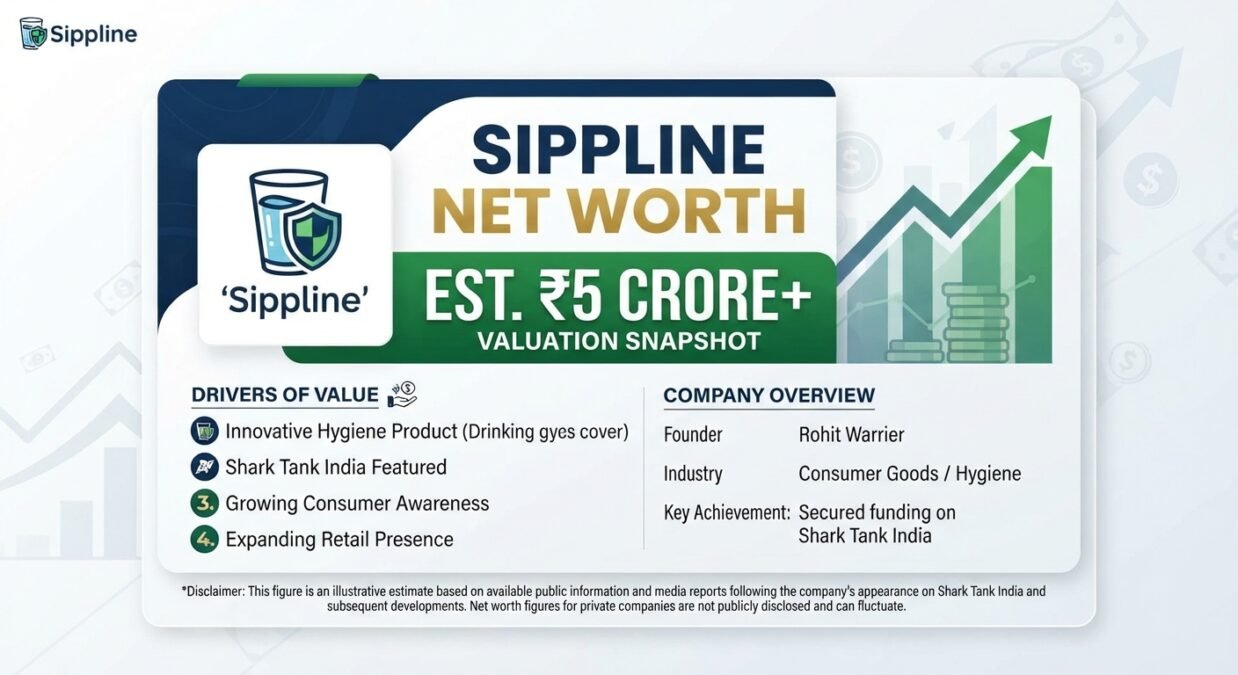

Introduction to Sippline Net Worth
Sippline net worth became a popular search topic after the unusual drinking accessory appeared on Shark Tank India Season 1. The product attracted attention because it offered a simple idea: helping people drink from public glasses without placing their lips directly on the rim. However, the pitch became famous for another reason. The founder’s requested valuation led to questions about the company’s actual business value, customer demand, and future potential.
Sippline was founded by entrepreneur Rohit Warrier. During his appearance on the television show in January 2022, he asked for ₹75 lakh in exchange for 15% equity in his company. This request implied a business valuation of ₹5 crore. However, the sharks did not offer him a deal, so the proposed valuation should not be confused with a confirmed sale price or a current financial assessment. Public information about the company’s latest revenue, assets, and profits remains limited. <Cite refs={[“turn265458search0″,”turn265458search2”]}/>
This article explores the reported Sippline net worth, the founder’s entrepreneurial background, the product’s purpose, the company’s television appearance, and the lessons its journey offers aspiring business owners.
What Is Sippline?
Sippline is an Indian product brand known for its portable drinking shield, sometimes described as a glass mask. The accessory was designed to fit onto the rim of a drinking glass, creating a barrier between the user’s lips and the glass itself.
The basic idea came from a familiar situation. People often drink water, juice, or other beverages from glasses in restaurants, hotels, offices, and social gatherings. Although businesses are expected to clean their glassware properly, some customers may still worry about hygiene.
Sippline attempted to address this concern with a small, portable accessory.
Its intended features included:
- Portable design: The product was designed to be carried easily.
- Reusable construction: It was presented as an accessory that could be used more than once.
- A physical barrier: It aimed to reduce direct contact between the user’s lips and the glass rim.
- A practical size: Its compact design was intended to make it convenient for travel and social events.
- A distinctive concept: It offered an alternative to drinking directly from a glass or using a straw.
The idea was easy to understand, but convincing customers to purchase and regularly carry a separate drinking accessory proved to be a major business challenge.
Sippline Net Worth: How Much Was the Company Worth?
The most widely reported figure associated with Sippline is ₹5 crore, or ₹50 million. This amount came from the valuation implied by Rohit Warrier’s original investment request on Shark Tank India. <Cite refs={[“turn265458search2″,”turn265458search5”]}/>
It is important to understand what that figure actually represents.
A startup founder may assign a value to a business when seeking investment. That valuation reflects the price the founder hopes investors will accept for a portion of the company. It does not necessarily represent the amount of cash the business owns, the total money it has earned, or the amount another buyer would pay for it.
In Sippline’s case, the ₹5 crore figure was a proposed valuation during the television pitch, not a publicly verified estimate of its present-day worth.
Understanding the reported valuation
| Financial detail | Reported information |
|---|---|
| Company | Sippline Drinking Shields |
| Founder | Rohit Warrier |
| Proposed valuation | ₹5 crore |
| Investment requested | ₹75 lakh |
| Equity offered | 15% |
| Result on Shark Tank India | No deal |
| Verified current net worth | Not publicly established |
| Latest verified annual revenue | Not publicly established |
The show’s pitch record confirms the proposed valuation and the absence of an investment offer. It does not establish the company’s current financial position. <Cite refs={[“turn265458search0″,”turn265458search11”]}/>
Therefore, the most responsible answer to the question about Sippline net worth is that the company sought a ₹5 crore valuation during its television appearance, but its current net worth cannot be reliably confirmed from the available public information.
How Was Sippline’s ₹5 Crore Valuation Calculated?
The mathematics behind the proposed valuation is straightforward.
Rohit Warrier requested ₹75 lakh for a 15% ownership stake. If ₹75 lakh represents 15% of the company, the implied value of the entire business is calculated as follows:
Implied company valuation = Investment requested ÷ Equity offered
Using the figures from the pitch:
₹75 lakh ÷ 0.15 = ₹500 lakh
₹500 lakh equals ₹5 crore.
This is how the company arrived at its proposed valuation.
However, this calculation only explains the investment request. It does not prove that the company had ₹5 crore in cash, inventory, equipment, or other assets. Nor does it show that the business could generate enough future profit to justify that amount.
Investors generally examine several factors before deciding whether a startup deserves a particular valuation.
These may include:
- Current sales and expected future revenue.
- The cost of making and delivering each product.
- Customer demand and repeat purchases.
- Competition from existing alternatives.
- The strength of the brand and its marketing strategy.
- Intellectual property and product differentiation.
- The founder’s ability to manage and expand the business.
- The financial risks involved in scaling operations.
A strong idea can be valuable, but investors usually need evidence that customers are willing to pay for it.
Who Is Rohit Warrier?
Rohit Warrier is the entrepreneur associated with Sippline. He gained wider public attention after presenting his drinking shield on Shark Tank India.
According to an interview published by Indian Business Times, Warrier had entrepreneurial experience before Sippline and had founded or worked on other business ventures. The interview also described his hospitality-related educational background and explained that his interest in improving drinking hygiene influenced the product idea. <Cite refs={[“turn265458search2″,”turn265458search9”]}/>
His experience is relevant because entrepreneurs often identify business opportunities through problems they encounter in their professional lives.
For someone familiar with hotels and hospitality, the cleanliness of drinking glasses can become a topic worth examining. A founder may then try to turn that concern into a product that customers can use.
That process, however, involves more than creating an accessory. It requires testing whether the problem is important enough for customers to change their habits and spend money.
The difference between founder wealth and company wealth
Another important point is that Sippline’s valuation and Rohit Warrier’s personal net worth are two different things.
A company may own stock, equipment, intellectual property, or cash. Its founder may own shares in that company, have personal savings, earn income from other ventures, or have financial obligations of their own.
These figures cannot be treated as interchangeable.
For example, even if a company were valued at ₹5 crore, its founder would not automatically have ₹5 crore in personal wealth. The founder’s ownership percentage, personal debts, business liabilities, and the actual value of the shares would all matter.
There is no reliable public figure in the cited sources that establishes Warrier’s current personal net worth. It would therefore be misleading to assign him an exact personal fortune based solely on Sippline’s original investment request.
Sippline’s Appearance on Shark Tank India
Sippline appeared on Season 1 of Shark Tank India, with the pitch airing on January 28, 2022, according to the show’s independent pitch archive. <Cite refs={[“turn265458search0”]}/>
The show gives entrepreneurs an opportunity to present their businesses to experienced investors, explain their financial expectations, and answer questions about their plans.
Warrier entered the Tank seeking ₹75 lakh for 15% equity. His request placed the implied company valuation at ₹5 crore.
The product attracted immediate attention because it was unusual. Rather than introducing a familiar consumer item with a new design, Sippline attempted to create a new category of drinking accessory.
That difference made the pitch memorable, but it also raised difficult questions about demand and practicality.
Why the sharks did not invest
The sharks questioned whether the product solved a widespread problem and whether enough customers would pay to use it.
Their concerns reflected several common challenges faced by early-stage startups:
- Demand: Would customers consider the product necessary?
- Convenience: Would people carry and clean an additional accessory?
- Competition: Could customers achieve a similar result with an ordinary straw or other existing options?
- Marketing: How much effort would be needed to explain the product?
- Valuation: Was the proposed price for an ownership stake justified by the available business evidence?
No shark made an investment offer, according to the pitch record. <Cite refs={[“turn265458search0″,”turn265458search6”]}/>
Although the outcome was disappointing for the founder, it provides a useful lesson. An entrepreneur must convince investors that a product is not only interesting but also commercially practical.
A product can generate discussion and still struggle to achieve consistent sales.
The Sippline Product and Its Intended Benefits
Sippline’s main product was designed to create a protective layer around the rim of a drinking glass. The concept was aimed at people who felt uncomfortable drinking from shared glassware in public places.
The product’s intended benefits included convenience, portability, and an additional barrier between the mouth and the glass.
However, it’s important to separate the product’s intended purpose from proven health benefits. A drinking shield should not automatically be considered a guarantee against germs or infection. Its effectiveness would depend on factors such as how it was cleaned, stored, handled, and fitted to the glass.
Who might have been interested in Sippline?
The company could potentially appeal to several customer groups:
- Frequent travelers: People who regularly use hotel facilities and public dining spaces.
- Office workers: Employees attending meetings, conferences, and business events.
- Restaurant customers: People who prefer an additional barrier when drinking from shared glassware.
- Event attendees: Guests at weddings, parties, and other gatherings.
- Hygiene-conscious consumers: Individuals who prefer to take extra precautions when using public facilities.
Still, identifying a possible audience isn’t the same as proving that a profitable market exists. A business needs research, customer feedback, and consistent sales to show that its target customers genuinely want the product.
Sippline Sales and Business Performance
Sales figures are an important part of understanding Sippline net worth because they help explain the difference between an interesting business idea and a financially successful company.
Reports published around the time of the show’s first season stated that Sippline had sold approximately 1,200 units before or around its television appearance. <Cite refs={[“turn265458search5″,”turn265458search7”]}/>
That number provides some information about its early commercial activity. However, it doesn’t tell us how much profit the business made.
To understand why, consider the expenses involved in selling a physical product.
A business may receive money from customers, but it must also pay for manufacturing, packaging, delivery, marketing, storage, staff, and other operating costs.
For example, if a company sells a product for ₹100, it doesn’t necessarily earn ₹100 in profit. If manufacturing and packaging cost ₹40, delivery and selling expenses cost ₹20, and other expenses take another ₹15, the remaining amount is only ₹25 before any additional overheads or taxes.
The example above is illustrative, not a statement of Sippline’s actual costs.
Why sales volume matters
Sales volume can help investors assess whether a product has real demand.
A business with thousands of customers who regularly purchase its products may have stronger evidence of market demand than a company that has received attention but sold relatively few units.
Investors also consider whether sales are growing, whether customers recommend the product, and whether the company can sell it without spending too much on advertising.
For Sippline, the reported early sales figure suggests that some customers purchased the product. However, the publicly available information cited here does not provide enough verified financial data to calculate its lifetime revenue, annual profit, or current business value.
What Happened to Sippline After Shark Tank India?
A television appearance can give a startup considerable exposure. Even when investors reject a pitch, viewers may become curious about the product, search for its name online, and discuss it on social media.
Sippline received public attention after its appearance, and founder Rohit Warrier continued discussing the venture in interviews. An interview published by Indian Business Times in December 2022 described the business as primarily funded through the founder’s parent company, Warrier Electronics, and discussed the possibility of finding a suitable strategic investor. <Cite refs={[“turn265458search2”]}/>
This is an important part of the story because a startup doesn’t necessarily stop operating just because it fails to secure an investment on television.
Some founders continue using their own resources, seek different investors, or change their business strategies. Others decide that the original product needs further development before they invest more money in it.
Did Sippline become a major success after the show?
The available sources don’t establish that Sippline became a large, financially successful business after its television appearance.
A report published by Shark Tank India Club in January 2024 described the business as apparently inactive at that time, citing a website that had been unavailable and a lack of recent social media activity. However, this is a third-party report, not an audited financial statement or official confirmation that the company permanently closed. <Cite refs={[“turn265458search3”]}/>
Consequently, it’s best not to make a definite claim about the company’s current operating status without more recent, reliable evidence.
The key distinction is between receiving publicity and building a sustainable business. Public attention can help attract customers, but long-term success depends on product demand, sales, customer satisfaction, and sound financial management.
Why Did Sippline Face Business Challenges?
Sippline’s experience illustrates several common difficulties that entrepreneurs encounter when introducing an unfamiliar product.
Limited customer awareness
Many people had never heard of a drinking shield before seeing the product on television. Explaining a new product can require time, demonstrations, and repeated marketing efforts.
If customers don’t immediately understand the benefit, they may ignore the product even when it has a reasonable purpose.
Questions about everyday convenience
Customers often prefer solutions that fit naturally into their routines.
Someone might appreciate the idea of avoiding direct contact with a public glass but still decide that carrying an additional item is inconvenient. Another person might prefer requesting a fresh glass or using a straw where appropriate.
A startup must understand how its product compares with these everyday alternatives.
Uncertain willingness to pay
A problem can exist without being important enough for customers to spend money solving it.
For example, people may worry about cleanliness in public places but still prefer solutions already provided by hotels and restaurants. Sippline needed to persuade customers that its accessory offered enough additional value to justify purchasing and carrying it.
Marketing and distribution expenses
Even a useful product needs a way to reach customers.
Businesses selling physical goods may need online stores, retail partnerships, product demonstrations, advertisements, and customer support. These activities can become expensive, especially when the product belongs to an unfamiliar category.
Investor confidence
Investors generally look for evidence that a business can grow.
A distinctive idea may attract their attention, but they also want to see reliable sales, reasonable costs, a clear target audience, and a realistic expansion plan.
These challenges help explain why the ₹5 crore proposed valuation should not be treated as proof of financial success.
What Can Entrepreneurs Learn From Sippline?
Although Sippline’s television pitch did not result in an investment, its story offers useful lessons for people who want to start their own businesses.
Solve a problem customers care about
The first step in creating a product is identifying a genuine problem. The next step is discovering how important that problem is to potential buyers.
Entrepreneurs can interview customers, conduct surveys, observe existing behavior, and test early product samples before spending heavily on production.
Test demand before scaling
Instead of manufacturing large quantities immediately, a startup can begin with a small batch.
This approach allows the founder to learn whether customers will pay for the product, which features they value, and what improvements might be necessary.
Make the benefit easy to understand
A product should communicate its main purpose clearly.
Simple demonstrations, useful product descriptions, and honest explanations can help customers understand what they are buying. Clear communication also makes advertising more effective.
Use financial evidence to support valuation
A startup’s valuation should be supported by reasonable assumptions and business evidence.
Useful figures include:
- Total sales and sales growth.
- Manufacturing costs and gross profit margins.
- Customer acquisition costs.
- Repeat purchase rates.
- Operating expenses.
- Available cash and outstanding debts.
- Expected future demand.
These figures help founders explain why their businesses may be worth a particular amount.
Treat rejection as useful feedback
Investor rejection can be disappointing, but it can also reveal weaknesses that the founder needs to address.
An entrepreneur can use feedback to improve the product, test another market, change the price, or develop a more effective sales strategy.
Success doesn’t come from an idea alone. It often requires patience, careful planning, and a willingness to adapt.
Sippline Net Worth Compared With Company Revenue and Profit
People frequently use the words net worth, revenue, profit, and valuation as though they mean the same thing. In business, they describe different financial measures.
| Term | Meaning | What it tells us about Sippline |
|---|---|---|
| Valuation | The estimated value of a business | ₹5 crore was the implied valuation in the original pitch |
| Revenue | Money received from selling products and services | Current verified revenue isn’t established by the cited sources |
| Profit | Money remaining after applicable expenses | Current verified profit isn’t publicly established here |
| Assets | Resources owned by the business | A complete current asset statement isn’t available in the cited sources |
| Liabilities | Debts and financial obligations | A complete current liability statement isn’t available in the cited sources |
| Net worth | Assets minus liabilities, subject to the relevant accounting basis | A reliable current figure cannot be calculated from the available information |
For a privately held business, accurate net worth calculations generally require financial records that may not be publicly available.
That is why responsible reporting should distinguish confirmed historical figures from estimates and avoid presenting guesses as facts.
The Future Potential of Sippline
The broader idea behind Sippline touches on hygiene, travel convenience, and consumer products. These are areas in which businesses may identify opportunities, but potential alone doesn’t guarantee future success.
If the brand were to pursue further development, several strategies could be considered.
Product improvement: Customer feedback could help determine whether the accessory needs a different shape, material, size, or cleaning method.
Market research: Surveys and product trials could reveal which customer groups are most interested in a drinking shield and what price they would accept.
Business partnerships: Hospitality businesses might provide useful feedback about product practicality and cleaning requirements, although any commercial partnership would need to be established rather than assumed.
Clearer communication: Demonstrations could explain how to use and clean the product while avoiding unsupported health claims.
Cost control: A startup could examine manufacturing and distribution costs to determine whether the product can be sold at a sustainable margin.
These are possible approaches, not confirmed plans for Sippline. No reliable public evidence cited here establishes that the company is currently pursuing these strategies.
Frequently Asked Questions About Sippline Net Worth
What is Sippline net worth?
The best-known figure is ₹5 crore, which was the implied company valuation during Rohit Warrier’s Shark Tank India pitch. It is not a verified estimate of the company’s current net worth. <Cite refs={[“turn265458search0″,”turn265458search2”]}/>
Who founded Sippline?
Sippline was founded by Rohit Warrier, who presented its drinking shield on the first season of Shark Tank India. <Cite refs={[“turn265458search2″,”turn265458search5”]}/>
How much money did Sippline ask for on Shark Tank India?
The founder requested ₹75 lakh in exchange for 15% equity, implying a valuation of ₹5 crore. <Cite refs={[“turn265458search0″,”turn265458search11”]}/>
Did Sippline receive an investment from the sharks?
No. The pitch archive records the result as no offer. Therefore, the original request did not result in a deal on the show. <Cite refs={[“turn265458search0”]}/>
How many Sippline products had been sold?
Reports from around the time of the television appearance stated that approximately 1,200 units had been sold. This is a historical figure and should not be interpreted as a current sales total. <Cite refs={[“turn265458search5″,”turn265458search7”]}/>
What did Sippline’s product do?
It was designed as a portable attachment for a drinking glass, intended to reduce direct contact between the user’s lips and the rim.
Is Rohit Warrier’s personal net worth ₹5 crore?
That conclusion isn’t supported by the available evidence. The ₹5 crore figure referred to Sippline’s proposed business valuation, not a verified calculation of the founder’s personal wealth.
Is Sippline still operating?
The sources cited here don’t establish its current operating status with sufficient certainty. A third-party report described signs of inactivity in 2024, but that does not independently prove permanent closure. <Cite refs={[“turn265458search3”]}/>
Final Thoughts on Sippline Net Worth
Sippline net worth remains an interesting subject because the brand illustrates the difference between an entrepreneur’s proposed valuation and a business’s proven financial performance. Rohit Warrier’s appearance on Shark Tank India brought attention to an unusual product designed to address concerns about drinking from public glassware.
The company sought ₹75 lakh for 15% equity, implying a valuation of ₹5 crore. However, the sharks did not make an offer, and the publicly available sources discussed in this article do not establish the company’s present-day net worth, annual profit, or complete financial position.
The broader lesson is valuable for every aspiring entrepreneur: an original idea can create interest, but a sustainable business needs customers who are willing to pay for the solution. Market research, sensible pricing, effective marketing, and reliable financial records are essential for turning an idea into a lasting enterprise.
Ultimately, the most accurate way to describe Sippline net worth is to treat ₹5 crore as its reported historical pitch valuation—not as a confirmed measure of its current wealth. Until reliable financial information becomes available, any more precise current estimate would be speculation.
Sippline Net Worth Part 2: Business Challenges, Market Potential, and Lessons for Entrepreneurs
Sippline Net Worth and the Importance of Long-Term Business Growth
When discussing sippline net worth, it’s important to look beyond the original valuation presented on Shark Tank India. A business’s financial position can change over time as sales increase, costs rise, new products launch, or customer interest declines.
Sippline attracted attention because its drinking shield offered a different approach to a familiar concern. However, the long-term value of a company depends on more than the originality of its product. It also depends on how well the company meets customer needs and manages its finances.
For example, a business might receive thousands of website visits after appearing on television. Yet, if only a small number of visitors purchase the product, that publicity may not translate into strong revenue.
On the other hand, a smaller business with loyal customers, controlled expenses, and steady sales may develop a stronger financial foundation.
This is why the reported ₹5 crore valuation should be treated as a historical investment proposal rather than proof of Sippline’s current financial strength.
How Publicity Can Affect Sippline’s Business Value
Television exposure can help a startup reach customers who might never have discovered it through ordinary advertising. A memorable appearance can also create online searches, social media discussions, and interest from potential business partners.
Sippline’s unusual concept made it easy for viewers to remember the product. Nevertheless, publicity alone doesn’t establish a company’s value.
Several outcomes are possible after a television appearance:
- More people may visit the company’s website.
- Customers may purchase the product out of curiosity.
- Retailers may become interested in carrying the product.
- Potential investors may contact the founder.
- Online discussions may reveal concerns that the business needs to address.
The real question is whether this attention leads to lasting customer demand.
A company that turns publicity into repeat sales may strengthen its financial position. However, a business that receives attention without converting it into purchases may struggle to cover its operating expenses.
For Sippline, current verified sales records would be necessary to determine how much its television appearance contributed to long-term business performance.
The Difference Between a Popular Product and a Profitable Business
A product can become famous without generating enough money to support a company.
Imagine a startup selling an accessory for ₹200. If the business sells 1,000 units, its total sales revenue would be ₹2 lakh.
However, the company must still pay for manufacturing, packaging, delivery, marketing, and other costs. If those expenses are high, its final profit could be small or even negative.
This example illustrates why the number of products sold isn’t enough to determine net worth.
A profitable business generally needs to balance three important areas:
Customer demand: People must have a reason to buy the product.
Healthy profit margins: The selling price must cover the costs of producing and delivering it, while leaving enough money to support the business.
Sustainable growth: Sales should be able to increase without operating costs rising too quickly.
These principles apply to Sippline and almost every other consumer-product startup.
Could Sippline Have Expanded Into Other Markets?
A business that starts with one product may eventually explore related products or customer groups. For a drinking accessory brand, possible areas for research could include travel accessories, hospitality supplies, or reusable beverage products.
However, expansion should be based on customer research rather than assumptions.
For example, a company could test whether frequent travelers find a portable drinking shield useful. It could also ask restaurant customers whether they prefer such an accessory or consider existing alternatives sufficient.
Possible expansion strategies might include:
- Testing product samples with a small customer group.
- Collecting feedback from hotels and restaurants.
- Improving the design based on real-world use.
- Researching manufacturing costs before increasing production.
- Building an online sales channel if customer demand supports it.
- Exploring partnerships with retailers or hospitality suppliers.
These are possible business strategies, not confirmed expansion plans for Sippline.
A careful approach would allow a company to identify genuine opportunities without spending too much money on an untested idea.
What Investors Look for When Valuing a Startup
Sippline’s television pitch highlights a common question in entrepreneurship: how do investors decide what a company is worth?
Investors usually examine both the current business and its potential for future growth.
| Investment factor | Why it matters |
|---|---|
| Revenue | Shows how much money the company earns from sales |
| Profit margins | Indicates how much remains after product-related costs |
| Market demand | Helps estimate the number of potential customers |
| Competition | Shows whether customers have other choices |
| Brand recognition | Can help a business attract and retain buyers |
| Management | Reflects the team’s ability to run the company |
| Growth potential | Helps investors assess future opportunities |
| Financial risk | Identifies possible losses and business challenges |
A startup may have a clever product, but investors still need evidence that customers want it and that the company can make money.
This explains why a founder’s proposed valuation may differ greatly from the value investors are willing to accept.
The Role of Customer Feedback in Business Success
Customer feedback can help a company discover what works and what needs improvement.
For a product like Sippline, useful questions could include:
- Is the product easy to attach to a drinking glass?
- Does it fit different glass shapes?
- Is it easy to carry while traveling?
- Can it be cleaned properly?
- Is it durable enough for repeated use?
- Would customers buy it again or recommend it to others?
- Does the product offer enough value for its price?
Honest answers can help a company improve its design and marketing.
A startup should also be willing to accept negative feedback. Sometimes customers reveal that a product is inconvenient or that an existing solution already meets their needs.
Rather than ignoring these concerns, a business can use them to improve the product or reconsider its target market.
What Sippline’s Journey Teaches New Entrepreneurs
The story behind Sippline offers lessons for people who want to create their own businesses.
Start with a clear problem
A successful product should address a problem that matters to customers. Founders should learn how people currently handle that problem and why existing solutions may not be enough.
Test before investing heavily
A small product trial can reveal whether people are willing to pay. This may prevent a startup from spending too much money on manufacturing before demand has been established.
Set a realistic valuation
Business valuations should reflect evidence, reasonable financial expectations, and the risks involved. A high valuation may sound impressive, but investors are more likely to take it seriously when the founder can explain it clearly.
Build trust through honest marketing
Companies should explain what their products do without making unsupported promises. For a hygiene-related accessory, this means avoiding claims that it completely prevents germs or guarantees protection from illness.
Keep accurate financial records
Sales, expenses, debts, and assets should be recorded carefully. These records help founders understand their business performance and make informed decisions.
Frequently Asked Questions About Sippline Net Worth: Part 2
Was Sippline’s ₹5 crore valuation confirmed by investors?
No. It was the valuation implied by the founder’s request for ₹75 lakh in exchange for 15% equity. The pitch did not result in an investment deal.
Does a Shark Tank rejection mean a business has no value?
No. A rejected business may continue operating, improve its product, or find other funding sources. However, rejection can indicate that investors have concerns about the product, valuation, or growth potential.
Can Sippline’s current net worth be calculated from its original sales?
Not accurately. Historical sales figures alone cannot establish present-day assets, liabilities, profits, or the value of the business.
Why is Sippline still discussed online?
Its unusual product and memorable television appearance helped make it a recognizable example of an unconventional startup pitch. Online interest, however, shouldn’t be confused with evidence of current commercial success.
Conclusion: What Sippline Net Worth Really Tells Us
Sippline net worth is a useful case study in understanding startup valuations and entrepreneurial challenges. The company’s reported ₹5 crore valuation came from its Shark Tank India pitch, in which founder Rohit Warrier requested ₹75 lakh for a 15% ownership stake.
The sharks did not make an offer, and the available information doesn’t establish the company’s current net worth or profitability. Therefore, the original valuation should not be presented as a confirmed measure of its present-day financial position.
Sippline’s story also demonstrates an important business principle: an unusual product can attract attention, but lasting success requires customer demand, practical design, effective marketing, and responsible financial planning.
For aspiring entrepreneurs, the most valuable lesson is to test ideas carefully, listen to customers, and build a business on reliable evidence. In the long run, these practices matter far more than a headline valuation.
Explore more insightful articles on All Vantage News and never miss an update.Contact Us