
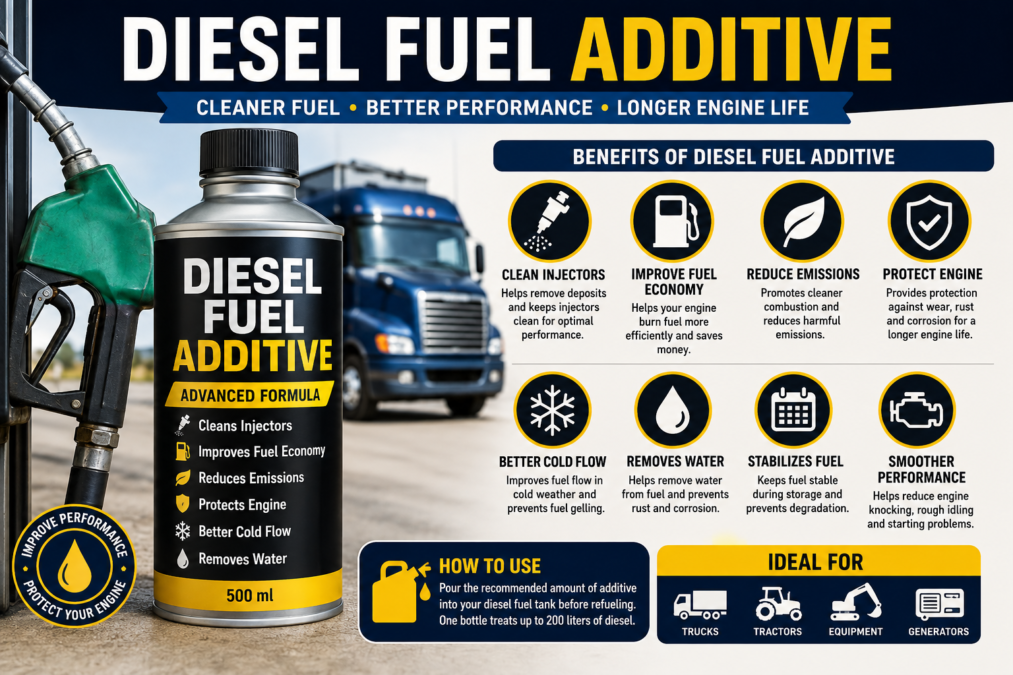

diesel fuel additive is a specially formulated liquid or chemical product designed to improve certain properties of diesel fuel and support the performance of diesel-powered engines. Depending on its formula, an additive may help with fuel stability, injector cleanliness, cold-weather performance, water control, lubrication, or deposit reduction.
Diesel engines are used in many parts of everyday life. They power cars, trucks, buses, tractors, construction equipment, generators, boats, and industrial machines. Because these engines often work under demanding conditions, the quality and condition of their fuel can matter a great deal.
Over time, diesel fuel can be affected by moisture, temperature changes, storage conditions, oxidation, contamination, and microbial growth. These problems can affect fuel-system components and may contribute to poor engine performance. That’s where the right diesel fuel additive may have a useful role.
However, not every additive does the same thing, and more additive isn’t necessarily better. Choosing a product should depend on the engine, fuel, operating conditions, and specific problem being addressed.
This guide explains how diesel fuel additives work, their common types, possible benefits, limitations, safety considerations, and practical tips for using them responsibly.
What Is a diesel fuel additive?
A diesel fuel additive is a substance blended into diesel fuel in a controlled amount to change or improve one or more fuel characteristics.
Different formulas are designed for different purposes. Some products are intended for routine fuel-system maintenance, while others are developed for particular situations, such as extremely cold weather or long-term fuel storage.
Common additive categories include:
- Cetane improvers
- Detergent additives
- Lubricity enhancers
- Fuel stabilizers
- Anti-gelling additives
- Water-control products
- Corrosion inhibitors
- Biocides
- Deposit-control additives
- Multifunctional fuel treatments
The important thing to remember is that these products aren’t universal solutions.
A truck operating in a cold climate may need a different fuel treatment from a generator stored for several months. Likewise, a modern diesel vehicle with a sophisticated emissions system may have different requirements from older diesel equipment.
Reading the product label and following the engine manufacturer’s recommendations should always come first.
Why Diesel Fuel Quality Matters
Diesel fuel doesn’t simply sit inside a tank and magically remain perfect forever.
Storage time, heat, oxygen exposure, water contamination, and poor handling can all affect fuel quality. When fuel quality declines, the fuel system may become more difficult to maintain.
Modern diesel engines depend on precise fuel delivery. Fuel injectors must deliver fuel at carefully controlled pressures and timings. Even small deposits or contamination can interfere with proper operation.
Poor fuel quality can contribute to problems such as:
- Difficult starting
- Rough engine operation
- Reduced fuel economy
- Injector deposits
- Fuel-filter restriction
- Increased smoke
- Poor acceleration
- Fuel-system corrosion
- Storage-related fuel deterioration
Of course, these symptoms can have many causes. An additive shouldn’t be used as a substitute for proper diagnosis.
If an engine has a serious mechanical problem, adding a bottle of fuel treatment isn’t going to perform a miracle. Sometimes, as the saying goes, you have to fix the root of the problem rather than simply treat the symptom.
How a diesel fuel additive Works
The exact mechanism depends on the formulation.
A detergent-based product, for example, may contain chemicals designed to reduce or control deposits on fuel-system components. A cold-flow additive works differently by modifying the behavior of wax crystals that can form in diesel fuel at low temperatures.
A lubricity additive may help compensate for the lower lubricating properties of some modern diesel fuels. A stabilizer, meanwhile, is intended to slow certain fuel-degradation processes during storage.
The basic idea is simple:
The additive changes a particular fuel property to help the fuel perform more effectively under certain conditions.
That’s why it’s important to match the additive with the intended purpose.
For example, using a cold-weather additive when the real problem is a clogged fuel filter won’t necessarily solve the issue.
Common Types of diesel fuel additive
There are several major categories available on the market. Each has a different purpose.
Cetane Improvers
Cetane is a measure related to how readily diesel fuel ignites under compression.
Cetane-improving additives are designed to increase the fuel’s cetane number. Depending on the engine and fuel, this may help promote smoother ignition and combustion.
Potential benefits may include:
- Easier starting
- Smoother combustion
- Reduced combustion noise
- Improved cold-start behavior
- More consistent engine operation
The actual benefit depends on the original fuel quality and engine design.
If the fuel already meets a high cetane specification, the improvement may be relatively small.
Detergent and Deposit-Control Additives
Detergent additives are intended to help keep fuel-system components cleaner.
Diesel injectors operate under demanding conditions. Deposits can affect their spray pattern and overall performance.
A deposit-control product may help reduce the formation or accumulation of certain deposits.
These products are commonly considered for:
- High-mileage diesel vehicles
- Commercial trucks
- Agricultural equipment
- Construction machinery
- Generators
- Equipment exposed to demanding operating conditions
Regular maintenance is still important. An additive can support fuel-system cleanliness, but it can’t replace proper servicing.
Lubricity Additives
Fuel-system lubrication is important because components such as pumps and injectors operate under high pressure and tight tolerances.
Some diesel fuels have less natural lubricating ability than others. Lubricity additives are formulated to improve this characteristic.
Their purpose is generally to help reduce friction and wear in fuel-system components.
This category can be particularly relevant to users who operate older equipment or fuel systems with specific lubrication requirements.
However, modern diesel fuel is already required to meet applicable fuel-quality standards, so additional lubricity treatment isn’t automatically necessary for every vehicle.
Anti-Gel and Cold-Flow Additives
Cold weather can create special challenges for diesel fuel.
Diesel fuel contains paraffin wax. As temperatures fall, wax can begin forming crystals. In sufficiently cold conditions, these crystals can restrict fuel filters and fuel flow.
Anti-gel products are designed to improve low-temperature fuel behavior.
They may be useful for equipment operating in:
- Northern climates
- Mountain regions
- Winter conditions
- Outdoor construction sites
- Cold-storage environments
- Remote locations
Timing matters.
Many cold-flow treatments work best when added before the fuel reaches the temperature where wax begins to cause problems. Always follow the product instructions for correct treatment temperatures and dosage.
Water Removal and Moisture Control
Water is one of the biggest enemies of diesel fuel systems.
Water can enter fuel tanks through condensation, contaminated storage, damaged seals, or poor handling. Once present, it can contribute to corrosion and fuel-system problems.
Some fuel additives are marketed for water dispersion or moisture control.
However, users should understand that an additive isn’t always the right answer for significant water contamination.
If a fuel tank contains a substantial amount of water, proper draining, filtration, and fuel-system inspection may be necessary.
Water contamination can also create an environment where microorganisms grow.
Diesel Fuel Additive and Microbial Growth
Diesel fuel can occasionally become contaminated with microorganisms, sometimes called diesel fuel algae. The term “algae” is commonly used, although the organisms involved are generally bacteria, fungi, or other microbes rather than true algae.
Microbial growth can occur when water is present in a fuel system.
Signs of microbial contamination may include:
- Sludge
- Dark or unusual fuel deposits
- Filter plugging
- Unpleasant odors
- Fuel-system corrosion
- Reduced engine performance
Biocidal additives are designed specifically to control microbial contamination.
However, these products should be used carefully. If significant contamination exists, killing the microorganisms doesn’t necessarily remove the dead material from the fuel system.
In that situation, the tank and filters may still require cleaning or replacement.
Fuel Stabilizers for Diesel Storage
Diesel fuel that sits for long periods can experience chemical and physical changes.
This is especially important for:
- Backup generators
- Seasonal equipment
- Farm machinery
- Boats
- Emergency vehicles
- Stored commercial equipment
A diesel fuel stabilizer may help slow certain degradation processes and maintain fuel quality during storage.
Still, good storage practices matter just as much.
A proper storage strategy includes:
- Using clean fuel containers or tanks
- Keeping water out of the system
- Protecting fuel from excessive heat
- Checking tanks periodically
- Maintaining appropriate tank levels
- Following storage recommendations
- Inspecting fuel before returning equipment to service
An additive can’t compensate for a badly maintained storage tank.
Benefits of Using a diesel fuel additive
When correctly selected and properly used, a diesel fuel additive may provide several useful benefits.
Improved Fuel-System Cleanliness
Detergent formulations can help control certain deposits.
Better Cold-Weather Performance
Cold-flow treatments can help reduce problems associated with wax formation.
Improved Fuel Stability
Storage-focused products may help maintain fuel quality over time.
Enhanced Lubricity
Certain formulations may improve the lubricating properties of fuel.
Improved Combustion Characteristics
Cetane improvers can increase cetane levels when used according to their formulation.
Microbial Control
Biocides can help control microbial contamination when used correctly.
Corrosion Protection
Some products contain corrosion inhibitors designed to protect fuel-system surfaces.
It’s worth stressing that these benefits depend heavily on the product and the situation. No single additive provides every possible benefit.
Potential Disadvantages and Limitations
It would be misleading to say that every diesel fuel additive is beneficial for every diesel engine.
There are potential limitations.
Using an inappropriate product or incorrect dosage could potentially cause problems. Some products may not be compatible with certain fuel systems, emissions-control equipment, or fuel specifications.
Possible concerns include:
- Unnecessary expense
- Incorrect dosing
- Product incompatibility
- Misuse of specialized treatments
- Masking an underlying mechanical problem
- Poor-quality or unverified products
- Incorrect treatment of contaminated fuel
Modern diesel vehicles can have complex emissions systems, including diesel particulate filters and selective catalytic reduction systems. Owners should therefore pay close attention to manufacturer recommendations.
When in doubt, check the vehicle or equipment manual.
How to Choose the Right diesel fuel additive
Choosing an additive doesn’t have to be complicated.
Start by identifying the problem or objective.
Ask yourself:
What am I trying to accomplish?
If the goal is winter operation, look for a product specifically formulated for cold-flow performance.
If the goal is fuel storage, choose a stabilizer designed for diesel fuel.
If deposits are the concern, a reputable detergent-based treatment may be more appropriate.
If microbial contamination is suspected, a suitable biocide may be necessary.
A simple decision guide can help:
| Goal | Possible Additive Type | Important Consideration |
|---|---|---|
| Improve ignition quality | Cetane improver | Check existing fuel quality |
| Control deposits | Detergent | Follow dosage instructions |
| Improve lubrication | Lubricity enhancer | Check fuel-system requirements |
| Cold-weather operation | Anti-gel/cold-flow | Add before severe cold affects fuel |
| Long-term storage | Stabilizer | Maintain clean, dry storage |
| Microbial contamination | Biocide | Remove water and contamination |
| Corrosion protection | Corrosion inhibitor | Identify the source of moisture |
This table is only a general guide. Product labels and equipment manufacturers should remain the final authority.
How to Use a diesel fuel additive Safely
Correct dosing is one of the most important parts of using any fuel treatment.
More isn’t always better.
In fact, adding too much can be counterproductive.
Follow the manufacturer’s instructions carefully. Pay attention to:
- Recommended dosage
- Fuel volume
- Treatment frequency
- Mixing instructions
- Temperature requirements
- Storage instructions
- Safety warnings
- Compatibility information
Use appropriate personal protective equipment when required by the label.
Avoid getting fuel additives on your skin or in your eyes, and never intentionally inhale vapors. Keep products away from children, flames, sparks, and ignition sources.
If the product label provides specific emergency instructions, follow them.
Diesel Fuel Additive and Modern Diesel Engines
Modern diesel engines are considerably more advanced than older engines.
Common-rail injection systems operate at very high pressures. Fuel injectors are designed with extremely precise tolerances, while emissions systems are engineered to meet strict environmental requirements.
As a result, owners should be especially careful about using aftermarket products.
A suitable additive can be helpful when it addresses a genuine need, but an unsuitable chemical mixture may not provide any advantage.
Before using a product, check:
- Vehicle manufacturer recommendations
- Engine specifications
- Fuel requirements
- Emissions-system compatibility
- Additive manufacturer instructions
If your vehicle is under warranty, checking the manufacturer’s guidance is particularly sensible.
Common Myths About Diesel Fuel Additives
There are many claims about additives, but not all of them are reliable.
Myth: More Additive Means More Power
Not necessarily.
An additive isn’t a performance booster in the same way a larger engine or turbocharger might be. Its effects depend on its specific formulation and the condition of the fuel.
Myth: Every Diesel Needs an Additive
That’s also incorrect.
Many diesel fuels already meet established quality specifications, and many engines can operate perfectly well without routine aftermarket additives.
Myth: Additives Fix Mechanical Problems
They don’t.
A failing injector, damaged fuel pump, clogged filter, compression problem, or electrical fault requires proper diagnosis.
Myth: One Product Does Everything
Some multifunctional products offer several properties, but no product should automatically be assumed to solve every fuel-related issue.
Signs That Your Diesel System Needs Attention
Sometimes an engine gives you clues.
Potential warning signs include:
- Hard starting
- Loss of power
- Rough idling
- Excessive smoke
- Reduced fuel economy
- Repeated fuel-filter blockage
- Unusual engine noise
- Fuel contamination
- Water in the fuel separator
These symptoms can have many causes.
Before adding a treatment, it’s wise to identify the likely source of the problem.
For example, repeated fuel-filter blockage may indicate contaminated fuel rather than simply a need for a cleaning additive.
That’s an important distinction.
Storage Tips for Diesel Fuel
Good fuel storage practices can reduce the need for corrective treatments.
Keep stored diesel in an approved, clean container or tank. Protect it from water and unnecessary temperature extremes.
Regularly inspect the storage system for:
- Leaks
- Rust
- Water accumulation
- Sediment
- Damaged seals
- Contamination
If fuel is stored for a long period, periodic inspection becomes even more important.
For large commercial or industrial tanks, professional fuel testing and tank maintenance may be worthwhile.
The Role of Quality Fuel
A diesel fuel additive should complement good-quality fuel, not replace it.
Buying fuel from reputable suppliers can reduce the likelihood of contamination and quality problems.
Proper fuel handling also matters.
When filling equipment:
- Keep containers clean.
- Prevent dirt from entering the tank.
- Keep caps secure.
- Avoid unnecessary exposure to moisture.
- Replace damaged fuel filters according to the maintenance schedule.
Small habits can prevent expensive problems later.
Professional Maintenance Still Matters
Even the best fuel treatment can’t replace routine maintenance.
Diesel engines require regular attention to:
- Engine oil
- Oil filters
- Fuel filters
- Air filters
- Coolant
- Belts
- Hoses
- Batteries
- Fuel-system components
Following the manufacturer’s maintenance schedule is one of the simplest ways to protect an engine.
If an engine continues to experience fuel-related symptoms after treatment, professional diagnosis is the sensible next step.
Sometimes, the answer isn’t another bottle of additive. It’s a technician with the right diagnostic equipment.
Frequently Asked Questions About diesel fuel additive
Can I use a diesel fuel additive every time I fill the tank?
Some products are designed for regular use, while others are intended for occasional or specific treatments. Always follow the product label rather than assuming every additive should be used at every fill-up.
Can an additive improve fuel economy?
Certain products may claim to improve fuel economy, but results vary. If an engine has dirty injectors or poor combustion caused by a fuel-related issue, restoring proper operation may improve efficiency. However, additives shouldn’t be viewed as guaranteed fuel-saving products.
Is a diesel fuel additive necessary in winter?
It depends on the fuel, climate, and equipment. In very cold conditions, a suitable cold-flow treatment may help, but winterized diesel fuel and proper maintenance are also important.
Can additives remove water from a fuel tank?
Some products are marketed for water management, but significant water contamination may require physical removal, filtration, and tank cleaning rather than relying solely on an additive.
Can an additive clean fuel injectors?
Some detergent-based formulations are designed to control or remove certain deposits. Their effectiveness depends on the type and severity of contamination.
Should I use an additive in a modern diesel vehicle?
Only when the product is appropriate for the vehicle and its fuel system. Check the owner’s manual and product compatibility information first.
Final Thoughts on diesel fuel additive
A diesel fuel additive can be a useful tool when it is selected for the right purpose and used according to the manufacturer’s instructions. Different products are designed for different jobs, including deposit control, cetane improvement, lubrication, cold-weather protection, fuel stabilization, corrosion control, and microbial treatment.
The key is to avoid treating additives as magic solutions.
Good diesel-engine care starts with quality fuel, clean storage, regular maintenance, correct fuel-filter service, and proper operating practices. An additive can sometimes provide an extra layer of support, but it should complement—not replace—these fundamentals.
For vehicle owners, farmers, truck operators, equipment managers, and generator users, understanding the specific purpose of each product can prevent unnecessary spending and reduce the risk of misuse. When the right diesel fuel additive is matched to the right application, it can become a practical part of responsible fuel management and long-term diesel engine care.
Explore more insightful articles on All Vantage News and never miss an update.Contact Us.