
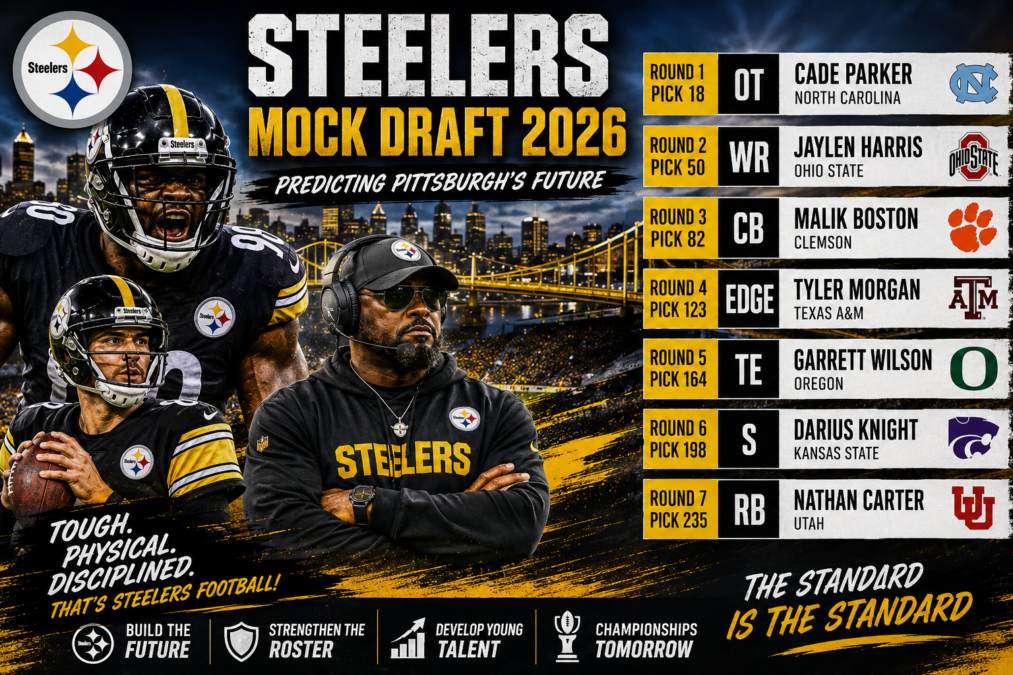

The steelers mock draft 2026 conversation was one of the most interesting parts of the NFL offseason because Pittsburgh entered the draft with several important questions to answer. The Steelers needed to think about the future at quarterback, strengthen the offensive line, add more weapons at wide receiver, and continue building a defense capable of competing in the AFC North.
There was plenty of uncertainty surrounding Pittsburgh before the draft. The quarterback situation received major attention, while the team also had to consider how to improve an offense that needed more consistency. At the same time, Pittsburgh had a collection of draft selections that gave general manager Omar Khan room to maneuver.
As it turned out, the real 2026 NFL Draft has now taken place. That means a modern steelers mock draft 2026 article needs to do more than simply predict names. It should also explain what analysts expected before the draft and compare those ideas with what Pittsburgh actually did.
The Steelers ultimately selected offensive tackle Max Iheanachor in Round 1, followed by wide receiver Germie Bernard, quarterback Drew Allar, cornerback Daylen Everette, and offensive lineman Gennings Dunker among their early selections. NFL.com’s final evaluation gave Pittsburgh an A- for its overall draft class.
So, let’s take a closer look at the strategy, prospects, positions of need, and long-term outlook surrounding the steelers mock draft 2026.
Understanding the Steelers Mock Draft 2026
A mock draft is essentially an educated prediction of how an NFL team might use its draft selections. It isn’t an official prediction, and it certainly isn’t a guarantee.
Mock drafts are created by studying:
- Team needs
- Current roster depth
- Free-agent additions and departures
- Draft capital
- College prospect rankings
- Scheme fit
- Injury history
- Contract situations
- Positional value
- Potential trades
For the Steelers, these factors made the 2026 draft especially difficult to predict.
NFL.com’s pre-draft needs analysis identified quarterback, offensive line, wide receiver, tight end, and linebacker among Pittsburgh’s major areas to watch. The quarterback position was particularly important because of uncertainty surrounding Aaron Rodgers’ future.
That uncertainty influenced many early steelers mock draft 2026 predictions.
Some analysts believed Pittsburgh should select a quarterback early. Others argued that the team needed to protect and support whichever quarterback eventually took the field.
In other words, there wasn’t one obvious answer.
Why Quarterback Was a Major Storyline
Quarterback was arguably the biggest question surrounding Pittsburgh heading into the 2026 draft.
The Steelers had veteran options, but the organization also needed to think beyond the immediate season. Building a sustainable team requires having a young quarterback who can potentially become a long-term starter.
That’s where players such as Drew Allar entered the conversation.
Allar came into the draft with an intriguing combination of size, arm talent, and experience at Penn State. He wasn’t universally viewed as a first-round quarterback, however, which made him an interesting potential target for a team like Pittsburgh.
The Steelers eventually selected Allar with the 76th overall pick in Round 3. NFL.com reported that Pittsburgh viewed him as a player with significant physical ability and a high ceiling who could continue developing in Mike McCarthy’s system.
That decision demonstrated an important draft principle: a team doesn’t always have to use a first-round pick to invest in a quarterback.
Pittsburgh found a way to address the position without spending its highest selection.
The Steelers’ First-Round Decision
The most important selection in almost every steelers mock draft 2026 was the team’s first-round pick.
Pittsburgh entered the draft holding the No. 21 overall selection.
Before the draft, different mock drafts connected the Steelers to players at several positions, including wide receiver, offensive line, quarterback, and defense.
One CBS Sports seven-round mock, for example, projected Pittsburgh to select Arizona wide receiver Jordyn Tyson at No. 21. Other mock-draft discussions looked at offensive linemen and defensive players.
The Steelers ultimately went in another direction.
They selected Max Iheanachor, an offensive tackle from Arizona State, at No. 21 overall.
That choice made plenty of sense from a roster-building perspective.
Pittsburgh needed to continue improving its offensive line, and a young tackle can provide value for many seasons. Iheanachor brought impressive physical tools, length, movement ability, and upside.
According to NFL.com’s analysis, he was viewed as an ascending, traits-heavy tackle prospect whose athleticism and play strength could translate to different run schemes.
It’s a classic Steelers-style investment: build in the trenches and give the offense a stronger foundation.
Max Iheanachor: A Long-Term Offensive Line Investment
Max Iheanachor was not necessarily the name every fan expected to hear when Pittsburgh went on the clock.
That’s what makes the pick interesting.
Iheanachor reportedly came to football relatively late after playing basketball and soccer. His athletic background helped give him unusual movement skills for a player of his size.
The Steelers saw potential rather than simply selecting a player based on immediate polish.
His key strengths included:
- Size and length
- Athletic movement
- Natural power
- Run-blocking potential
- Developmental upside
- Versatility in an offensive system
However, no prospect is perfect.
His technique still needed refinement, especially in pass protection. Hand placement and footwork were areas that could improve with NFL coaching.
That’s not necessarily a problem.
A first-round offensive tackle doesn’t need to be a finished product on draft night. What matters is whether the player has the physical foundation and mental approach to develop.
Steelers head coach Mike McCarthy expressed strong excitement about Iheanachor after the selection, describing him as a player whose stock continued to rise during the evaluation process.
If his technique catches up with his athletic ability, this pick could become one of the more important pieces of Pittsburgh’s offensive rebuild.
Germie Bernard Brings More Energy to the Receiving Group
The Steelers made an aggressive move in Round 2.
Instead of waiting for the 53rd pick, Pittsburgh traded up to No. 47 and selected Alabama wide receiver Germie Bernard.
NFL.com reported that Pittsburgh acquired the No. 47 pick and No. 249 from Indianapolis in exchange for picks 53, 135, and 237.
This was a fascinating move because it showed the Steelers weren’t simply sitting back and waiting for the board to come to them.
They identified a player they wanted and moved up.
Bernard brings versatility to the receiving group. He can line up outside or in the slot and has the route-running ability to contribute in different parts of the field.
NFL.com’s evaluation highlighted his size, acceleration, route-running, clean footwork, and run-after-catch ability.
His arrival gives Pittsburgh another young offensive weapon.
The Steelers already had major receiving talent, including DK Metcalf and Michael Pittman Jr., but adding Bernard gives the offense another player who can potentially grow into a reliable contributor.
Drew Allar and the Quarterback of the Future
If there was one pick that directly addressed the long-term future, it was Drew Allar.
The Steelers selected Allar at No. 76 overall.
This was a smart example of balancing present needs with future planning.
A team doesn’t have to force a quarterback selection simply because the position is important. If the right quarterback is available at a reasonable point in the draft, the organization can make the investment and develop him.
Allar’s college career at Penn State gave scouts plenty of material to study.
His strengths include:
- Strong arm
- Pro-style physical frame
- Pocket-passing ability
- Experience against high-level college competition
- Developmental upside
- Ability to make difficult throws
At the same time, he entered the NFL with questions that needed to be answered through coaching and experience.
The Steelers’ coaching staff clearly believed his ceiling was worth the investment.
NFL.com reported that quarterback coach Tom Arth praised Allar’s intelligence, arm talent, and potential while emphasizing that he had not yet reached his full ceiling.
That’s an important point.
The Steelers don’t need Allar to become an immediate superstar. They can develop him while allowing veteran quarterbacks to handle the short-term responsibilities.
Daylen Everette Adds Speed to the Secondary
Pittsburgh stayed busy in Round 3 by selecting Georgia cornerback Daylen Everette at No. 85.
This was another positionally logical selection.
Cornerback is a position where teams need depth because injuries are common, and defensive schemes increasingly demand athletes who can cover receivers in space.
Everette brought impressive athletic traits to the Steelers.
His profile included:
- Size
- Speed
- Length
- Starting experience
- Man-coverage potential
- Defensive versatility
NFL.com’s draft evaluation noted that Everette’s film was uneven but also highlighted his size and athleticism. The Steelers could eventually view him as an important contributor as the secondary evolves.
For Pittsburgh, adding young talent to the secondary was a sensible long-term move.
Gennings Dunker Adds Toughness to the Offensive Line
Only a short time after selecting a quarterback and cornerback, Pittsburgh returned to the offensive line.
The Steelers selected Iowa offensive lineman Gennings Dunker at No. 96.
Dunker brought a physical style to the draft class.
He had experience at tackle but projected as someone who could potentially move inside to guard at the NFL level.
That flexibility matters.
NFL teams need offensive linemen who can fill multiple positions because injuries can quickly change a depth chart.
NFL.com’s draft evaluation suggested that Dunker could compete for a starting position and could also provide emergency flexibility outside.
For a team trying to build a stronger offense, adding multiple offensive linemen was a sensible strategy.
A Look at the Steelers’ 2026 Draft Class
The final Steelers draft class contained 10 selections.
| Round | Pick | Player | Position | School |
|---|---|---|---|---|
| 1 | 21 | Max Iheanachor | OT | Arizona State |
| 2 | 47 | Germie Bernard | WR | Alabama |
| 3 | 76 | Drew Allar | QB | Penn State |
| 3 | 85 | Daylen Everette | CB | Georgia |
| 3 | 96 | Gennings Dunker | OL | Iowa |
| 4 | 121 | Kaden Wetjen | WR | Iowa |
| 5 | 169 | Riley Nowakowski | TE | Indiana |
| 6 | 210 | Gabe Rubio | DE | Notre Dame |
| 7 | 224 | Robert Spears-Jennings | S | Oklahoma |
| 7 | 230 | Eli Heidenreich | RB | Navy |
The Steelers’ official draft review confirms that Pittsburgh finished the draft with 10 selections and added players on both sides of the football.
This class wasn’t built around one position.
Instead, it was balanced.
Pittsburgh added:
- Offensive line help
- Wide receiver talent
- A developmental quarterback
- Cornerback depth
- Tight end depth
- Defensive line help
- Safety depth
- Running back talent
That’s a healthy approach for a team trying to build a deeper roster.
What Earlier Steelers Mock Draft 2026 Predictions Got Right
One of the best ways to evaluate a mock draft is to compare predictions with reality.
Several pre-draft ideas correctly identified the Steelers’ general areas of concern.
Quarterback was a major discussion point.
Wide receiver was another.
Offensive line was also regularly mentioned.
The actual draft addressed all three.
That’s important because mock drafts aren’t necessarily about getting every player correct. Their real value comes from identifying likely team-building priorities.
In that sense, many steelers mock draft 2026 projections were directionally correct.
For example, CBS Sports projected Pittsburgh to take Jordyn Tyson at No. 21, demonstrating how strongly wide receiver was viewed as a potential first-round priority.
The Steelers didn’t select Tyson, but they did select a wide receiver one round later.
That difference illustrates how quickly a draft board can change.
The Importance of Drafting for the Offensive Line
The Steelers’ decision to take Iheanachor and Dunker showed how seriously the organization viewed offensive line development.
There’s an old football saying that games are won in the trenches.
While the modern NFL has become increasingly focused on quarterbacks and explosive passing plays, offensive line performance remains essential.
A strong offensive line can:
- Give quarterbacks more time
- Improve the running game
- Reduce pressure
- Help young quarterbacks develop
- Create better red-zone opportunities
- Improve offensive consistency
For Pittsburgh, that matters even more when the quarterback room is evolving.
A young quarterback like Allar will benefit from playing behind a developing offensive line.
That’s why the first-round Iheanachor selection may have a larger impact than the box score initially suggests.
How the Draft Fits Mike McCarthy’s Offense
The Steelers entered 2026 with Mike McCarthy as head coach, making offensive structure another important part of the draft discussion.
A coaching change can influence what a team values.
McCarthy has extensive experience working with quarterbacks and developing offensive systems. The Steelers’ selection of Allar therefore becomes especially interesting.
The team wasn’t simply drafting a quarterback.
It was placing a physically talented quarterback into an environment where development could be emphasized.
Meanwhile, Iheanachor and Dunker can help strengthen the physical foundation of the offense, while Bernard and Wetjen provide additional receiving options.
It’s a bit like building a house.
You don’t start with the roof.
You build the foundation first.
For Pittsburgh, the 2026 draft appears to have focused heavily on that foundation.
Steelers Mock Draft 2026 and the AFC North Challenge
The AFC North isn’t exactly an easy neighborhood.
Pittsburgh competes in a division featuring the Baltimore Ravens, Cincinnati Bengals, and Cleveland Browns.
Every team has different strengths, but the division generally demands physical football, strong quarterback play, and defensive toughness.
The Steelers therefore need a roster that can survive a long season rather than one that depends on a single superstar.
The 2026 draft class reflects that philosophy.
Pittsburgh added players across multiple positions instead of putting all its resources into one area.
That could prove valuable over the long term.
Biggest Strengths of the 2026 Steelers Draft
There are several reasons to be optimistic about this class.
Building Through the Trenches
Iheanachor and Dunker give Pittsburgh two young offensive-line investments.
Adding a Quarterback
Allar provides a potential long-term quarterback option.
Improving Receiver Depth
Bernard and Wetjen add young talent to the receiving room.
Defensive Athleticism
Everette and Spears-Jennings give the secondary additional developmental options.
Roster Balance
The Steelers didn’t ignore either side of the ball.
That’s important for a team hoping to compete immediately while also preparing for future seasons.
Areas That Still Need Attention
Even after a strong draft, no roster is perfect.
The Steelers will continue to evaluate several areas.
Quarterback Development
Allar’s future will depend heavily on coaching, patience, and his ability to adapt to NFL defenses.
Offensive Line Growth
Iheanachor has tremendous upside, but development will take time.
Tight End Production
Pittsburgh added Riley Nowakowski in Round 5, but the position remains an area where the team could continue searching for impact talent.
Defensive Depth
Late-round defensive players have opportunities, but the Steelers will still need to monitor their depth chart throughout the season.
Young Player Development
Drafting players is only half the process.
Coaching them is the other half.
Why the Steelers Mock Draft 2026 Still Matters After the Draft
At first glance, some readers may wonder why anyone would discuss a steelers mock draft 2026 after the real draft has already happened.
The answer is simple: mock drafts provide valuable insight into the decision-making process.
They show what analysts believed a team needed before the draft.
They also help fans understand:
- Which positions were considered priorities
- Which prospects were realistic targets
- How draft boards changed
- Why certain players were selected
- How team needs influenced decisions
- Which predictions were close
- Which surprises changed expectations
In other words, a mock draft isn’t just about predicting the future.
It can also help explain the past.
The Bigger Picture for Pittsburgh
The 2026 draft was more than a collection of names.
It represented a transition period for Pittsburgh.
The organization had to think about veteran leadership while also preparing for the next generation.
That’s difficult.
You don’t want to rebuild so aggressively that you waste the talent already on the roster. But you also don’t want to ignore the future.
The Steelers attempted to find the middle ground.
They added experienced veterans and young players while using the draft to address multiple positions.
The quarterback situation remains especially important, but selecting Allar gives Pittsburgh another potential path forward.
If he develops well, the Steelers could eventually have a young quarterback capable of becoming a major part of the franchise’s future.
Final Thoughts on the Steelers Mock Draft 2026
The steelers mock draft 2026 story ultimately became a fascinating example of why NFL drafts are so difficult to predict.
Before the draft, analysts debated quarterbacks, receivers, offensive tackles, defenders, and possible trades. Pittsburgh eventually followed its own board and selected Max Iheanachor at No. 21, Germie Bernard at No. 47, Drew Allar at No. 76, Daylen Everette at No. 85, and Gennings Dunker at No. 96, among its top selections.
The final class showed a clear commitment to building for both today and tomorrow.
Iheanachor can develop into an important offensive tackle. Bernard gives the passing game another young weapon. Allar provides a potential quarterback of the future. Everette adds athleticism to the secondary, while Dunker strengthens offensive-line depth.
NFL.com’s final evaluation awarded Pittsburgh an A-, which reflects the overall quality and logic of the class.
Of course, draft grades don’t win games. Player development does.
That’s where the real story begins.
For Steelers fans, the most exciting part of the steelers mock draft 2026 discussion is no longer deciding who Pittsburgh might select. Now it’s watching these young players develop, compete for playing time, and eventually determine whether the team’s 2026 draft strategy becomes a long-term success.
Explore more insightful articles on All Vantage News and never miss an update.Contact Us.