
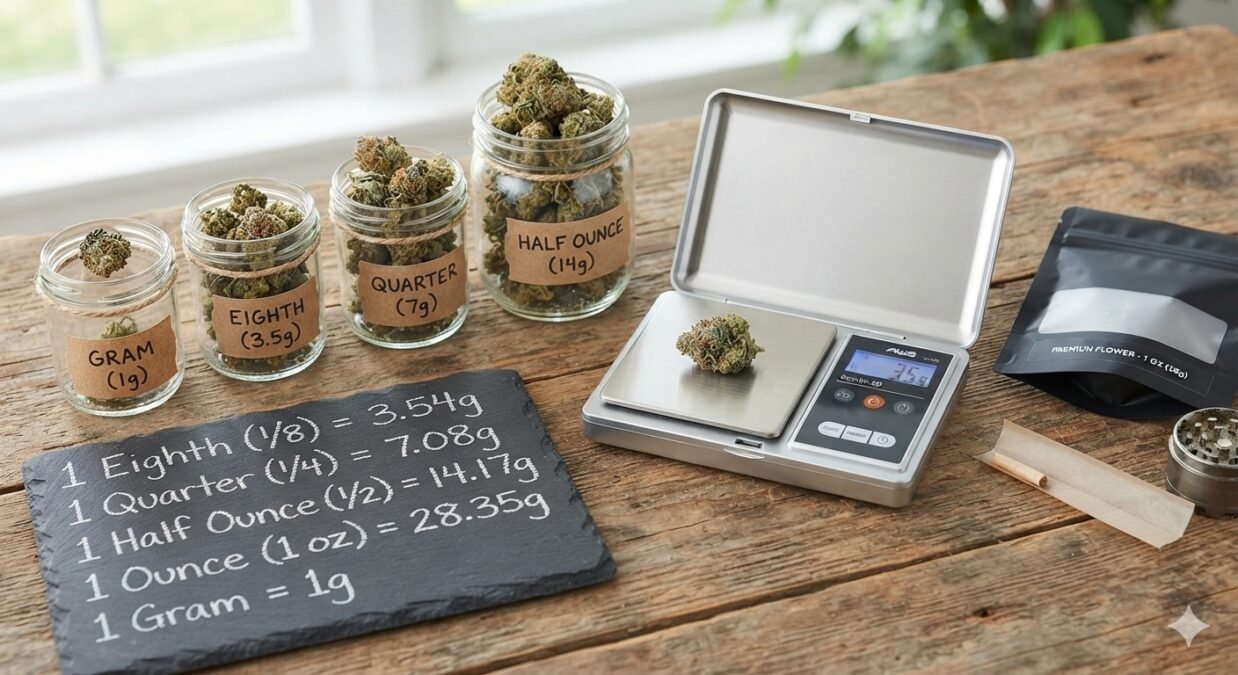

Weed measurements can seem confusing when you first come across terms such as gram, eighth, quarter, half ounce, ounce, or zip. At first glance, these words may sound like a completely different language. However, the basic system is actually quite simple once you understand how the amounts connect.
Cannabis flower is commonly described by weight. Smaller quantities are usually discussed in grams, while larger quantities are often described as fractions of an ounce. For example, an eighth usually means 3.5 grams, a quarter means 7 grams, a half ounce means 14 grams, and an ounce is commonly treated as 28 grams in cannabis retail language.
Understanding weed measurements isn’t only about remembering numbers. It also helps readers understand product labels, compare quantities, recognize common terminology, and avoid confusion when reading cannabis-related information.
This guide explains the subject in straightforward language. Whether you’re completely new to cannabis terminology or simply want a quick refresher, the information below will make the measurement system much easier to understand.
What Are Weed Measurements?
Weed measurements are units used to describe the weight or quantity of cannabis. Cannabis flower is generally sold and labeled according to its mass, most often in grams or fractions of an ounce.
The two measurement systems commonly appear together:
- Metric measurements: grams and kilograms
- Imperial or U.S. customary measurements: ounces and pounds
- Fractions: eighth, quarter, and half ounce
- Product-specific measurements: milligrams or grams for certain cannabis products
This mixture can be confusing at first. After all, why call 3.5 grams an “eighth” instead of simply saying 3.5 grams?
The answer is historical convention. Cannabis quantities have long been discussed using fractions of an ounce, so expressions such as “eighth” and “quarter” became familiar terms. Modern products, especially regulated products, may display their exact weight in grams on the package.
The good news is that once one key number is remembered, the rest becomes much easier:
1 ounce is commonly rounded to 28 grams in cannabis terminology.
From that point:
- One-eighth of 28 grams = 3.5 grams
- One-quarter of 28 grams = 7 grams
- One-half of 28 grams = 14 grams
- One full ounce = 28 grams
These are common retail conventions rather than a statement about the exact mathematical weight of an ounce.
Weed Measurements at a Glance
The following table provides a quick reference for the most common quantities.
| Common Term | Ounce Fraction | Common Cannabis Weight |
|---|---|---|
| Gram | About 1/28 oz | 1 g |
| Eighth | 1/8 oz | 3.5 g |
| Quarter | 1/4 oz | 7 g |
| Half ounce | 1/2 oz | 14 g |
| Ounce | 1 oz | 28 g |
| Quarter pound | 4 oz | About 113 g |
| Half pound | 8 oz | About 227 g |
| Pound | 16 oz | About 454 g |
The first five measurements are the ones most people are likely to encounter when reading ordinary cannabis product information. Larger quantities, such as quarter pounds and pounds, are more relevant to commercial or bulk contexts and may be subject to different rules.
The figures above use common cannabis rounding. A standard avoirdupois ounce is technically about 28.35 grams, which explains why exact mathematical conversions can differ slightly from the familiar 28-gram cannabis convention.
Understanding a Gram
A gram is one of the simplest weed measurements to understand.
A gram is a metric unit of mass. It is equal to one-thousandth of a kilogram. In cannabis terminology, “one gram” simply means the product weighs 1 gram.
You may see the abbreviation g on a package or menu.
For example:
- 1 g = one gram
- 2 g = two grams
- 3 g = three grams
- 3.5 g = three and a half grams
The gram is useful because it provides a straightforward way to describe smaller quantities without using fractions.
It’s also important not to judge a gram by its appearance. Cannabis flower can have different densities. A dense flower may look like a smaller amount than a loose, fluffy flower even when both have exactly the same weight. Public health educational material also warns that visual estimates are only estimates because flower density varies.
So, here’s a useful rule:
Weight tells you the quantity; appearance doesn’t.
What Is an Eighth?
An eighth is one of the most common terms in weed measurements.
An eighth means one-eighth of an ounce. Using the common cannabis convention of 28 grams per ounce:
28 ÷ 8 = 3.5 grams
Therefore:
1 eighth = 3.5 grams
You may see this written in several ways:
- Eighth
- 1/8 oz
- 3.5 g
- Sometimes informal slang such as “slice”
Different regions and communities can use different informal names, so the numerical weight printed on the product is the clearest reference.
The eighth is particularly important because many cannabis guides use it as a familiar middle-size reference point. Once you know that an eighth is 3.5 grams, understanding the larger quantities becomes much easier.
For example:
- 2 eighths = 7 g
- 4 eighths = 14 g
- 8 eighths = 28 g
Simple, right?
What Is a Quarter?
A quarter means one-quarter of an ounce.
Using the common 28-gram cannabis convention:
28 ÷ 4 = 7 grams
So:
1 quarter = 7 grams
A quarter is also twice the weight of an eighth.
Here’s the relationship:
- 1 eighth = 3.5 g
- 2 eighths = 7 g
- 1 quarter = 7 g
Some cannabis terminology guides also mention informal names such as “quad” or “Q” for a quarter. However, slang isn’t always universal, so it’s safer to confirm the actual weight when reading a product listing or discussing quantities.
The main thing to remember is simple:
Quarter = 7 grams in common cannabis measurement language.
What Is a Half Ounce?
A half ounce is half of an ounce.
Using the common 28-gram convention:
28 ÷ 2 = 14 grams
Therefore:
1 half ounce = 14 grams
You can also understand it through smaller quantities:
- 1 half ounce = 2 quarters
- 1 half ounce = 4 eighths
- 1 half ounce = 14 grams
This makes the measurement system almost like a small ladder:
3.5 g → 7 g → 14 g → 28 g
Each step doubles the previous amount.
The phrase “half” can sometimes be confusing because people may use it casually. In a cannabis context, “a half” often refers to a half ounce, but the safest approach is always to look for the exact weight.
What Is an Ounce?
An ounce, usually written as oz, is a larger traditional unit of cannabis weight.
In common cannabis retail terminology:
1 ounce = 28 grams
An ounce can also be divided into:
- 2 half ounces
- 4 quarters
- 8 eighths
- 28 individual one-gram portions under the common retail convention
Some cannabis communities use informal terms such as zip or simply O when referring to an ounce. These expressions aren’t formal scientific units, though, so product labels and legal documents should be interpreted using their stated numerical measurements.
There’s also an important mathematical detail worth knowing.
A standard avoirdupois ounce is approximately 28.35 grams, not exactly 28 grams. Cannabis terminology commonly rounds the figure to 28 grams for convenience.
That’s why an exact scientific conversion and a cannabis menu may sometimes show slightly different numbers.
Larger Weed Measurements and Pounds
Once you move beyond an ounce, pounds become another measurement you may encounter.
A pound contains 16 ounces.
Using exact mathematical conversion:
1 pound ≈ 453.6 grams
Some cannabis references use approximately 453 grams when rounding.
A quarter pound is:
- 4 ounces
- Approximately 113.4 grams mathematically
A half pound is:
- 8 ounces
- Approximately 226.8 grams mathematically
A full pound is:
- 16 ounces
- Approximately 453.6 grams mathematically
The terminology becomes especially important when reading industry or commercial information. Large quantities may be subject to laws, licensing requirements, purchase limits, or other regulations depending on the jurisdiction.
For that reason, a reader shouldn’t assume that knowing the weight automatically tells them whether possessing or purchasing that amount is legal.
Why Cannabis Uses Both Grams and Ounces
One of the interesting things about weed measurements is that they combine two systems.
You might see a product labeled 3.5 g, while someone calls the same amount an eighth.
Why?
The answer is largely historical and practical.
Ounces and fractions of ounces have traditionally been used in cannabis terminology, while grams provide a precise metric measurement. Modern scales also make it easy to weigh products in grams.
As a result, both systems continue to appear side by side.
For example:
| Metric Term | Traditional Term |
|---|---|
| 3.5 g | Eighth |
| 7 g | Quarter |
| 14 g | Half ounce |
| 28 g | Ounce |
Once you learn these relationships, reading cannabis-related information becomes much less intimidating.
Common Weed Measurement Slang
Cannabis vocabulary includes many informal terms. Some are widely recognized, while others may be local or less common.
Common examples include:
- Eighth: 3.5 g
- Quarter: 7 g
- Half: Usually 14 g when referring to a half ounce
- Zip: Common informal term for an ounce
- O: Sometimes used for an ounce
- Quad: Sometimes used for a quarter
- QP: Common shorthand for quarter pound
The key point is that slang can vary.
Imagine two people discussing cannabis quantities using different local terms. They might both understand the same number but use different words for it. That’s why the actual weight in grams is usually the clearest way to communicate.
When accuracy matters, don’t rely on slang alone.
Weed Measurements and Product Labels
Product labels are especially important because they can provide information that slang doesn’t.
A regulated cannabis product may display information such as:
- Net weight
- Product type
- Cannabinoid information
- THC content
- CBD content
- Ingredients
- Batch information
- Testing information
- Manufacturer or producer information
- Legal warnings
The exact label requirements depend on the country, state, province, or other jurisdiction.
A label stating 3.5 g describes the weight of the product. It doesn’t automatically tell you how strong the product is.
That’s an important distinction.
Weight and potency are different measurements.
For example, two products could both weigh 3.5 grams but have different cannabinoid concentrations. Therefore, simply comparing their weights doesn’t tell you that they’re chemically identical.
Weed Measurements Are Not the Same as Potency
This is one of the most important concepts in understanding cannabis information.
Weight tells you how much product there is. Potency tells you the concentration or amount of cannabinoids.
These concepts shouldn’t be mixed together.
For flower, a label may give a total weight in grams and separately provide THC or CBD information. For other products, cannabinoids may be expressed in milligrams.
For example:
- Product weight might be listed in grams.
- Cannabinoid content may be listed as a percentage.
- Edible products may list cannabinoid amounts in milligrams per serving or package.
Therefore, saying “this product is heavier” doesn’t necessarily mean “this product is stronger.”
That’s a common misunderstanding, and clearing it up is one of the main reasons accurate cannabis education matters.
Flower, Concentrates, and Edibles Use Different Information
Another reason weed measurements can be confusing is that cannabis comes in different product forms.
Cannabis flower
Flower is commonly discussed in grams and fractions of an ounce.
Common terms include:
- 1 g
- 3.5 g
- 7 g
- 14 g
- 28 g
Concentrates
Concentrates are also commonly described by weight, often in grams. However, their cannabinoid concentration can be much different from that of flower, so weight alone doesn’t describe their effects.
Edibles
Edibles are commonly described using milligrams of cannabinoids, such as THC or CBD. Their labeling can include the amount per serving and the total amount in the package.
Vape products
Vape products may show the weight or volume of their contents, depending on the product and labeling rules.
So, don’t assume that “one gram” means the same thing across every cannabis product. The number describes weight, but the product’s composition and cannabinoid concentration can vary.
Why Appearance Can Be Misleading
One of the biggest mistakes people make with weed measurements is trying to estimate weight with their eyes.
Two pieces of cannabis flower can look completely different while having similar weights.
Dense buds may appear compact. Fluffy buds can take up more physical space. Trim, moisture, structure, and density can all affect appearance.
That means:
A bigger-looking pile isn’t automatically heavier.
Official educational material on cannabis measurements similarly notes that visual examples are estimates because flower density varies.
This is why a scale is much more reliable than visual guessing when precise weight matters.
How a Digital Scale Helps With Weed Measurements
A digital scale can provide a numerical measurement instead of relying on appearance.
When precision matters, the basic idea is simple:
- Place the appropriate container on the scale.
- Use the scale’s tare function if available.
- Add the material.
- Read the displayed weight.
- Compare the result with the stated product weight.
Scales can display grams, ounces, and other units, although the exact features vary by model.
For legal cannabis products, the package’s stated net weight should remain the primary reference. A home scale can help someone understand measurements, but it shouldn’t be treated as a substitute for official packaging, regulatory information, or legal requirements.
Understanding the Difference Between 28 g and 28.35 g
This small mathematical detail causes a surprising amount of confusion.
In everyday cannabis terminology:
1 ounce ≈ 28 grams
In exact avoirdupois measurement:
1 ounce ≈ 28.35 grams
So why do cannabis guides often say 28 grams?
It’s simply a practical convention.
The difference becomes more noticeable when multiplying the rounded figure across larger quantities. For example, 16 exact ounces make approximately 453.6 grams, while 16 rounded 28-gram cannabis ounces total 448 grams.
That doesn’t mean one source is necessarily “wrong.” It means the sources are using different conventions.
For everyday understanding, remember:
Cannabis retail shorthand commonly uses 28 g for an ounce, while exact mathematical conversion is about 28.35 g.
When exact quantity matters, use the stated net weight rather than trying to reconstruct it from rounded fractions.
A Simple Weed Measurements Conversion Ladder
If you don’t want to memorize a long list, focus on this simple ladder:
1 g → 3.5 g → 7 g → 14 g → 28 g
These correspond approximately to:
Gram → Eighth → Quarter → Half ounce → Ounce
Another way to remember it is:
- 2 eighths = 1 quarter
- 2 quarters = 1 half
- 2 halves = 1 ounce
So:
8 eighths = 1 ounce
This pattern makes the system much easier to understand.
Once you’ve memorized the 3.5-gram eighth, you can work out the rest without much effort.
Common Mistakes When Reading Weed Measurements
People often make simple mistakes when learning cannabis terminology.
Here are some of the most common ones.
Confusing an eighth with one gram
An eighth isn’t 1 gram.
An eighth = 3.5 grams under the common cannabis convention.
Thinking a quarter means a quarter of a gram
It doesn’t.
A quarter normally means one-quarter of an ounce, or about 7 grams.
Assuming heavier means stronger
Weight and potency are different concepts.
A heavier product isn’t automatically more potent.
Judging quantity by appearance
Dense and fluffy flower can look very different even when their weights are similar.
Treating slang as universal
Terms can vary by region and community.
When accuracy matters, look at the numerical weight.
Forgetting the rounding issue
28 grams is a common cannabis retail convention, while the exact avoirdupois ounce is about 28.35 grams.
Knowing this prevents unnecessary confusion.
Weed Measurements and Legal Considerations
Understanding measurements doesn’t automatically tell you what is legal.
Cannabis laws vary widely between jurisdictions and can change over time. Rules may cover:
- Minimum age
- Possession limits
- Purchase limits
- Home cultivation
- Transportation
- Public consumption
- Medical use
- Recreational use
- Product types
- Concentrates
- Edibles
- Where cannabis can be purchased
For example, a quantity that is permitted under one jurisdiction’s rules may be restricted somewhere else.
Therefore, anyone dealing with cannabis should check the current rules that apply to their specific location rather than relying on a general measurement chart.
This article explains terminology and measurement concepts. It isn’t a substitute for current legal guidance.
Why Accurate Weed Measurements Matter
Accurate measurements can make cannabis information easier to understand.
For consumers, clear weight information can help with:
- Reading product labels
- Comparing package sizes
- Understanding terminology
- Avoiding confusion
- Checking stated quantities
- Distinguishing weight from potency
For writers and publishers, accurate terminology is equally important. A poorly explained measurement can quickly confuse readers.
That’s why responsible cannabis content should explain both the number and the terminology.
Instead of simply writing “an eighth,” a clear article can say:
An eighth is commonly 3.5 grams, representing one-eighth of an ounce.
That single sentence gives readers the term, number, and relationship.
A Quick Reference for Beginners
If you’re completely new to weed measurements, this is the cheat sheet to keep handy:
| Measurement | Common Weight | Easy Way to Remember |
|---|---|---|
| Gram | 1 g | Basic metric unit |
| Eighth | 3.5 g | One-eighth of an ounce |
| Quarter | 7 g | Two eighths |
| Half ounce | 14 g | Four eighths |
| Ounce | 28 g | Eight eighths |
| Quarter pound | About 113 g | Four ounces |
| Half pound | About 227 g | Eight ounces |
| Pound | About 454 g | Sixteen ounces |
Remember that the larger pound conversions use the exact mathematical ounce relationship, while everyday cannabis terminology often rounds an ounce to 28 grams.
Frequently Asked Questions About Weed Measurements
How many grams are in an eighth?
An eighth is commonly 3.5 grams. It represents one-eighth of an ounce using the common 28-gram cannabis convention.
How many grams are in a quarter?
A quarter is commonly 7 grams, or one-quarter of an ounce.
How many grams are in a half ounce?
A half ounce is commonly described as 14 grams.
How many grams are in an ounce?
An ounce is commonly described as 28 grams in cannabis retail terminology. The exact avoirdupois conversion is approximately 28.35 grams.
How many eighths are in an ounce?
There are 8 eighths in one ounce.
How many eighths are in a quarter?
There are 2 eighths in one quarter.
How many quarters are in a half ounce?
There are 2 quarters in a half ounce.
Is an eighth always exactly 3.5 grams?
In common cannabis terminology, yes, an eighth is treated as 3.5 grams. However, exact ounce mathematics involves the 28.35-gram avoirdupois ounce, so terminology and exact unit conversion can differ slightly.
Does the size of the buds tell you the weight?
No. Bud density can vary considerably, so visual size isn’t a reliable way to determine weight.
Does more cannabis mean higher potency?
Not necessarily. Weight and potency are separate measurements. A larger amount of a lower-concentration product isn’t automatically stronger than a smaller amount of a higher-concentration product.
Are weed measurements the same for edibles?
Not necessarily. Edibles often use milligrams to describe cannabinoid content, while flower is commonly discussed in grams and fractions of an ounce.
Final Thoughts on Weed Measurements
Learning weed measurements doesn’t have to be complicated. The entire system becomes much easier once you understand a few basic numbers.
Start with the most important relationships:
1 gram = 1 g
1 eighth = 3.5 g
1 quarter = 7 g
1 half ounce = 14 g
1 ounce = commonly 28 g
From there, larger measurements can be understood by using ounces and pounds. Just remember that the familiar 28-gram cannabis ounce is a rounded convention, while an exact avoirdupois ounce is approximately 28.35 grams.
It’s also worth remembering that weight isn’t the same as potency, and appearance isn’t a dependable substitute for a measured weight. Product labels, stated net weights, and current local regulations are the best sources when precision or legality matters.
Ultimately, understanding weed measurements gives readers a clearer foundation for interpreting cannabis terminology. Once the relationship between grams, eighths, quarters, halves, and ounces clicks, what initially looks confusing becomes a straightforward system of fractions and conversions. That basic knowledge can make cannabis-related information easier to read, compare, and understand responsibly.
Weed Measurements: Practical Conversion Guide and Important Details
Why Weed Measurements Can Seem Confusing
Weed measurements use a mixture of metric units, traditional weight units, fractions, and informal terms. For someone who is new to the subject, words like “eighth,” “quarter,” and “zip” may seem unrelated to grams. In reality, they are connected through simple weight conversions.
The easiest way to understand the system is to begin with grams and then move toward fractions of an ounce. Once that foundation is clear, most common terms become easy to recognize.
For educational purposes, the common cannabis convention is:
- 1 gram = 1 g
- 1 eighth = 3.5 g
- 1 quarter = 7 g
- 1 half ounce = 14 g
- 1 ounce = 28 g
The exact mathematical weight of an avoirdupois ounce is about 28.35 grams, but cannabis terminology commonly rounds an ounce to 28 grams.
The Relationship Between Grams and Ounces
Grams are part of the metric system, while ounces are traditionally used in the U.S. customary system. Cannabis information often uses both.
This can be shown as a simple progression:
3.5 g → 7 g → 14 g → 28 g
Each step doubles the previous amount.
| Common Name | Approximate Weight |
|---|---|
| Gram | 1 g |
| Eighth | 3.5 g |
| Quarter | 7 g |
| Half ounce | 14 g |
| Ounce | 28 g |
This conversion pattern is useful because it allows readers to move between familiar terms without having to memorize dozens of values.
Breaking Down an Eighth
An eighth represents one-eighth of an ounce. In common cannabis terminology, it equals 3.5 grams.
You can think of an ounce as being divided into eight equal parts:
1 ounce ÷ 8 = 1 eighth
Using the common 28-gram convention:
28 g ÷ 8 = 3.5 g
That’s why the term “eighth” appears so frequently in cannabis discussions.
It’s important, however, to distinguish the informal name from the exact weight printed on a regulated product. When a package provides a numerical net weight, that information is the more precise reference.
Breaking Down a Quarter
A quarter is one-quarter of an ounce and is commonly understood as 7 grams.
The calculation is straightforward:
28 g ÷ 4 = 7 g
Another way to understand it is to combine two eighths:
3.5 g + 3.5 g = 7 g
So the basic relationship is:
2 eighths = 1 quarter
This simple connection can make the terminology much easier for beginners.
Understanding a Half Ounce
A half ounce is exactly what its name suggests: half of an ounce.
Using the common cannabis convention:
28 g ÷ 2 = 14 g
Therefore:
1 half ounce = 14 g
A half ounce can also be described as:
- 2 quarters
- 4 eighths
- 14 grams
This gives us another useful pattern:
4 × 3.5 g = 14 g
Understanding a Full Ounce
An ounce is one of the larger quantities commonly mentioned in cannabis terminology.
The common retail convention is:
1 ounce = 28 g
An ounce contains:
- 2 half ounces
- 4 quarters
- 8 eighths
This makes the entire system easier to visualize.
One ounce
28 g
Two half ounces
14 g + 14 g = 28 g
Four quarters
7 g × 4 = 28 g
Eight eighths
3.5 g × 8 = 28 g
All of these descriptions refer to the same commonly rounded quantity.
Understanding Weed Measurements on Product Packaging
When reading cannabis packaging, it’s useful to separate three different pieces of information:
Weight, potency, and serving information.
Weight describes how much material is in the package. Potency describes the concentration or cannabinoid content. Serving information is especially important for products such as edibles.
For example, a flower package might display its net weight in grams while separately showing THC and CBD information.
A larger package doesn’t automatically mean higher potency. Similarly, a smaller package doesn’t automatically mean lower potency.
That distinction is essential when interpreting weed measurements.
Weight Versus Potency
These two concepts are often confused.
Imagine two products that each contain 3.5 grams of flower. Their weights are the same, but their cannabinoid concentrations could be different.
This means:
Same weight ≠ same potency
Likewise:
More weight ≠ automatically stronger
For responsible cannabis education, readers should always consider the product’s complete label instead of using weight alone to judge strength.
Why Visual Size Isn’t a Reliable Measurement
Cannabis flower can vary in density, structure, moisture, and appearance. Because of this, two quantities with the same weight may look very different.
A compact flower may occupy less physical space than a loose flower. A fluffy piece may look larger even though its weight is similar.
Therefore, estimating weight by sight isn’t a reliable method.
When exact weight matters, the numerical measurement is more useful than appearance.
Common Slang and Their Meanings
Cannabis terminology includes several informal expressions. Some are widely recognized, while others may be more local.
Common examples include:
| Informal Term | Usually Refers To |
|---|---|
| Eighth | 3.5 g |
| Quarter | 7 g |
| Half | 14 g when referring to a half ounce |
| Zip | Commonly an ounce |
| O | Ounce |
| QP | Quarter pound |
| Quad | Sometimes a quarter |
Slang can change from one community or region to another. For that reason, it’s best not to depend on an informal word when exact weight is important.
A numerical label such as 7 g is much clearer than relying on slang.
Larger Quantities and Pound Conversions
Once measurements move beyond ounces, pounds become useful.
One pound contains 16 ounces.
Using exact mathematical conversion, one pound is approximately 453.6 grams.
A simplified reference is:
| Quantity | Approximate Metric Equivalent |
|---|---|
| 1 oz | 28.35 g exact |
| 2 oz | 56.7 g |
| 4 oz | 113.4 g |
| 8 oz | 226.8 g |
| 16 oz | 453.6 g |
These figures demonstrate why exact mathematical conversions may differ from the rounded cannabis convention.
For example, eight 28-gram “ounces” equal 224 grams, while eight exact avoirdupois ounces equal about 226.8 grams.
This is a small difference in everyday terminology but becomes more noticeable with larger quantities.
Why the 28-Gram Convention Is So Common
The 28-gram convention makes everyday cannabis terminology easier.
Rather than repeatedly using 28.35 grams, people commonly use 28 grams when referring to a traditional ounce in cannabis contexts.
This also makes fraction calculations simple:
- Half = 14 g
- Quarter = 7 g
- Eighth = 3.5 g
It’s essentially a convenient shorthand.
When precision is required, however, readers should check the actual stated weight and the measurement system being used.
Weed Measurements and Legal Limits
Weight terminology can also appear in laws and regulations. However, legal cannabis limits aren’t universal.
Different jurisdictions may establish different rules concerning:
- Possession
- Purchase
- Transportation
- Cultivation
- Medical cannabis
- Recreational cannabis
- Concentrates
- Edibles
- Public use
A measurement chart can’t determine whether a particular quantity is legally permitted.
Readers should therefore check the current rules of their own jurisdiction before making decisions involving cannabis possession, purchase, or transportation.
Why Exact Language Matters
Clear language prevents misunderstandings.
Consider the difference between these two statements:
“The package contains an eighth.”
and:
“The package contains 3.5 grams.”
The second statement gives the reader an exact numerical reference. The first assumes the reader already knows what “an eighth” means.
For educational writing, it’s helpful to provide both:
An eighth is commonly understood as 3.5 grams.
This approach combines familiar terminology with clear measurement.
A Beginner-Friendly Memory Trick
If remembering every conversion feels like too much, focus on one number:
3.5 grams = one eighth
Then double it each time:
3.5 → 7 → 14 → 28
These represent:
Eighth → Quarter → Half → Ounce
It’s a simple pattern, and once you remember it, most basic weed measurements become much easier to understand.
Important Takeaways
Here are the main points from this guide:
- Grams are a common metric measurement for cannabis.
- An eighth is commonly 3.5 grams.
- A quarter is commonly 7 grams.
- A half ounce is commonly 14 grams.
- An ounce is commonly treated as 28 grams in cannabis terminology.
- An exact avoirdupois ounce is about 28.35 grams.
- Weight and potency are different concepts.
- Appearance isn’t a reliable way to estimate weight.
- Informal slang can vary by location.
- Product labels provide more precise information than slang.
- Cannabis laws and possession limits vary by jurisdiction.
Final Understanding of Weed Measurements
Weed measurements become much easier when the basic relationships are understood. Instead of memorizing a long list of unfamiliar words, start with grams and connect them to common fractions of an ounce.
The central pattern is simple:
1 g → 3.5 g → 7 g → 14 g → 28 g
From there, terms such as gram, eighth, quarter, half ounce, and ounce begin to make sense. Just remember that cannabis terminology often uses the convenient 28-gram approximation for an ounce, while exact mathematical conversion gives approximately 28.35 grams.
With a clear understanding of weed measurements, readers can interpret common cannabis terminology more accurately, understand product information more easily, and avoid confusing weight with potency or assuming that informal slang always has the same meaning everywhere.
Explore more insightful articles on All Vantage News and never miss an update.Contact Us.