
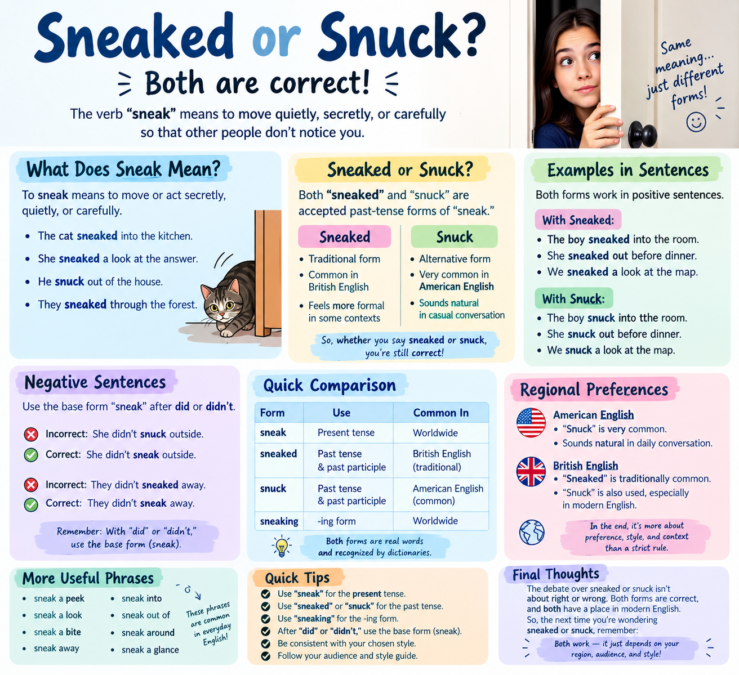

Sneaked or snuck is a common English grammar question that can confuse even experienced speakers. Both words are forms of the verb “sneak,” which means to move quietly, secretly, or carefully so that other people don’t notice you. The confusion happens because English speakers use two different past-tense forms: “sneaked” and “snuck.”
So, which one is correct? The good news is that both “sneaked” and “snuck” are accepted English forms. However, their popularity can depend on the country, region, writing style, and context.
For example, someone might say, “He sneaked into the room,” while another person might naturally say, “He snuck into the room.” Both sentences communicate the same basic idea.
The word “snuck” is especially common in American English, while “sneaked” has traditionally been more common in British English and in more formal or careful writing. That said, the distinction isn’t absolute. English is always changing, and modern dictionaries recognize both forms.
Understanding the difference can help you write and speak more naturally. Whether you’re writing an article, completing an English assignment, or simply wondering which form sounds right, learning how these two words work is surprisingly useful.
What Does Sneak Mean?
Before comparing sneaked or snuck, it’s important to understand the original verb “sneak.”
To sneak means to move or act secretly, quietly, or carefully. Usually, someone sneaks because they don’t want to be seen, heard, or noticed.
Consider these examples:
- The cat sneaked into the kitchen.
- The child snuck downstairs after bedtime.
- We sneaked away before the meeting ended.
- He snuck into the house without making a sound.
- She sneaked a look at the answer.
- They snuck out of the party early.
The word can describe physical movement, but it can also describe doing something secretly.
For example, “She sneaked a cookie from the kitchen” doesn’t necessarily mean she moved quietly across the room. Instead, it means she took the cookie secretly.
That’s one reason the verb is so useful in everyday English.
Sneaked or Snuck: Are Both Correct?
Yes. “Sneaked” and “snuck” are both recognized forms of the verb “sneak.”
The main difference is not correctness but usage and preference.
The traditional past-tense form is:
Sneak → sneaked
The alternative form is:
Sneak → snuck
Both can be used as the simple past tense.
The past participle can also be used in perfect constructions:
- I have sneaked outside.
- I have snuck outside.
Again, both forms can be found in modern English.
However, there are differences in frequency and regional preference.
| Form | Basic use | Common association |
|---|---|---|
| Sneak | Present tense | Standard English everywhere |
| Sneaked | Past tense | Traditional form; common in British English |
| Snuck | Past tense | Very common in American English |
| Sneaked | Past participle | Used in some varieties of English |
| Snuck | Past participle | Widely used in American English |
So, if someone tells you that “snuck” is always wrong, that’s not accurate. Likewise, saying that “sneaked” is incorrect would also be wrong.
Why Does English Have Two Forms?
English contains many irregular verbs.
For example:
- Go → went
- Sing → sang
- Take → took
- Write → wrote
- Speak → spoke
- Break → broke
However, “sneak” originally followed a more regular pattern:
Sneak → sneaked
Over time, another form developed:
Sneak → snuck
This type of change isn’t unusual in English.
Language users often create alternative forms that become accepted through repeated use. Once enough speakers use a particular form, dictionaries and language references may eventually recognize it.
“Snuck” is a good example of an informal-looking form that became established in standard English.
The History Behind “Snuck”
The history of “snuck” is especially interesting.
The word “sneak” is relatively old, but “snuck” became increasingly common in American English during the nineteenth and twentieth centuries.
Some linguists have connected its development to patterns found in other irregular verbs.
English speakers already had verbs such as:
- Stick → stuck
- Strike → struck
- Stink → stunk
- Shrink → shrank or shrunk
The form “snuck” fits naturally into this pattern.
At first, some speakers considered it informal or nonstandard. However, its use became widespread, especially in North American English.
Today, “snuck” is not simply a mistake made by careless speakers. It is an established past-tense form recognized by major dictionaries.
Language changes, after all. What sounds unusual in one generation can become completely ordinary in another.
When Should You Use “Sneaked”?
“Sneaked” is a perfectly correct past-tense form.
It can be especially useful when you want a traditional, straightforward form.
Examples include:
- The boy sneaked into the garden.
- She sneaked out of the house quietly.
- We sneaked a quick look at the map.
- The dog sneaked into the bedroom.
- He sneaked away before anyone noticed.
- They sneaked through the narrow doorway.
“Sneaked” is also common in British English.
If you’re writing for an international audience, “sneaked” may sometimes feel more traditional or formal.
That doesn’t mean “snuck” is incorrect. Rather, “sneaked” can be a good stylistic choice when you want to follow the traditional regular form.
When Should You Use “Snuck”?
“Snuck” is widely used, particularly in American English.
It sounds very natural in casual conversation.
For example:
- I snuck out after everyone went to sleep.
- She snuck into the room.
- He snuck a piece of cake from the kitchen.
- We snuck away before the rain started.
- They snuck behind the building.
- The dog snuck into the backyard.
In American everyday speech, “snuck” may actually sound more natural than “sneaked” to many speakers.
That’s important because grammar isn’t only about rules in a textbook. Natural usage matters, too.
If an American speaker says, “I snuck downstairs,” there is nothing inherently grammatically wrong with that sentence.
Sneaked or Snuck in American English
American English generally favors “snuck” in everyday usage.
For example:
She snuck out of the house before sunrise.
This sounds completely natural to many American speakers.
Another example is:
He snuck a cookie before dinner.
Again, this is common conversational English.
That doesn’t mean Americans never use “sneaked.” They certainly do. The regular form still appears, particularly in some writing and specific constructions.
However, if you’re watching an American movie or television show, you’ll probably hear “snuck” quite often.
Sneaked or Snuck in British English
British English has traditionally favored “sneaked.”
For example:
He sneaked out of the room quietly.
This form may sound more natural to many British speakers.
However, “snuck” isn’t completely absent from British English. Modern English usage crosses national boundaries, especially because of films, television, social media, music, books, and the internet.
As a result, British speakers may encounter and use “snuck” more often than previous generations did.
Language doesn’t respect borders very well. That’s part of what makes it fascinating.
Sneaked or Snuck in Formal Writing
When writing formally, both forms can be grammatically acceptable, but your choice may depend on the audience.
If you’re writing for a British audience or following a traditional British style, “sneaked” may be a comfortable choice.
If you’re writing in American English, “snuck” is widely accepted and natural.
The key is consistency.
For example, don’t switch between different regional styles without a reason:
He sneaked into the office and then snuck out again.
The sentence isn’t necessarily grammatically wrong, but the change can sound stylistically inconsistent.
A smoother approach would be:
He sneaked into the office and then sneaked out again.
Or:
He snuck into the office and then snuck out again.
Consistency makes writing easier to read.
Sneaked or Snuck in Everyday Conversation
In casual speech, “snuck” is extremely common, especially among American speakers.
Imagine a group of friends discussing a party:
“How did you get inside?”
“I snuck through the back door.”
That sounds natural.
Another example:
“Did you eat the last piece of cake?”
“Maybe I snuck a piece earlier.”
The word can add a playful, informal feeling.
On the other hand, “sneaked” can sound perfectly natural in the same situation depending on the speaker’s regional variety.
Neither form changes the basic meaning.
The Difference Between Sneak, Sneaked, and Snuck
The easiest way to understand these words is to look at their grammatical roles.
Sneak
This is the base form.
Examples:
- I want to sneak outside.
- Don’t sneak away.
- They plan to sneak into the building.
Sneaked
This is a past-tense and past-participle form.
Examples:
- She sneaked into the room.
- They sneaked away quietly.
- He has sneaked into the kitchen.
Snuck
This is an alternative past-tense and past-participle form.
Examples:
- She snuck into the room.
- They snuck away quietly.
- He has snuck into the kitchen.
The basic meaning remains the same.
Common Examples of Sneaked
Here are several examples using “sneaked”:
- The cat sneaked under the table.
- She sneaked out while everyone was talking.
- He sneaked a glance at his phone.
- The children sneaked into the garden.
- We sneaked away before the movie ended.
- The dog sneaked through the open gate.
- She sneaked some snacks into her room.
- The students sneaked a look at the clock.
Notice that “sneaked” works with both movement and secret actions.
Common Examples of Snuck
Now let’s look at the same kinds of sentences using “snuck.”
- The cat snuck under the table.
- She snuck out while everyone was talking.
- He snuck a glance at his phone.
- The children snuck into the garden.
- We snuck away before the movie ended.
- The dog snuck through the open gate.
- She snuck some snacks into her room.
- The students snuck a look at the clock.
The meaning hasn’t changed.
That’s the key point.
What Does “Sneak a Look” Mean?
The phrase “sneak a look” is extremely common.
It means to look at something secretly or quickly.
For example:
He sneaked a look at his watch.
Or:
He snuck a look at his watch.
Both mean that he looked at his watch, probably without drawing attention to what he was doing.
Other common expressions include:
- Sneak a peek
- Sneak a glance
- Sneak a bite
- Sneak a taste
- Sneak out
- Sneak in
- Sneak away
- Sneak around
These expressions appear frequently in everyday English.
Sneak In and Sneak Out
The phrases “sneak in” and “sneak out” are particularly common.
To sneak in means to enter quietly or secretly.
Example:
The children sneaked into the house.
Or:
The children snuck into the house.
To sneak out means to leave quietly or secretly.
Example:
He sneaked out before anyone noticed.
Or:
He snuck out before anyone noticed.
Both forms work.
Is “Snuck” Informal?
“Snuck” can sound more informal than “sneaked,” particularly to speakers who learned traditional grammar rules.
However, calling it simply “incorrect slang” would be misleading.
Modern dictionaries recognize “snuck” as a legitimate past-tense form of “sneak.”
Its status has changed over time because language changes through actual usage.
A word doesn’t become standard merely because a grammar book announces it. Usage by large communities of speakers is one of the forces that shapes language.
Why Some People Prefer “Sneaked”
Some speakers prefer “sneaked” because it follows the familiar regular pattern:
Walk → walked
Jump → jumped
Talk → talked
Sneak → sneaked
This pattern is easy to understand.
For people who grew up hearing “sneaked,” the alternative “snuck” may initially sound unusual.
In writing, “sneaked” can also feel more traditional.
However, preference is not the same thing as grammatical correctness.
Why Some People Prefer “Snuck”
The appeal of “snuck” comes partly from its short and irregular sound.
English has many irregular verbs, and speakers naturally use patterns that already exist in the language.
Compare:
- Stick → stuck
- Strike → struck
- Stink → stunk
- Sneak → snuck
The similarity may make “snuck” feel natural to speakers who use these patterns frequently.
For many Americans, “snuck” is simply the normal word.
Is “Sneaked” More Correct Than “Snuck”?
No.
It isn’t accurate to say that “sneaked” is always more correct than “snuck.”
Both forms are accepted.
The better question is:
Which form is more appropriate for the audience and style?
For example:
- American conversational English → “snuck” is very natural.
- Traditional British English → “sneaked” may be preferred.
- Academic writing → either can work, depending on style and audience.
- Creative writing → choose the form that fits the character or setting.
- International writing → either is understandable.
The goal is clear communication.
Is “Snuck” a Real Word?
Absolutely.
“Snuck” is a real English word and is recognized by major English dictionaries.
It has been used for generations, particularly in North American English.
If you see “snuck” in a professionally edited book, article, or newspaper, don’t assume the editor made a mistake.
The form is legitimate.
Of course, individual style guides may have different preferences. Some organizations may prefer “sneaked” for consistency.
That’s a style choice rather than proof that “snuck” is grammatically invalid.
Common Mistakes With Sneaked or Snuck
Learners sometimes make mistakes when using these forms.
Using “Sneak” for a Past Event
Incorrect in standard past-tense usage:
Yesterday, I sneak into the room.
Better:
Yesterday, I sneaked into the room.
Or:
Yesterday, I snuck into the room.
Mixing Tenses
Avoid:
She snuck into the room and leaves quickly.
Better:
She snuck into the room and left quickly.
Assuming Only One Form Is Correct
It’s a mistake to believe that only “sneaked” or only “snuck” is acceptable.
Both are established forms.
Using Regional Preferences Without Considering the Audience
If you’re writing for a specific audience, think about regional English.
A British reader may be more familiar with “sneaked,” while an American reader may naturally expect “snuck.”
Sneaked or Snuck: Which Should Students Use?
Students should follow the English variety expected by their teacher, school, textbook, or examination system.
If the course uses British English, “sneaked” may be the preferred form.
If the course uses American English, “snuck” is widely accepted.
When in doubt, checking the style used by the rest of the course is a smart approach.
For example, if your textbook consistently uses British vocabulary and spelling, matching that style can prevent unnecessary confusion.
How Writers Can Choose the Right Form
Writers can choose based on three simple factors:
Know Your Audience
Think about who will read your work.
Maintain Consistency
Don’t switch between styles randomly.
Follow the Required Style Guide
Professional publications may have their own preferences.
A writer working for an American publication may naturally use “snuck,” while another publication may prefer “sneaked.”
Neither choice automatically makes the writing better.
Sneaked or Snuck in Creative Writing
Creative writers have an additional reason to choose one form over the other: character voice.
Suppose you’re writing dialogue for an American teenager:
“I snuck out after midnight.”
That may sound natural.
Now imagine a character in a story written with a traditional British voice:
“I sneaked out before anyone noticed.”
The choice can contribute to the feel of the dialogue.
Good writers understand that grammar and style can work together.
Sometimes the most natural word isn’t the one that appears in a grammar textbook first.
A Quick Comparison
Here’s a simple summary:
| Question | Sneaked | Snuck |
|---|---|---|
| Is it correct? | Yes | Yes |
| Is it a form of “sneak”? | Yes | Yes |
| Common in American English? | Yes, but less dominant in many contexts | Very common |
| Common in British English? | Traditionally common | Also used, but less traditional |
| Can it be used in formal writing? | Yes | Yes, depending on style |
| Can it be used in conversation? | Yes | Yes |
| Does it mean something different? | Generally no | Generally no |
This table makes the central point clear: the difference is mainly about usage, history, and regional preference, not basic meaning.
Why English Grammar Keeps Changing
The story of sneaked or snuck demonstrates a larger truth about English.
Language isn’t frozen.
Words change meaning. New words appear. Old words disappear. Pronunciation shifts. Grammar patterns develop.
Sometimes a form that was once criticized becomes widely accepted.
English has always been influenced by different communities, countries, cultures, and historical periods.
That flexibility is one reason English has such a large vocabulary.
So, if you encounter “snuck” and wonder how it became accepted, remember that language develops through use.
Tips for Remembering the Difference
If you have trouble remembering which word to use, try this simple method.
Think of the base verb:
Sneak
Then remember two possible past forms:
Sneaked / Snuck
You can associate them with regional preferences:
Sneaked → traditional and especially common in British English
Snuck → especially common in American English
This isn’t an absolute rule, but it’s a useful guide.
Most importantly, remember that both are accepted.
Final Thoughts on Sneaked or Snuck
The debate over sneaked or snuck is a great example of how English grammar can be more flexible than it first appears. Both words are accepted past-tense forms of “sneak,” and both can describe moving secretly or doing something without being noticed.
“Sneaked” is the traditional regular form and has long been associated with British English and more traditional usage. “Snuck” developed as an alternative form and is especially common in American English. Today, both forms are established in modern English.
The best choice depends on your audience, regional variety, and writing style. If you’re writing in American English, “snuck” will usually sound perfectly natural. If you’re following traditional British usage, “sneaked” may be the more familiar option.
There’s no need to worry when you see either form. Once you understand the history and usage, the choice becomes much easier. Whether you say “she sneaked outside” or “she snuck outside,” the meaning remains clear.
In short, sneaked or snuck are both correct forms, and choosing between them is mainly a matter of regional preference, style, and context rather than a simple question of right versus wrong.
Sneaked or Snuck: A Deeper Look at the Two Forms
The question of sneaked or snuck may seem simple at first, but the two forms provide an interesting lesson in how English develops. Both forms come from the verb “sneak,” and both can describe an action that happened in the past.
The main difference is usually connected to regional preference and style rather than meaning. “Sneaked” follows the regular past-tense pattern, while “snuck” is an irregular form that became especially common in American English.
Once you understand that basic idea, the rest becomes much easier.
How Sneak Changes in Different Tenses
To use sneaked or snuck correctly, it’s helpful to see how the verb changes across different tenses.
| Tense | Example |
|---|---|
| Present | I sneak outside quietly. |
| Present continuous | I am sneaking outside. |
| Simple past | I sneaked outside. |
| Simple past | I snuck outside. |
| Present perfect | I have sneaked outside. |
| Present perfect | I have snuck outside. |
| Past perfect | I had sneaked outside. |
| Past perfect | I had snuck outside. |
| Future | I will sneak outside. |
Notice something important: “sneaking” remains the same in the continuous form. The main variation appears in the past and past participle forms.
This makes the verb easier to understand once you separate its different forms.
Why “Sneaking” Is Not Confusing
While people often debate sneaked or snuck, there is usually no similar debate about the present participle.
The standard form is:
Sneak → sneaking
For example:
- She is sneaking into the room.
- He was sneaking through the hallway.
- They are sneaking away from the crowd.
- The cat was sneaking toward the food.
The spelling follows the usual English rule for adding “-ing.”
So, the real question appears when we talk about the past.
Sneaked or Snuck in Positive Sentences
Both forms work naturally in positive sentences.
With “Sneaked”
- The boy sneaked into the kitchen.
- She sneaked out before dinner.
- We sneaked behind the building.
- He sneaked a quick look at the letter.
With “Snuck”
- The boy snuck into the kitchen.
- She snuck out before dinner.
- We snuck behind the building.
- He snuck a quick look at the letter.
The meaning stays essentially the same.
The choice depends mainly on the speaker’s preferred variety of English.
Sneaked or Snuck in Negative Sentences
Negative sentences usually use didn’t followed by the base form “sneak.”
This is an important grammar rule.
For example:
She didn’t sneak outside.
Not:
She didn’t sneaked outside.
And not:
She didn’t snuck outside.
Why?
Because when “did” or “didn’t” is used to form the simple past, the main verb normally returns to its base form.
Consider:
- She walked home.
- She didn’t walk home.
Not:
- She didn’t walked home.
The same pattern applies to “sneak.”
Therefore:
Correct: He didn’t sneak away.
Incorrect: He didn’t sneaked away.
Incorrect: He didn’t snuck away.
This small rule can make your writing much more accurate.
Questions With Sneak
The same principle applies to questions.
Correct examples include:
- Did she sneak outside?
- Did he sneak into the building?
- Did they sneak away?
- Did you sneak a look at the answer?
You wouldn’t normally say:
Did he snuck outside?
Instead, use:
Did he sneak outside?
This is because “did” already marks the past tense.
It’s a small detail, but it matters in standard English grammar.
Sneaked or Snuck With “Have”
When using “have,” “has,” or “had,” the past participle form is required.
Both forms can be used:
She has sneaked into the room.
Or:
She has snuck into the room.
Likewise:
They had sneaked away before we arrived.
Or:
They had snuck away before we arrived.
Both forms are possible, although regional preferences can influence which one sounds more natural.
Sneaked or Snuck in Different English Varieties
English isn’t exactly the same everywhere.
There are many recognized varieties, including:
- American English
- British English
- Canadian English
- Australian English
- New Zealand English
- Irish English
- Indian English
- South African English
Each variety can develop its own preferences.
For sneaked or snuck, American English has strongly embraced “snuck,” while “sneaked” remains an important traditional form.
Other English varieties may show different levels of preference.
This is why one speaker might confidently use “snuck” while another prefers “sneaked.”
Neither person necessarily has poor grammar.
How Dictionaries Treat Snuck
Modern English dictionaries generally recognize “snuck” as a form of “sneak.”
That is important because dictionaries don’t merely list words that grammar teachers happen to like. They document established language usage.
When a form becomes widely used by English speakers, lexicographers can record it.
This doesn’t mean every dictionary or style guide has exactly the same description. Some may identify “snuck” as especially common in American English or as an alternative form.
Still, the basic point remains:
“Snuck” is an established English word.
Is Sneaked Old-Fashioned?
Not necessarily.
“Sneaked” can sound traditional in some contexts, but it isn’t simply an outdated word.
It continues to be used by English speakers around the world.
For example:
He sneaked out of the house quietly.
There’s nothing wrong with that sentence.
It may simply sound different from:
He snuck out of the house quietly.
The second sentence may feel more natural to many American speakers.
Language preference can be influenced by where someone grew up and what they read or hear.
Is Snuck Less Formal?
Some speakers may perceive “snuck” as more conversational.
However, that doesn’t make it automatically unsuitable for formal writing.
Context matters.
A formal article can correctly say:
The researcher noted that the animal had snuck into the area.
But if a particular publication follows a house style that prefers “sneaked,” the editor might change it.
Professional writing often follows specific style preferences.
Therefore, grammar and editorial style aren’t always identical.
How to Choose Between the Two Forms
When you’re unsure about sneaked or snuck, ask yourself three questions.
Who Is My Audience?
If your audience mainly uses American English, “snuck” may sound especially natural.
If your audience follows traditional British English, “sneaked” may be preferable.
What Style Am I Following?
School assignments, newspapers, websites, and publishers may have their own style rules.
Follow the required style when one exists.
Which Form Fits the Voice?
In dialogue, choose the form that sounds natural for the character.
In general writing, choose one form and use it consistently.
Sneak as a Secret Action
The word “sneak” doesn’t always mean physically walking quietly.
It can also mean doing something secretly.
For example:
She sneaked a piece of chocolate.
Or:
She snuck a piece of chocolate.
The person may not have moved quietly at all. Instead, the important idea is that the action was done secretly.
Other examples include:
- sneak a look
- sneak a peek
- sneak a bite
- sneak a taste
- sneak a message
- sneak a photograph
- sneak a question into a conversation
This wider meaning makes “sneak” useful in many situations.
Sneak a Peek and Sneak a Look
Two common expressions are “sneak a peek” and “sneak a look.”
Both mean to look quickly or secretly.
For example:
I sneaked a peek at the gift.
Or:
I snuck a peek at the gift.
Another example:
He sneaked a look at his phone during the meeting.
Or:
He snuck a look at his phone during the meeting.
These phrases are common in everyday conversation and informal writing.
Sneak Into Versus Sneak Out Of
Prepositions can also change the meaning of the phrase.
Sneak Into
This means entering somewhere quietly or secretly.
She snuck into the room.
Sneak Out Of
This means leaving somewhere quietly or secretly.
She sneaked out of the room.
Sneak Around
This means moving or behaving secretly.
The children were sneaking around the house.
Sneak Away
This means leaving quietly or without attracting attention.
He snuck away while everyone was talking.
Learning these combinations can help English learners sound more natural.
Examples From Everyday Situations
Imagine a student arriving late at school.
You could say:
The student sneaked into the classroom after the lesson started.
Or:
The student snuck into the classroom after the lesson started.
Imagine someone leaving a party early:
She sneaked out of the party at midnight.
Or:
She snuck out of the party at midnight.
Imagine a child taking an extra cookie:
The child sneaked a cookie from the kitchen.
Or:
The child snuck a cookie from the kitchen.
In each pair, the meaning remains almost identical.
Examples in Storytelling
Writers often use “sneak” because it creates a sense of secrecy.
For example:
The detective sneaked through the dark hallway.
Or:
The detective snuck through the dark hallway.
The choice can influence the rhythm of the sentence.
“Snuck” is shorter and can make a sentence sound more conversational.
“Sneaked” has a slightly different rhythm and may fit a more traditional narrative voice.
Good writing isn’t just about grammar. Rhythm and voice matter, too.
How Teachers Can Explain Sneaked or Snuck
For teachers, the easiest explanation is to present both forms and then explain their usage.
A simple lesson might include:
Base form: sneak
Past forms: sneaked / snuck
-ing form: sneaking
Students can then practice sentences such as:
- I sneak into the room.
- Yesterday, I sneaked into the room.
- Yesterday, I snuck into the room.
- I am sneaking into the room.
- I didn’t sneak into the room.
This approach makes the pattern easy to understand.
A Useful Grammar Exercise
Choose the correct form for each sentence.
Sentence One
Yesterday, he ______ into the house.
Possible answers:
- sneaked
- snuck
Both can work.
Sentence Two
She didn’t ______ outside.
Correct answer:
- sneak
Sentence Three
They were ______ through the hallway.
Correct answer:
- sneaking
Sentence Four
He has ______ away already.
Possible answers:
- sneaked
- snuck
Both can work.
Sentence Five
Did she ______ into the room?
Correct answer:
- sneak
This exercise shows an important point: the correct form depends on the structure of the sentence.
Common Grammar Confusion
One of the biggest problems learners face is thinking that every past-tense sentence must use the past form of the main verb.
That’s not true when an auxiliary verb already carries the tense.
Compare:
He snuck outside.
with:
He didn’t sneak outside.
The first sentence uses “snuck” because there is no auxiliary “did.”
The second sentence uses “sneak” because “didn’t” already establishes the past tense.
The same rule applies to many other verbs:
She went home.
But:
She didn’t go home.
Understanding this pattern will improve your grammar far beyond the word “sneak.”
Does Sneaked or Snuck Change the Meaning?
Generally, no.
Both forms normally describe the same basic action.
For example:
He sneaked into the room.
and
He snuck into the room.
Both tell us that he entered quietly or secretly.
There may be differences in tone or regional feel, but the central meaning remains the same.
That makes this a useful example of variation in English rather than a major difference in meaning.
Why Context Matters
English words can carry subtle feelings depending on context.
Consider:
The child snuck into the kitchen.
This may sound casual and conversational.
Now consider:
The child sneaked into the kitchen.
This can sound a little more traditional.
Neither sentence changes the event itself.
The context and surrounding words determine the overall tone.
This is why experienced writers don’t always choose words based solely on dictionary definitions. They also consider rhythm, audience, tone, and voice.
What English Learners Should Remember
If English isn’t your first language, don’t let this pair confuse you.
Remember these simple points:
- “Sneak” is the base verb.
- “Sneaked” is a correct past form.
- “Snuck” is also a correct past form.
- “Snuck” is especially common in American English.
- “Sneaked” is traditionally common in British English.
- After “did” or “didn’t,” use “sneak.”
- “Sneaking” is the standard -ing form.
- Follow your school’s or publication’s preferred English variety.
- Both forms generally have the same basic meaning.
Once these points become familiar, you’ll be able to use the verb confidently.
Sneaked or Snuck in Professional Editing
Editors often make decisions based on audience and house style.
For example, a publisher serving an American audience may accept “snuck” without hesitation.
Another publisher may prefer “sneaked” throughout its content.
This doesn’t necessarily mean one publisher understands grammar better than the other.
Professional editing involves consistency.
If an article uses “sneaked” throughout, an editor may keep using it rather than switching randomly to “snuck.”
Consistency helps create a polished reading experience.
A Comparison With Other English Variations
The debate over sneaked or snuck is not unique.
English contains many words with regional differences.
For example:
| British preference | American preference |
|---|---|
| Petrol | Gas |
| Lift | Elevator |
| Holiday | Vacation |
| Biscuit | Cookie |
| Flat | Apartment |
| Queue | Line |
| Sneaked | Snuck often preferred |
These differences don’t mean that one variety is automatically better.
They show that English has developed differently in different communities.
The same language can have several accepted forms.
How Language Learners Can Build Confidence
The best way to become comfortable with words such as “sneaked” and “snuck” is to encounter them in real English.
Try reading:
- Novels
- Newspapers
- Magazines
- Online articles
- English-language blogs
- Subtitles
- Interviews
- Everyday conversations
You’ll notice that different writers and speakers make different choices.
Instead of worrying that one form is always right and the other always wrong, pay attention to context.
Over time, the differences will become much easier to recognize.
Final Thoughts on Sneaked or Snuck
The discussion surrounding sneaked or snuck reveals something important about English: correct language can have more than one accepted form.
“Sneaked” is the regular past form and has a long history of use. “Snuck” developed as an alternative and became especially common in American English. Both are recognized forms of “sneak,” and both can be used naturally in appropriate contexts.
The most important grammar rule to remember is that after did or didn’t, you should use the base form:
Did he sneak outside?
He didn’t sneak outside.
For ordinary past-tense statements, however, both forms are possible:
He sneaked outside.
He snuck outside.
When writing, consider your audience, regional English, tone, and any style guide you’re expected to follow. If you’re writing American English, “snuck” will usually feel natural. If you’re following traditional British usage, “sneaked” may be the preferred choice.
Ultimately, sneaked or snuck isn’t a battle between a correct word and an incorrect word. It’s an interesting example of regional variation and the natural evolution of English. Once you understand when and why each form is used, you’ll be able to choose confidently and communicate your meaning clearly.
Explore more insightful articles on All Vantage News and never miss an update.Contact Us.