
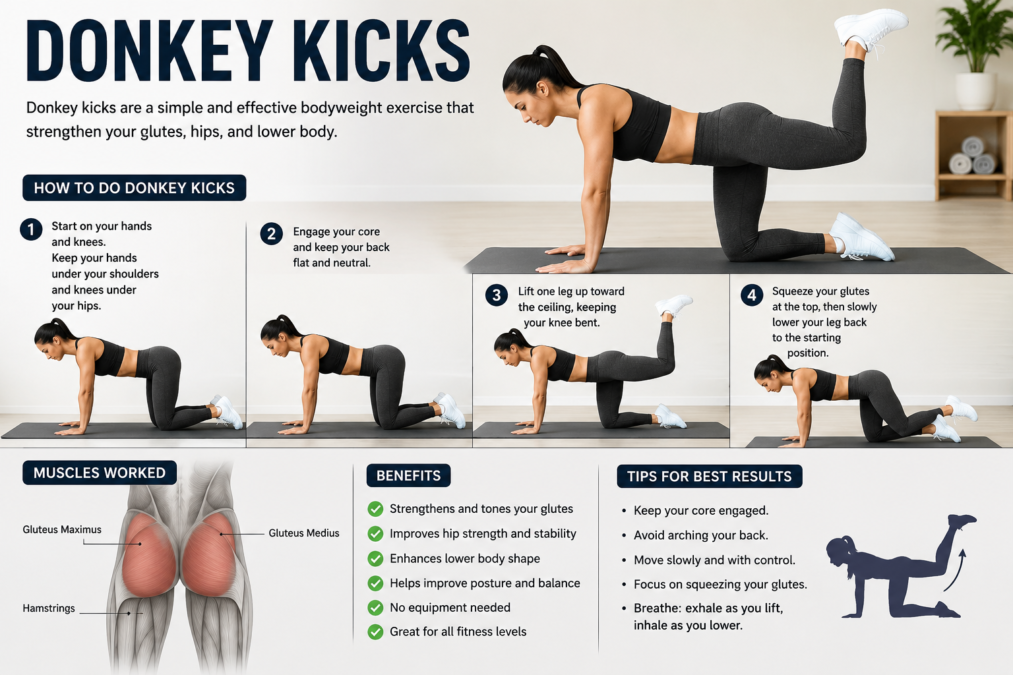

Introduction to donkey kicks
Donkey kicks are a simple and popular bodyweight exercise that mainly targets the glute muscles. They can be performed at home, in a gym, or almost anywhere with enough floor space. Because they don’t require expensive equipment, donkey kicks are often included in beginner-friendly workouts, lower-body routines, and home fitness programs.
At first glance, the movement looks easy. You get onto your hands and knees, lift one leg toward the ceiling, lower it with control, and repeat. However, getting the most from donkey kicks isn’t simply about moving your leg as high as possible. Good technique, controlled movement, proper posture, and consistent training are much more important.
The exercise can help strengthen and activate the muscles around the hips and buttocks. It can also be useful as part of a warm-up before a lower-body workout. Furthermore, different variations can make the movement more challenging as your fitness level improves.
Whether you’re completely new to exercise or you’ve already been training for a while, understanding how donkey kicks work can help you perform them safely and effectively. So, let’s break it down step by step.
What Are donkey kicks?
Donkey kicks are a quadruped lower-body exercise performed from a hands-and-knees position. The movement involves keeping one knee bent while driving the foot upward behind the body.
The basic position looks like this:
- Hands are placed under or close to the shoulders.
- Knees are positioned under or close to the hips.
- The spine stays in a neutral position.
- The abdominal muscles are gently engaged.
- One knee remains bent as the leg moves upward.
- The foot travels toward the ceiling.
- The leg returns slowly to the starting position.
The main goal isn’t to swing the leg wildly. Instead, the movement should come from the hip while the rest of the body remains stable.
That’s what makes the exercise useful. Your body has to control the moving leg while the core and supporting muscles work to keep you balanced.
Donkey kicks are sometimes called quadruped hip extensions because they involve extending the hip while the body is supported on four points.
Muscles Worked by donkey kicks
One of the biggest reasons people include donkey kicks in their workouts is their focus on the glutes. However, several muscles contribute to the movement.
Gluteus maximus
The gluteus maximus is the largest muscle in the buttocks. It plays an important role in hip extension, which is the primary action involved when you drive the leg backward and upward.
Strong glutes can contribute to many everyday and athletic movements, including walking, climbing stairs, running, jumping, and standing from a seated position.
Gluteus medius
The gluteus medius sits on the outer portion of the hip. It helps stabilize the pelvis and assists with moving the leg away from the body’s center.
Although the basic donkey kick focuses more heavily on hip extension, certain variations can involve the gluteus medius more strongly.
Hamstrings
The hamstrings are located on the back of the thigh. They assist with hip extension and knee control during the movement.
They aren’t necessarily the primary target, but they’ll still contribute to the exercise.
Core muscles
Your abdominal and lower-back muscles help stabilize the torso while one leg moves.
This is an important point. A good donkey kick isn’t just about the moving leg. Your core should help prevent excessive movement through your lower back.
Shoulders and arms
Because your hands remain on the floor, your shoulders, arms, and upper-body muscles also help support your body.
They aren’t the main target, but maintaining a stable tabletop position requires some upper-body endurance.
Benefits of donkey kicks
When performed with proper technique, donkey kicks can offer several useful benefits.
Helps strengthen the glutes
The most obvious benefit is their ability to train the glute muscles.
Strong glutes are important for more than appearance. They contribute to hip movement, posture, balance, and many everyday activities.
Easy to perform at home
You don’t need a barbell, machine, or large exercise area.
A yoga mat or comfortable floor surface is usually enough.
Beginner friendly
The basic version is relatively simple and can be modified according to your fitness level.
Beginners can start with a small number of repetitions and gradually increase the workload.
Supports lower-body training
Donkey kicks can complement exercises such as:
- Squats
- Lunges
- Glute bridges
- Step-ups
- Hip thrusts
- Romanian deadlifts
Combining different movements can train the lower body from several angles.
Improves movement awareness
Because you need to stabilize your torso while moving one leg, the exercise can help you become more aware of hip and pelvic positioning.
Requires little equipment
Bodyweight donkey kicks can be performed without equipment. Later, resistance bands or ankle weights can increase the challenge if appropriate.
How to Perform donkey kicks Correctly
Good technique is the key to getting the most out of donkey kicks.
Start on your hands and knees.
Place your hands underneath your shoulders and your knees beneath your hips. Keep your fingers comfortably spread and press gently into the floor.
Next, tighten your abdominal muscles slightly. Your back should remain relatively neutral rather than excessively arched.
Choose one leg.
Keep the knee bent at approximately a right angle and slowly lift the foot toward the ceiling.
Stop when you feel your glute working strongly without needing to twist your hips or overextend your lower back.
Then lower the leg under control.
Don’t simply drop it.
Repeat the movement for your desired number of repetitions before switching sides.
A basic sequence looks like this:
Set up → Brace your core → Lift the leg → Pause briefly → Lower slowly → Repeat → Switch sides
The movement should feel controlled rather than rushed.
Breathing During donkey kicks
Breathing may seem like a small detail, but it can make exercise feel smoother.
A simple approach is to breathe naturally throughout the movement.
For example:
- Inhale as you lower the leg.
- Exhale as you lift the leg.
- Avoid holding your breath.
- Keep your breathing steady during each repetition.
There isn’t one magical breathing pattern that makes donkey kicks dramatically better. The most important thing is to avoid unnecessary breath-holding and maintain good control.
If you’re performing a difficult variation, steady breathing becomes even more useful.
Common donkey kicks Mistakes
Even a simple exercise can be performed incorrectly.
Here are some common mistakes to watch for.
Lifting the leg too high
Many people assume that a higher leg automatically means a better repetition.
Not necessarily.
If lifting the leg high causes your lower back to arch dramatically, you’ve probably gone beyond the range you can control properly.
Instead, focus on moving from the hip while keeping the torso stable.
Rotating the hips
Your pelvis should remain relatively square to the floor.
If one side of your hip opens dramatically during each repetition, you’re changing the movement.
Try to imagine that your hip bones are facing the floor.
Moving too quickly
Fast repetitions can turn a controlled exercise into a swinging movement.
Slow down.
Feel the glute working as the leg rises and lower the leg with control.
Forgetting the core
The exercise isn’t just about the leg.
Your core helps stabilize your torso and pelvis.
If your body is rocking back and forth, reduce the range of motion and focus on stability.
Locking the elbows
Your arms should provide a stable foundation without excessive tension.
Avoid collapsing through the shoulders or forcing the elbows into an uncomfortable position.
Holding your breath
Breathing naturally helps you stay relaxed and controlled.
If you find yourself holding your breath, reduce the intensity and focus on your rhythm.
How Many donkey kicks Should You Do?
There isn’t one perfect number of repetitions for everyone.
Your ideal workload depends on your fitness level, goals, training experience, and the rest of your workout.
For beginners, a reasonable starting point might be:
| Fitness level | Suggested approach |
|---|---|
| Beginner | 1–2 sets of 8–12 repetitions per side |
| Intermediate | 2–3 sets of 10–15 repetitions per side |
| Advanced | 3–4 sets of 12–20 controlled repetitions per side |
| Resistance variation | Fewer repetitions may be appropriate because the movement is harder |
These are general training examples rather than strict rules.
Quality matters more than simply chasing a large number.
If your technique becomes poor after 15 repetitions, doing 30 isn’t necessarily better.
Likewise, if 10 repetitions feel extremely easy, you may eventually benefit from a more challenging variation.
donkey kicks for Beginners
If you’re new to exercise, start with the basic bodyweight version.
You don’t need to rush.
Begin by practicing the tabletop position. Learn how to keep your back stable and your hips controlled.
Then perform a few slow repetitions.
A simple beginner routine could look like:
- Warm up for several minutes.
- Perform 8–10 donkey kicks on one side.
- Rest briefly.
- Perform 8–10 on the other side.
- Repeat for another set if comfortable.
- Finish with gentle movement or stretching.
The goal is to build consistency.
You don’t have to feel exhausted after every workout for it to be effective.
In fact, beginners often make faster progress by focusing on good technique and regular training rather than trying to do too much too soon.
donkey kicks Variations
Once the basic movement becomes comfortable, you can experiment with different variations.
Resistance-band donkey kicks
A resistance band can be placed around the thighs or ankles, depending on the type of band and exercise setup.
The added resistance makes the muscles work harder.
Start with light resistance and maintain control.
Straight-leg donkey kicks
Instead of keeping the knee bent, you extend the leg backward.
This changes the movement pattern and may feel different through the glutes and hamstrings.
However, don’t sacrifice pelvic control simply to get a longer leg position.
Pulsing donkey kicks
At the top of the movement, you can perform small controlled pulses.
The range should remain small.
Avoid bouncing aggressively.
Bent-knee pulses
Keep the knee bent and perform short pulses near the top of the movement.
This can increase local muscular fatigue.
Fire hydrant combination
A donkey kick can be combined with a fire hydrant.
You might lift the bent knee backward, return it toward the starting position, and then move it outward to the side.
This combination challenges the hip muscles from different directions.
Weighted donkey kicks
More advanced exercisers may use ankle weights.
However, added resistance isn’t automatically better. You should first master bodyweight technique.
donkey kicks and Glute Activation
People often use donkey kicks during glute-focused workouts because the movement creates a strong contraction in the buttock muscles.
Glute activation can be useful as part of a warm-up.
For example, before squats or hip thrusts, a person might perform a few controlled sets of donkey kicks to prepare for lower-body training.
However, it’s worth remembering that feeling a muscle work isn’t the same thing as proving that an exercise is the best muscle-building movement.
For overall strength and muscle development, progressive resistance exercises such as squats, hip thrusts, deadlifts, and lunges can also be valuable.
A balanced workout is usually better than relying on one movement alone.
donkey kicks for Home Workouts
One major advantage of donkey kicks is convenience.
You can perform them in a bedroom, living room, gym, hotel room, or outdoor exercise area.
A simple home workout could combine donkey kicks with other bodyweight exercises.
For example:
- Bodyweight squats
- Reverse lunges
- Glute bridges
- Donkey kicks
- Bird dogs
- Push-ups
- Planks
This combination can provide a balanced full-body session.
However, don’t feel pressured to complete every exercise in one workout. Training volume should match your experience and recovery ability.
donkey kicks and Athletic Training
Strong hip muscles are important for many sports.
Runners, football players, basketball players, dancers, and other athletes rely on their hips and glutes for movement and stability.
Donkey kicks can be used as an accessory exercise because they allow athletes to practice controlled hip extension without requiring heavy equipment.
That said, athletes shouldn’t treat donkey kicks as a replacement for sport-specific strength training.
A football player, for example, needs sprinting, jumping, strength, balance, agility, and conditioning work in addition to simple glute exercises.
Think of donkey kicks as one tool in the toolbox—not the whole toolbox.
Can donkey kicks Help Build the Glutes?
They can contribute to glute training, especially when performed consistently and with appropriate resistance.
However, muscle growth depends on several factors:
- Progressive overload
- Adequate training volume
- Sufficient protein and overall nutrition
- Recovery
- Sleep
- Consistency
- Individual genetics
Bodyweight donkey kicks may become less challenging as you become stronger.
At that point, you can increase difficulty by using resistance bands, ankle weights, or more demanding exercises.
The important principle is progressive challenge.
If your body adapts to the same workload, gradually increasing resistance or difficulty can help you continue progressing.
donkey kicks and Weight Loss
It’s important to clear up a common misunderstanding.
Donkey kicks can strengthen muscles, but they aren’t a magic exercise for burning belly fat or creating spot reduction.
You can’t choose exactly where your body loses fat by exercising one specific body part.
For overall weight management, factors such as:
- Nutrition
- Daily activity
- Resistance training
- Cardiovascular exercise
- Sleep
- Stress management
- Long-term consistency
all matter.
Donkey kicks can still be part of a healthy fitness program, especially when combined with full-body exercise.
The bigger picture matters.
Safety Tips for donkey kicks
Most healthy adults can perform basic donkey kicks, but proper technique remains important.
Keep these tips in mind:
- Use a comfortable surface.
- Keep your hands stable.
- Maintain a controlled spine position.
- Avoid excessive lower-back arching.
- Don’t force the leg beyond your comfortable range.
- Start with manageable repetitions.
- Increase resistance gradually.
- Stop if you experience sharp or unusual pain.
Muscle fatigue and mild effort are normal.
Sharp pain, numbness, unusual weakness, or persistent discomfort is different and shouldn’t simply be pushed through.
People with existing injuries, significant joint problems, or medical conditions should consider speaking with an appropriately qualified healthcare or fitness professional before beginning a new exercise program.
How to Make donkey kicks More Effective
If the basic movement becomes too easy, don’t immediately start doing hundreds of repetitions.
Instead, improve the quality of the exercise.
Try these strategies:
Slow the Movement
Take two or three seconds to lower the leg.
Pause at the Top
Hold the top position briefly while maintaining pelvic control.
Add Resistance
Use a suitable resistance band or ankle weight.
Increase Sets Gradually
Add an additional set when your current workload becomes manageable.
Combine Exercises
Pair donkey kicks with squats, lunges, or glute bridges.
Focus on Technique
A controlled repetition is usually more valuable than a sloppy one.
As the saying goes, quality over quantity.
donkey kicks Compared With Other Glute Exercises
No single exercise is perfect for every person.
| Exercise | Main focus | Equipment | Difficulty |
|---|---|---|---|
| donkey kicks | Glutes and hip extension | None | Beginner |
| Glute bridge | Glutes and hips | None | Beginner |
| Squat | Glutes, thighs, core | Optional | Beginner–Intermediate |
| Lunge | Glutes and legs | Optional | Beginner–Intermediate |
| Hip thrust | Glutes | Optional weight | Intermediate |
| Romanian deadlift | Glutes and hamstrings | Usually weights | Intermediate |
| Step-up | Glutes and legs | Bench/step | Beginner–Intermediate |
This comparison shows why a balanced program can be useful.
Donkey kicks are convenient, but exercises such as squats, hip thrusts, lunges, and deadlift variations can provide different forms of resistance and movement.
Creating a Simple donkey kicks Workout
A basic lower-body routine might include several exercises.
Warm-Up
Start with five to ten minutes of easy movement.
Walking, gentle cycling, or dynamic mobility exercises can help prepare the body.
Main Workout
You could then perform:
- Bodyweight squats
- Glute bridges
- donkey kicks
- Reverse lunges
- Step-ups
Rest as needed between sets.
The exact number of sets and repetitions should depend on your experience and fitness level.
Cooldown
Finish with relaxed movement and gentle mobility work.
There’s no need to turn the cooldown into an extremely long stretching session.
The key is to finish the workout feeling capable of recovering for your next session.
Frequently Asked Questions About donkey kicks
Are donkey kicks good for beginners?
Yes. The basic bodyweight movement is relatively simple and can be adjusted to suit beginners.
Do donkey kicks make your glutes bigger?
They can contribute to glute training, but noticeable muscle growth requires an appropriate overall resistance-training program, nutrition, and recovery.
Can I do donkey kicks every day?
You don’t necessarily need to perform them every day. Muscles benefit from recovery, particularly when training becomes challenging or resistance is added.
Are donkey kicks good for the lower back?
The exercise is designed mainly for the hips and glutes, not the lower back. Maintaining a neutral spine can help keep unwanted lower-back movement under control.
Can I use resistance bands?
Yes. Resistance bands can make donkey kicks more challenging. Start with a manageable resistance so you can maintain good form.
How high should I lift my leg?
Lift only as high as you can while keeping your hips stable and avoiding excessive lower-back arching. Higher isn’t automatically better.
Can donkey kicks replace squats?
Not completely. Donkey kicks and squats train the lower body differently. A balanced workout can include several movement patterns.
Are donkey kicks good for home workouts?
Absolutely. One of their biggest advantages is that they require very little space and no equipment in their basic form.
Final Thoughts on donkey kicks
Donkey kicks are a convenient, beginner-friendly exercise that can play a useful role in lower-body and glute-focused workouts. They require little space, no equipment in their basic form, and can be modified as your fitness level improves.
The key to getting results isn’t simply doing more repetitions. Good technique, controlled movement, appropriate resistance, consistent training, and adequate recovery are far more important. Keep your torso stable, avoid excessive lower-back movement, and lift the leg only as far as you can control.
For beginners, bodyweight donkey kicks can be an excellent starting point. More experienced exercisers can add resistance, pauses, pulses, or other variations to increase the challenge. Still, they work best as part of a broader program that includes exercises such as squats, lunges, bridges, step-ups, and other strength movements.
Most importantly, remember that fitness is a long-term journey. You don’t need to rush or chase impossible results overnight. Start with good form, progress gradually, listen to your body, and stay consistent. Used wisely, donkey kicks can be a simple yet effective addition to a balanced fitness routine.
Explore more insightful articles on All Vantage News and never miss an update.Contact Us.