
How Trailies Big Feelings Deck Can Be Used in Daily Life
The Trailies Big Feelings Deck is most useful when it becomes part of normal daily life instead of being treated like a formal lesson. Children experience emotions throughout the day, so emotional learning can happen during ordinary moments.
For example, a child may become upset because a favorite toy breaks. Another child may feel nervous before going to school. Someone else may become frustrated when they can’t complete a puzzle.
These moments can become small learning opportunities.
Rather than ignoring the feeling, an adult can help the child stop for a moment and think about what is happening.
A simple process might be:
- Notice the emotion.
- Give the emotion a name.
- Ask what the body is feeling.
- Choose a suitable activity.
- Practice the activity together.
- Talk about what happened afterward.
The process doesn’t need to take a long time.
In fact, keeping it short can make it easier for children to participate.
Trailies Big Feelings Deck and Calming Activities
One important part of emotional regulation is learning what helps the body settle after a strong emotional reaction.
Different children may respond to different strategies.
Some children may enjoy movement, while others may prefer quiet activities. Some may find breathing useful, while others may benefit from sensory activities.
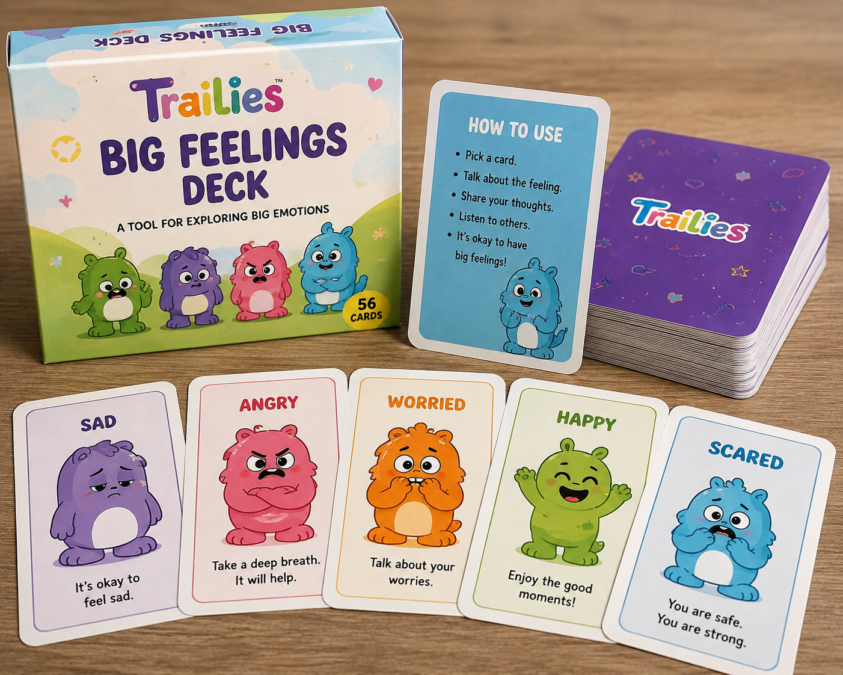
The Trailies Big Feelings Deck uses short activities intended to give families practical ways to respond in these moments.
Examples of general calming strategies can include:
Slow Breathing
Slow breathing can encourage a child to pause instead of reacting immediately.
A parent can breathe slowly alongside the child rather than simply telling them to breathe.
Gentle Movement
Walking, stretching, or another simple movement can provide a physical break.
Sensory Reset
Some children find sensory experiences calming. This might involve paying attention to sounds, textures, or other safe sensory experiences.
Quiet Time
A child may sometimes need a peaceful place before they’re ready to talk.
Positive Connection
A calm adult presence can also be reassuring.
The important thing is to avoid treating one strategy as the perfect answer for every child.
Why Practice Matters Before a Big Emotional Moment
Imagine giving someone a new tool for the first time during an emergency.
They may not know how to use it.
The same idea can apply to emotional tools.
If a child only sees the Trailies Big Feelings Deck during a major meltdown, they may associate the cards with being in trouble or having a problem.
Instead, families can explore the cards during calm moments.
Parents can say:
“Let’s try this one together.”
There doesn’t need to be an emotional crisis.
Practicing when everyone is calm can make the process familiar.
Then, when a difficult moment arrives, the child may already know what to expect.
Making Emotional Learning Feel Fun
Children learn well when they are interested and involved.
Emotional learning doesn’t always need to feel serious.
A parent can make activities playful while still taking emotions seriously.
For example, a family could have a regular “feelings check-in.”
Each person can share:
- One feeling they had today
- Something that caused the feeling
- Something that helped them
- One thing they’re looking forward to
This can help children understand that emotions aren’t something to hide.
Everyone experiences them.
Even adults.
That’s a powerful lesson because children often learn by watching the people around them.
Trailies Big Feelings Deck and Parent-Child Connection
Emotional regulation isn’t only about controlling behavior.
Connection matters too.
When a child is upset, they may need to know that an adult understands what they’re experiencing.
This doesn’t mean that adults have to agree with every reaction.
For example, a parent can say:
“I know you’re angry because playtime is finished. It’s okay to feel angry, but we still need to put the toys away.”
This response does two things:
- It recognizes the emotion.
- It keeps a reasonable boundary.
That balance can be valuable.
Children need both emotional support and clear limits.
What Parents Should Avoid During Big Feelings
Even a helpful tool can be less effective if the adult approaches the situation in a harsh or impatient way.
During an emotional moment, parents may want to avoid:
- Shaming the child
- Making fun of the emotion
- Saying “Stop crying” repeatedly
- Giving a long lecture
- Demanding immediate calm
- Comparing the child with siblings
- Threatening consequences for having a feeling
- Trying to solve everything immediately
A child can learn that feelings are acceptable while certain behaviors are not.
For example:
“It’s okay to be angry. It’s not okay to hit someone.”
That distinction is important.
Understanding the Difference Between Feelings and Actions
Feelings and actions aren’t the same thing.
A child may feel angry.
Feeling angry isn’t wrong.
However, hitting, kicking, or breaking something can cause harm.
This gives parents an opportunity to teach an important lesson:
All feelings can be recognized, but not every action is appropriate.
The Trailies Big Feelings Deck can be used alongside this kind of conversation.
The child can learn to recognize the emotion first and then think about a safer response.
Over time, this can support better decision-making.
Trailies Big Feelings Deck for Family Conversations
The deck can also become a conversation starter.
Sometimes children don’t know how to begin talking about something difficult.
A card can provide a simple opening.
For example, an adult might ask:
“What feeling do you think this activity could help with?”
The child might answer:
“Anger.”
Then the adult could ask:
“When do you feel angry?”
This can lead to a deeper conversation without making the child feel as though they’re being questioned.
That’s especially useful when children are reluctant to talk.
Using Emotional Tools During Sibling Conflicts
Sibling arguments are common.
Two children may want the same toy. One may believe the other received more attention. A game may not feel fair.
When emotions rise, parents can help children pause.
A useful sequence might be:
Pause → Identify → Calm → Talk → Solve
First, pause the conflict.
Next, help each child identify what they’re feeling.
Then allow everyone time to settle.
After that, the children can explain what happened.
Finally, they can work toward a solution.
A card-based activity can fit naturally into the calming part of this process.
Trailies Big Feelings Deck and School Stress
School can create many emotions.
Children may feel nervous about tests, embarrassed about mistakes, worried about friendships, or frustrated by difficult work.
Teachers and parents can help children understand that struggling doesn’t mean they’re incapable.
A child who says:
“I’m stupid because I can’t do this.”
may actually be feeling frustrated or discouraged.
A supportive adult can respond:
“This is difficult right now, but difficult doesn’t mean impossible.”
That small change in language can make a difference.
Emotional tools can support this process by helping students identify what they are experiencing before they try to solve the problem.
Creating a Feelings Corner
At home or in a classroom, adults can create a small area where children can take a break.
It doesn’t need to be expensive.
A simple feelings corner might include:
- Comfortable seating
- Books
- Drawing materials
- Age-appropriate emotional tools
- A quiet space
- Soft sensory items
- A feelings chart
The purpose shouldn’t be punishment.
Instead, the area can be presented as a place to pause and reset.
This distinction matters.
A child shouldn’t feel that they are being sent away because their emotions are bad.
They should understand that the space is available to help them regain control.
Trailies Big Feelings Deck and Emotional Independence
As children grow, adults can gradually reduce the amount of support they provide.
A younger child might need a parent to choose a card and complete the activity with them.
An older child might be able to select a strategy independently.
This gradual change can support independence.
The long-term goal isn’t for a child to depend on a card every time they experience an emotion.
Instead, the child can learn different strategies and eventually recognize which ones work best for them.
That’s an important part of emotional development.
Benefits of Emotional Regulation Skills
Learning emotional regulation can support many areas of everyday life.
Possible benefits include:
- Better communication
- Improved self-awareness
- Stronger problem-solving
- More confidence
- Better understanding of emotions
- Improved ability to pause before reacting
- Greater awareness of personal needs
- Healthier family conversations
These benefits don’t happen instantly.
Children develop gradually.
Some days may go well, while other days may be difficult.
That’s normal.
Progress should be measured over time rather than by expecting every emotional situation to end perfectly.
A Simple Comparison of Emotional Responses
| Situation | Immediate Reaction | Helpful Learning Response |
|---|---|---|
| Toy breaks | Crying or shouting | Name the disappointment |
| Screen time ends | Anger | Pause and choose a calming strategy |
| Homework feels difficult | Giving up | Identify frustration and ask for help |
| Friend says something upsetting | Sadness | Talk about the feeling |
| Plans change | Resistance | Recognize disappointment and adjust |
| Sibling takes a toy | Anger | Pause before reacting and communicate |
This table shows why emotional learning is useful in ordinary situations.
The goal isn’t to prevent children from having emotions.
The goal is to give them better tools for responding.
What Makes a Good Emotional Learning Tool?
A useful emotional learning tool should be:
Simple
Children should be able to understand what they’re being asked to do.
Practical
Activities should fit real-life situations.
Age Appropriate
The language and activities should match the child’s developmental level.
Flexible
Different children need different strategies.
Respectful
The child’s emotions should be treated seriously.
Easy to Repeat
Emotional skills improve through practice.
The Trailies Big Feelings Deck is designed around short, practical activities, which can make it easier to incorporate into family or classroom routines.
Limitations to Keep in Mind
It’s important to maintain realistic expectations.
No card deck can solve every emotional or behavioral challenge.
Children may experience difficulties that require additional support from parents, teachers, counselors, psychologists, or other qualified professionals.
Parents should also remember that emotional tools work best as part of a supportive environment.
Other important factors include:
- Consistent routines
- Enough sleep
- Healthy communication
- Appropriate boundaries
- Positive relationships
- Safe surroundings
- Individual attention
If a child experiences serious or ongoing emotional difficulties, a card activity shouldn’t be viewed as a replacement for professional help.
Instead, it can be one practical resource within a larger support system.
Tips for Getting Better Results
Parents and teachers can make emotional activities more effective by keeping expectations realistic.
Here are some helpful tips:
- Start practicing before a crisis.
- Keep activities short.
- Use calm language.
- Give children choices when possible.
- Don’t force a child to talk immediately.
- Praise effort rather than perfection.
- Model emotional regulation yourself.
- Repeat useful strategies regularly.
- Respect personal boundaries.
- Ask what helped afterward.
Most importantly, stay patient.
Emotional skills take time.
A child may need to practice the same strategy many times before using it independently.
Modeling Emotional Regulation as an Adult
Children learn a great deal by observing adults.
If a parent becomes frustrated and says:
“I’m really annoyed. I need a minute before I respond.”
the child is seeing emotional regulation in action.
The adult isn’t pretending that anger doesn’t exist.
Instead, they’re showing what a healthy response can look like.
This can be more powerful than a long explanation.
Parents don’t need to be perfect.
In fact, it can be helpful for children to see adults make mistakes and repair them.
For example:
“I was frustrated earlier and I spoke too loudly. I’m sorry. Next time I’ll try to take a breath first.”
That’s a valuable lesson.
Building a Long-Term Emotional Toolkit
The best result of using emotional activities isn’t simply getting through one difficult afternoon.
The bigger goal is to help children develop a personal emotional toolkit.
That toolkit might eventually include:
- Breathing
- Taking a break
- Talking to someone
- Asking for help
- Moving the body
- Drawing
- Writing
- Listening to music
- Using positive self-talk
- Finding a quiet place
- Identifying the problem
- Thinking about possible solutions
Every child can discover which strategies work best for them.
The Trailies Big Feelings Deck can be one way to introduce children to this wider collection of skills.
Frequently Asked Questions About Trailies Big Feelings Deck
What is Trailies Big Feelings Deck?
The Trailies Big Feelings Deck is an emotional-support card tool designed to help children recognize and respond to strong emotions through short, practical activities.
What age group is it designed for?
Trailies states that the Big Feelings Deck is designed for children around ages 4 to 12, while noting that some activities may also be useful outside that range.
Can parents use it at home?
Yes. The deck is designed for practical use during everyday emotional moments at home.
Can teachers use it?
Trailies also offers classroom-focused materials intended to support emotional regulation in school settings.
Does it stop children from feeling angry or sad?
No. The purpose isn’t to eliminate normal emotions. Instead, the focus is on helping children recognize feelings and learn appropriate ways to respond.
Should the deck replace professional support?
No. If a child has serious, persistent, or concerning emotional difficulties, parents and caregivers should consider seeking advice from an appropriately qualified professional.
Can adults participate?
Yes. Adult participation can be especially helpful for younger children because children often learn emotional skills through modeling and shared practice.
Final Thoughts on Trailies Big Feelings Deck
The Trailies Big Feelings Deck offers a practical way to introduce emotional awareness and regulation into everyday life. Children don’t automatically know how to handle anger, sadness, worry, frustration, disappointment, or excitement. These are skills they gradually learn through relationships, practice, language, and experience.
That’s why simple tools can be useful.
Instead of waiting for a major emotional crisis, parents and teachers can introduce emotional strategies during calm moments. A child can learn what different feelings mean, practice calming activities, and gradually discover which strategies work best.
At the same time, adults should remember that every child is different. One strategy may work beautifully for one child and not work at all for another. That’s perfectly normal. Emotional development isn’t a straight line.
Some days will be easy.
Other days won’t.
What matters is continuing to provide patience, support, clear boundaries, and opportunities to learn.
Used thoughtfully, the Trailies Big Feelings Deck can become part of a broader emotional-learning routine. It can help turn everyday moments into opportunities for communication, connection, and growth.
Ultimately, big feelings aren’t something children need to fear or hide. They’re a normal part of being human. With guidance and practice, children can learn to understand those feelings and respond to them in healthier ways.
For parents, teachers, and caregivers looking for a simple starting point for emotional conversations, Trailies Big Feelings Deck can provide a structured and approachable way to begin that journey.
Explore more insightful articles on All Vantage News and never miss an update.Contact Us