
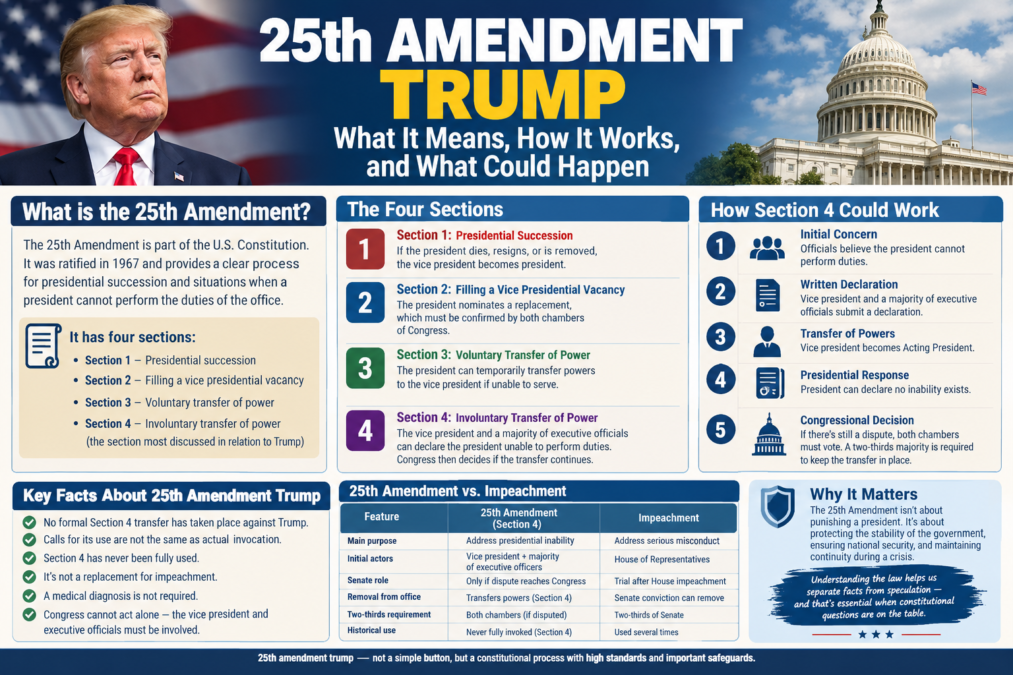

The 25th amendment trump discussion is about one of the most important parts of the United States Constitution: what happens when a president cannot perform the powers and duties of the office. The 25th Amendment does not exist to remove a president simply because people disagree with his policies, decisions, personality, or political views. Instead, it provides a constitutional process for presidential succession and presidential inability.
The subject has received attention whenever questions arise about the health, age, ability, or decision-making capacity of a president. Because Donald Trump is a major political figure and has served as president, discussions about the 25th amendment trump have appeared in political debates and public commentary.
However, it’s important to separate political discussion from the actual constitutional process. The 25th Amendment has specific rules, and Section 4 requires the vice president and senior executive officials to take formal action before Congress could become involved.
The amendment was proposed by Congress in 1965 and ratified by the states on February 10, 1967. It was created to provide a clearer system for presidential succession and inability.
Understanding these rules can help readers look beyond headlines and understand what the Constitution actually says.
What Is the 25th Amendment?
The 25th Amendment is an amendment to the U.S. Constitution dealing with presidential succession, vacancies in the vice presidency, and presidential inability.
Before the amendment was adopted, the Constitution contained language about presidential succession, but it didn’t clearly answer every practical question about what should happen when a president was alive but unable to perform presidential duties.
The National Archives explains that the amendment was created after concerns about presidential succession and disability, particularly following the assassination of President John F. Kennedy in 1963.
The amendment contains four major sections:
- Section 1: Explains what happens when a president dies, resigns, or is removed.
- Section 2: Provides a process for filling a vacancy in the vice presidency.
- Section 3: Allows a president to voluntarily declare an inability to perform presidential duties.
- Section 4: Provides a process for declaring presidential inability when the president cannot or will not make that declaration.
These sections are different from one another. That distinction matters a lot when discussing the 25th amendment trump topic.
Why Was the 25th Amendment Created?
The Constitution originally stated that presidential powers could pass to the vice president in cases involving removal, death, resignation, or inability. However, the original language left important questions unanswered.
For example, what exactly should happen if a president became seriously ill but remained alive?
What if the president was unconscious?
What if a president temporarily could not perform official duties?
What if the president refused to admit that he or she was unable to perform the job?
These were not just theoretical questions. Presidential history had already included periods when presidents were seriously ill or incapacitated.
The 25th Amendment created clearer procedures for these situations. The National Archives notes that the amendment changed the constitutional rules connected with Article II, Section 1.
In simple terms, the amendment was designed to make the government more prepared for an emergency.
25th amendment trump and the Meaning of Presidential Inability
When people search for 25th amendment trump, they may sometimes assume that the amendment is another form of impeachment. It isn’t.
This is one of the most important points to understand.
The 25th Amendment is primarily concerned with presidential inability, not punishment for political behavior.
A president could make controversial decisions without being subject to Section 4. Political disagreement alone doesn’t meet the constitutional standard described in the amendment.
Section 4 says that the vice president and a majority of the principal officers of the executive departments can declare that the president is unable to discharge the powers and duties of the office.
That is a very serious constitutional action.
It isn’t simply a vote of politicians who dislike the president. It involves the vice president and senior executive officials and must follow the procedure established by the Constitution.
What Does Section 1 Say?
Section 1 is probably the easiest part of the amendment to understand.
It states that if the president is removed from office, dies, or resigns, the vice president becomes president.
This distinction is important.
The vice president doesn’t merely become someone who temporarily performs presidential duties in these situations. Under Section 1, the vice president becomes President.
For example, if a president resigns from office, the vice president takes over as president.
This happened in American history when President Richard Nixon resigned in 1974. Vice President Gerald Ford became president.
Section 1 therefore deals with a permanent change in presidential office caused by death, resignation, or removal.
What Does Section 2 Do?
Section 2 deals with the vice presidency.
If the office of vice president becomes vacant, the president nominates someone to become vice president.
That nominee must then be confirmed by a majority vote in both the House of Representatives and the Senate.
The National Archives lists this requirement directly in the text of the 25th Amendment.
This provision is important because the vice president plays a major role in the presidential succession system.
It also means that the vice presidency does not simply remain empty until the next presidential election.
There is a constitutional mechanism for filling the position during a presidential term.
What Does Section 3 Mean?
Section 3 provides a voluntary process.
Under this section, the president can send a written declaration to the president pro tempore of the Senate and the Speaker of the House stating that the president is unable to perform the powers and duties of the office.
When that happens, the vice president becomes Acting President until the president sends another written declaration saying that the inability no longer exists.
Notice the wording: Acting President.
The vice president does not become president under Section 3. Instead, the vice president temporarily performs the president’s powers and duties.
This can be useful when a president expects to be temporarily unable to perform presidential responsibilities.
For example, the process can be used when a president undergoes a medical procedure requiring anesthesia.
President Ronald Reagan’s 1981 assassination attempt provides an important historical example of preparations for using Section 3. The National Archives notes that letters invoking Amendment XXV, Section 3, were prepared during the situation, although they were not ultimately used.
What Is Section 4?
Section 4 is the part most often discussed when people search for 25th amendment trump.
It deals with a situation where the president is unable or unwilling to declare an inability.
Under Section 4, the vice president and a majority of the principal officers of the executive departments can send a written declaration to the president pro tempore of the Senate and the Speaker of the House.
They must declare that the president is unable to discharge the powers and duties of the office.
Once that declaration is made, the vice president immediately assumes the powers and duties of the presidency as Acting President.
But that’s not the end of the process.
The Constitution provides a procedure for the president to challenge the declaration.
How Section 4 Can Lead to a Congressional Vote
Suppose Section 4 is invoked.
The vice president and the required executive officials declare that the president cannot perform presidential duties.
The vice president becomes Acting President.
The president can then send a written declaration stating that no inability exists.
If the vice president and a majority of the required executive officials disagree, they have four days to send another declaration saying that the president remains unable to perform the duties of office.
At that point, Congress must decide the issue.
The Constitution requires Congress to assemble within 48 hours if it is not already in session.
Congress then has a limited period to decide the question. If two-thirds of both the House and Senate determine that the president remains unable to perform the duties of the office, the vice president continues as Acting President.
If that two-thirds threshold is not reached, the president resumes presidential powers and duties.
This high threshold shows how serious Section 4 is.
25th amendment trump: Is It the Same as Impeachment?
No.
The 25th amendment trump debate should not be confused with impeachment.
The two constitutional processes have different purposes.
| 25th Amendment | Impeachment |
|---|---|
| Primarily addresses presidential inability | Addresses serious misconduct and constitutional offenses |
| Section 4 can transfer presidential powers to the vice president | Impeachment can ultimately lead to removal |
| Involves the vice president and executive officials under Section 4 | Begins in the House of Representatives |
| Focuses on ability to perform presidential duties | Focuses on alleged high crimes and misdemeanors |
| Can result in the vice president serving as Acting President | Conviction can remove the president from office |
The Constitution separately provides for impeachment. Article II says that the president and other civil officers can be removed after impeachment and conviction for treason, bribery, or other high crimes and misdemeanors.
So, despite frequent political comparisons, the 25th Amendment and impeachment are not interchangeable.
Does the 25th Amendment Remove a President Permanently?
Generally, no—not in the same way impeachment does.
This is another area where headlines can create confusion.
Under Section 4, the vice president becomes Acting President while the constitutional dispute is being resolved.
The president doesn’t automatically lose the office of president simply because Section 4 has been invoked.
If Congress does not reach the required two-thirds vote in both chambers, the president resumes the powers and duties of the office.
The constitutional text therefore creates a process rather than an automatic permanent removal mechanism.
That’s an important difference.
Has the 25th Amendment Ever Been Used?
Yes.
Parts of the 25th Amendment have been used several times, particularly Sections 2 and 3.
Section 2 has been used to fill vice-presidential vacancies.
For example, after Vice President Spiro Agnew resigned in 1973, President Nixon nominated Gerald Ford. Ford was confirmed by Congress and became vice president.
After Nixon resigned and Ford became president, Nelson Rockefeller was later confirmed as vice president under the same amendment.
Section 3 has also been used by presidents to temporarily transfer power to their vice presidents during medical procedures.
These historical examples show that the amendment isn’t simply a political theory. It has practical applications.
However, Section 4—the most controversial part—has never been successfully used to permanently transfer presidential power through the full congressional process.
Why Does the Trump Discussion Attract So Much Attention?
Donald Trump has been one of the most politically influential and controversial American presidents of the modern era.
Because of this, discussions about his leadership, health, age, public appearances, and political decisions can quickly become national news.
That makes the phrase 25th amendment trump especially common in political commentary.
Still, public discussion isn’t the same thing as constitutional action.
People can debate whether a president should remain in office, but the actual Section 4 procedure requires specific officials to take formal steps.
A social media post, newspaper opinion, political speech, or television discussion does not invoke the 25th Amendment.
Nor does a petition from ordinary citizens automatically activate Section 4.
The Constitution establishes who can begin the Section 4 process.
Who Can Invoke Section 4?
Section 4 specifically identifies the vice president and a majority of the principal officers of the executive departments.
They must make a written declaration that the president is unable to perform the powers and duties of the office.
This requirement is important because it places the decision within the constitutional structure of the executive branch.
Congress can become involved later if the president contests the declaration.
The process therefore includes several levels of constitutional protection:
- A written declaration is required.
- The vice president has a central role.
- A majority of the principal executive officers must participate.
- The president can challenge the declaration.
- Congress can review the dispute.
- A two-thirds vote of both chambers is required for the vice president to continue as Acting President after the congressional dispute.
This structure was designed to prevent a simple political disagreement from becoming an immediate transfer of presidential power.
What Would Happen to Presidential Powers?
If Section 4 were properly invoked, the vice president would assume the powers and duties of the office as Acting President.
This means the vice president could perform presidential responsibilities.
The situation is different from ordinary succession.
The original president would still hold the office unless removed through another constitutional process or until circumstances changed according to the constitutional rules.
The goal is continuity of government.
In an emergency, the United States can’t simply stop functioning while political leaders debate what should happen.
The 25th Amendment provides a legal framework so that presidential responsibilities can continue.
25th amendment trump and the Role of the Vice President
The vice president is central to any Section 4 discussion.
Without the vice president’s participation, Section 4 cannot be invoked in the manner described by the Constitution.
This makes the vice president’s constitutional role much more important than many people realize.
The vice president isn’t only the president of the Senate or a political partner of the president. Under the 25th Amendment, the vice president can become Acting President when the constitutional requirements are met.
This is one reason the amendment was carefully written.
A transfer of presidential authority is one of the most serious actions that can happen within the executive branch.
Why the Two-Thirds Requirement Matters
The two-thirds requirement is a major safeguard.
If a president disputes a Section 4 declaration, Congress must consider the question.
For the vice president to continue exercising presidential powers after the constitutional process reaches Congress, two-thirds of both the House and Senate must determine that the president remains unable to perform the duties of office.
That is a very high standard.
A simple majority isn’t enough.
This design reflects the importance of presidential authority in the American constitutional system.
It also shows why claims about the 25th amendment trump topic should be evaluated carefully rather than treated as automatic predictions of presidential removal.
Common Myths About the 25th Amendment
Several myths frequently appear in public discussions.
Myth: Anyone Can Invoke the 25th Amendment
This isn’t correct.
Ordinary citizens can’t directly activate Section 4. The Constitution gives that responsibility to the vice president and the required executive officers.
Myth: The 25th Amendment Is a Political Recall Vote
It isn’t.
The amendment is focused on presidential succession and inability, not on whether the public likes or dislikes the president.
Myth: Section 4 Automatically Removes the President
It doesn’t.
Section 4 initially makes the vice president Acting President. A constitutional dispute can then involve Congress.
Myth: Impeachment and the 25th Amendment Are the Same
They aren’t.
Impeachment addresses constitutional misconduct, while the 25th Amendment addresses presidential inability and succession.
Myth: A President Can Never Return to Power
That’s also incorrect.
The Constitution provides a process through which a president can declare that no inability exists and, depending on the circumstances and congressional action, resume presidential powers.
The Importance of Constitutional Stability
The 25th amendment trump debate also highlights a larger issue: constitutional stability.
The United States has a complex political system designed to prevent sudden changes in government.
Presidential power is enormous, but it is surrounded by constitutional rules.
The 25th Amendment is one of those safeguards.
It recognizes that presidents are human beings. They can become sick, injured, unconscious, or otherwise unable to perform their duties.
Rather than leaving the country without clear guidance, the amendment provides a process.
That’s not a sign of weakness. In fact, it’s a sign of institutional strength.
A government is more stable when it has clear procedures for difficult moments.
How the 25th Amendment Protects Continuity
Imagine a situation in which a president suddenly becomes unconscious.
The country still needs:
- A commander in chief
- A leader for national emergencies
- A person able to make executive decisions
- A functioning executive branch
- A clear chain of authority
- Stability in international relations
The Constitution cannot wait indefinitely for uncertainty to disappear.
The 25th Amendment creates a legal path for presidential duties to continue.
This is especially important during national emergencies, military crises, natural disasters, or serious medical situations.
The system is designed to protect the government as an institution rather than one individual.
Why Accurate Information Matters
Political subjects can become emotional very quickly.
That’s why readers should distinguish between verified constitutional facts and political speculation.
When discussing 25th amendment trump, a reliable source should be the Constitution itself or authoritative government information.
The National Archives provides the official text of the 25th Amendment, including all four sections.
The original Constitution also explains the broader constitutional framework concerning presidential powers, succession, and inability.
Readers should be cautious with social media claims that say the amendment has been “invoked” simply because someone is discussing it.
There is a big difference between talking about a constitutional provision and formally using it.
25th amendment trump: What Readers Should Watch For
If a major Section 4 controversy ever develops, readers should look for official constitutional actions rather than rumors.
Important signs would include:
- A formal written declaration
- Participation by the vice president
- Participation by the required executive officers
- Official communication to congressional leaders
- A presidential response, if applicable
- Congressional action
- Official statements from the House and Senate
These are much more meaningful than social media trends or political speculation.
In other words, don’t believe every headline at first glance.
Check the constitutional process.
The Broader Lesson From the 25th Amendment
The 25th Amendment teaches an important lesson about democratic government.
Strong institutions need rules for unusual situations.
No president knows exactly what the future will bring. A president can become ill, suffer an injury, or temporarily lose the ability to perform official duties.
The Constitution therefore needs a practical mechanism for continuity.
The amendment also demonstrates that presidential power is not based only on personal authority. It operates within a constitutional system.
That system includes Congress, the courts, the vice president, executive departments, and the states.
The result is a government built around rules rather than individual personalities.
Frequently Asked Questions About 25th amendment trump
What is the 25th Amendment?
The 25th Amendment is a constitutional amendment dealing with presidential succession, vice-presidential vacancies, and presidential inability.
What is Section 4?
Section 4 provides a process for the vice president and a majority of the principal executive officers to declare that the president is unable to perform the powers and duties of the office.
Does the 25th Amendment mean impeachment?
No. The 25th Amendment and impeachment are separate constitutional processes.
Can ordinary citizens invoke Section 4?
No. Section 4 gives the initiating authority to the vice president and the required executive officials.
Does invoking Section 4 permanently remove a president?
No. The process initially transfers presidential powers and duties to the vice president as Acting President. Further constitutional steps determine what happens if the president contests the declaration.
Can a president return to power?
Yes. The amendment includes a process through which the president can declare that no inability exists, subject to the constitutional procedures described in Section 4.
Why was the 25th Amendment created?
It was designed to provide clearer rules for presidential succession and inability. It was proposed in 1965 and ratified in 1967.
Final Thoughts on 25th amendment trump
The 25th amendment trump topic is ultimately about much more than one president. It is about how the United States Constitution handles one of the most difficult situations a government can face: when a president may be unable to perform the duties of the office.
The 25th Amendment establishes a structured process for succession and presidential inability. It distinguishes between a president voluntarily transferring powers, a vice president becoming president after a vacancy, and the more serious Section 4 process involving the vice president, executive officials, and potentially Congress.
For readers trying to understand the 25th amendment trump debate, the most important lesson is simple: constitutional procedures matter more than political rumors. The amendment isn’t an ordinary political tool, and it doesn’t automatically remove a president because of disagreement or controversy.
Instead, it provides a carefully designed system for maintaining continuity when presidential duties cannot be performed. Understanding that system helps citizens follow political news with a clearer mind, separate fact from speculation, and appreciate how constitutional safeguards support the peaceful operation of American government.
In the end, the 25th amendment trump discussion is best understood through the actual Constitution, verified government information, and careful attention to the difference between political commentary and formal constitutional action.
25th amendment trump: A Deeper Look at Presidential Power
The 25th amendment trump discussion becomes easier to understand when we look beyond political headlines and examine how presidential power works during unusual or difficult circumstances. The 25th Amendment is one of the Constitution’s important safety systems. It helps the country continue operating if a president cannot perform the duties of the office.
At first glance, the amendment may seem complicated. However, its basic purpose is fairly simple: the United States must always have a functioning system for presidential leadership.
That principle becomes especially important during periods of political tension. Whether people strongly support or oppose a president, constitutional rules remain the same. The process isn’t supposed to depend on popularity, party membership, or public opinion.
25th amendment trump and Presidential Authority
The president of the United States has broad constitutional responsibilities. These include serving as commander in chief, carrying out federal laws, appointing certain officials, conducting foreign policy, and performing many other executive duties.
Because these responsibilities are so important, the government needs a plan for situations in which the president temporarily or permanently cannot perform them.
This is where the 25th Amendment comes into play.
The amendment doesn’t reduce the importance of the presidency. Instead, it protects the continuity of presidential authority.
For example, imagine that a president becomes temporarily unconscious because of an unexpected medical emergency. The government cannot simply pause while waiting for the president to recover.
Under the constitutional system, there must be a lawful way for presidential responsibilities to continue.
That’s the central idea behind presidential inability.
The Difference Between Inability and Disagreement
One of the biggest misunderstandings surrounding the 25th amendment trump topic is the difference between being unable to perform presidential duties and making decisions that people strongly dislike.
A president can make unpopular decisions.
A president can face protests.
A president can receive criticism from members of Congress.
A president can lose support among voters.
None of these facts automatically means the president is constitutionally unable to perform the duties of office.
The 25th Amendment is concerned with inability, not ordinary political disagreement.
This distinction is crucial because otherwise almost every controversial presidency could create pressure for a constitutional transfer of power.
The amendment wasn’t designed that way.
Why the Vice President Is So Important
The vice president has a central position in the 25th Amendment.
Under Section 1, the vice president becomes president when the presidency becomes vacant because of death, resignation, or removal.
Under Sections 3 and 4, the vice president can instead become Acting President when presidential powers and duties are temporarily transferred.
This difference between “President” and “Acting President” is important.
The vice president doesn’t automatically become president whenever the 25th Amendment is discussed.
The specific constitutional circumstances determine what happens.
In a Section 4 situation, the vice president serves as Acting President rather than automatically replacing the president as the officeholder.
How Section 3 Has Been Used
Section 3 is sometimes overlooked because political discussions usually focus on Section 4.
However, Section 3 has practical importance.
A president can voluntarily notify Congress in writing that the president is unable to perform the duties of the office. The vice president then assumes those powers and duties as Acting President.
Once the president is ready to resume those responsibilities, another written declaration can be sent.
This creates a temporary and orderly transfer.
In modern American history, presidents have used this provision during medical procedures.
For example, President George W. Bush temporarily transferred presidential authority to Vice President Dick Cheney during medical procedures in 2002 and 2007.
These situations demonstrate that a temporary transfer of presidential authority doesn’t necessarily represent a political crisis.
Sometimes, it’s simply a practical constitutional procedure.
What Makes Section 4 Different?
Section 4 is different because the president doesn’t initiate the process.
Instead, the vice president and a majority of the principal officers of the executive departments make the declaration.
This is why the 25th amendment trump conversation often focuses heavily on Section 4.
The process is designed for circumstances in which a president is unable to perform the duties but doesn’t voluntarily declare an inability.
The Constitution therefore provides another path.
However, that path contains several safeguards.
The Four-Day Period
If the president responds to a Section 4 declaration by stating that no inability exists, the vice president and the required executive officials can disagree.
They have four days to send another written declaration.
This is an important part of the constitutional timeline.
It prevents uncertainty from continuing indefinitely without a defined next step.
If the second declaration is made, Congress must consider the matter.
The Constitution therefore creates a clear sequence rather than leaving the dispute open-ended.
The Role of Congress
Congress becomes especially important if the president contests a Section 4 declaration.
If the issue reaches Congress, lawmakers must determine whether the president remains unable to perform the powers and duties of the office.
The Constitution requires a two-thirds vote in both the House of Representatives and the Senate for the vice president to continue exercising presidential powers under these circumstances.
That’s a high standard.
It means that simply having a majority in Congress isn’t enough.
Both chambers must reach the required level of agreement.
This safeguard helps prevent the process from becoming an ordinary political vote.
Why a Two-Thirds Vote Is Significant
A two-thirds requirement makes the process difficult by design.
Imagine a Congress divided closely between political parties.
A simple majority could potentially be achieved through party-line voting. But a two-thirds threshold requires substantially broader support.
This reflects the seriousness of transferring presidential powers against the president’s wishes.
The Constitution isn’t supposed to make this process easy.
The presidency is one of the most powerful offices in the world, so changing who exercises presidential authority requires strong constitutional safeguards.
Could Political Pressure Matter?
Political pressure can influence public debate, but it doesn’t replace constitutional requirements.
Citizens may call for action.
Political commentators may discuss the 25th Amendment.
Members of Congress may express opinions.
News organizations may report on the possibility.
None of these activities, by themselves, invokes Section 4.
Formal constitutional action must follow the process written in the Constitution.
This is particularly important when discussing the 25th amendment trump topic because political language can sometimes make constitutional procedures sound much simpler than they actually are.
The Role of Public Opinion
Public opinion has an important place in American democracy, especially during elections.
However, public opinion doesn’t directly activate the 25th Amendment.
Presidential elections allow voters to choose their preferred candidates.
The 25th Amendment serves a different purpose.
It provides a constitutional mechanism for dealing with presidential inability.
That distinction helps explain why a president can remain in office despite low approval ratings or intense political opposition.
Approval ratings and constitutional inability aren’t the same thing.
25th amendment trump and the Importance of Evidence
Whenever questions about presidential ability arise, evidence matters.
Political debates can become heated, but serious constitutional action requires more than rumors.
People should be careful about claims based only on:
- Edited video clips
- Unverified social media posts
- Anonymous online comments
- Political memes
- Speculation from commentators
- Misleading headlines
- Out-of-context statements
Reliable information should come from official documents, credible reporting, and direct statements from responsible government institutions.
That’s especially important when the subject involves presidential authority.
Historical Events That Shaped Succession Rules
The 25th Amendment didn’t appear out of nowhere.
American history had already demonstrated the difficulties associated with presidential disability and succession.
The assassination of President John F. Kennedy in 1963 created renewed attention to presidential succession.
Before the 25th Amendment was ratified, important questions about presidential inability remained less clearly defined.
The amendment eventually established a more detailed constitutional structure.
History therefore played a major role in shaping the modern system.
What Happens If a President Resigns?
Resignation is different from presidential inability.
If a president resigns, Section 1 of the 25th Amendment applies.
The vice president becomes president.
This happened on August 9, 1974, when Richard Nixon resigned.
Gerald Ford, who had become vice president under the 25th Amendment after Spiro Agnew’s resignation, then became president.
This was the first time an unelected person became president through the 25th Amendment’s succession provisions.
The event demonstrated why clear succession rules matter.
What Happens After a Presidential Death?
If a president dies while in office, the vice president becomes president.
This isn’t a temporary transfer.
The vice president assumes the presidency.
The United States has experienced several presidential deaths in office, including deaths caused by assassination and illness.
The succession system provides a clear answer in such circumstances.
Again, this is different from Section 4.
Why the Amendment Uses Written Declarations
Written declarations provide a formal record.
The Constitution doesn’t say that the vice president and executive officials can simply announce during a television interview that the president is unable to perform the duties.
The formal procedure requires written communication to congressional leaders.
This matters because constitutional transitions need clarity.
There should be a record of:
- Who made the declaration
- What was declared
- When it was made
- What constitutional provision was being used
- What happened afterward
Written documentation helps reduce confusion during a potentially serious national event.
Can Courts Get Involved?
The Constitution assigns specific responsibilities to different branches of government.
A dispute involving presidential inability could raise complicated legal questions, including questions about constitutional authority.
However, the text of the 25th Amendment specifically establishes roles for the president, vice president, executive officials, and Congress.
The amendment doesn’t simply say that a court can replace the process.
Therefore, readers should be cautious when claims suggest that one institution can automatically take over the entire Section 4 procedure.
Constitutional powers are divided carefully.
25th amendment trump and the Peaceful Transfer of Power
The broader purpose of the amendment connects to one of America’s most important democratic principles: peaceful transfer of power.
A constitutional government should have clear procedures for leadership changes.
Those procedures are particularly important during emergencies.
Instead of relying on personal authority or political force, the government relies on established law.
This is one of the strengths of constitutional democracy.
Rules provide stability even when political disagreements are intense.
What Happens When the President Recovers?
The answer depends on which section of the amendment is involved.
Under Section 3, the president can notify Congress that the inability no longer exists.
Under Section 4, the situation can become more complicated if the vice president and executive officials disagree with the president’s declaration.
The Constitution establishes specific procedures for resolving that disagreement.
The key point is that a temporary inability doesn’t necessarily mean the presidency permanently changes hands.
The constitutional system recognizes that some disabilities can be temporary.
Is the 25th Amendment a Medical Law?
No.
The 25th Amendment is constitutional law.
It doesn’t provide a medical diagnosis or establish a particular medical test for presidential fitness.
The amendment uses the constitutional concept of being unable to discharge the powers and duties of the office.
Medical information could obviously become relevant in a real-world situation, but the constitutional decision involves government officials and the constitutional process.
This is another reason why online speculation should be treated carefully.
Why the Topic Is Relevant to Every President
Although the phrase 25th amendment trump is connected to Donald Trump in political discussions, the amendment itself isn’t about Trump alone.
It applies to every U.S. president.
The same constitutional rules apply regardless of whether the president is:
- Republican
- Democratic
- Independent
- Popular
- Unpopular
- Young
- Older
- Politically controversial
- Widely supported
That’s one of the important features of constitutional law.
Rules are supposed to apply beyond individual political personalities.
A Simple Example of Section 4
Let’s make the process easier to understand.
Imagine a president suffers a serious condition and cannot perform presidential duties.
The vice president and a majority of the principal executive officers determine that the president is unable to perform those duties.
They send the required written declaration to congressional leaders.
The vice president becomes Acting President.
Later, the president says that no inability exists.
If the vice president and required executive officials disagree, they can send another declaration.
Congress then considers the issue.
If two-thirds of both chambers determine that the president remains unable to perform the duties, the vice president continues as Acting President.
If the required congressional vote isn’t achieved, the president resumes the powers and duties of the office.
That’s the basic structure.
Why Clear Rules Matter During a Crisis
Imagine a national emergency occurring while there is uncertainty about who has presidential authority.
Such uncertainty could affect national security, government agencies, financial markets, foreign governments, and the public.
A constitutional process reduces that uncertainty.
The 25th Amendment provides a chain of authority.
In difficult times, clarity can be incredibly valuable.
That’s why constitutional procedures aren’t just abstract legal language. They can have real-world consequences.
Common Questions About 25th amendment trump
Can Trump be removed simply through the 25th Amendment?
The 25th Amendment doesn’t provide a simple political removal mechanism. Section 4 concerns presidential inability and establishes a specific procedure involving the vice president and executive officials, with Congress becoming involved if the president contests the declaration.
Is Section 4 the same as impeachment?
No. Impeachment and the 25th Amendment have different constitutional purposes and procedures.
Can Congress alone invoke Section 4?
No. The initial Section 4 declaration comes from the vice president and a majority of the principal officers of the executive departments.
Does a public petition invoke the amendment?
No. Public petitions don’t replace the constitutional procedure.
Can the president challenge a Section 4 declaration?
Yes. The president can send a written declaration stating that no inability exists.
Does the vice president become president under Section 4?
No. Under Section 4, the vice president becomes Acting President.
Why does the amendment matter?
It provides a constitutional framework for maintaining presidential authority when the president cannot perform the powers and duties of the office.
Final Perspective on 25th amendment trump
The 25th amendment trump discussion should always begin with the Constitution rather than political speculation. The amendment establishes specific rules for succession, temporary transfer of presidential powers, and presidential inability.
Its importance extends far beyond one administration. The amendment exists because the presidency must continue functioning even during unexpected circumstances.
For readers, the best approach is to understand the difference between Sections 1, 2, 3, and 4. Section 1 deals with succession when a president dies, resigns, or is removed. Section 2 deals with vacancies in the vice presidency. Section 3 allows a president to voluntarily transfer powers temporarily. Section 4 creates a process for situations in which the president is unable or unwilling to declare an inability.
The 25th amendment trump topic may continue to appear in political conversations, but understanding the actual constitutional language provides a much clearer picture. Rather than relying on rumors or dramatic headlines, readers can look at the formal process and ask what the Constitution really requires.
Ultimately, the 25th Amendment represents preparation, continuity, and constitutional stability. Its purpose is not to settle ordinary political arguments but to make sure that the United States has a lawful way to handle extraordinary circumstances. That principle remains important no matter who occupies the White House, and it makes the 25th amendment trump discussion an important subject for anyone interested in American government and constitutional law.
Explore more insightful articles on All Vantage News and never miss an update.Contact Us.