
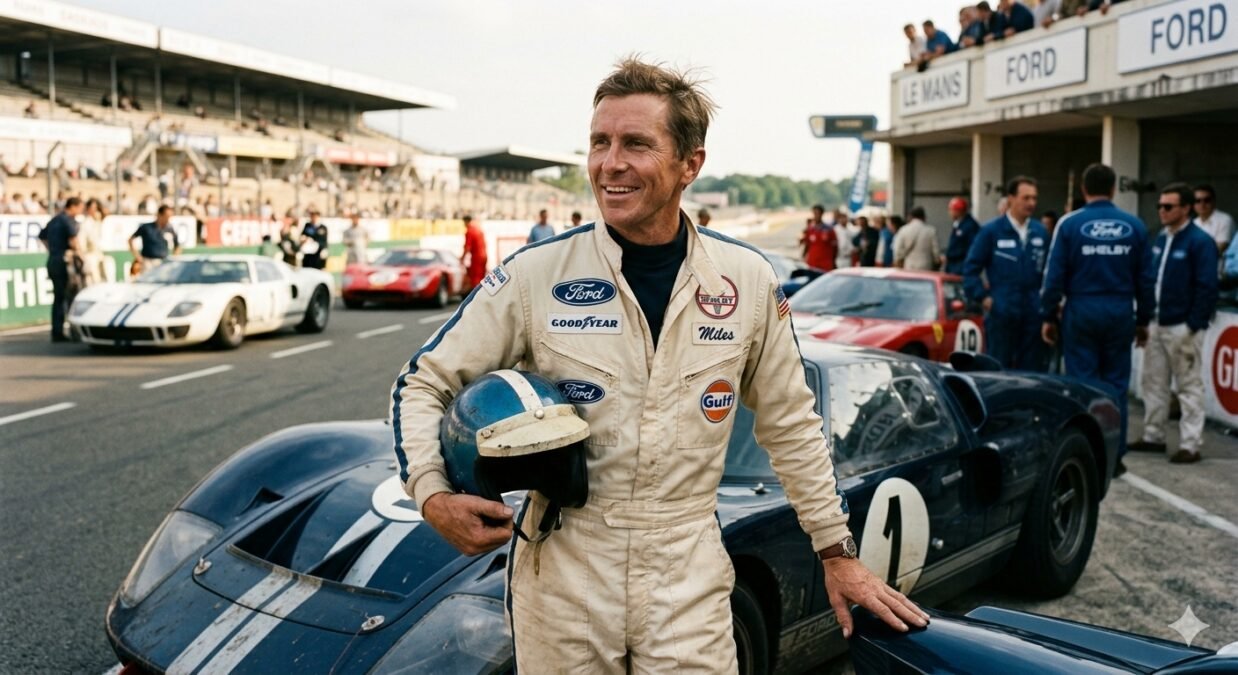

ken miles was a British-born racing driver, engineer, and test driver whose name became closely connected with one of the most important chapters in American motorsport history. Known for his technical knowledge, fearless driving style, and close working relationship with Carroll Shelby, Miles played a major role in developing Ford’s GT40 into a serious endurance-racing machine.
His story is much bigger than one famous race. It includes military service, club racing, engineering, sports cars, testing, friendship, competition, triumph, disappointment, and a tragic death while testing a prototype.
Although Miles never received the official 1966 Le Mans victory that many expected him to achieve, his contribution to Ford’s racing program was enormous. Ford’s own historical records describe how Miles spent countless hours developing and testing the GT40, including the Mark II that eventually dominated endurance racing.
For racing fans, ken miles remains an example of how a driver can contribute far beyond simply sitting behind the wheel.
Who Was ken miles?
ken miles was a British racing driver who later became an important figure in American motorsport. He was particularly respected for his ability to understand racing cars from an engineering perspective.
That combination was unusual and extremely valuable.
Miles didn’t simply drive a car and report whether it felt fast. He studied how the machine behaved. He could identify problems, suggest changes, and then test those changes at racing speeds.
His work with Ford and Shelby American became especially important during the development of the GT40.
The Ford GT40 program was created to challenge Ferrari at the 24 Hours of Le Mans. Ford had experienced disappointing results in its early attempts, but the program eventually became one of the most successful endurance-racing projects of the 1960s.
Miles became one of the people at the center of that transformation.
ken miles Early Life and Interest in Cars
Miles was born in England and developed an interest in automobiles and mechanical engineering at an early age.
His early life was shaped by the difficult period surrounding World War II. Ford’s recent historical material describes Miles as having served as a tank commander in Normandy before eventually moving into the California racing scene.
After the war, he became increasingly involved in motorsport.
Racing in that period was very different from modern professional racing. Cars were less protected, safety technology was limited, and drivers often had to understand mechanical systems in considerable detail.
For someone like Miles, that environment was an opportunity.
He wasn’t merely interested in winning races. He was fascinated by how cars could be made faster, more reliable, and more responsive.
That technical curiosity would later become one of his greatest strengths.
From Club Racing to Professional Motorsport
Before becoming famous for Ford’s GT40 program, Miles competed in smaller racing events and developed a reputation as a skilled driver.
He eventually moved to California, where the growing sports-car and hot-rod culture provided a perfect environment for his talents.
California motorsport was becoming increasingly important during the 1950s and 1960s. Enthusiasts were building, modifying, and racing cars in ways that helped create America’s emerging performance-car culture.
Miles became part of this world.
He earned respect not only because he was quick but also because he understood vehicle setup.
A racing driver needs to know how a car responds to:
- Suspension changes
- Tire selection
- Braking
- Aerodynamics
- Engine performance
- Weight distribution
- Gear ratios
- Track conditions
- Fuel loads
Miles developed a reputation for understanding these details exceptionally well.
And that skill would become crucial when Ford began its massive effort to defeat Ferrari at Le Mans.
ken miles and Carroll Shelby
One of the most important professional relationships in Miles’s life was with Carroll Shelby.
Shelby was already a famous racing personality. He had won the 1959 24 Hours of Le Mans with Aston Martin before a heart condition forced him to step away from full-time driving.
He later became a major force in American performance-car development.
Miles and Shelby worked together through Shelby American, and their partnership became central to Ford’s GT40 effort.
The relationship worked because their skills were complementary.
Shelby understood racing, business, competition, and team management. Miles brought detailed knowledge of vehicle behavior and development.
Together, they helped transform Ford’s ambitious racing project.
Ford’s historical account identifies Miles as Shelby’s developmental driver and describes his extensive work testing and modifying the GT40.
The Ford GT40 Challenge
The Ford GT40 program began because Ford wanted to compete at the highest level of international endurance racing.
Ferrari had established an extraordinary reputation at Le Mans. Ford wanted to challenge that dominance.
The first GT40 attempts were not successful.
The cars could be extremely fast, but speed wasn’t enough.
Le Mans demanded a machine that could remain competitive for 24 hours.
That meant the car needed:
- High speed
- Strong brakes
- Reliable engine performance
- Durable transmission components
- Stable handling
- Effective aerodynamics
- Good fuel efficiency
- Consistent tire performance
- Drivers capable of maintaining concentration for hours
Early Ford efforts suffered from mechanical problems.
Miles became heavily involved in solving those problems.
He tested components, provided feedback, and helped engineers understand what the car needed.
The development process was intense.
It wasn’t simply a case of building a fast car and entering it in a race. The team had to repeatedly test, change, break, repair, and test again.
That’s where ken miles became so valuable.
ken miles as a Development Driver
A development driver has a different job from a driver who simply competes in races.
A development driver needs to communicate.
After a test session, engineers need useful information. Saying “the car feels bad” isn’t enough.
A skilled development driver can explain:
- When the problem appears
- What part of the track exposes it
- Whether the problem happens under braking
- Whether it happens during acceleration
- Whether it changes with fuel load
- Whether the car becomes unstable at high speed
- Whether the tires are contributing to the problem
Miles had the ability to provide this kind of feedback.
Ford’s historical records describe him testing aerodynamic changes and other modifications to the GT40. In one development session, Miles reached 210 mph while testing the 427-powered GT40X.
That’s a remarkable illustration of his role.
He wasn’t simply driving a finished machine.
He was helping create the machine.
The GT40 Mark II
The GT40 Mark II became one of the most famous endurance-racing cars ever built.
Ford made significant changes to the vehicle for the 1966 racing season. The development program included improvements to the body, suspension, fuel system, and brakes. Ford also worked on the engine and other mechanical components.
Miles played an important role in this development.
The Mark II used a large Ford V8 engine and was designed to provide the power needed to compete with Ferrari.
But horsepower alone couldn’t guarantee success.
The car had to survive.
At Le Mans, a machine could travel at extremely high speeds for an entire day and night. Any major mechanical failure could end a team’s race.
Miles understood this very well.
His experience as a test driver allowed him to push the car hard while identifying weaknesses.
ken miles at Daytona
The 1966 season began with the 24 Hours of Daytona.
Miles shared a Ford GT40 Mark II with Lloyd Ruby.
The pair delivered an important victory for Ford.
Ford’s historical documentation states that the Miles-Ruby car won the 24-hour Daytona race with a substantial advantage, helping demonstrate that the improved GT40 could finally combine speed with endurance reliability.
This wasn’t just another trophy.
It was evidence that the years of development were beginning to pay off.
The GT40 was becoming a serious endurance machine.
For Miles, the victory was also a personal achievement because he had spent so much time testing and improving the car.
The hours in the workshop and on test tracks were translating into results on the international racing stage.
ken miles and Sebring
After Daytona came the 12 Hours of Sebring.
Miles shared the Ford Mark II with Dan Gurney.
The race demonstrated both the strengths and challenges of endurance racing.
Ferrari remained a serious competitor, but the Ford Mark II showed impressive pace and reliability.
According to Ford’s historical account, Miles and Gurney were able to maintain strong performance while Ferrari experienced transmission trouble. Eventually, Miles and Gurney were ordered to slow down to protect the car.
The situation also revealed something about Miles’s personality.
He was intensely competitive.
He wanted to drive quickly.
He wanted to test the limits.
That’s exactly what made him valuable as a development driver, but it could also create tension within a team where reliability and strategy were just as important as raw speed.
Even so, Miles went on to win Sebring after Gurney’s car suffered an engine problem near the end.
That gave him two major endurance victories in 1966 before Le Mans.
The Historic 1966 24 Hours of Le Mans
The biggest chapter of ken miles‘s racing story came at Le Mans in June 1966.
Ford arrived in France with a much stronger GT40 program.
The team entered several Mark II cars, and Ferrari remained the major rival.
The race began on June 18, 1966, and continued for 24 hours.
Ford’s cars were fast.
The early stages were competitive, but as the race continued, Ferrari’s cars began suffering mechanical problems.
By the later stages, Ford held the leading positions.
Miles shared his GT40 with Denny Hulme.
The pair were among the leading Ford crews.
Ford’s official historical account records that Miles and Hulme were running near the front while Bruce McLaren and Chris Amon were also fighting for the overall victory.
The outcome would become one of the most debated moments in Le Mans history.
The Famous Finish
Near the end of the 1966 race, Ford held the first three positions.
Team officials wanted to create a dramatic formation finish.
The idea was for the leading Ford cars to cross the finish line together.
Initially, the plan appeared to have been acceptable to the race organizers.
Miles and McLaren were informed of the plan.
The cars slowed.
The finish was carefully arranged.
But there was a problem.
The cars had not started from exactly the same position.
McLaren and Amon’s car had started farther back on the grid than Miles and Hulme’s car.
As a result, the race organizers determined that McLaren and Amon had traveled a greater distance during the race.
They were therefore officially classified as the winners.
Ford’s own historical account explains that this interpretation became the basis for McLaren and Amon being declared the winners, while Miles and Hulme were classified second.
For Miles, it was a heartbreaking result.
He had already won Daytona.
He had already won Sebring.
A Le Mans victory would have completed an extraordinary endurance-racing achievement in the same season.
Instead, he finished second.
Why the 1966 Result Matters
The 1966 Le Mans finish continues to attract attention because it combines racing strategy, team orders, sporting regulations, and human emotion.
It wasn’t simply about who crossed the line first.
The final result involved the distance each car had covered and the interpretation of the race’s rules.
Ford’s historical account acknowledges that the decision remains a debated part of the event.
It is important to separate the dramatic story from the official result.
The official classification was:
| Position | Drivers | Team |
|---|---|---|
| First | Bruce McLaren / Chris Amon | Shelby American |
| Second | ken miles / Denny Hulme | Shelby American |
| Third | Ronnie Bucknum / Dick Hutcherson | Holman & Moody |
Ford achieved a historic 1-2-3 finish.
The victory was also Ford’s first overall win at Le Mans.
So while Miles didn’t receive the official win, his contribution to the victory was enormous.
ken miles and the GT40’s Development
It’s easy to focus only on the 1966 finish.
But doing so overlooks Miles’s deeper contribution.
He had spent years helping develop the car.
Ford’s historical material describes how Miles worked on suspension settings, aerodynamic testing, and other technical improvements.
He understood the GT40 at a level few people did.
The car wasn’t simply something he drove.
It was something he helped shape.
That distinction is important.
A racing driver can win because the car is excellent.
A development driver helps make the car excellent in the first place.
In Miles’s case, those roles overlapped.
ken miles and Engineering Knowledge
One reason Miles became so respected was his technical understanding.
He could communicate with engineers because he understood what they were trying to accomplish.
He could also communicate from the driver’s perspective because he experienced the car at extreme speeds.
This made him a bridge between two worlds.
Engineering perspective:
“What is happening mechanically?”
Driver perspective:
“What does the car feel like at speed?”
Racing perspective:
“How does this affect lap time and endurance?”
A great development driver brings all three together.
Miles did exactly that.
The Tragic Death of ken miles
The story of ken miles ended tragically in 1966.
After the Le Mans race, he continued working with Ford on vehicle development.
He was testing a prototype known as the J-car at Riverside International Raceway in California.
During testing on August 17, 1966, Miles was killed when the prototype crashed.
His death came only weeks after the Le Mans race.
It was a devastating loss for Ford, Shelby American, and the racing community.
The tragedy also highlighted the dangers faced by racing drivers and test drivers during the 1960s.
Safety standards were far less advanced than those found in modern motorsport.
Cars could reach extraordinary speeds while offering drivers much less protection.
The Legacy of ken miles
Although Miles’s life was tragically short, his influence lasted.
The Ford GT40 went on to win Le Mans again in 1967, 1968, and 1969. Ford’s historical records list McLaren and Amon as the 1966 winners, Gurney and A.J. Foyt as the 1967 winners, Rodriguez and Bianchi as the 1968 winners, and Ickx and Oliver as the 1969 winners.
The GT40 became one of the most recognizable racing cars in history.
Miles’s role in its development became an important part of that story.
His reputation also grew beyond the immediate racing community.
He became known as a driver who combined courage, intelligence, technical knowledge, and determination.
ken miles in Popular Culture
The story of Ford versus Ferrari eventually reached a much wider audience through books, documentaries, interviews, and popular entertainment.
The 2019 movie Ford v Ferrari introduced the story to millions of viewers.
In the film, Ken Miles is portrayed as a highly skilled and outspoken driver working closely with Carroll Shelby.
However, movies are designed for storytelling.
They may combine events, simplify complicated situations, or dramatize relationships.
Therefore, anyone researching ken miles should distinguish between cinematic storytelling and documented historical records.
Ford’s own historical material provides useful evidence about the real development program and the 1966 Le Mans result.
What Made ken miles Special?
Several qualities helped define Miles’s career.
Technical Understanding
He understood how racing cars behaved and how engineering changes could affect performance.
Driving Skill
He was capable of pushing powerful cars to their limits.
Testing Ability
He could provide useful feedback during vehicle development.
Competitive Spirit
He wanted to win and wasn’t afraid to challenge himself.
Adaptability
He worked across different cars, tracks, and racing conditions.
Courage
Motorsport during his era involved serious physical danger.
Passion
Most importantly, Miles genuinely loved racing and engineering.
These qualities made him more than a conventional racing driver.
He became part of the development process itself.
Important Achievements of ken miles
| Achievement | Year | Significance |
|---|---|---|
| Daytona 24 Hours victory | 1966 | Won with Lloyd Ruby in a Ford GT40 Mark II |
| Sebring 12 Hours victory | 1966 | Won with Ford after a dramatic endurance race |
| Le Mans overall result | 1966 | Finished second with Denny Hulme |
| GT40 development work | 1960s | Helped test and improve Ford’s endurance racer |
| GT40 Mark II development | 1965–1966 | Important contribution to the car that dominated endurance racing |
Ford records confirm Miles’s Daytona victory and his second-place Le Mans result, while also documenting his extensive development work on the GT40.
Lessons From ken miles’ Career
The life of ken miles offers lessons that go beyond motorsport.
Great Results Require Preparation
The GT40 didn’t become successful overnight.
It required years of testing and improvement.
Technical Knowledge Matters
A driver who understands the machine can contribute far more than someone who simply follows instructions.
Teamwork Is Essential
Even the fastest driver needs engineers, mechanics, managers, and teammates.
Competition Can Push Innovation
Ford’s battle with Ferrari encouraged the development of faster and more reliable racing technology.
Success Isn’t Always Simple
Miles’s Le Mans experience shows that a driver can perform at an exceptional level and still not receive the final result expected.
Legacy Is Bigger Than a Trophy
Miles didn’t win Le Mans officially, but his contribution to Ford’s historic victory remains widely remembered.
Frequently Asked Questions About ken miles
Who was ken miles?
ken miles was a British-born racing driver, test driver, and development specialist who became closely associated with Ford’s GT40 racing program.
Did ken miles win Le Mans?
No. Miles and Denny Hulme officially finished second at the 1966 24 Hours of Le Mans. Bruce McLaren and Chris Amon were classified first.
What races did ken miles win in 1966?
Miles won the 24 Hours of Daytona with Lloyd Ruby and the 12 Hours of Sebring.
Who was ken miles’ teammate at Le Mans?
Miles shared the Ford GT40 with Denny Hulme during the 1966 Le Mans race.
Was ken miles involved in developing the GT40?
Yes. He was deeply involved in testing and development work, including suspension, aerodynamics, and other performance-related improvements.
How did ken miles die?
Miles died in a crash while testing a Ford prototype at Riverside International Raceway in California in August 1966.
Why is ken miles famous today?
He is remembered for his role in developing and racing the Ford GT40, his victories at Daytona and Sebring, his controversial second-place finish at Le Mans, and his close professional relationship with Carroll Shelby.
The Lasting Legacy of ken miles
The story of ken miles is ultimately about much more than a racing result.
He was a driver, but he was also a tester, engineer-minded problem solver, and important member of Ford’s endurance-racing program. His work helped turn the GT40 from a promising but unreliable machine into a car capable of defeating Ferrari on the world’s biggest endurance-racing stage.
His 1966 season was extraordinary. He won Daytona and Sebring, then finished second at Le Mans after Ford achieved its historic 1-2-3 result.
Sadly, his death only weeks later ended his career far too soon.
Still, his contribution didn’t disappear.
Every time the Ford GT40 is remembered, the name of ken miles is part of that history. His combination of driving ability, engineering knowledge, determination, and passion helped shape one of motorsport’s most famous racing programs.
In the end, ken miles remains remembered not simply because of what happened at the finish line, but because of the countless miles, tests, improvements, and sacrifices that helped make Ford’s historic GT40 success possible.
:::
ken miles and the Golden Age of Sports Car Racing
The story of ken miles belongs to an exciting period in motorsport history. During the 1950s and 1960s, sports car racing was growing rapidly in both Europe and the United States. Cars were becoming faster, manufacturers were becoming more competitive, and endurance races were attracting worldwide attention.
It was an era when a talented driver could also be a mechanic, tester, engineer, and problem solver.
That environment suited Miles perfectly.
He understood cars in a practical way. He wasn’t interested only in looking at specifications on paper. He wanted to drive a machine, feel its behavior, find its weaknesses, and then make it better.
This combination of driving and engineering knowledge eventually made him an important part of Ford’s international racing ambitions.
ken miles and His Technical Mind
One of the most important things that separated ken miles from many other drivers was his technical understanding.
A racing driver spends a great deal of time behind the wheel, but a development driver needs to understand what happens underneath the bodywork.
Miles paid attention to details such as:
- Suspension behavior
- Braking performance
- Steering response
- Tire grip
- Engine power
- Aerodynamics
- Weight distribution
- Gear changes
- High-speed stability
- Driver comfort
These factors can make the difference between a car that is merely fast and one that can survive a 24-hour race.
During development work, Miles could communicate his observations to engineers and mechanics. That feedback helped teams understand what needed to be changed.
In other words, he was part driver and part engineer.
The Importance of Test Driving
Test driving a racing car isn’t the same as taking an ordinary road car for a spin.
A test driver may deliberately push a vehicle toward its limits.
The goal is often to discover what happens when the car is subjected to extreme conditions.
For example, engineers might want to know:
How does the car behave under hard braking?
Does it remain stable at very high speed?
How does the suspension react to a rough section of track?
Does the car become difficult to control as the tires wear?
Can the engine and transmission survive a long endurance event?
These questions were especially important for Ford’s GT40 program.
Miles’s willingness to test aggressively made him valuable to the development process.
ken miles and the Shelby American Team
The relationship between ken miles and Carroll Shelby became one of the best-known partnerships in American motorsport.
Shelby brought together talented engineers, mechanics, drivers, and managers to create competitive racing cars.
Miles fit naturally into this environment.
He was experienced, technically knowledgeable, and highly competitive.
The team needed someone who could drive a prototype hard and then explain exactly what was happening.
Miles could do that.
Shelby and Miles also had different personalities and responsibilities. Shelby became known as a larger-than-life figure in the automotive world, while Miles was often associated more directly with driving and technical development.
Together, however, their skills complemented each other.
ken miles and Ford’s Battle With Ferrari
Ford’s desire to beat Ferrari at Le Mans was a major factor behind the GT40 program.
Ferrari had dominated the event during the early 1960s. Ford wanted to establish itself as a serious international performance brand.
The competition wasn’t simply about pride.
Motorsport could demonstrate engineering capability and generate publicity for automobile manufacturers.
Ford needed a car that could prove itself against the best European sports cars.
The first GT40 efforts faced serious reliability problems.
The team had speed, but speed alone wasn’t enough.
At Le Mans, cars needed to operate for an entire day and night.
That’s where development work became critical.
Miles and other members of the team worked to improve the car’s reliability, handling, braking, and overall performance.
The GT40 Becomes a Winning Machine
After early difficulties, Ford’s racing program became increasingly successful.
The GT40 Mark II featured major mechanical improvements and used a powerful Ford V8 engine.
Miles was deeply involved in testing and development.
The results became visible during the 1966 endurance-racing season.
Ford won the 24 Hours of Daytona and the 12 Hours of Sebring, with Miles playing a central role in those victories.
The achievements demonstrated that the GT40 had become much more than an experimental racing car.
It was now a serious competitor.
And, boy, the pressure was enormous.
The ultimate target remained Le Mans.
ken miles at Daytona
The 1966 Daytona victory was one of the highlights of ken miles‘s career.
Miles shared the Ford GT40 Mark II with Lloyd Ruby.
The pair completed the 24-hour race successfully and gave Ford an important victory.
This race was significant for several reasons.
First, endurance racing tests reliability.
A car can be extremely fast for a few laps and still fail badly over 24 hours.
Second, Daytona provided confidence.
The team could see that its development work was producing results.
Third, the victory increased expectations for the upcoming Le Mans event.
Miles was no longer simply a skilled test driver.
He was becoming one of the most important drivers in Ford’s international racing effort.
ken miles at Sebring
The 12 Hours of Sebring followed Daytona.
Miles shared the Ford GT40 Mark II with Dan Gurney.
The race was another important test of Ford’s machine.
Endurance races can be unpredictable. Weather, traffic, mechanical problems, tire wear, and driver mistakes can all change the outcome.
Ford’s cars remained competitive.
Miles and Gurney eventually secured the victory after a demanding race.
Winning both Daytona and Sebring made Miles a major figure going into Le Mans.
He had an opportunity to achieve something extremely rare: winning the three major American and European endurance races in the same season.
The Dream of Winning Le Mans
For any endurance driver, the 24 Hours of Le Mans represents an extraordinary challenge.
The circuit is long and includes high-speed sections, tight corners, and demanding braking zones.
The race also runs through day and night.
Drivers have to deal with darkness, fatigue, traffic, changing weather, and constantly changing track conditions.
The machine faces enormous stress as well.
Engines run for hours.
Brakes are repeatedly used at high speeds.
Tires experience heavy loads.
Gearboxes must survive thousands of gear changes.
For ken miles, winning Le Mans would have been the perfect continuation of his 1966 season.
He had already proven himself at Daytona and Sebring.
Now the biggest race remained.
The 1966 Le Mans Race
Ford entered the 1966 Le Mans race with a much stronger program than it had possessed during its earlier attempts.
Several GT40 Mark IIs were entered.
Miles shared one of the cars with Denny Hulme.
The race developed into a major Ford-Ferrari contest.
As the hours passed, Ferrari’s challenge weakened because of mechanical failures.
Ford’s cars moved toward the front.
Eventually, Ford had three cars in the leading positions.
This created a remarkable opportunity for the manufacturer.
Ford could potentially achieve a historic 1-2-3 finish.
The team decided to arrange a formation finish.
That decision created one of the most famous endings in endurance-racing history.
ken miles and the Le Mans Finish
Miles and Hulme were running at the front.
Bruce McLaren and Chris Amon were also in contention.
The Ford team wanted the cars to finish together.
The drivers slowed their pace and approached the finish line in formation.
However, the cars had not started the race from exactly the same position.
McLaren and Amon’s car had started farther back.
Race officials therefore determined that the McLaren-Amon car had covered more distance.
As a result, McLaren and Amon were officially classified first, while Miles and Hulme were classified second.
This remains one of the most discussed moments in the history of Le Mans.
It is important to understand that the official result is different from the dramatic impression created by the formation finish.
Ford still achieved a historic 1-2-3 victory.
But Miles did not receive the official first-place result.
Why the Le Mans Finish Is Still Remembered
The 1966 result continues to attract attention because it involves several complicated factors.
There was:
- Team strategy
- Racing regulations
- Starting positions
- Distance covered
- Driver expectations
- Manufacturer goals
- Personal disappointment
For Miles, the situation was particularly painful because he had already won two major endurance races that year.
A Le Mans victory would have completed an extraordinary triple.
Instead, he officially finished second.
Still, his performance remained a major part of Ford’s achievement.
The GT40 had finally defeated Ferrari.
That accomplishment changed Ford’s position in international endurance racing.
ken miles After Le Mans
The Le Mans race wasn’t the end of Miles’s work.
He returned to testing and development.
Ford was continuing to work on new racing prototypes.
One of these was the J-car.
The J-car represented another stage in Ford’s efforts to improve its endurance-racing technology.
Miles was once again involved as a test driver.
This was a dangerous period in motorsport.
Cars were becoming faster, but safety technology had not developed at the same pace.
Testing could be extremely demanding.
The Final Test of ken miles
On August 17, 1966, ken miles was testing the Ford J-car at Riverside International Raceway in California.
During the test, the car crashed.
Miles was killed in the accident.
His death shocked the racing community.
It came only a few months after his extraordinary Daytona-Sebring-Le Mans campaign.
He was just 47 years old.
The timing made the tragedy even more painful.
A driver who had spent years helping Ford develop its racing cars was suddenly gone.
The J-Car and Future Ford Racing Cars
The J-car project didn’t end with Miles’s death.
Ford continued developing the vehicle and eventually created the Mk IV.
The Mk IV would become the Ford model used for the company’s 1967 Le Mans victory.
This is another important part of Miles’s legacy.
His development work formed part of a larger engineering process that continued after his death.
Ford’s later Le Mans successes showed how quickly the company had transformed its endurance program.
The GT40 won Le Mans four years in a row, from 1966 through 1969.
ken miles and His Relationship With Racing Technology
The career of ken miles demonstrates how closely drivers and engineers worked together during the development of racing technology.
Today, motorsport teams use sophisticated simulation systems, telemetry, computer modeling, wind tunnels, and enormous amounts of data.
In Miles’s era, drivers relied much more heavily on direct physical feedback.
They had to feel the car.
They had to listen to the engine.
They had to understand vibrations.
They had to recognize changes in steering and braking.
A driver with excellent mechanical awareness could provide extremely valuable information.
Miles was especially suited to this role.
How Drivers Help Engineers
A professional racing driver can provide information that machines alone may not fully capture.
For example, a driver may notice that:
- The rear of the car feels unstable.
- The steering becomes heavier during a corner.
- The brakes lose consistency.
- The tires begin to slide after several laps.
- The car changes behavior as fuel is consumed.
- A vibration appears only at certain speeds.
Engineers can then investigate the possible causes.
This relationship between driver and engineer remains important in motorsport today.
The tools may have changed, but the basic principle hasn’t.
The driver experiences the machine directly.
The engineering team turns that experience into technical changes.
ken miles’ Driving Style
Miles became known for his aggressive but highly controlled approach to racing.
He was prepared to push cars hard.
However, endurance racing requires more than aggression.
A driver must understand when to attack and when to protect the machine.
This is especially important during a 24-hour race.
A driver who pushes beyond the car’s limits may gain a few seconds but risk losing the entire race.
Miles’s experience as a development driver helped him understand this balance.
His victories at Daytona and Sebring demonstrated his ability to combine speed with endurance.
The Human Side of ken miles
Behind the racing legend was a person with ambitions, frustrations, friendships, and family responsibilities.
Motorsport history often focuses on lap times and trophies.
But drivers are human beings.
They experience pressure.
They worry about mechanical failures.
They deal with disappointment.
They become attached to teammates and colleagues.
They take enormous risks because of their passion for competition.
The story of ken miles is therefore not simply a story about a famous car.
It is also a story about a man who devoted much of his life to understanding and driving machines.
ken miles and Carroll Shelby’s Friendship
The relationship between Miles and Shelby became an important part of the Shelby American story.
Their partnership wasn’t based simply on friendship.
It was also built around professional trust.
Shelby needed a driver who could test his cars honestly.
Miles needed a team that would allow him to use his technical knowledge.
Their relationship worked because both men understood that winning required more than individual talent.
It required cooperation.
Engineers, mechanics, drivers, and managers all had to work together.
Why ken miles Remains Famous
More than half a century after his death, ken miles remains well known among racing enthusiasts.
Several factors explain his lasting reputation.
His GT40 Work
He helped develop one of the most famous racing cars ever built.
His 1966 Victories
He won Daytona and Sebring.
The Le Mans Story
His second-place classification at Le Mans became one of motorsport’s most famous disputed and discussed finishes.
His Technical Ability
He was respected for understanding racing cars at an engineering level.
His Relationship With Shelby
Their professional partnership became a major part of Ford’s racing history.
His Tragic Death
His death during testing added a tragic final chapter to his story.
ken miles in Ford v Ferrari
The 2019 film Ford v Ferrari brought renewed attention to ken miles.
The movie focuses on Ford’s effort to defeat Ferrari at Le Mans and highlights the relationship between Miles and Carroll Shelby.
Christian Bale portrayed Miles, while Matt Damon portrayed Shelby.
The film was praised for bringing the excitement of the period to a modern audience.
However, viewers should remember that a feature film is entertainment rather than a complete historical record.
Some events, conversations, relationships, and timelines were dramatized for storytelling.
Historical sources remain important when researching the real ken miles.
What Young Drivers Can Learn From ken miles
The career of ken miles provides useful lessons for people interested in motorsport.
Learn the Machine
Driving skill becomes even more powerful when combined with mechanical knowledge.
Listen to Experts
A racing team is made up of many specialists. Learning from engineers and mechanics can make a driver better.
Practice Continuously
High-level performance requires repeated testing and improvement.
Accept Challenges
Miles worked on difficult projects and didn’t avoid demanding assignments.
Stay Curious
Curiosity can lead to better understanding and innovation.
Respect Safety
Perhaps the most important modern lesson is that motorsport safety matters enormously. Today’s safety standards exist partly because previous generations experienced serious accidents and losses.
Frequently Asked Questions About ken miles
What was ken miles famous for?
He was famous for his work as a racing driver and development driver, especially his contribution to Ford’s GT40 program.
Did ken miles win Daytona?
Yes. Miles and Lloyd Ruby won the 1966 24 Hours of Daytona in a Ford GT40 Mark II.
Did ken miles win Sebring?
Yes. He won the 1966 12 Hours of Sebring with Ford.
Did ken miles officially win Le Mans?
No. Miles and Denny Hulme were officially classified second at the 1966 24 Hours of Le Mans. Bruce McLaren and Chris Amon were classified first.
How old was ken miles when he died?
Miles was 47 years old when he died in a testing crash in August 1966.
What car was ken miles testing when he died?
He was testing the Ford J-car prototype at Riverside International Raceway.
Who played ken miles in Ford v Ferrari?
Christian Bale portrayed Miles in the 2019 film.
The Enduring Legacy of ken miles
The legacy of ken miles isn’t limited to a trophy cabinet.
His importance comes from the combination of skills he brought to motorsport. He was a racing driver, but he was also deeply involved in testing and vehicle development. He understood that a successful racing car must work as a complete system.
The Ford GT40 became a symbol of American determination in international endurance racing. Its four consecutive Le Mans victories from 1966 through 1969 helped secure its place in automotive history.
Miles was an important part of the foundation behind that success.
His 1966 season remains especially remarkable. Daytona and Sebring victories demonstrated his ability to win major endurance events, while his second-place Le Mans finish became a lasting part of racing history.
Although his career ended tragically, his work continued to influence Ford’s racing program.
For anyone studying motorsport history, ken miles offers a fascinating example of how driving talent, technical knowledge, teamwork, and determination can come together. His story reminds us that behind every legendary racing machine are people who spend countless hours testing, improving, repairing, and pushing technology forward.
Ultimately, ken miles remains remembered as one of the key figures behind the Ford GT40’s rise to international success. His name lives on not only because of what happened at Le Mans, but because of the enormous effort he put into making the car competitive in the first place.Correct Ken Miles capitalization consistentlyAdd a clear Part 2 introduction
Explore more insightful articles on All Vantage News and never miss an update.Contact Us.