
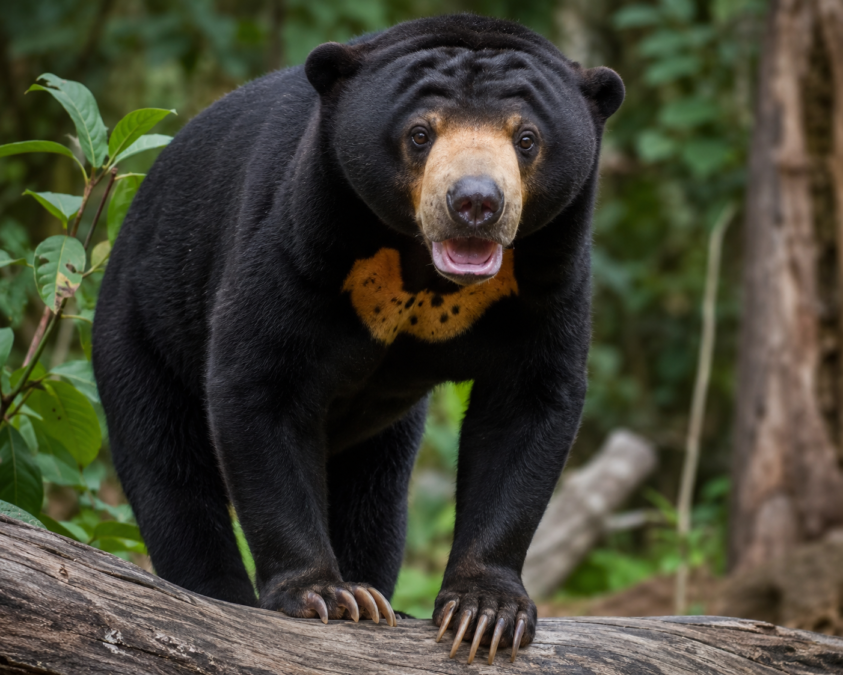

Introduction to the sun bear
The sun bear is one of the most fascinating animals living in the tropical forests of Southeast Asia. Small compared with other bears, it is powerful, intelligent, curious, and remarkably well adapted to life among trees. Its scientific name is Helarctos malayanus, and it belongs to the bear family, Ursidae. The species is recognized as Vulnerable, meaning it faces a high risk of extinction in the wild.
At first glance, the sun bear may look quite different from the large brown and polar bears that many people know. It has short black fur, a broad head, strong claws, small rounded ears, and a pale marking across its chest. That chest marking often looks like a rising or setting sun, which is where its common English name comes from. Interestingly, no two chest markings are exactly alike.
This remarkable bear is also famous for its long tongue. Measuring roughly 20 to 25 centimeters, the tongue helps the animal reach honey, insects, and other food hidden inside trees and nests. Because of its love of honey, the sun bear is sometimes called a “honey bear.”
Despite its small size, the sun bear plays an important role in forest ecosystems. It helps spread seeds, controls insect populations, digs through soil, and creates openings in trees that can later be used by other animals. In other words, this little bear is a much bigger part of the forest story than its size might suggest.
What Is a sun bear?
The sun bear is the smallest living species in the bear family. It is also one of the most tree-loving bears. Adult animals generally measure about 120 to 150 centimeters in length and may weigh approximately 20 to 70 kilograms, although size varies between individuals and regions.
Its scientific classification is:
| Classification | Information |
|---|---|
| Common name | Sun bear |
| Scientific name | Helarctos malayanus |
| Family | Ursidae |
| Order | Carnivora |
| Type | Mammal |
| Diet | Omnivorous |
| Main habitat | Tropical forests |
| Geographic region | Southeast Asia |
| Conservation status | Vulnerable |
| Typical lifespan | Around 30 years in the information provided by BSBCC |
The sun bear’s small body is not a weakness. In fact, it is one of the reasons the species is so successful at climbing.
Unlike some larger bears, a sun bear can move through trees with impressive skill. Its curved claws provide a strong grip, while its muscular body allows it to climb, hang, and search for food above the forest floor.
So, although it may look cute and compact, don’t let appearances fool you. The sun bear is a tough and highly adapted forest animal.
Where Does the sun bear Live?
The natural range of the sun bear covers large parts of Southeast Asia. It has historically occurred across mainland and island regions, including areas of Myanmar, Thailand, Cambodia, Laos, Vietnam, Malaysia, Indonesia, and parts of southern China. Its current distribution is more fragmented because forests have been cleared or degraded in many areas.
The species is strongly associated with tropical forest environments.
In island Southeast Asia, sun bears can occur in several forest types, including:
- Lowland tropical rainforest
- Peat swamp forest
- Freshwater swamp forest
- Hill forests
- Limestone and karst forests
- Lower montane forests
- Other forested landscapes
On mainland Southeast Asia, they may also inhabit seasonal evergreen and other forest types.
Large, healthy forests are especially important because they provide food, shelter, trees for climbing, and safe areas for raising young.
However, recent research shows that sun bears can sometimes use moderately disturbed forests and forest edges. A 2026 study examining camera-trap information from many landscapes found that sun bears were frequently associated with large forests but could also occur in forests near human activity. The study emphasized that even moderately degraded forests may have important conservation value.
That finding offers a useful lesson: protecting only perfect, untouched forests isn’t enough. Forests that have already been affected by humans can still provide valuable habitat if they are managed carefully.
What Does a sun bear Look Like?
One of the easiest ways to identify a sun bear is by looking at its chest.
The animal usually has black or very dark brown fur and a pale yellow, orange, or whitish marking across the upper chest. The shape can resemble a horseshoe, crescent, U, or other irregular pattern.
This marking is highly variable. Some animals have a large, bright patch, while others have a much smaller or less obvious marking.
The body is compact, and the legs are relatively short. Its paws are large, and the claws are long and curved.
Some of its most interesting physical features include:
- Short, dark, water-resistant fur
- Small rounded ears
- A broad head
- A short tail
- Strong limbs
- Large paws
- Long curved claws
- A very long tongue
- A pale chest marking
The sun bear also has loose skin around its body. This feature may help it defend itself if another animal grabs it, because the bear can twist within the loose skin.
Its claws are especially important.
A sun bear can use them to climb trees, break open rotting wood, dig into soil, and reach insects. Imagine having a built-in set of climbing tools on every foot—that’s essentially what this bear has.
The Amazing Long Tongue of the sun bear
Perhaps the most unusual feature of the sun bear is its extremely long tongue.
The tongue can reach around 20 to 25 centimeters in length. This might sound surprising for such a small animal, but it serves a very practical purpose.
Sun bears often search for food inside places that are difficult to reach.
For example, a bear may discover a bee nest inside a tree. Using its claws, it can tear into the wood and expose the nest. Then, with its long tongue, it can reach deep into narrow spaces to collect honey, larvae, and insects.
The tongue is also useful when feeding on termites and other small creatures.
This feeding technique shows how well the sun bear’s body is designed for its environment. Its claws open the food source, while its tongue reaches into the hidden spaces.
It’s a perfect example of adaptation in nature.
What Does the sun bear Eat?
The sun bear is an omnivore, meaning it eats both plant and animal foods.
Its diet can change according to the season, location, and food available in the forest.
Common foods include:
- Honey
- Bees
- Bee larvae
- Termites
- Ants
- Beetle larvae
- Other insects
- Figs
- Tropical fruits
- Flowers
- Palm shoots
- Other plant material
Sun bears may occasionally eat small animals such as birds, rodents, or reptiles. They can also consume food found near forest edges, including certain crops.
Figs can be particularly important because they may be available during different periods of the year. In some Southeast Asian forests, sun bears consume many different types of fruit.
Their flexible diet is an advantage.
If one food source becomes scarce, the bear can search for another. This ability to use many different foods may help sun bears survive in changing forest environments.
However, having a flexible diet doesn’t mean the species can survive without forests. Sun bears remain strongly connected to forest ecosystems.
Why Is the sun bear Called a Honey Bear?
The sun bear is sometimes called a honey bear because honey is an important part of its diet.
When a bear discovers a bee nest, it can use its powerful claws to open the nest. Then it uses its long tongue to collect honey and larvae.
This behavior isn’t risk-free.
Bees can defend their nests, and a bear may receive many stings while feeding. Yet the nutritional reward can make the effort worthwhile.
The bear’s dark fur, thick body, and loose skin provide some protection, while its powerful paws allow it to break into nests.
Honey isn’t the only food it seeks, though. The animal also spends considerable time searching for insects, fruit, and other edible materials.
So calling it a “honey bear” is accurate as a nickname, but the species has a much more varied diet than honey alone.
How Does the sun bear Behave?
Sun bears are generally solitary animals. Adults usually travel and search for food alone, although mothers stay with their cubs. Several bears may sometimes gather in an area when a large fruiting tree provides plenty of food.
Their activity patterns can vary.
Sun bears are often described as mainly active during the daytime and around dawn or dusk. They can also become active at night, particularly in areas where human activity influences their behavior.
Unlike several bear species that live in colder climates, sun bears do not hibernate.
There is no need for them to enter a long winter sleep because their tropical environment does not produce the same seasonal conditions found in northern habitats.
When resting, they may sleep:
- In tree branches
- On fallen logs
- Inside hollow trees
- In sheltered forest locations
- In nests built in trees
Their tree nests are particularly interesting.
Sun bears can build platforms from branches high above the ground. These resting places provide a comfortable location away from some dangers on the forest floor.
How Good Are sun bears at Climbing?
The sun bear is considered one of the most arboreal, or tree-living, bear species.
Its climbing ability comes from a combination of physical features.
Powerful claws
Long, curved claws allow the bear to grip tree bark and climb.
Strong limbs
Muscular legs and arms help the animal pull itself upward.
Compact body
Its relatively small body makes climbing easier than it would be for a much larger bear.
Flexible movement
Sun bears can move around trunks and branches while searching for insects and honey.
They may spend considerable time above the ground.
This behavior is one reason forests with large, mature trees are so important. When forests are heavily cleared, animals lose not only feeding grounds but also the structures they use for resting and climbing.
How Does the sun bear Help the Forest?
It would be easy to think of the sun bear simply as another predator looking for food. But its ecological role is much broader.
Sun bears can contribute to forest health in several ways.
Seed dispersal
When sun bears eat fruit, they can help move seeds from one location to another. This can support forest regeneration.
Insect control
They consume termites, ants, beetles, bees, and other insects. This makes them part of the natural system that regulates insect populations.
Soil disturbance
While searching for insects and other underground food, sun bears dig through soil. This can mix soil layers and influence nutrient movement.
Creating tree openings
When bears tear open tree trunks to reach insects or honey, they may create holes that later become useful to other wildlife.
The Bornean Sun Bear Conservation Centre notes that openings created by sun bears can provide nesting opportunities for animals such as hornbills and flying squirrels.
So the bear isn’t simply living in the forest.
It is helping shape the forest.
Reproduction and Sun Bear Cubs
Information about sun bear reproduction in the wild is more limited than information about some better-studied bear species.
Females usually give birth to a small number of cubs, commonly one cub at a time.
Young cubs depend heavily on their mothers during the early stages of life.
The mother provides:
- Protection
- Food
- Warmth
- Guidance
- A safe resting place
As the cub grows, it gradually becomes more capable of moving around and finding food.
Learning to climb is particularly important.
A young sun bear must eventually understand how to move safely through trees, identify food sources, and respond to potential threats.
Because sun bears generally have small numbers of offspring, the survival of each young bear matters greatly for the future of the population.
Threats Facing the sun bear
Sadly, the sun bear faces serious challenges in the wild.
The biggest problems are connected to human activities.
Deforestation
Forest clearing removes habitat needed for food, shelter, and reproduction.
Large areas of Southeast Asian forest have been converted for agriculture, plantations, roads, settlements, and other development.
Habitat fragmentation
Even when some forest remains, it may become divided into smaller pieces.
Fragmented forests can isolate bear populations and make it harder for animals to move safely between habitats.
Hunting
Illegal hunting remains a major threat in parts of the species’ range.
Sun bears have been targeted for their body parts, including gall bladders and other materials used in illegal wildlife trade.
Human-wildlife conflict
Bears may enter plantations, farms, orchards, or other areas near forests to find food.
When this happens, people may see them as pests or threats, increasing the risk of retaliation.
Illegal wildlife trade
Young bears may also be captured for illegal trade, while adults can be killed during the process.
These pressures often work together. Habitat loss can push bears closer to people, which can increase conflict, while hunting can further reduce already fragmented populations.
Conservation Status of the sun bear
The sun bear is classified as Vulnerable.
This classification means the species faces a high risk of extinction in the wild if threats continue. The exact global population is difficult to determine, partly because sun bears are elusive and occur across a large, fragmented area.
A major concern is that populations have declined significantly over recent decades.
The conservation picture isn’t hopeless, though.
Scientists, governments, wildlife organizations, protected areas, and local communities are working to protect forests and reduce illegal hunting.
Recent research also provides a useful reason for optimism: sun bears may still use some moderately degraded forests. Protecting these areas and improving connections between forest patches could therefore provide additional conservation benefits.
How Can People Help Protect the sun bear?
Protecting the sun bear requires action at many levels.
People can support conservation in practical ways.
Protect forests
Forest conservation is one of the most important steps.
Support responsible tourism
Visitors can choose wildlife attractions and tourism operators that respect animals and support genuine conservation.
Avoid wildlife products
Consumers should avoid purchasing products made from threatened wild animals or their body parts.
Learn about illegal wildlife trade
Understanding the problem can make people better able to recognize and reject harmful practices.
Support conservation organizations
Organizations working on habitat protection, rescue, research, and education can play an important role.
Respect wildlife
People living near forests should avoid approaching or feeding wild bears.
A wild sun bear is not a pet.
It may look small, but it is still a powerful wild animal with strong claws and teeth.
Interesting sun bear Facts
The sun bear has many unusual characteristics that make it stand out among the world’s eight bear species.
Here are some fascinating facts:
- It is the smallest bear species in the world.
- Its scientific name is Helarctos malayanus.
- It has a distinctive pale chest marking.
- No two chest markings are exactly the same.
- Its tongue can reach about 20–25 centimeters.
- It is an excellent climber.
- It doesn’t hibernate.
- It eats both plants and animals.
- Honey and insects are important foods.
- It can build resting platforms in trees.
- It contributes to seed dispersal and insect control.
- It lives in tropical regions rather than cold northern environments.
- Its populations are threatened by habitat loss and hunting.
These facts show why the sun bear deserves more attention.
Small doesn’t mean unimportant.
sun bear Compared With Other Bears
The sun bear is easy to distinguish from other bear species once its key features are understood.
| Feature | sun bear | Polar Bear | Brown Bear | Sloth Bear |
|---|---|---|---|---|
| Main region | Southeast Asia | Arctic | Europe, Asia, North America | South Asia |
| Typical habitat | Tropical forests | Sea ice and Arctic areas | Forests, mountains, grasslands | Forests and grasslands |
| Size | Smallest bear | Very large | Large | Medium-large |
| Fur | Black or dark brown | White/cream | Brown and variable | Black |
| Chest marking | Usually pale | No sun-shaped marking | Usually none | Pale chest marking |
| Diet | Omnivorous | Mostly carnivorous | Omnivorous | Mainly insects and plant foods |
| Tree climbing | Excellent | Poor | Limited | Good |
| Hibernation | No | No | Many populations do | No |
This comparison makes one thing clear: the sun bear has a unique combination of small size, tropical adaptation, climbing skill, and feeding behavior.
The Future of the sun bear
The future of the sun bear depends heavily on how Southeast Asia manages its remaining forests.
Conservation cannot focus on bears alone.
Healthy sun bear populations require healthy ecosystems.
That means protecting:
- Forests
- Rivers
- Trees
- Fruit-producing plants
- Insect communities
- Wildlife corridors
- Protected areas
- Local communities
Wildlife corridors can be especially valuable because fragmented forests can isolate populations.
Connecting forest areas gives animals more opportunities to move, find food, and reproduce.
At the same time, conservation programs need to consider local communities. People who live near forests need practical solutions for reducing conflict and protecting their livelihoods.
When wildlife conservation and human needs are considered together, long-term results are more likely.
Frequently Asked Questions About the sun bear
Is the sun bear the smallest bear?
Yes. The sun bear is recognized as the smallest living bear species. Adults generally measure around 120–150 centimeters long, although individual size varies.
Why is it called a sun bear?
The name comes from the pale marking on its chest, which often resembles a sun or a rising or setting sun.
What does the sun bear eat?
It is an omnivore. Its diet includes insects, honey, bee larvae, termites, ants, fruit, figs, flowers, palm shoots, and occasionally small animals.
Can sun bears climb trees?
Yes. They are excellent climbers and are considered one of the most arboreal bear species. Their strong claws and compact bodies help them move through trees.
Do sun bears hibernate?
No. Sun bears live in tropical environments where they don’t need the seasonal hibernation behavior seen in some other bear species.
How long is a sun bear’s tongue?
Its tongue can be around 20 to 25 centimeters long. This helps it collect honey and insects from narrow spaces.
Is the sun bear endangered?
The species is currently classified as Vulnerable, meaning it faces a high risk of extinction in the wild. Habitat loss and hunting are among its major threats.
Where can sun bears be found?
They occur across parts of Southeast Asia, including mainland and island regions. Their current range is fragmented compared with their historical distribution.
Are sun bears dangerous?
Like all wild bears, sun bears can be dangerous if threatened, cornered, or approached too closely. They should never be treated as domestic animals. Their strong claws, teeth, and physical strength make respectful distance essential.
Final Thoughts on the sun bear
The sun bear may be the smallest bear in the world, but it has an enormous role in Southeast Asian forests. Its powerful claws, remarkable climbing ability, long tongue, varied diet, and distinctive chest marking make it one of the most fascinating mammals on Earth.
More importantly, the sun bear is part of a much larger ecological system. By eating insects, consuming fruit, dispersing seeds, disturbing soil, and creating openings in trees, it contributes to the health and diversity of the forest.
Yet its future is not guaranteed. Deforestation, habitat fragmentation, hunting, illegal wildlife trade, and human-wildlife conflict continue to put pressure on populations. The species’ Vulnerable status reminds us that conservation action is needed now rather than later.
There is reason for hope, however. Research shows that sun bears can use some modified and moderately degraded forests, while conservation programs are working to protect habitats, improve knowledge, reduce hunting, and educate communities.
Ultimately, protecting the sun bear means protecting the forests it calls home. When forests remain healthy, this remarkable little bear has a better chance to climb trees, search for honey, raise its cubs, and continue playing its important role in nature. The future of the sun bear can still be bright when people choose conservation, responsible wildlife practices, and respect for the natural world.
Explore more insightful articles on All Vantage News and never miss an update.Contact Us.