
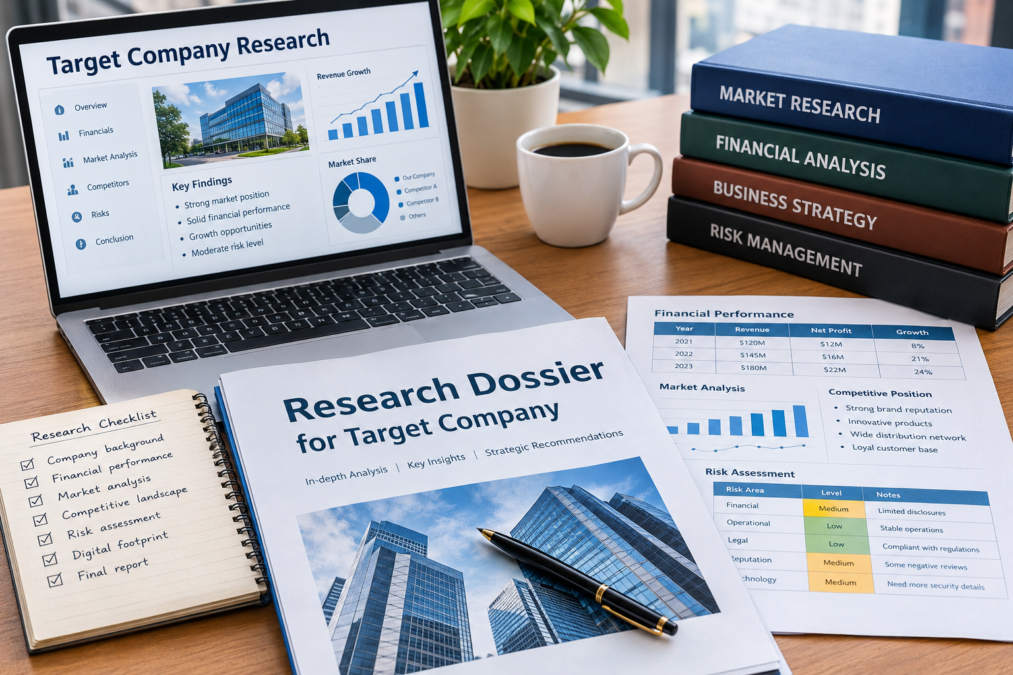

Introduction to Research Dossier for Target Company
A research dossier for target company is a detailed document that brings together important information about a business. It helps readers understand what a company does, how it operates, who its customers are, how strong its market position is, and what opportunities or risks it may face in the future. Whether you are preparing for a business partnership, planning an investment, researching a competitor, or considering an acquisition, a well-organized dossier can help you make better decisions.
In today’s competitive business world, information is one of the most valuable resources a person or organization can have. However, collecting information alone isn’t enough. You must also check its accuracy, understand its meaning, and connect the facts to your goals. That’s where a research dossier becomes useful.
Imagine that you want to work with a technology company. Before signing an agreement, you may want to know about its leadership, financial performance, products, customer reviews, reputation, and legal history. Instead of searching through scattered websites and reports every time you need an answer, you can bring the most useful findings into one organized document.
A strong dossier does more than describe a business. It explains what the available evidence means and highlights questions that still need answers. By following a clear research process, even beginners can create a useful company profile that supports informed, responsible, and confident business decisions.
What Is a Research Dossier for Target Company?
A research dossier for target company is a structured collection of verified information, analysis, and supporting evidence about a specific business. The word target refers to the company being studied, while dossier means a collection of documents and facts organized around a particular subject.
The purpose of this document depends on the researcher’s goals. A sales team may use it to understand a potential client. An investor may examine the company’s financial strength. A business owner may study a competitor’s products and marketing strategy. Similarly, a company considering a merger may investigate another business before making a major commitment.
A useful dossier normally includes:
- Basic company information and business history
- Products, services, and revenue sources
- Leadership and organizational structure
- Financial performance and available financial records
- Industry trends and market position
- Main competitors and business advantages
- Customer feedback and public reputation
- Legal, regulatory, and operational risks
- Growth opportunities and future challenges
- Sources, research dates, and recommendations
Not every dossier needs to contain every possible detail. Instead, its contents should match the decision being considered. For example, a marketing partnership may require more information about customers and brand reputation than a simple company overview would provide.
The most important principle is simple: a dossier should help someone answer a real business question, not merely collect facts without a clear purpose.
Why a Company Research Dossier Matters
Business decisions often involve money, time, reputation, and long-term commitments. Making those decisions without proper research can lead to unnecessary risks. A company dossier helps reduce uncertainty by bringing relevant evidence together in one place.
Supports Better Business Decisions
When information is organized and easy to understand, decision-makers can compare different options more fairly. Instead of relying on a sales presentation or a few online comments, they can review several sources and consider the bigger picture.
For instance, a company may appear successful because it has a modern website and a large social media following. However, additional research might reveal that its customer service is weak or that its business model depends on a single major client. Such findings could change the final decision.
Helps Identify Business Opportunities
Research isn’t only about finding problems. It can also reveal opportunities that others have overlooked.
A dossier may show that a target company:
- Has developed a useful product for an underserved market.
- Is expanding into a new region.
- Has a strong customer base but limited online visibility.
- Could benefit from a strategic partnership.
- Offers services that complement another business’s products.
These findings can help organizations identify practical ways to work together and create mutual value.
Reduces Unnecessary Risks
Every business relationship carries some level of uncertainty. A company may have financial difficulties, unresolved legal issues, weak internal controls, or a poor public reputation.
A properly researched dossier helps highlight warning signs before a decision becomes difficult or expensive to reverse. Of course, research cannot eliminate every risk, but it can make those risks easier to recognize and manage.
Saves Time and Improves Teamwork
Without a central research document, different employees may repeat the same searches or rely on outdated information. A shared dossier creates a common reference point.
As a result, sales teams, managers, investors, analysts, and legal professionals can work from the same verified facts while adding their own specialist insights.
Main Objectives of a Research Dossier for Target Company
Before starting research, define what you want to learn. A clear objective keeps the process focused and prevents the document from becoming unnecessarily long.
Common objectives include the following.
Understanding the Company’s Identity
The first objective is to establish exactly which business is being researched. Companies can have similar names, operate through subsidiaries, or use different names in different countries.
Researchers should identify the correct legal name, official website, headquarters, registration details where publicly available, and main business activities.
Evaluating Business Performance
Another objective is to understand how the company performs. This may involve reviewing revenue, profitability, customer growth, operating costs, debt, and cash flow when reliable records are available.
A private company may not publish all this information. In that case, researchers should clearly identify missing information rather than treating estimates as confirmed facts.
Assessing Market Position
A dossier can explain how a company compares with others in its industry. This includes its target customers, pricing, product quality, distribution network, brand recognition, and competitive advantages.
Identifying Risks and Opportunities
The document should examine both positive and negative factors. A balanced assessment gives readers a more realistic picture than a report that focuses only on success stories.
Supporting a Specific Decision
Finally, the dossier should connect research findings to the intended action. That action might involve investing, purchasing services, entering a partnership, hiring a supplier, or studying a competitor.
Key Information to Include in a Research Dossier for Target Company
A strong dossier follows a logical structure. Although the exact format can vary, several core sections are useful for most types of company research.
Company Overview and Background
Begin with a short profile that explains the company’s identity and history.
Include information such as:
- Official company name
- Year founded, if verified
- Headquarters and operating locations
- Industry and main business activities
- Ownership structure, where known
- Company size, if reliable figures are available
- Official website and published contact information
- Major milestones and important changes
This section should give readers a clear understanding of the business before they explore more detailed findings.
Company history can also provide useful context. A business that has changed its products, ownership, or strategy several times may have a different risk profile from one that has followed a stable plan for many years. However, past changes should be interpreted carefully rather than automatically treated as signs of success or failure.
Products and Services
Explain what the company sells and how its products or services meet customer needs.
For each important offering, consider:
- Main features and benefits
- Target audience
- Pricing model, when publicly available
- Distribution channels
- Product quality and customer support
- Differences from competing products
- Dependence on particular suppliers or technologies
For example, a software company may earn money through monthly subscriptions, enterprise contracts, technical support, and consulting services. Understanding these revenue sources helps explain how the company operates and where its growth may come from.
Leadership and Management
Leadership can influence business performance, workplace culture, innovation, and strategic direction.
Research the company’s executives, founders, board members, and other relevant leaders using appropriate public sources. Confirm their current positions and distinguish their professional experience from claims that haven’t been independently verified.
Useful questions include:
- Who makes major business decisions?
- What experience does the leadership team have?
- Has the company recently changed its senior management?
- Does the business explain its goals clearly?
- Are there reliable reports about major leadership concerns?
The goal isn’t to judge people based on rumors. Instead, it is to understand the company’s management structure and the experience available to guide its future.
Financial Information
Financial research is particularly important when the dossier supports investment, lending, acquisition, or supplier decisions.
Depending on the company’s reporting obligations, relevant documents may include annual reports, audited financial statements, regulatory filings, investor presentations, and official financial announcements.
Key measures may include:
| Financial measure | What it helps explain |
|---|---|
| Revenue | The money earned from selling products or services |
| Net profit | The amount remaining after expenses and applicable taxes |
| Operating margin | How much operating profit the company earns relative to revenue |
| Cash flow | How money moves into and out of the business |
| Debt | The company’s borrowing obligations |
| Current assets and liabilities | Short-term resources and obligations |
| Revenue growth | Whether sales are increasing or decreasing over time |
These figures should be interpreted together. For instance, increasing revenue doesn’t always mean a company is becoming more profitable. Costs may be rising faster than sales, or the business may be borrowing heavily to fund expansion.
Whenever possible, compare multiple reporting periods instead of relying on a single year’s results. This makes it easier to identify trends and unusual changes.
For private businesses, financial details may be limited. Researchers should state that limitation clearly and avoid inventing figures or presenting unsupported estimates as facts.
Market Position and Industry Analysis
A company doesn’t operate in isolation. Its results are influenced by customer demand, economic conditions, new technologies, government policies, and competitor activity.
This section should describe the industry, its current direction, and the target company’s position within it.
Consider questions such as:
- Is the industry growing, stable, or shrinking?
- What are the most important customer needs?
- Which trends may affect future demand?
- Are new competitors entering the market?
- Does the company have a strong brand or distribution network?
- Are changing laws or technologies likely to affect operations?
Reliable industry reports, official statistics, trade associations, and credible business publications can help answer these questions.
Be careful with market-size claims. Some reports define an industry broadly, while others focus on a narrow segment. A comparison is meaningful only when the figures use compatible definitions and time periods.
Competitor Analysis
Competitor research helps explain what makes a company different and whether its advantages are likely to last.
Identify direct competitors that offer similar products to similar customers. Also consider indirect competitors that solve the same customer problem in another way.
A comparison table can make the findings easier to understand.
| Research area | Questions to investigate |
|---|---|
| Products | What does each business offer? |
| Pricing | Which pricing models are used? |
| Customers | Which groups does each company serve? |
| Reputation | What do credible customer reviews indicate? |
| Marketing | Which channels and messages are used? |
| Innovation | What new products or services are being developed? |
| Customer support | How does each company handle customer needs? |
Avoid assuming that the biggest competitor is always the strongest. A smaller company may serve a specific customer group more effectively or offer a better solution to a particular problem.
The aim is to understand the competitive environment and identify the target company’s strengths, weaknesses, and possible areas for improvement.
Customers and Public Reputation
Customer research helps reveal how a company is viewed by the people who use its products or services.
Possible sources include verified customer reviews, public testimonials, industry surveys, consumer protection notices, and reputable media reports.
Look for repeated patterns rather than focusing on a single comment. Several independent complaints about delayed deliveries may suggest an operational issue, while one negative review may simply reflect an isolated experience.
Researchers should also consider the age and context of the information. A complaint from several years ago may not describe the company’s current service quality, especially if the business has made clear improvements since then.
Legal and Regulatory Information
Legal research can help identify matters that may affect a company’s operations or reputation.
Depending on the purpose of the dossier, relevant information may include:
- Publicly available business registration details
- Regulatory licenses and approvals
- Official enforcement actions
- Public court records
- Published product recalls
- Reported intellectual property disputes
- Applicable industry regulations
Legal findings require special care. An allegation is not the same as a proven violation, and a lawsuit does not automatically mean that a company acted unlawfully.
Whenever legal matters are included, describe their status accurately and rely on official records or reputable reporting. For major transactions, qualified legal professionals should review important findings.
Company Culture and Workforce
A company’s employees and internal practices can affect productivity, innovation, and customer experience.
Public information may include official careers pages, published workplace policies, employee surveys, and credible reports about working conditions.
Consider whether the company appears to invest in employee development, communicate its values clearly, and attract the skills needed for its business.
Employee reviews can provide useful clues, but they should not be treated as complete or perfectly representative evidence. People who leave reviews may have unusually positive or negative experiences.
Technology, Innovation, and Digital Presence
Technology can create opportunities while introducing new risks. For this reason, a modern dossier should examine how the target company uses digital tools and responds to technological change.
Relevant areas may include:
- Official website quality and accessibility
- E-commerce or digital service capabilities
- Published product development plans
- Research and development activity
- Publicly announced technology partnerships
- Data protection and cybersecurity statements
- Digital marketing and customer communication
Researchers should use lawful, publicly available information. A company dossier should never depend on unauthorized access to private systems, confidential files, or restricted accounts.
How to Prepare a Research Dossier for Target Company Step by Step
Creating a useful dossier becomes much easier when you follow a repeatable process. The following steps can help beginners and experienced researchers produce organized, evidence-based reports.
Define the Research Purpose
Start by writing down the main question your research must answer. This step determines which information you need and how much time you should spend collecting it.
For example, if you’re researching a potential supplier, your main questions may concern product quality, delivery reliability, financial stability, and customer service. If you’re researching a possible investment, you’ll need a closer look at financial records, market opportunities, and business risks.
Write a short statement explaining the purpose of the dossier. Keep it specific enough to guide your work.
Identify the Target Company Correctly
Next, confirm the identity of the business. Search for its official website, legal name, business registration information, and reliable public records.
Pay attention to subsidiaries, parent companies, and businesses with similar names. A mistake at this stage can lead to incorrect conclusions later.
Record the date when the company’s identity and key details were verified. This is especially useful when researching businesses that change ownership or structure.
Gather Information From Reliable Sources
Collect information from sources that match the subject being investigated. Official documents are generally preferable for confirming formal company details, while independent sources can help provide outside perspectives.
Useful sources include:
- Official company websites and annual reports
- Government business registries
- Securities regulators and stock exchange filings
- Official court and regulatory records
- Credible newspapers and business publications
- Industry reports and trade associations
- Verified product information and customer feedback
- Publicly available company announcements
Don’t depend on one website for every claim. Comparing independent sources can help reveal mistakes, outdated details, and conflicting accounts.
Verify Important Claims
Information should be checked before it becomes part of the final dossier. A professional-looking website doesn’t automatically make its claims accurate.
For each important fact, ask:
- Who published this information?
- When was it published?
- Does the source have direct knowledge of the subject?
- Can another reliable source confirm the claim?
- Is the statement a verified fact, an estimate, or an opinion?
For example, if a company claims to be the market leader, look for evidence that supports the statement. It may lead a particular market segment without being the largest business in the entire industry.
When evidence is incomplete, say so clearly. Honest uncertainty is more useful than false confidence.
Organize the Findings Into Sections
Once you have enough information, arrange it into clear sections. Start with basic facts, then move to business operations, financial information, competitors, and risk analysis.
Use short paragraphs, descriptive headings, and tables where they improve understanding. Keep detailed supporting documents in an appendix when the main report would otherwise become difficult to read.
Every section should answer a clear question. Remove unrelated details that don’t contribute to the research objective.
Analyze the Evidence
Research is more valuable when it explains what the facts mean.
Suppose a company reports increasing sales for three consecutive years. This may indicate stronger demand, but you should also examine profit margins, operating costs, and cash flow before concluding that the business is becoming financially healthier.
Likewise, a growing number of customer reviews may indicate increased interest, but it doesn’t automatically prove that customer satisfaction has improved.
Compare trends, identify patterns, consider alternative explanations, and separate evidence from interpretation.
Write Conclusions and Recommendations
The final stage is to summarize the most important findings and explain how they relate to the original research question.
A recommendation might be to proceed with a partnership, request additional financial records, conduct a deeper legal review, or compare the company with other suppliers before making a decision.
Recommendations should follow from the evidence. If important information is missing, the correct conclusion may be that further research is needed.
Review and Update the Dossier
Before sharing the document, check names, dates, figures, source links, and spelling. Make sure the conclusions match the evidence and that confidential or unnecessary personal information hasn’t been included.
Company information can change quickly. Add a preparation date and review date, and update important sections when new evidence becomes available.
Research Tools and Resources for Company Analysis
The right tools can make company research faster and more accurate. However, no single tool provides a complete picture of every business.
Choose resources based on the company’s location, industry, ownership, and the purpose of your investigation.
| Tool or resource | Main purpose |
|---|---|
| Company website | Confirms published business information and offerings |
| Government business registry | Helps verify legal registration where records are available |
| Securities regulator | Provides filings for companies subject to disclosure requirements |
| Annual reports | Explains financial results, operations, and business risks |
| Search engines | Helps locate relevant public information |
| Spreadsheet software | Organizes figures, comparisons, and research notes |
| Industry databases | Provides market and competitor information |
| News archives | Helps track important events and business developments |
| Customer review platforms | Offers insight into customer experiences |
| Document management tools | Stores reports and supporting evidence in an organized way |
Some databases charge subscription fees, and access to company records varies by country. Before using a source, check whether it is authoritative, current, and appropriate for the claim you want to verify.
For a small business, a combination of its official website, public registration records, credible news reports, and customer feedback may provide a useful starting point. A large public company may require a much broader review of regulatory filings, financial statements, industry data, and investor communications.
Using SWOT Analysis in a Research Dossier for Target Company
SWOT analysis is a practical framework for organizing the most important findings about a business. The letters stand for strengths, weaknesses, opportunities, and threats.
It helps turn a large collection of information into a concise assessment of the company’s position.
<box border radius=”lg” padding={3} gap={3}> <grid columns={2} gap={3}> <grid-item> <box background=”surface-secondary” radius=”md” padding={3} gap={1}> <title size=”md”>Strengths</title> <text size=”sm”>Internal advantages, such as a trusted brand, skilled employees, or strong customer relationships.</text> </box> </grid-item> <grid-item> <box background=”surface-secondary” radius=”md” padding={3} gap={1}> <title size=”md”>Weaknesses</title> <text size=”sm”>Internal limitations, such as high operating costs, limited resources, or dependence on one product.</text> </box> </grid-item> <grid-item> <box background=”surface-secondary” radius=”md” padding={3} gap={1}> <title size=”md”>Opportunities</title> <text size=”sm”>External possibilities, such as new customer groups, emerging technologies, or expanding markets.</text> </box> </grid-item> <grid-item> <box background=”surface-secondary” radius=”md” padding={3} gap={1}> <title size=”md”>Threats</title> <text size=”sm”>External challenges, such as new competitors, changing regulations, or falling customer demand.</text> </box> </grid-item> </grid> </box>
Consider a hypothetical clothing company with a recognizable brand and loyal customers. Those are potential strengths. Its high production costs may be a weakness. Selling through new online channels could represent an opportunity, while rising material prices might create a threat.
These examples are illustrative, not claims about a real company.
A useful SWOT analysis should be supported by research rather than personal guesses. It should also explain why each point matters. For example, a weakness becomes more important if it threatens the company’s ability to meet customer demand or maintain profitability.
Risk Assessment and Due Diligence
A research dossier for target company can form part of a wider due diligence process. Due diligence means carrying out appropriate checks before entering a significant business arrangement or making an important financial decision.
The level of investigation should match the size and nature of the risk. A small purchase may require only basic checks, while a major acquisition may require extensive financial, legal, operational, and technical reviews.
Financial Risks
Financial risks may include high debt, unstable cash flow, declining sales, or dependence on a small number of customers.
Researchers should look for evidence of these issues and consider whether the available records are complete. A single financial measure rarely tells the whole story.
Operational Risks
Operational risks concern the company’s ability to deliver products and services reliably.
Examples include supply chain interruptions, outdated equipment, limited production capacity, poor quality controls, or reliance on a single supplier.
Legal and Compliance Risks
A business may face obligations related to taxation, employment, data protection, licensing, consumer rights, and industry-specific rules.
The relevant requirements depend on where the company operates and what it does. Significant concerns should be reviewed with qualified legal or compliance professionals.
Reputation Risks
Public criticism, poor customer experiences, or misleading advertising may affect trust in a company.
However, reputation research should be fair. Verify claims, consider the context, and distinguish confirmed findings from allegations and personal opinions.
Cybersecurity and Data Risks
Businesses that store customer information or depend on digital systems may face data breaches, service disruptions, and privacy concerns.
Review publicly available security statements, regulatory announcements, and credible reports. Don’t attempt to access private systems or confidential data without authorization.
Common Mistakes to Avoid When Preparing a Company Dossier
Even a well-intentioned research project can produce misleading results if basic research practices are ignored.
Relying on One Source
A company’s own website can explain its products and goals, but it may not provide an independent assessment of its performance. Similarly, a single negative review cannot establish that a business has a widespread problem.
Use different types of reliable sources to develop a balanced understanding.
Using Outdated Information
Leadership, prices, ownership, financial results, and business operations can change. Always check publication dates and confirm whether older information remains relevant.
Confusing Facts With Opinions
A statement that a company was fined by a regulator is different from an opinion that its management is irresponsible. Label interpretations clearly and support factual claims with evidence.
Ignoring Missing Information
When financial records or other key documents aren’t available, don’t assume the company is either healthy or unhealthy. Record the information gap and explain how it affects your conclusions.
Making Unsupported Predictions
Historical performance may provide useful context, but it cannot guarantee future results. Describe forecasts as estimates, explain their assumptions, and avoid presenting uncertain outcomes as established facts.
Collecting Irrelevant Personal Information
Company research should focus on legitimate business needs. Avoid collecting private personal details about employees, executives, customers, or other individuals when those details aren’t necessary for the task.
Writing Without a Clear Conclusion
A long report can still be unhelpful if it doesn’t explain what the evidence means. Finish with a concise summary, major risks, opportunities, unanswered questions, and practical next steps.
Ethical and Responsible Company Research
Professional research requires accuracy, fairness, and respect for legal and ethical boundaries.
Researchers should rely on lawful sources, respect access restrictions, protect confidential information, and avoid deceptive methods of obtaining data.
If a company shares confidential documents under a formal agreement, handle them according to the agreed terms and applicable laws. Publicly available information should also be used responsibly, especially when it contains personal details.
Transparency is equally important. A reader should be able to understand where major findings came from and which conclusions depend on assumptions.
When research reveals conflicting evidence, explain the disagreement instead of hiding it. When a claim cannot be confirmed, state that limitation.
These practices help build a dossier that is not only informative but also credible and suitable for professional use.
Sample Structure of a Research Dossier for Target Company
A consistent template makes it easier to prepare dossiers for different businesses. You can adapt the following structure for academic assignments, business development, market research, or preliminary due diligence.
<box border radius=”lg” padding={4} gap={3}> <title size=”lg”>Company Research Dossier Template</title> <text color=”secondary” size=”sm”>Copy this structure into your preferred document editor and fill in the verified information.</text> <divider color=”subtle”/> <text weight=”medium”>Company identification</text> – Company name: – Official website: – Industry: – Headquarters: – Ownership: – Research date: <divider color=”subtle”/> <text weight=”medium”>Business overview</text> – Company history and background – Main products and services – Target customers – Revenue sources <divider color=”subtle”/> <text weight=”medium”>Research and analysis</text> – Leadership and management – Financial performance – Industry and market position – Competitor comparison – Customer reputation – Legal and regulatory findings – SWOT analysis <divider color=”subtle”/> <text weight=”medium”>Final assessment</text> – Major strengths – Main concerns and risks – Potential opportunities – Missing information – Recommendations and next steps <divider color=”subtle”/> <text weight=”medium”>Supporting evidence</text> – Source links and publication dates – Relevant official records – Supporting reports and appendices </box>
This template is a starting point, not a fixed rule. For a small company, a concise document may be enough. For a complex acquisition or investment, each section may require additional analysis and specialist review.
Practical Example: Researching a Hypothetical Technology Company
To understand how the process works, consider a fictional business called BrightPath Technologies. The company provides cloud-based software to small businesses.
The following example demonstrates how a researcher might organize findings. All company details are hypothetical and are included for educational purposes only.
Company Overview
BrightPath Technologies provides software that helps small businesses manage customers, sales, and daily operations. Its business model relies mainly on monthly subscriptions.
The research objective is to determine whether BrightPath could be a suitable technology partner for another business.
Research Findings
| Research area | Illustrative finding | Further action |
|---|---|---|
| Products | Offers business management software | Review features and product reliability |
| Revenue model | Uses monthly subscriptions | Verify revenue and customer retention |
| Target market | Focuses on small businesses | Estimate demand in the intended market |
| Competition | Competes with other software providers | Compare pricing and key features |
| Customer service | Public feedback is mixed | Review independent feedback and service policies |
| Security | Publishes a general privacy statement | Request appropriate security documentation |
These findings would not be enough to make a final decision. They identify areas that deserve further investigation.
For example, a subscription model may offer recurring revenue, but the researcher should check whether customers continue paying over time. Similarly, a privacy statement is useful, but it doesn’t independently prove that a company’s security controls are effective.
Possible SWOT Analysis
- Strength: A product designed for a specific customer group.
- Weakness: Limited public information about financial performance.
- Opportunity: Potential demand from businesses moving to digital tools.
- Threat: Competition from established software providers.
Final Recommendation
Based on the hypothetical information, the appropriate next step would be to continue the evaluation rather than approve a partnership immediately.
The researcher could request a product demonstration, review service agreements, verify customer references, and conduct a suitable security assessment. Financial checks may also be necessary depending on the size of the proposed relationship.
This example shows how a dossier turns scattered information into a structured process for making decisions.
How to Make a Company Research Dossier More Professional
A professional dossier should be easy to read, well-supported, and focused on the reader’s needs.
Follow these practices to improve the quality of your report.
- Use a clear title: State the target company’s name and the purpose of the report.
- Add an executive summary: Present the most important findings before the detailed sections.
- Use consistent headings: Organize information in a logical order.
- Include useful tables: Compare competitors, financial measures, or risk factors when appropriate.
- Cite important claims: Provide source links, publication dates, and document references.
- Separate evidence from analysis: Make it clear when you’re reporting a fact and when you’re interpreting it.
- Use plain English: Explain technical terms so that readers without specialist knowledge can understand the report.
- Highlight information gaps: Identify areas where more evidence is required.
- Protect sensitive information: Share the dossier only with appropriate people and follow relevant privacy obligations.
- Set a review date: Make it clear when the information was collected and when it should be checked again.
An executive summary is especially useful when the report is long. It allows busy readers to understand the company’s background, the main findings, the largest concerns, and the recommended next steps without reading every page immediately.
However, the summary must accurately reflect the detailed research. It shouldn’t make stronger claims than the supporting evidence allows.
Who Can Benefit From a Research Dossier for Target Company?
A company dossier can serve different professional needs. Its usefulness depends on how the information is collected and applied.
Business Owners and Entrepreneurs
Business owners can use dossiers to evaluate potential partners, study competitors, understand suppliers, and identify gaps in the market.
For a new business, competitor research may reveal opportunities to serve customers who are not being well served by existing providers.
Investors and Financial Analysts
Investors can use company research to understand business models, assess financial performance, identify potential risks, and compare investment opportunities.
A dossier is a research aid, not a guarantee of investment success. Financial decisions may require additional analysis and advice from qualified professionals.
Sales and Marketing Teams
Sales teams can research potential clients before approaching them. Understanding a company’s products, customers, business priorities, and recent developments can make conversations more relevant.
Marketing teams can also use research to understand competitors, customer expectations, and changes in the market.
Procurement and Supplier Management Teams
Organizations often need to evaluate suppliers before signing contracts. A dossier can help compare service quality, delivery capabilities, financial stability, compliance, and reputation.
The depth of investigation should reflect the supplier’s importance and the potential consequences of a failure.
Researchers and Students
Students and academic researchers can use a company dossier to study business strategy, market structure, corporate performance, and management decisions.
In this setting, clear citations and careful source evaluation are particularly important because they allow readers to check the evidence and understand how conclusions were reached.
Frequently Asked Questions
What is the main purpose of a research dossier for target company?
Its main purpose is to collect and analyze relevant company information in one organized document. It helps readers understand a business, evaluate opportunities and risks, and make informed decisions based on evidence.
How long should a company research dossier be?
There is no universal length. A basic company profile may require only a few pages, while a detailed investigation for an acquisition or major investment may require many more. The report should be long enough to answer the research question without unnecessary repetition.
What is the difference between a company profile and a research dossier?
A company profile usually provides a short overview of a business, including its history, products, and main activities. A research dossier is generally broader and more analytical. It may include financial reviews, competitor comparisons, legal information, risk assessments, and recommendations.
Which sources are best for company research?
The best sources depend on the information required. Official company documents can establish what a business publicly reports, government records can help verify registration and regulatory details, and reputable independent sources can provide outside perspectives.
For financial and legal claims, relevant official filings and records are often especially valuable.
Can a dossier be prepared for a private company?
Yes. Private companies can be researched using lawful public information, official websites, product details, industry reports, customer feedback, and other available records. However, some private businesses disclose less financial information than publicly traded companies, so the dossier should explain any important limitations.
How often should a company dossier be updated?
The schedule depends on the company’s industry and the reason for the research. A dossier supporting an active transaction may need frequent updates, while a general background report may be reviewed less often. Important changes in ownership, financial results, legal status, or business strategy should prompt a review.
Is a research dossier the same as due diligence?
No. A dossier is a document that organizes and analyzes research findings. Due diligence is a broader process of checking relevant facts, documents, risks, and obligations before a significant decision. A dossier can support due diligence, but it may not replace specialist reviews or formal verification.
Conclusion: Building a Reliable Research Dossier for Target Company
A research dossier for target company is a valuable tool for understanding a business, evaluating its position in the market, and making better-informed decisions. By organizing company background, products, leadership, financial information, competitors, customer feedback, and potential risks, researchers can develop a clearer picture of the business they are studying.
The most effective approach begins with a clear objective, uses reliable sources, verifies important claims, and separates facts from opinions. SWOT analysis, competitor comparisons, financial reviews, and risk assessments can then turn the collected information into practical insights.
Above all, remember that quality matters more than quantity. A long report filled with unverified statements may be less useful than a concise dossier supported by accurate evidence and clear reasoning. Missing information should be acknowledged, uncertain claims should be treated carefully, and recommendations should follow logically from the findings.
Whether you’re a student, entrepreneur, investor, marketer, or business professional, learning how to prepare a research dossier for target company can strengthen your research skills and improve your approach to business decisions. With a structured method, ethical research practices, and regular updates, you can create a dependable resource that supports better planning, stronger partnerships, and more informed business opportunities.
Research Dossier for Target Company: Advanced Strategies and Best Practices
Advanced Research Methods for a Target Company
Preparing a research dossier for target company involves more than collecting basic information. A detailed investigation requires a clear method for finding reliable evidence, understanding business performance, and identifying factors that may influence future decisions.
Advanced research methods help researchers move beyond general company descriptions. Instead of simply stating what a business does, they explore why the company performs in a certain way, how it compares with competitors, and what its future challenges might be.
One useful approach is to combine several research methods. Public records can help confirm company details, financial reports can explain performance, and independent industry publications can provide a wider market perspective.
The strongest conclusions usually come from evidence that supports the same finding across multiple reliable sources.
Using Primary and Secondary Research
Primary and secondary research are two important methods used when preparing a company dossier. Each method offers different benefits, and combining them can improve the quality of the final report.
Primary Research
Primary research involves collecting information directly for a particular research purpose.
Depending on the project, it may include:
- Interviews with authorized company representatives
- Customer surveys conducted with appropriate consent
- Product demonstrations
- Discussions with industry experts
- Feedback from business partners
- Direct observations of publicly accessible services
For example, a business considering a software supplier might request a product demonstration and ask about technical support, service availability, and contract terms.
Primary research can provide specific answers that aren’t available in public reports. However, responses should still be checked where possible. A company’s representative may present its products positively, so independent evidence remains valuable.
Secondary Research
Secondary research uses information that has already been published or collected by another party.
Examples include annual reports, government records, industry studies, business news, academic research, and publicly available market statistics.
This approach is often faster and less expensive than collecting new information. It also helps researchers understand the wider business environment.
However, secondary sources can become outdated or rely on different definitions. Always check publication dates, research methods, and the original source when possible.
Evaluating the Reliability of Company Information
A research dossier for target company is only as reliable as the evidence supporting it. That’s why source evaluation should be a regular part of the research process.
A useful source assessment examines the publisher’s authority, the date of publication, the evidence provided, and whether independent sources support the same claim.
Check the Publisher
Determine whether the information comes from an official company document, a government agency, a recognized research organization, or an unknown website.
An official source may be best for confirming a published executive appointment. An independent financial analysis may provide additional context about the company’s performance.
Check the Publication Date
Business information can change rapidly. A report about a company’s leadership from several years ago may no longer reflect its current structure.
Record when the information was published and, when relevant, the period it describes.
Look for Supporting Evidence
Important claims should be supported by reliable documentation. If a company announces a major contract, for example, look for an official announcement or credible independent reporting.
If sources disagree, investigate the reason. They may be discussing different time periods, using different definitions, or reporting different stages of an event.
Distinguish Evidence From Assumptions
A report should make it clear when a statement is confirmed, estimated, or interpreted.
For example, a company’s expanding product range may suggest a growth strategy, but it doesn’t prove that the strategy will succeed. That conclusion would require additional evidence about demand, costs, competition, and execution.
Financial Analysis Techniques for Company Research
Financial analysis helps explain a company’s economic position. It is especially important when evaluating a potential investment, acquisition, lending arrangement, or long-term supplier relationship.
The available information depends on whether the company is publicly traded, privately owned, or subject to special reporting requirements.
Compare Performance Over Time
Reviewing several reporting periods can help identify trends in revenue, expenses, profit, debt, and cash flow.
An increase in revenue may indicate stronger sales, but rising costs can reduce profitability. Similarly, a profitable company may still face cash flow problems if customers pay late or large amounts of money are tied up in inventory.
The goal is to understand how the company’s financial position is changing rather than focusing on one figure.
Use Financial Ratios Carefully
Financial ratios help compare performance across periods or businesses. Common examples include:
| Financial ratio | What it measures |
|---|---|
| Gross profit margin | Gross profit relative to revenue |
| Net profit margin | Net profit relative to revenue |
| Current ratio | Current assets relative to current liabilities |
| Debt-to-equity ratio | Debt relative to shareholders’ equity, using a clearly defined calculation |
| Return on assets | Profitability relative to the assets used by the business |
Ratios must be interpreted in context. A healthy current ratio in one industry may not be typical in another. Accounting methods and the definition of debt can also affect comparisons.
For this reason, researchers should explain the period, calculation, and source behind important financial measures.
Identify Financial Warning Signs
Potential warning signs may include falling profit margins, rapidly increasing debt, repeated cash flow difficulties, or a heavy dependence on one major customer.
These signals don’t automatically mean a business is failing. They indicate areas that deserve further investigation.
A fair assessment considers the company’s industry, business model, growth stage, and wider economic conditions before reaching a conclusion.
Market Intelligence and Competitive Positioning
Market intelligence helps researchers understand the external forces that influence a target company’s performance.
These forces may include changing customer expectations, new competitors, economic conditions, technological developments, and government policies.
A company can have a strong product but still struggle if the market is shrinking or customers are moving toward alternative solutions. On the other hand, a business operating in a growing market may have opportunities to expand if it can meet customer needs effectively.
Study Customer Demand
Researchers should identify the customers a company serves and the problems its products solve.
Useful questions include:
- Who is the main customer group?
- What problem does the product address?
- How do customers currently solve that problem?
- What factors influence purchasing decisions?
- Are customer needs changing?
Reliable market reports, customer research, and industry surveys can help answer these questions.
Evaluate Competitive Advantages
A competitive advantage is a factor that helps a company perform better than its rivals in a particular area.
Examples may include a trusted brand, strong distribution, specialized knowledge, efficient production, valuable intellectual property, or excellent customer service.
However, an advantage is most meaningful when there is evidence that customers value it and competitors cannot easily copy it.
Monitor Industry Changes
A company’s market position can change as new technologies emerge or regulations develop.
Researchers should monitor important developments and explain how they might affect the target company. Avoid making certain predictions about events that remain unclear.
Digital Footprint and Online Reputation Analysis
A company’s digital footprint includes the information it publishes and the public information available about its online activities.
Examining this footprint can help researchers understand how the business communicates, presents its products, and responds to customers.
Useful areas to review include the official website, published company announcements, public social media accounts, online product listings, and credible customer review platforms.
Website Quality and Transparency
A company’s website may explain its services, leadership, policies, and contact channels. Researchers can assess whether the information is clear, current, and consistent with other reliable sources.
A professional-looking website, however, doesn’t prove that a company is financially stable or trustworthy. Website quality should be treated as one part of a wider assessment.
Social Media Activity
Public social media accounts can show how a company communicates with customers and announces products or events.
Look for consistent messaging, useful updates, and appropriate responses to customer questions. Consider the context and date of the posts rather than judging the company from a single interaction.
Review Patterns
Customer reviews can reveal repeated experiences involving product quality, delivery, support, or refunds.
Still, reviews may be incomplete, biased, or difficult to verify. A balanced report should compare multiple sources and avoid treating individual comments as established facts.
Creating a Company Risk Register
A risk register is a structured list of potential problems that could affect a business decision. It can make a research dossier more useful by showing which concerns require attention first.
A simple risk register may include the risk, supporting evidence, possible impact, likelihood, and recommended next step.
| Risk area | Example concern | Suggested next step |
|---|---|---|
| Financial | Limited financial disclosures | Request suitable financial documentation |
| Operational | Dependence on one supplier | Assess alternative supply arrangements |
| Legal | Unclear licensing status | Verify requirements with the relevant authority |
| Reputation | Repeated complaints about service | Review complaint patterns and company responses |
| Technology | Limited public security information | Request appropriate security documentation |
A risk register should be based on evidence and should distinguish confirmed problems from issues that still need investigation.
Risk ratings such as low, medium, and high can help prioritize work, but the criteria for each rating should be defined. Otherwise, different researchers may classify the same issue inconsistently.
Writing an Effective Executive Summary
The executive summary is often the first section decision-makers read. It should explain the purpose of the dossier, introduce the target company, summarize the most important findings, and identify recommended next steps.
Although it appears at the beginning, it is usually best to write the executive summary after completing the main research.
A useful summary answers five questions:
- Which company was researched?
- Why was the research conducted?
- What are the most important findings?
- What risks or information gaps remain?
- What action should be considered next?
Avoid filling this section with every detail from the report. Focus on the findings that are most relevant to the decision.
Maintaining Research Quality and Documentation
A professional dossier should allow readers to trace important claims back to their sources.
Keep a research log that records the information collected, the source, the publication date, and any verification steps completed.
For important documents, record the document title, issuing organization, relevant reporting period, and access date where appropriate.
This practice is particularly valuable when several researchers contribute to the same report. It reduces duplicated work and makes later updates easier.
Researchers should also use consistent definitions. For example, if one source measures annual revenue and another reports quarterly revenue, those figures shouldn’t be compared without adjusting for the difference.
Before finalizing the report, review the calculations, confirm the identity of the company, check for conflicting evidence, and remove unsupported statements.
Common Challenges in Company Research
Company research can involve practical difficulties, especially when the target business operates across several countries or provides limited public information.
Limited Information
Private companies may not publish detailed financial records or internal operational information. Researchers should identify these gaps and seek authorized documentation where necessary.
Conflicting Reports
Different sources may report different figures or dates. Check the original documents and establish whether the difference comes from reporting periods, definitions, or an actual disagreement.
Rapid Business Changes
Ownership, leadership, products, and market conditions can change after a dossier is completed. Important findings should be reviewed before they are used for a major decision.
Information Overload
Searching the internet can produce more information than a report needs. Keep the research focused on the original objective and prioritize evidence that affects the decision.
Uncertain Conclusions
Not every research question will have a definite answer. A professional report explains what the evidence supports, what remains uncertain, and what additional information could resolve the uncertainty.
Conclusion: Improving Your Research Dossier for Target Company
A strong research dossier for target company combines accurate information, independent verification, financial and market analysis, and a clear assessment of business risks. Advanced research methods can help turn scattered public information into a useful resource for decision-makers.
By evaluating sources carefully, comparing performance over time, examining the competitive environment, and documenting potential risks, researchers can build a more complete understanding of a business.
The process also requires patience and good judgment. Not every online claim is reliable, and not every missing detail indicates a problem. The best conclusions are those that reflect the available evidence while acknowledging its limitations.
Ultimately, a well-prepared research dossier for target company should help readers understand the business, identify important questions, and decide what to investigate next. With consistent documentation, ethical practices, and regular updates, it can become a valuable part of responsible business planning and long-term decision-making.
Explore more insightful articles on All Vantage News and never miss an update.Contact Us