
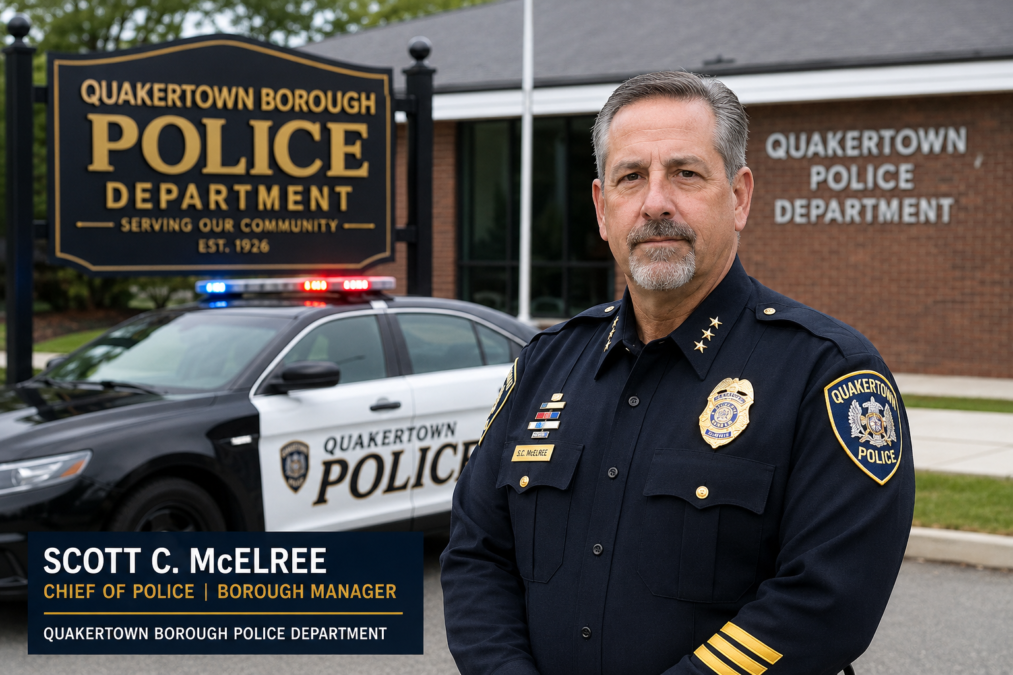

Quakertown police chief is a topic that has received significant public attention in 2026, particularly because of the actions of Scott C. McElree during a February student protest and the investigations that followed. McElree is the current Chief of Police of the Quakertown Borough Police Department in Pennsylvania, and he also serves as the borough manager. The official Quakertown Borough website lists him in both positions.
The role of a police chief is much bigger than wearing a badge or supervising officers. A chief is responsible for leadership, public safety, professional standards, community relationships, and the overall direction of a police department. In Quakertown, these responsibilities have become especially important as officials and residents continue to consider the events of February 20, 2026.
This article explains the role of the quakertown police chief, Scott McElree’s professional position, the February incident, the investigations that followed, and what the situation means for public trust. The goal is to provide clear, balanced, and factual information without exaggerating claims or ignoring important details.
Understanding the Quakertown Police Chief Role
The quakertown police chief leads the Quakertown Borough Police Department, which provides police protection around the clock. According to the borough’s official website, the department patrols the borough, responds to emergencies and accidents, and provides several non-emergency services. These services include accident reports, vacation checks, fingerprinting, and assistance to drivers who are locked out of their vehicles.
The department’s mission is centered on several major responsibilities:
- Preventing crime
- Protecting life and property
- Maintaining peace and public order
- Enforcing laws and ordinances
- Protecting constitutional rights
- Serving residents with respect and fairness
- Building public trust
- Addressing community problems
These responsibilities show why the chief’s position matters so much.
A police chief isn’t simply the highest-ranking police officer in a local department. The chief is also a public leader. Every major decision can influence how residents view the department.
Who Is Scott McElree?
Scott C. McElree is the current quakertown police chief. The borough’s official staff directory lists his title as “Chief of Police | Borough Manager.” The borough provides his office through its municipal administration and lists the police department separately as part of the town’s public-safety structure.
McElree has held the police chief position for many years. Reporting in 2026 stated that he became Quakertown’s top police officer in 2004. In 2007, borough leaders also appointed him borough manager, creating an unusual arrangement in which one person held both positions.
That dual role is important because a police chief normally focuses primarily on law enforcement, while a borough manager handles broader municipal administration.
The combination means McElree’s responsibilities have extended beyond police operations. His work has involved both public safety and the everyday management of borough government.
The Dual Role of Police Chief and Borough Manager
One of the most unusual parts of the Quakertown structure is that Scott McElree has served as both police chief and borough manager.
The borough manager’s responsibilities can involve areas such as:
- Municipal administration
- Personnel matters
- Budget and operations
- Public records
- Borough services
- Coordination between departments
- Administrative planning
Meanwhile, the police chief has responsibilities related to:
- Police officers
- Patrol operations
- Emergency response
- Law enforcement
- Public safety
- Training and policies
- Community relations
Having both jobs gives a person significant responsibility.
It can also create difficult questions when an event involves the police department and the wider borough government. That’s one reason McElree’s dual position has received renewed attention during the 2026 controversy.
Quakertown Police Department and Community Service
The quakertown police chief works within a department that provides services every day of the year.
The official borough website states that police protection is available 24 hours a day, seven days a week. The department is also part of the Bucks County 911 system. Residents are instructed to call 911 for genuine emergencies and use the non-emergency police dispatch number for matters that don’t require an emergency response.
This structure is important because modern policing involves far more than responding to crimes.
Officers may also help people who:
- Have been involved in traffic accidents
- Need certain reports
- Are temporarily locked out of vehicles
- Need a vacation check
- Require fingerprinting
- Need assistance during emergencies
In short, local policing is closely connected to everyday community life.
The February 20, 2026 Student Protest
The current public discussion surrounding the quakertown police chief largely began with an incident on February 20, 2026.
A student protest connected to opposition to federal immigration enforcement took place in Quakertown. The confrontation later became physical, involving police officers and students.
Videos of the incident circulated widely online. One video showed McElree, who was not wearing a police uniform at the time, physically restraining a student. News reports described the restraint as a chokehold, while Quakertown officials later disputed that characterization.
Because the incident involved teenagers and the chief of police, it quickly became a major local and regional story.
People expressed different opinions about what happened.
Some residents argued that police officers were responding to aggression and attempting to control a chaotic situation. Others believed the use of force against a student was inappropriate and demanded accountability.
That’s where the situation became complicated.
Why the Incident Attracted National Attention
The incident attracted attention beyond Quakertown because video footage spread through social media.
In today’s digital environment, a local event can become widely known within hours. A single video may be viewed by thousands or even millions of people before investigators have completed their work.
That creates several challenges.
First, viewers may see only a portion of an incident.
Second, different people may interpret the same footage differently.
Third, early reports can change when investigators obtain additional evidence.
Therefore, responsible reporting requires separating confirmed facts from allegations and opinions.
The February incident demonstrated exactly why that distinction matters.
Arrests Following the Confrontation
Following the February 20 confrontation, Quakertown police arrested five juveniles and recommended charges including aggravated assault.
The Bucks County District Attorney’s Office later reviewed additional evidence, including video footage obtained after the initial charges were filed. According to the DA’s June 15 update, prosecutors withdrew aggravated-assault and other charges in cases where they determined those charges were not supported by the evidence as a whole. Diversionary options were offered to the five juveniles based on the individual circumstances of their cases.
This development is an important part of understanding the story.
Initial charges aren’t the same as final findings.
When prosecutors review more evidence, they may change, reduce, or withdraw charges. That’s a normal part of the justice process.
The Quakertown Police Chief and the Investigation
Because McElree was directly involved in the confrontation, questions were raised about the conduct of the quakertown police chief and the department’s response.
The Bucks County District Attorney’s Office conducted an independent investigation into the February incident.
The investigation considered the conduct of civilians and police officers. This was important because a fair review needs to examine the entire event rather than automatically assuming that one side was completely responsible.
The investigation took several months.
During that period, public discussion continued, and community members expressed strong opinions about whether McElree should remain in his position.
McElree’s Leave and Return to Work
Following the February confrontation, McElree was placed on workers’ compensation leave. During his absence, Lt. Josh Mallery led the police department, while Assistant Manager Doug Probst handled borough affairs.
McElree later returned to work.
In May 2026, Quakertown Borough announced that he had returned as manager and police chief while working reduced hours as he recovered from injuries sustained during the February incident.
This return was controversial.
Some residents welcomed the continuation of normal municipal operations, while others publicly opposed his return and continued to call for his resignation.
The disagreement shows how difficult it can be for a community to rebuild trust after a highly publicized confrontation.
What the Police Chiefs’ Review Found
Before the Bucks County District Attorney’s final report, a separate review was conducted by a panel of four members of the Police Chiefs’ Association of Bucks County.
According to reporting in May, the panel concluded that McElree’s actions were justified and within police policy during the confrontation.
This finding represented one perspective in the broader review process.
However, it wasn’t the final word on the matter. The Bucks County District Attorney’s Office continued its independent investigation.
This distinction is important because different reviews can examine different questions.
A police-policy review may focus on whether an officer’s conduct fell within departmental standards.
A criminal investigation asks whether available evidence supports criminal charges.
Those are not necessarily the same question.
The Bucks County District Attorney’s Final Report
On August 3, 2026, the Bucks County District Attorney’s Office announced that it had completed its independent review of the February 20 incident. The office released an investigative memorandum after redacting the names of juveniles.
The DA’s Office determined that no further criminal charges would be filed against civilians or police officers involved in the incident.
That means McElree did not face criminal charges as a result of the investigation.
However, the conclusion wasn’t simply a complete endorsement of everything that happened.
The DA’s report strongly criticized aspects of McElree’s conduct and discussed the effect the incident had on the community. CBS Philadelphia reported that the report described the chief’s decision involving force as deeply problematic while also concluding that his conduct was not criminal.
This distinction is essential.
No criminal charge does not necessarily mean every decision was considered ideal.
It means prosecutors did not determine that criminal charges were warranted.
Public Trust After the Incident
For any quakertown police chief, public trust is one of the most important parts of the job.
The borough’s own police mission emphasizes trust, respect, fairness, compassion, ethics, and integrity.
When a police department becomes the subject of intense controversy, rebuilding trust can take time.
Trust isn’t repaired with one press release.
It may require:
- Open communication
- Clear explanations
- Independent reviews
- Professional accountability
- Listening to residents
- Consistent enforcement
- Respect for constitutional rights
- Transparent policies
- Community engagement
The DA’s final report itself noted that the February incident caused pain and division in the community and said public trust remained in need of repair.
That’s a significant observation.
The Importance of Police Accountability
Accountability doesn’t mean assuming that police officers are always wrong.
It means making sure law enforcement officials can explain their decisions and that appropriate oversight exists.
A strong police department should have systems for:
- Reviewing use-of-force incidents
- Investigating complaints
- Training officers
- Updating policies
- Monitoring performance
- Communicating with residents
- Correcting mistakes when necessary
Accountability can actually strengthen law enforcement.
When people believe officers are held to professional standards, they’re more likely to cooperate with police.
And cooperation is a powerful tool in preventing crime.
Leadership Lessons From the Quakertown Situation
The events surrounding the quakertown police chief provide several broader lessons about public leadership.
Communication Matters
Officials need to explain what happened as clearly as possible.
When information is missing, rumors can fill the gap.
Independent Review Matters
Outside investigations can help answer difficult questions and give the public greater confidence in the process.
Context Matters
Short videos can show important moments, but investigators often need additional footage, witness statements, records, and other evidence.
Policy Matters
Police officers need clear rules for handling protests, crowd situations, and use-of-force incidents.
Community Relationships Matter
A police department can’t operate successfully without the cooperation of the community it serves.
The Role of Lt. Josh Mallery
Lt. Josh Mallery is another important figure within the Quakertown Police Department.
In May 2025, the borough formally appointed then-Sergeant Joshua Mallery to the lieutenant position following the department’s promotional process. The borough’s official council record says the process followed the Quakertown Civil Service Rules and Regulations and that Mallery was selected for the position.
During McElree’s 2026 leave, Mallery was reported to have led the police department.
This demonstrates why a police department needs a strong leadership structure beneath the chief.
No chief can handle every responsibility alone.
A capable command team helps maintain continuity when the chief is unavailable.
The History of the Quakertown Police Department
Quakertown’s police history goes back many decades.
According to material published by the Quakertown Historical Society, the Quakertown Police Department was inaugurated on August 1, 1926, and Harry Rhodes served as the first chief. The historical record also identifies several chiefs who served during the department’s early decades.
This history provides useful perspective.
The current department isn’t an institution that appeared recently. It has developed over a century of changing community needs.
Modern police work looks very different from policing in 1926.
Today, departments must deal with:
- Digital evidence
- Cybercrime
- Social media
- School safety
- Mental-health-related calls
- Traffic enforcement
- Public demonstrations
- Community relations
- Advanced communication systems
- Modern forensic techniques
Yet one responsibility remains the same: serving the public.
Quakertown Police Chief and the Future of Public Safety
The future of the quakertown police chief position will depend not only on one individual but also on the department’s ability to maintain professional standards and community confidence.
Modern policing requires balance.
Officers must be prepared to act quickly when someone is in danger. At the same time, they must respect constitutional rights and use appropriate force.
That’s not always easy.
Police work can involve unpredictable situations where decisions must be made within seconds. Afterwards, those decisions may be examined for months.
That is why training, policy, leadership, and accountability are so important.
What Residents Should Expect From Local Police Leadership
Residents have a reasonable expectation that their police department will provide both safety and fairness.
A strong local police department should aim to:
- Protect people from crime
- Respond quickly to emergencies
- Treat residents respectfully
- Follow established policies
- Protect constitutional rights
- Explain major incidents
- Investigate complaints properly
- Learn from difficult events
- Maintain professional standards
- Work with community organizations
These expectations apply to the quakertown police chief as much as they apply to every officer.
Leadership starts at the top.
Frequently Asked Questions About the Quakertown Police Chief
Who is the Quakertown police chief?
Scott C. McElree is the current quakertown police chief, according to the official Quakertown Borough website. He also serves as borough manager.
How long has Scott McElree been police chief?
News reporting states that McElree became Quakertown’s police chief in 2004. He later took on the borough manager role in 2007.
What happened during the February 2026 incident?
A student protest in Quakertown on February 20 became a physical confrontation involving police officers and students. Video of McElree physically restraining a student circulated online, leading to widespread controversy.
Was the Quakertown police chief charged?
No. The Bucks County District Attorney’s Office announced in August 2026 that no further criminal charges would be filed against civilians or police officers involved in the incident.
Did investigators criticize McElree?
Yes. Although the DA’s Office concluded that no criminal charges were warranted, its report criticized aspects of McElree’s conduct and discussed the damage to public trust.
Did McElree return to work?
Yes. Quakertown Borough announced in May 2026 that McElree had returned to his roles as police chief and borough manager on a reduced-hours basis while recovering from injuries sustained during the February confrontation.
Who led the police department while McElree was on leave?
Lt. Josh Mallery was reported to have led the police department during McElree’s leave.
What is the mission of the Quakertown Police Department?
The department says its mission includes crime prevention, protecting life and property, maintaining peace and safety, enforcing laws, and safeguarding constitutional guarantees.
Final Thoughts on the Quakertown Police Chief
The story of the quakertown police chief is ultimately a story about public leadership, law enforcement, accountability, and community trust. Scott McElree remains the chief of the Quakertown Borough Police Department and also serves as borough manager, a dual role he has held for many years.
The February 20, 2026 student protest created a serious and highly visible controversy. The incident resulted in arrests, public criticism, an independent police-policy review, McElree’s temporary leave, his later return to work, and a lengthy investigation by the Bucks County District Attorney’s Office. The final DA review concluded that no further criminal charges would be filed, while still criticizing aspects of the chief’s conduct and emphasizing the need to repair public trust.
For Quakertown, the road ahead is about more than one incident. Strong policing requires clear policies, professional training, independent oversight, respectful communication, and a commitment to serving everyone fairly. The community’s confidence will be shaped by how officials respond to difficult questions and how effectively they work to rebuild trust.
Ultimately, the quakertown police chief represents a position with enormous responsibility. Public safety and public trust must go hand in hand. By focusing on transparency, professionalism, fairness, and community cooperation, Quakertown can continue working toward a safer and stronger future.
Explore more insightful articles on All Vantage News and never miss an update.Contact Us.