
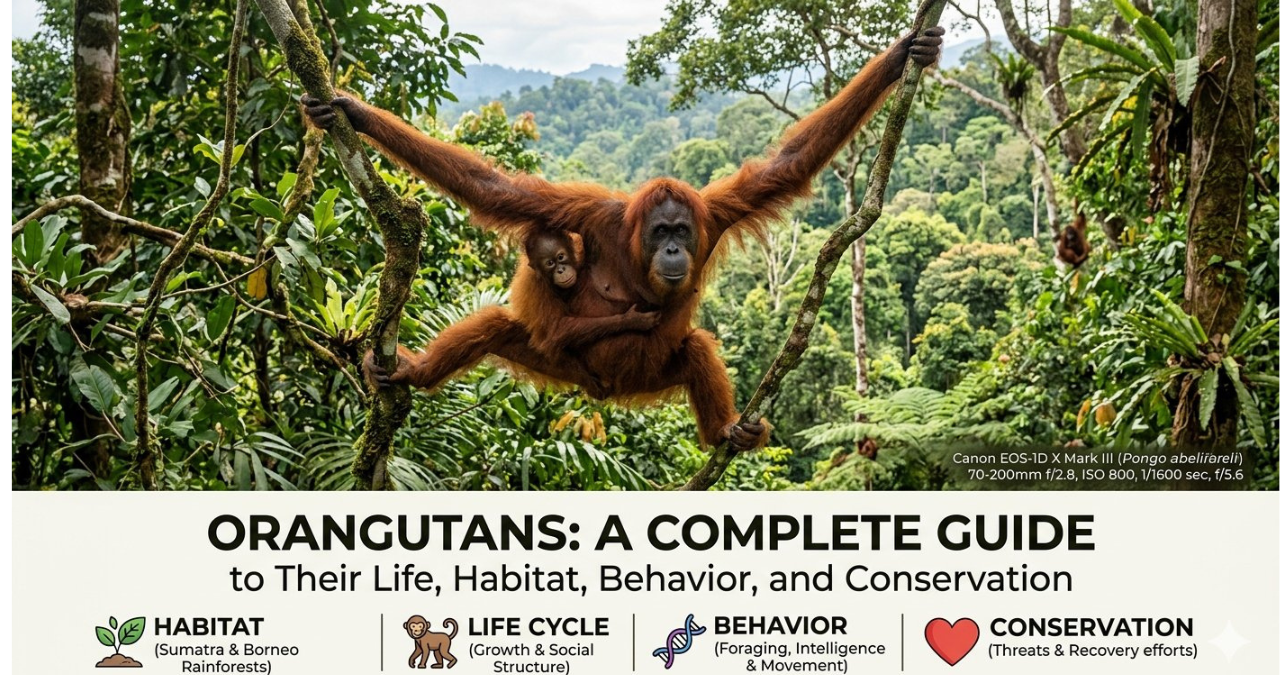

Orangutans are among the most fascinating animals on Earth. With their bright reddish-brown hair, long arms, intelligent eyes, and remarkable ability to live high in forest trees, they have captured the attention of people around the world. These great apes are closely related to humans and share many interesting physical and behavioral features with us.
The word orangutan comes from Malay and means “person of the forest.” The name is fitting because these animals spend most of their lives in tropical forests, where they climb trees, search for fruit, build sleeping nests, and care for their young. Today, however, their forest homes are under serious pressure from deforestation, agriculture, logging, hunting, and illegal wildlife trade.
There are three recognized species of orangutan: the Bornean orangutan, the Sumatran orangutan, and the Tapanuli orangutan. All three face significant conservation challenges. The Tapanuli orangutan is especially vulnerable because fewer than 800 are estimated to remain.
Learning about orangutans isn’t simply about appreciating an unusual animal. Their survival is closely connected to the health of tropical forests. By understanding their lifestyle, diet, intelligence, threats, and conservation needs, people can better understand why protecting these great apes matters.
What Are Orangutans?
Orangutans are great apes belonging to the genus Pongo. They are members of the same broad ape family that includes humans, chimpanzees, bonobos, and gorillas.
Unlike many other large mammals, orangutans are highly adapted to life in trees. Their long and powerful arms help them reach branches, while their hands and feet provide a strong grip. Their bodies are built for moving through forest canopies where branches may be far apart.
Orangutans are also known for their intelligence. They can learn new behaviors, solve problems, remember locations, and use objects in useful ways. Their intelligence becomes especially important when they search for food in changing forest environments.
Adult males can become much larger than females. Some adult males may weigh up to around 200 pounds. Mature males can also develop large cheek pads, known as flanges, which make their faces appear much wider. They may also have a throat sac that helps them produce loud calls across the forest.
Where Do Orangutans Live?
Wild orangutans are found only on the Southeast Asian islands of Borneo and Sumatra. Their natural range has become much smaller over time because large areas of forest have been cleared or changed by human activity.
Borneo is home to the Bornean orangutan, while the Sumatran orangutan lives mainly in northern Sumatra. The Tapanuli orangutan has an extremely limited range in the Batang Toru ecosystem of North Sumatra.
These forests provide everything orangutans need:
- Food such as fruit, leaves, flowers, and insects
- Tall trees for movement
- Branches for sleeping nests
- Natural shelter
- Water sources
- Safe places for mothers to raise their young
Orangutans spend most of their lives above the ground. Sumatran orangutans are particularly dependent on trees, with females rarely traveling on the ground. Bornean orangutans are somewhat more likely to come down from trees.
Their dependence on forests makes habitat destruction an especially serious problem. When forests disappear, orangutans don’t simply lose a place to live—they lose their food sources, travel routes, nesting locations, and opportunities to reproduce.
The Three Species of Orangutans
For many years, people commonly discussed orangutans as though they were one species. Modern scientific research recognizes three living species.
| Species | Main Location | Conservation Status | Key Feature |
|---|---|---|---|
| Bornean orangutan | Borneo | Endangered | Broader face and strong adaptation to forest habitats |
| Sumatran orangutan | Sumatra | Critically Endangered | Strongly arboreal and often more socially connected |
| Tapanuli orangutan | North Sumatra | Critically Endangered | Extremely small and restricted population |
The Bornean orangutan is estimated to number around 104,700, while the Sumatran orangutan is estimated at about 13,846. The Tapanuli orangutan has fewer than 800 individuals according to WWF’s current overview.
These numbers should be understood as estimates rather than exact counts. Wildlife populations are difficult to measure because orangutans live in large, dense forests and often travel across difficult terrain.
Bornean Orangutans
Bornean orangutans live across parts of Borneo, including areas of Indonesia and Malaysia. They have a somewhat broader face and shorter facial hair than Sumatran orangutans.
Their populations have experienced major declines. WWF reports that Bornean orangutan populations have fallen by more than 50 percent over the past 60 years, while their habitat has been reduced substantially.
The species is affected by logging, agriculture, mining, fires, hunting, and habitat fragmentation.
Sumatran Orangutans
Sumatran orangutans are found mainly in northern Sumatra. They are almost entirely tree-dwelling, particularly females.
They can have longer facial hair than Bornean orangutans and are often described as having stronger social relationships. Large fruiting trees can sometimes bring several individuals together to feed.
Their population is much smaller than that of the Bornean species, making every breeding individual extremely important.
Tapanuli Orangutans
The Tapanuli orangutan was recognized as a separate species in 2017. It lives in a restricted forest area of North Sumatra.
With fewer than 800 individuals estimated to remain, it is considered one of the world’s most endangered great apes. Its small population and limited habitat make it highly vulnerable to disease, natural disasters, habitat changes, and human activity.
What Do Orangutans Eat?
Orangutans are primarily fruit eaters, although their diet is much more varied than many people realize.
Fruit can make up a large portion of their diet. They may eat figs, mangoes, lychees, mangosteens, and many other forest fruits. They also consume:
- Young leaves
- Shoots
- Flowers
- Tree bark
- Insects
- Eggs
- Soil
- Other small food items when available
WWF reports that fruit makes up about 60 percent of the orangutan diet.
Their diet changes depending on what is available in the forest. During periods when certain fruits are abundant, orangutans may focus heavily on those foods. When fruit becomes scarce, they adapt by eating other plant materials and small sources of animal protein.
This flexible feeding behavior is important because tropical forests don’t produce the same foods equally throughout the year.
Orangutans as Forest Gardeners
Here’s something remarkable: orangutans help forests grow.
When they eat fruit, they often swallow seeds. Later, those seeds pass through their digestive systems and are deposited in different parts of the forest. This process helps plants spread.
Because orangutans travel through large forest areas, they can transport seeds away from the parent trees. Some plants benefit greatly from this natural process.
For this reason, orangutans are sometimes described as “gardeners of the forest.” Their role is not merely interesting; it is important for maintaining healthy tropical ecosystems.
A healthy orangutan population therefore supports more than just the survival of one animal species. It can contribute to the regeneration and diversity of the wider forest.
How Orangutans Move Through Trees
An orangutan moving through a rainforest canopy is an impressive sight.
Their long arms allow them to reach branches that would be difficult for many other animals to access. Their hands and feet can grip branches securely, helping them move through complicated networks of vegetation.
Their movement isn’t always fast. In fact, orangutans often move carefully. They test branches before placing their full weight on them, especially when traveling through high trees.
This cautious approach makes sense. A fall from a great height could cause serious injury.
Unlike some monkeys that frequently leap quickly between branches, orangutans often use a slower style of movement. They may hang from one branch, reach toward another, and shift their weight gradually.
Their bodies are essentially designed for life in the canopy.
Orangutan Intelligence and Problem-Solving
Orangutans are among the most intelligent animals on the planet.
Their intelligence can be seen in many aspects of their daily lives. They can remember locations where food is available, learn from experience, manipulate objects, and develop solutions to challenges.
They can also use simple objects as tools. In controlled environments and natural settings, researchers have observed orangutans demonstrating impressive learning abilities.
This intelligence is particularly valuable in forests where food isn’t always easy to find.
An orangutan may need to remember which trees produce fruit, when certain foods become available, and how to access difficult food sources. In other words, surviving in the rainforest requires more than physical strength—it requires a good memory and flexible thinking.
Their intelligence is another reason why orangutans are so valuable to scientific research. Studying them can help researchers understand the evolution of intelligence, learning, memory, and social behavior in great apes.
Orangutan Families and Young
Adult orangutans are generally more solitary than humans and many other primates. However, mothers and their young form very strong relationships.
A young orangutan depends heavily on its mother. The mother teaches the infant how to move through trees, find food, build nests, and recognize dangers.
This learning process takes years.
According to WWF, young orangutans can remain with their mothers for up to eight years, which is longer than the period seen in any other great ape.
During this time, the young animal isn’t simply growing physically. It’s also receiving a practical education in survival.
The mother demonstrates where to find food and how to handle different forest situations. The young orangutan watches, copies, experiments, and gradually becomes more independent.
This long childhood is closely connected to the species’ intelligence.
Orangutan Reproduction
Orangutans reproduce slowly compared with many other mammals.
Females generally give birth to one infant at a time, and the period between births can be several years. WWF notes that orangutans have an extremely low reproductive rate, with females giving birth roughly every three to five years in its general species overview. Sumatran orangutans can have even longer intervals reported in some populations.
This slow reproduction creates a major conservation challenge.
Imagine a population losing many adult females because of hunting or habitat destruction. Replacing those animals naturally can take decades.
That’s why protecting adult females and their young is especially important. Conservation isn’t simply about increasing the number of animals today. It is about creating safe conditions that allow future generations to survive.
The Biggest Threats Facing Orangutans
The future of orangutans is closely connected to the future of tropical forests.
Several major threats affect them.
Deforestation
Deforestation is one of the most serious problems.
Forests are cleared for agriculture, plantations, logging, roads, mining, and other forms of development. When forests are removed, orangutans lose their homes.
Even when some forest remains, roads and cleared land can divide it into smaller sections. This fragmentation can make it harder for orangutans to move between populations.
Palm Oil Production
Palm oil is an important agricultural product used in many everyday goods. However, unsustainable plantation expansion can destroy tropical forests.
WWF identifies agricultural expansion, including palm oil development, as an important threat to orangutan habitat.
The solution isn’t necessarily to eliminate palm oil altogether. Instead, sustainable production and better land management can help reduce damage to important wildlife habitats.
Illegal Wildlife Trade
Young orangutans can be targeted for the illegal pet trade.
Because mothers commonly protect their young, capturing an infant can result in the death of the mother. This makes wildlife trafficking especially devastating for wild populations.
Rescue organizations and government agencies work to stop illegal trade, care for confiscated animals, and, where possible, return rehabilitated orangutans to suitable forest habitats.
Hunting
Hunting can also reduce populations.
Orangutans may be hunted for food, killed because of conflict with agricultural activities, or captured for illegal trade. Because they reproduce slowly, even relatively small losses can have serious long-term effects.
Why Orangutans Need Our Help
Protecting orangutans isn’t only about saving a beautiful animal.
Their survival is linked to the health of tropical forests. These forests support countless plants and animals while also providing important resources for human communities.
Forests can help provide:
- Fresh water
- Food
- Natural resources
- Climate benefits
- Wildlife habitat
- Protection against soil erosion
- Economic opportunities through responsible tourism
Sumatran forests, for example, provide water resources for communities while also supporting many other threatened species.
When people protect orangutan habitat, they often protect an entire ecosystem at the same time.
Conservation Efforts for Orangutans
There is good news, too. Conservation groups, governments, scientists, local communities, and wildlife experts are working to protect these animals.
Conservation efforts include:
- Protecting remaining forests
- Restoring damaged habitats
- Preventing illegal hunting
- Fighting wildlife trafficking
- Monitoring wild populations
- Supporting local communities
- Creating wildlife corridors
- Promoting sustainable agriculture
- Rescuing and rehabilitating confiscated orangutans
- Educating the public
WWF has worked on orangutan conservation since the 1970s and continues to support habitat protection, sustainable forestry and agriculture, anti-poaching efforts, population monitoring, and wildlife-trade prevention.
Recent conservation work also shows that agriculture and wildlife protection don’t always have to be enemies. WWF reported in 2026 on coffee agroforestry work in Indonesia designed to support forest landscapes while helping local livelihoods.
How Ordinary People Can Help Orangutans
You don’t have to live in Borneo or Sumatra to support orangutan conservation.
Small choices can make a difference.
People can:
- Learn about responsible palm oil products.
- Avoid purchasing illegal wildlife products.
- Support reputable conservation organizations.
- Share accurate information about endangered wildlife.
- Choose tourism companies that respect wildlife.
- Never support keeping wild orangutans as pets.
- Encourage sustainable business practices.
- Support forest restoration projects.
Perhaps most importantly, people should remember that wild animals belong in healthy natural habitats. An orangutan may look cute and friendly, but it isn’t a household pet.
Interesting Facts About Orangutans
Here are some fascinating facts worth remembering:
- The word orangutan means “person of the forest.”
- Orangutans are great apes.
- They are the largest tree-dwelling mammals.
- They live naturally in Borneo and Sumatra.
- There are three recognized living orangutan species.
- Their diet includes large amounts of fruit.
- They help spread seeds through tropical forests.
- Adult males can develop large cheek pads.
- Young orangutans may stay with their mothers for up to eight years.
- Orangutans build nests in trees for sleeping and resting.
- Their long arms help them move through forest canopies.
- The Tapanuli orangutan has fewer than 800 estimated individuals.
- Habitat destruction is one of their greatest threats.
The Future of Orangutans
The future of orangutans is challenging, but it isn’t hopeless.
The greatest opportunity is to protect the forests that remain while restoring areas that have already been damaged. Conservation becomes stronger when local communities benefit from healthy forests and when governments, businesses, scientists, and conservation groups work together.
Protecting orangutans also requires patience. These animals reproduce slowly, and damaged forests can take many years to recover. There won’t be an overnight solution.
Still, progress is possible.
Better enforcement, responsible agriculture, forest restoration, wildlife rescue, scientific monitoring, and public education can all contribute to a safer future.
The story of orangutans should therefore not be told only as a story of decline. It should also be a story of responsibility, cooperation, and hope.
Final Thoughts on Orangutans
Orangutans are intelligent, remarkable, and deeply connected to the forests where they live. Their powerful arms, reddish hair, complex behavior, long childhood, and important role in seed dispersal make them one of nature’s most extraordinary great apes.
At the same time, their future remains fragile. Deforestation, agriculture, hunting, fires, logging, and illegal wildlife trade continue to put pressure on wild populations. Their slow reproduction means that recovery can take a very long time.
Yet there is reason for optimism. People are learning more about these animals, conservation programs are protecting forests, and communities are developing ways to live alongside wildlife. Every protected forest, rescued animal, restored habitat, and responsible decision can contribute to the bigger picture.
Ultimately, protecting orangutans means protecting more than one remarkable species. It means helping preserve the forests, plants, wildlife, and communities connected to them. With continued effort and responsible action, we can give orangutans a better chance to remain part of the world’s natural heritage for generations to come.
Orangutans: Behavior, Intelligence, Communication, and Daily Life
Orangutans are not only impressive because of their reddish hair and powerful arms. They are also highly intelligent great apes with complex memories, individual personalities, and fascinating ways of communicating. In the wild, their lives are shaped by the availability of food, forest conditions, and relationships with other orangutans.
Orangutans and Their Remarkable Intelligence
Orangutans are considered highly intelligent animals. Their intelligence can be seen in the way they solve problems, remember locations, learn from experience, and use objects in useful ways.
Scientists have studied orangutan memory and decision-making to better understand how great apes think. At the Smithsonian’s National Zoo, for example, orangutans have participated in memory activities involving touchscreens. These studies have helped researchers explore questions about memory, confidence, and metacognition—the ability to monitor one’s own knowledge or uncertainty.
In the wild, this mental ability is especially useful. An orangutan may need to remember:
- Which trees produce certain fruits
- When particular foods become available
- How to open difficult fruits
- Where water can be found
- Which areas are safe
- How to respond to another orangutan
- How to build a suitable sleeping nest
This is no small task. A tropical forest can contain hundreds of plant species, and food availability changes throughout the year.
How Orangutans Learn From Their Mothers
Young orangutans spend many years learning from their mothers. This long period of dependence gives a young ape time to develop the knowledge needed for survival.
A mother doesn’t simply provide food. She effectively acts as a teacher.
Young orangutans watch their mothers closely. They observe what she eats, how she travels through the trees, where she sleeps, and how she responds to unfamiliar situations.
Smithsonian researchers note that mothers teach their young about different foods, where those foods can be found, and how availability changes with the seasons. Young orangutans therefore need to learn a large amount of information before becoming independent.
This process is one reason why the loss of adult females can be particularly damaging to wild populations. When an experienced mother disappears, an infant can lose both a parent and an important source of survival knowledge.
Orangutan Communication
Orangutans may be relatively solitary compared with other great apes, but that doesn’t mean they are silent.
They communicate using:
- Facial expressions
- Body movements
- Touch
- Vocal sounds
- Branch shaking
- Long calls
- Other behavioral displays
Unlike some highly social primates, orangutans don’t need a huge collection of vocal signals to maintain large permanent groups. Their communication is closely connected to their more independent lifestyle.
Adult males can produce powerful long calls. These calls can travel through the forest and are used to attract females and discourage other males from approaching.
The large cheek pads found in mature males can also help amplify these calls. Their throat sacs add resonance, making the sound even more impressive.
What Is a Flanged Male Orangutan?
One of the most recognizable features of an adult male orangutan is the development of large cheek pads, commonly called flanges.
A flanged male can look dramatically different from a younger male. His face becomes wider, his body may become larger, and his hair can become longer.
These cheek pads are not simply decorative. They are associated with mature male behavior and help with vocal displays.
A mature male may use his long call to communicate over considerable distances. In a dense rainforest, this can be much more practical than constantly traveling around looking for other orangutans.
Orangutans Have Individual Personalities
Here’s something that makes orangutans especially interesting: individuals can have very different personalities.
Some may be adventurous and curious, while others may be quieter and more cautious. Some enjoy interacting with others, while others prefer their own space.
Observations of orangutans in human care have shown differences in patience, playfulness, curiosity, and social preferences. Smithsonian keepers have described individual animals displaying distinctive behaviors and preferences.
This reminds us that animals aren’t simply machines following fixed instructions. Their behavior can be flexible and influenced by experience.
Why Are Orangutans Mostly Solitary?
People sometimes assume that all great apes live in large groups. That’s not true.
Orangutans are the most socially solitary of the great apes. Adult males often spend much of their time alone, while females usually travel with their dependent young.
But calling them “solitary” doesn’t mean they have no social relationships.
Orangutans can recognize other individuals living within their home range. Females can have relationships with other females, and several orangutans may gather when large amounts of fruit are available.
Food is one of the biggest reasons behind this pattern.
When food is spread out, orangutans need to spread out too. When a fruiting tree provides plenty of food, several individuals may tolerate being close together.
In other words, their social lives are strongly influenced by the forest’s food supply.
Orangutans and Social Relationships
Although they don’t form large permanent troops, orangutans can be socially tolerant.
Females may travel with their offspring and encounter other familiar orangutans. Males generally have larger home ranges that overlap with those of several females.
During periods of abundant fruit, orangutans may form temporary feeding groups. These gatherings can provide opportunities for social interaction even though individuals generally maintain considerable independence.
This flexible social structure is fascinating because it shows that an animal doesn’t need to live in a large permanent group to have social knowledge.
The Special Bond Between Mother and Baby
The mother-infant relationship is one of the most important relationships in an orangutan’s life.
A young orangutan stays close to its mother for years. It may ride on her body, follow her through the trees, sleep beside her, and observe everything she does.
This long childhood is necessary because survival requires extensive knowledge.
The youngster must gradually learn:
- How to recognize edible foods
- How to travel safely
- How to build a nest
- How to handle different fruits
- How to avoid danger
- How to respond to other orangutans
- How to find resources during different seasons
Smithsonian sources describe orangutan infants as dependent on their mothers for roughly six or seven years, with exceptionally long intervals between births.
That’s a huge investment by the mother, but it makes sense for an animal whose survival depends heavily on learned knowledge.
How Orangutans Build Nests
As evening approaches, an orangutan doesn’t simply find a random branch and go to sleep.
It usually builds a nest.
Orangutans typically construct sleeping nests above the ground using branches and vegetation. They often build a fresh nest each night, although an older nest can sometimes be reused or repaired.
The nest provides a safer and more comfortable place to rest high in the forest.
Nest building also demonstrates their ability to manipulate materials and make decisions about their surroundings.
A young orangutan can watch its mother build nests and gradually learn how to do it independently.
Why Sleeping in Trees Matters
Living high above the forest floor can provide several advantages.
Trees may offer protection from some ground-based dangers and give orangutans direct access to their main food sources.
Their bodies are exceptionally well adapted to an arboreal lifestyle. Their arms are longer than their legs, and their hands and feet have long fingers and toes that help them grip branches. They also don’t have an external tail.
Moving through the canopy requires balance, strength, coordination, and careful judgment.
A branch that looks strong may not be able to support a large adult male. So orangutans often move thoughtfully rather than rushing.
Orangutans and Tool Use
One of the most exciting areas of orangutan research is tool use.
Some wild orangutans have been observed modifying objects to help them access food. Smithsonian researchers describe populations that use sticks for specific tasks, including probing tree trunks for foods such as honey. Some Sumatran orangutans also modify sticks to help open difficult fruits and collect seeds.
This behavior is important because it demonstrates flexibility.
A tool doesn’t have to be complicated. A simple stick can become useful when an animal understands how to modify it and how to apply it to a particular problem.
Orangutans Can Use Leaves as Sponges
Here’s a neat trick.
When water is difficult to reach, orangutans have been observed chewing leaves and turning them into a pulpy material that can absorb water.
They can then use the material to obtain moisture.
This is another example of practical intelligence. Instead of simply giving up when water is hard to reach, they can modify available materials to solve the problem.
What Does a Typical Orangutan Day Look Like?
A wild orangutan’s day revolves largely around finding food, moving through the forest, resting, and maintaining social relationships.
A simplified daily routine may look something like this:
| Part of Day | Common Activity |
|---|---|
| Morning | Leave sleeping nest and begin searching for food |
| Late morning | Feed on fruit, leaves, flowers, or other foods |
| Midday | Travel, feed, rest, or interact with other orangutans |
| Afternoon | Continue feeding and moving through the forest |
| Evening | Select a sleeping location and construct a nest |
| Night | Sleep high above the forest floor |
Of course, wild orangutans don’t follow a strict human-style timetable. Their activities change according to weather, food availability, forest conditions, age, and individual behavior.
Orangutans and Water
Although orangutans obtain much of their water from food, they also drink from natural sources.
They may collect water from tree holes, leaves, and other places where rainwater gathers.
During dry periods, finding enough water can become more difficult.
This makes their knowledge of the forest even more important. An experienced orangutan may know where water is available and how to access it.
How Strong Are Orangutans?
Don’t let their calm appearance fool you.
Orangutans are extremely strong animals.
Their long arms and powerful muscles allow them to move through trees, support their body weight, pull branches, and climb effectively.
Their strength is one reason that people who care for orangutans in zoos must treat them with great respect. Smithsonian animal-care staff describe them as both extremely intelligent and incredibly strong.
Their strength also means that enrichment objects must be selected carefully. A simple object can sometimes be used in unexpected ways by an intelligent and powerful ape.
Play and Enrichment
Young orangutans, like young humans, love to explore and play.
Play can help develop physical coordination and mental skills.
In zoos, keepers provide enrichment activities such as:
- Puzzle feeders
- Training sessions
- Novel objects
- Bubbles
- Boxes
- Paper materials
- Food-search activities
- Touchscreen games
- Climbing opportunities
These activities encourage natural behaviors such as exploration, problem-solving, manipulation, and foraging.
Enrichment isn’t simply entertainment. For intelligent animals, mental stimulation is an important part of good care.
Orangutans and Technology
You might be surprised to learn that some orangutans have used touchscreen computers.
At the Smithsonian’s National Zoo, orangutans have participated in cognitive studies involving touchscreen memory games. Other enrichment programs have also introduced technology to provide new forms of stimulation.
The purpose isn’t to turn orangutans into computer experts.
Instead, technology can provide researchers with controlled ways to study memory, decision-making, learning, and problem-solving.
It can also offer an engaging activity for animals living under human care.
Orangutans and Human DNA
Orangutans are among our closest relatives in the animal kingdom.
The Smithsonian’s National Zoo reports that humans and orangutans share about 97 percent of their DNA.
This genetic relationship helps explain why scientists study orangutans when investigating evolution, cognition, behavior, and other biological questions.
However, sharing much of our DNA doesn’t mean orangutans are simply “little humans.” They are a distinct species with their own needs, abilities, communication styles, and natural behaviors.
Respecting those differences is just as important as appreciating their similarities.
Orangutans in Captivity and Conservation
Zoos and specialized wildlife centers can play a role in orangutan conservation when animals are cared for under appropriate professional programs.
Modern care focuses on physical health as well as mental stimulation.
The Smithsonian’s National Zoo, for example, uses enrichment, training, social opportunities, and cognitive research to support the well-being of its orangutans. Its animals also participate in a Species Survival Plan designed to help maintain healthy and genetically diverse populations in accredited zoos.
However, protecting orangutans in captivity can never replace protecting their natural forests.
The ultimate goal of conservation remains the survival of healthy wild populations in functioning ecosystems.
Why Forest Protection Is So Important
Every aspect of an orangutan’s life is connected to the forest.
The forest provides:
- Food
- Water
- Nesting materials
- Shelter
- Travel routes
- Social opportunities
- Breeding habitat
When a forest is destroyed, all of these resources can disappear at once.
Fragmented forests can also isolate populations, making it more difficult for animals to move and maintain healthy genetic connections.
That is why habitat conservation is at the heart of orangutan protection.
Sustainable Choices Can Help
People far away from Indonesia can still play a role.
One important example is palm oil.
Palm oil is used in many packaged foods, cosmetics, soaps, and household products. The Smithsonian advises consumers to check product labels and support certified sustainable palm oil that aims to reduce deforestation.
The issue is complicated because palm oil is economically important and can produce high yields compared with some alternative oils.
The better approach is therefore to encourage responsible production rather than simply treating every palm oil product as identical.
Conservation Requires Cooperation
Saving orangutans isn’t a job for one organization.
It requires cooperation between:
- Local communities
- Governments
- Scientists
- Wildlife organizations
- Responsible businesses
- Rangers
- Forest managers
- Zoos
- Consumers
- International conservation groups
Local communities are especially important because people living near forests understand the landscape and depend on natural resources.
Conservation works best when protecting wildlife also supports sustainable livelihoods for people.
Lesser-Known Facts About Orangutans
Here are several facts that make these great apes even more fascinating:
- Orangutans are great apes, not monkeys.
- They are the largest mammals that spend most of their lives living in trees.
- They don’t have an externally visible tail.
- Their social lives are strongly influenced by food availability.
- Adult males can produce long calls that travel through the forest.
- Mothers teach young orangutans where and when to find different foods.
- Some wild orangutans use modified sticks as tools.
- Orangutans can use leaves to help collect water.
- They commonly build sleeping nests above the ground.
- Different orangutans can have noticeably different personalities.
- Young orangutans spend many years learning from their mothers.
- Their intelligence makes enrichment and mental stimulation important in professional care.
Frequently Asked Questions About Orangutans
Are orangutans monkeys?
No. Orangutans are great apes, along with humans, gorillas, chimpanzees, and bonobos.
Why are orangutans mostly solitary?
Their social structure is strongly connected to the distribution of food. Because fruit and other resources can be spread across large areas, orangutans often live more independently than other great apes.
Do orangutans use tools?
Yes. Some wild orangutans have been observed modifying sticks and other materials for specific tasks.
Do orangutans build nests?
Yes. They normally build sleeping nests above the ground, often creating a new nest each night.
How long do young orangutans stay with their mothers?
Young orangutans can remain dependent on their mothers for roughly six or seven years, while the full learning process can extend even longer.
Why are orangutans endangered?
The major pressures include habitat loss, forest destruction, agricultural expansion, hunting, and illegal wildlife trade.
Final Thoughts on Orangutans
Orangutans are extraordinary great apes whose intelligence, patience, strength, and complex behavior make them truly special. From building nests high in rainforest trees to remembering seasonal food sources and using simple tools, they demonstrate remarkable abilities.
Their lives also teach us an important lesson: intelligence alone isn’t enough to guarantee survival. Orangutans still depend on healthy forests, safe habitat, and responsible human behavior.
Protecting forests, supporting sustainable practices, preventing illegal wildlife trade, and educating future generations can all help. It may seem like a huge challenge, but conservation is built from many individual actions.
The more we understand orangutans, the better prepared we are to protect them. Their future depends on people choosing to value both the animals themselves and the remarkable forests they call home.
:::Explore more insightful articles on All Vantage News and never miss an update.Contact Us.