
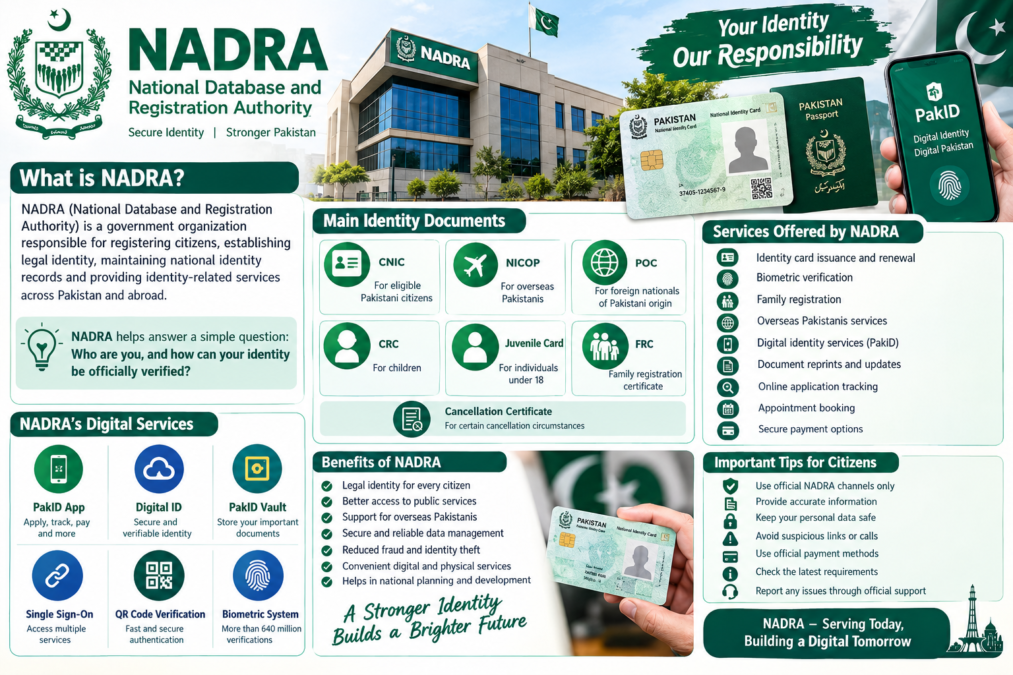

nadra is one of Pakistan’s most important public institutions. The National Database and Registration Authority is responsible for registering citizens, establishing legal identity, maintaining national identity records, and providing several identity-related services. Its work affects millions of people, from children receiving their first registration document to adults applying for identity cards and overseas Pakistanis managing their identity records.
In simple words, NADRA helps answer an important question: Who are you, and how can your identity be officially verified?
The organization operates a large identity management system supported by biometric technology and digital services. According to NADRA’s official website, its services include the Computerised National Identity Card (CNIC), National Identity Card for Overseas Pakistanis (NICOP), Pakistan Origin Card (POC), Child Registration Certificate (CRC), Juvenile Card, Family Registration Certificate (FRC), and cancellation certificates.
Over time, NADRA has also moved toward digital services. Its PakID mobile application allows eligible users to apply for identity documents, renew or reprint certain documents, upload information, make payments, and track applications.
This article explains what NADRA is, why it matters, what services it provides, how its digital system works, and how it continues to develop Pakistan’s identity infrastructure.
What Is nadra?
NADRA stands for National Database and Registration Authority.
It was established under the National Database and Registration Authority Ordinance, 2000. The official NADRA website explains that the organization is responsible for registering citizens and establishing their legal identity. It maintains a central national identity database and provides secure identity credentials and verification services.
NADRA isn’t simply an office where people go to collect identity cards. It is part of a much larger national identity system.
Its responsibilities include:
- Registering eligible citizens
- Maintaining identity information
- Issuing identity documents
- Supporting biometric identification
- Providing electronic identity verification
- Offering services to overseas Pakistanis
- Maintaining family-related registration records
- Supporting digital identity services
- Helping public and private organizations verify identities
The scale of this work is enormous. NADRA reported more than 222.6 million registered individuals in its July 31, 2026 statistics, along with hundreds of registration centres, mobile registration vans, and other service facilities.
That scale shows why a reliable identity system is so important for a country as large and diverse as Pakistan.
Why nadra Is Important for Pakistan
Identity is the foundation of many everyday activities.
A person may need an official identity document to access government services, complete financial activities, travel, register important life events, or prove personal information.
Without a reliable identity system, it can become difficult to distinguish between genuine records and false information.
NADRA helps create a more organized system by giving eligible individuals an official identity record.
Its importance can be understood through several areas.
Legal Identity
NADRA helps establish an individual’s recognized identity within Pakistan’s national registration system.
Public Services
Government departments and other organizations can use identity verification systems to confirm information.
Financial Activities
Verified identity can be important when dealing with banks and other regulated services.
Family Records
NADRA provides Family Registration Certificates that reflect and verify family composition data recorded for a registered person.
Digital Services
As more government and private services move online, secure digital identity becomes increasingly important.
National Planning
Accurate demographic information can help institutions understand population patterns and plan services.
So, while an identity card might look like a small plastic document, the system behind it has a much larger purpose.
Main Identity Documents Offered by nadra
One of the most important things to understand about nadra is that it doesn’t provide only one type of document.
Different people may need different identity or registration documents depending on their age, citizenship, residence, and circumstances.
| Document | Main Purpose |
|---|---|
| CNIC | Identity document for eligible Pakistani citizens |
| NICOP | Identity document for Pakistani citizens living abroad |
| POC | Identity card for eligible foreign nationals of Pakistani origin |
| CRC | Registration document for children |
| Juvenile Card | Identity document for eligible individuals under 18 |
| FRC | Shows recorded family composition |
| Cancellation Certificate | Used for certain cancellation circumstances |
NADRA officially lists CNIC, NICOP, POC, CRC, Juvenile Card, FRC, and cancellation certificates among its identity services.
Each document has its own eligibility requirements and application process. Therefore, applicants should check the official NADRA requirements before submitting an application.
Understanding the CNIC
The Computerised National Identity Card, commonly called the CNIC, is one of NADRA’s best-known identity documents.
NADRA states that the CNIC is issued under Sections 9 and 10 of the NADRA Ordinance, 2000.
For many Pakistani adults, the CNIC is an essential form of official identification.
It may be needed when dealing with different government and private services.
The CNIC system is important because it connects an individual with an official identity record.
Applicants may need supporting documents depending on their situation. NADRA’s official guidance explains that applicants must establish eligibility and provide the required evidence. The organization also warns that submitting false or misleading information or fake documents can have legal consequences.
Therefore, applicants should always provide accurate information.
A small mistake can create unnecessary delays, while intentionally providing false information can create much more serious problems.
NICOP and Services for Overseas Pakistanis
Pakistan has a large overseas community, and nadra provides identity services designed for Pakistani citizens living abroad.
The National Identity Card for Overseas Pakistanis, or NICOP, is issued to Pakistani citizens residing outside Pakistan under Section 12 of the NADRA Ordinance, 2000.
NADRA has developed digital services to make identity-related processes easier for overseas applicants.
According to the official overseas services information, applicants can use the PakID mobile application for various identity services, including document processing, application tracking, document uploads, appointment-related functions, and online payments where available.
This is particularly useful because overseas applicants may live far away from Pakistani missions or other physical service locations.
Digital services can reduce unnecessary travel and make the process more convenient.
Of course, some cases may still require physical verification or a visit to a registration centre. Applicants should therefore follow the instructions shown for their specific service.
Understanding the Pakistan Origin Card
The Pakistan Origin Card, commonly known as POC, serves eligible foreign nationals of Pakistani origin.
According to NADRA, a POC may be issued to certain foreign nationals who have a Pakistani background. Eligibility can include people who previously held Pakistani citizenship, people with Pakistani parents or grandparents, and certain spouses of Pakistani citizens or individuals of Pakistani origin, subject to the applicable requirements.
NADRA currently describes different forms of POC, including Smart POC and a newer QR-code-based POC.
The organization says the newer QR-code feature is designed to support faster verification and authentication of cardholder information.
For eligible people of Pakistani origin living abroad, the POC can therefore provide an important connection with Pakistan.
Child Registration Certificate and Juvenile Card
Children also need proper registration.
NADRA provides the Child Registration Certificate (CRC) and Juvenile Card for individuals under 18, according to its official identity-document information.
The CRC is commonly associated with child registration and family records.
Proper registration during childhood is important because accurate records can help establish a person’s identity and family relationship as they grow older.
Parents and guardians should therefore make sure that information submitted for a child’s registration is correct.
Important information may include:
- Child’s name
- Date of birth
- Parents’ information
- Family details
- Relevant supporting records
Because requirements can change according to individual circumstances, families should check NADRA’s current instructions before applying.
What Is an FRC?
The Family Registration Certificate, or FRC, is another important service offered by NADRA.
NADRA describes the FRC as a certificate that reflects, verifies, and provides a record of the family composition data of a registered person.
In simple terms, an FRC helps show the family information recorded in the NADRA system.
It can be useful when an organization needs official evidence of recorded family relationships.
The certificate is particularly useful because family information can play an important role in many administrative processes.
However, users should remember that an FRC reflects the information available in NADRA’s records. If there is an error in the underlying record, the relevant correction process may need to be completed first.
nadra and Biometric Verification
One of NADRA’s most important technological features is biometric verification.
Biometric identification uses physical characteristics to help verify a person’s identity.
Depending on the service, biometric processes can involve fingerprints or other identity verification methods.
NADRA says its verification services provide electronic authentication for public and private sectors. Its official website currently reports more than 640 million biometric verifications.
This enormous number demonstrates how widely identity verification technology is used.
Biometric verification can help reduce problems associated with identity fraud and incorrect identification.
However, technology is only one part of the process. Accurate records, proper documentation, secure systems, trained staff, and responsible data handling are also essential.
The Role of the PakID Mobile App
One of the biggest developments in modern nadra services is the PakID mobile application.
The official NADRA website describes PakID as its official mobile application for identity registration, updates, and application tracking.
The application provides several features, including:
- Applying for certain identity documents
- Renewing eligible documents
- Requesting reprints
- Uploading documents
- Capturing photographs
- Biometric verification
- Digital signature capture
- Tracking applications
- Making eligible online payments
This approach can save time because applicants don’t always need to begin the process through a physical registration centre.
NADRA also states that PakID supports multiple payment methods depending on service eligibility, including cards and selected mobile-wallet and payment options.
Still, users should only download and use the official application.
With identity services, security matters enormously. People should avoid sharing personal information through unofficial websites, suspicious links, or unknown applications.
Digital Identity and the Future of nadra
The future of nadra is closely connected to digital identity.
NADRA describes Digital ID as a legal, secure, and verifiable credential that can help eligible individuals access digital services, transactions, and interactions.
This represents an important change.
In the past, people often needed physical documents for many processes.
Digital identity can make it possible to verify information electronically.
NADRA’s Digital ID initiative focuses on:
- Secure identification
- Digital authentication
- Access to public services
- Access to private digital services
- Privacy
- Consent
- Data protection
The official Digital ID information also describes a system where individuals can control how their information is shared.
This is an encouraging development because convenience should go hand in hand with privacy.
PakID Vault and Digital Documents
Another interesting development is the PakID Vault.
NADRA describes the PakID Vault as a secure digital space where users can store and view important documents, including identity documents, degrees, licences, and certificates.
The system is designed to make documents easier to access while reducing the need to carry physical papers.
NADRA says documents in the vault can have unique QR codes that can be used for verification. It also describes offline verification through QR-code scanning.
This could become increasingly useful as Pakistan’s digital economy grows.
Imagine having several important documents available securely through one verified digital identity.
That could save time, reduce paperwork, and make verification more convenient.
The New QR-Code-Based National Identity Card
NADRA has also introduced a newer QR-code-based national identity card.
In an August 14, 2026 announcement, NADRA said it introduced a chipless national identity card built around a secure QR code. The organization stated that the card is manufactured in Pakistan and is designed to support secure digital verification through the PakID mobile application.
This development is significant because it reflects a move toward locally produced technology and digital verification.
According to NADRA, the new design replaces the imported microchip with a secure QR code containing relevant cardholder information and the person’s photograph.
Technology doesn’t stand still.
As smartphones become more common and digital services expand, identity systems must also evolve.
How nadra Supports Good Governance
A strong identity system can support good governance in many ways.
When people have reliable identity records, government organizations can work with better information.
Identity verification can help reduce administrative errors and make certain services more efficient.
NADRA’s own official material describes its identity infrastructure as supporting governance, public service delivery, and national development.
For example, reliable identity records can support:
- Better verification
- More organized government services
- Improved record management
- Digital public services
- More efficient administration
- Reduced opportunities for identity misuse
Of course, no system is perfect.
A modern identity system must continuously improve its security, accuracy, accessibility, and customer support.
Privacy and Data Security
Because NADRA handles sensitive identity information, privacy is extremely important.
A national identity database contains information that should be protected carefully.
NADRA’s digital identity program emphasizes privacy, consent, and data protection. Its Digital ID information explains that individuals should have control over access to their information in supported systems.
Users should also take responsibility for their own security.
They should:
- Use official NADRA websites and applications
- Avoid suspicious links
- Never share passwords unnecessarily
- Protect verification codes
- Avoid giving personal information to unknown callers
- Check official instructions before making payments
- Report suspicious activity through appropriate official channels
In short, digital convenience is great, but security must come first.
NADRA Registration Centres and Mobile Services
Although digital services are expanding, physical registration centres remain important.
Not everyone has reliable internet access, a suitable smartphone, or the ability to complete every digital verification step.
NADRA’s official statistics list hundreds of inland registration centres as well as mobile registration vans and other service facilities.
Mobile registration services are especially useful for reaching communities where access to permanent offices may be difficult.
This combination of physical and digital services gives NADRA a wider reach.
People can use the method that best fits their circumstances, depending on the service and eligibility.
How to Use nadra Services Responsibly
When dealing with nadra, accuracy is extremely important.
Applicants should carefully review all information before submitting an application.
A responsible applicant should:
- Use accurate personal information
- Provide genuine supporting documents
- Follow official instructions
- Keep application details safe
- Use official payment channels
- Track applications through official systems
- Respond to requests for additional information
- Keep important receipts or reference information
- Avoid agents who promise illegal shortcuts
It may be tempting to look for a faster way when dealing with paperwork.
But taking shortcuts can create bigger problems later.
The safest approach is to follow the official procedure.
Common Challenges Applicants May Face
Even a modern identity system can involve challenges.
Some applicants may experience problems because their information doesn’t match older records.
Others may need additional documents to establish their eligibility.
Common difficulties can include:
- Incorrect personal information
- Differences between documents
- Missing supporting records
- Biometric verification difficulties
- Family-record issues
- Application delays
- Technical problems
- Unclear documentation requirements
The correct response is not to panic.
Instead, applicants should check the official instructions and contact NADRA through its official support channels when necessary.
NADRA’s website currently provides a helpline, complaint contact, FAQs, and other support options.
Why Official Information Matters
Identity services are sensitive.
That’s why people should be careful when reading information online.
Many unofficial websites publish information about CNICs, fees, application procedures, and requirements. Some may be outdated or incomplete.
The best source for current requirements is NADRA itself.
The official website provides information about identity documents, services, fees, application procedures, FAQs, and digital services.
Rules and procedures can change, so information found in an old social media post may no longer be correct.
When in doubt, check the official source.
The Importance of Customer Service
A large national organization must also focus on customer experience.
NADRA’s Services Charter states that the organization is committed to transparent, efficient, and accessible services. It also describes application processes, timelines, requirements, and expectations for citizens and stakeholders.
Good customer service matters because identity problems can affect important areas of a person’s life.
A clear process can reduce confusion.
Helpful instructions can reduce mistakes.
Accessible support can help people resolve problems more quickly.
In the long run, better customer service benefits both the organization and the public.
nadra and Pakistan’s Digital Future
Pakistan is becoming increasingly digital.
People are using smartphones for banking, education, shopping, communication, government services, and business.
As this happens, reliable digital identity becomes more important.
NADRA is positioned at the centre of this transformation because identity verification is one of the foundations of digital services.
The move toward Digital ID, PakID, QR-code verification, digital document storage, and single sign-on demonstrates this direction. NADRA’s official information describes PakID Single Sign-On as a way for users to access multiple connected services through one verified login, with identity verification and consent-based data sharing.
This could make digital government services easier to use.
Instead of remembering many accounts, users may increasingly be able to rely on a trusted identity system.
Benefits of Modernizing Identity Services
Modern identity systems can offer several advantages.
Convenience
People can complete more tasks from home.
Speed
Digital applications can reduce unnecessary paperwork and travel.
Better Verification
Biometric and digital verification can strengthen identity authentication.
Accessibility
Online systems can help people who live far from service centres.
Record Management
Digital records can be easier to organize and verify than large volumes of paper documents.
Transparency
Application tracking can help people understand the progress of their requests.
These benefits explain why digital identity has become an important part of modern public administration.
A Simple Comparison of Traditional and Digital Services
| Feature | Traditional Approach | Digital Approach |
|---|---|---|
| Application | Physical visit often required | Online options available for eligible services |
| Documents | Paper copies commonly used | Digital uploads can be supported |
| Tracking | May require follow-up | Application tracking through PakID |
| Verification | Physical processes | Digital and biometric options |
| Payments | Physical/payment-centre options | Online payment options for eligible services |
| Convenience | Depends on location | Greater remote accessibility |
| Technology | Paper-based records and systems | Mobile and digital identity infrastructure |
The two approaches aren’t necessarily enemies.
For a country with a large and diverse population, both physical and digital services can work together.
Frequently Asked Questions About nadra
What does NADRA stand for?
NADRA stands for National Database and Registration Authority.
What is NADRA responsible for?
NADRA is responsible for national identity registration, identity documentation, identity verification, and related digital identity infrastructure in Pakistan.
What is a CNIC?
A CNIC is the Computerised National Identity Card issued by NADRA to eligible Pakistani citizens.
What is NICOP?
NICOP stands for National Identity Card for Overseas Pakistanis. It is issued to Pakistani citizens residing abroad.
What is a POC?
POC stands for Pakistan Origin Card. It is available to eligible foreign nationals of Pakistani origin under NADRA’s applicable rules.
What is an FRC?
An FRC, or Family Registration Certificate, provides a record of the family composition information maintained for a registered person.
What is PakID?
PakID is NADRA’s official mobile application for identity services, including eligible applications, updates, document uploads, verification, payments, and application tracking.
Can overseas Pakistanis use NADRA digital services?
Yes. NADRA provides online services for overseas Pakistanis, including identity-related services through PakID.
Why is biometric verification important?
Biometric verification helps authenticate identity using biological characteristics and can strengthen the reliability of identity verification.
Where should people check current NADRA requirements?
Applicants should use NADRA’s official website, official PakID application, or official customer-support channels for the latest requirements.
Final Thoughts on nadra
nadra plays a vital role in Pakistan’s identity system. From CNICs and family records to NICOP, POC, child registration, biometric verification, and digital identity, its services touch many parts of everyday life.
The organization has also entered a new phase of digital development. PakID, Digital ID, digital document storage, QR-code verification, and single sign-on services show how identity management is moving beyond traditional paper processes.
At the same time, accuracy, privacy, security, and accessibility remain essential. A modern identity system must not only be fast; it must also be trustworthy.
For citizens, the best approach is straightforward: use official channels, provide correct information, protect personal details, and check the latest requirements before submitting an application.
Looking ahead, nadra has an important opportunity to make identity services even more convenient, secure, transparent, and accessible. As Pakistan continues its digital transformation, a reliable identity system can help connect citizens with government services and the wider digital economy.
Ultimately, nadra is more than an identity-card organization. It is an important part of Pakistan’s national identity infrastructure, and its continuing digital transformation can play a valuable role in building a more connected and efficient future.
NADRA and the Rise of Digital Identity Services
NADRA has become much more than a place where people receive an identity card. In recent years, its services have moved strongly toward digital platforms. This change is designed to make identity-related services easier, faster, and more accessible for citizens in Pakistan and overseas.
The official NADRA website now presents services such as CNIC, NICOP, POC, CRC, FRC, verification services, and PakID in a more organized digital system. NADRA also provides digital identity features that can help people use verified information when accessing online services.
This digital transformation is important because many people want to complete simple identity tasks without spending unnecessary time traveling to an office. Through the PakID platform, eligible users can apply for several identity services, upload documents, make payments, and track applications.
Understanding the NADRA CNIC System
The Computerised National Identity Card, commonly called the CNIC, is one of the most important services provided by NADRA. It serves as official proof of a citizen’s identity, nationality, and legal status in Pakistan.
For Pakistani citizens who have reached the required age, the CNIC becomes an important document for many everyday activities. It can be required when dealing with government departments, financial institutions, telecommunications companies, property matters, travel-related services, and other formal processes.
NADRA currently provides different forms of identity cards, including standard CNIC formats, Smart CNIC options, and newer QR-code-based identity cards. These formats are part of the country’s continuing effort to improve identity verification and security.
A CNIC can therefore be viewed as more than a simple plastic card. It connects an individual with an official identity record maintained through NADRA’s national identity system.
How Citizens Can Apply Through PakID
One of the biggest developments in NADRA services is the PakID mobile application. The application is designed as an official digital platform through which eligible users can access identity-related services from their mobile devices.
Depending on the service, users can perform tasks such as:
- Applying for eligible identity documents
- Renewing an existing identity document
- Requesting a reprint
- Updating certain information
- Uploading supporting documents
- Completing required digital steps
- Making online payments
- Tracking an application
- Using biometric verification features
- Capturing a live photograph
- Providing a digital signature
NADRA explains that PakID can support applications for services such as CNIC and NICOP, while some cases may still require a visit to a NADRA Registration Centre for biometric verification or other necessary steps.
This means the app doesn’t necessarily remove every physical step for every applicant. Instead, it can reduce unnecessary visits and allow users to complete many parts of the process digitally.
What Makes PakID Useful for Citizens?
The biggest advantage of PakID is convenience. A person can begin an eligible application from a smartphone instead of immediately visiting a registration centre.
For many users, this can make the process easier because documents and application information can be managed digitally.
Some important benefits include:
| Feature | Benefit |
|---|---|
| Online application | Reduces the need for unnecessary office visits |
| Document upload | Allows supporting documents to be submitted digitally |
| Application tracking | Helps users monitor application progress |
| Online payments | Provides digital payment options for eligible services |
| Live photo | Supports digital identity application requirements |
| Digital signature | Allows electronic submission where supported |
| Biometric features | Helps verify identity through approved methods |
| One account | Provides access to multiple connected services |
NADRA says PakID also provides secure payment options and application tracking, making it part of a wider mobile-first identity ecosystem.
NADRA Services for Overseas Pakistanis
NADRA is also important for Pakistanis living outside the country. Traveling to Pakistan simply to complete every identity-related task can be difficult and expensive for overseas citizens.
For this reason, NADRA provides services designed for overseas Pakistanis through digital channels and international service arrangements.
One major document is the National Identity Card for Overseas Pakistanis (NICOP). NADRA describes NICOP as an identity document issued to Pakistani citizens residing abroad.
The PakID platform can support several overseas identity processes, including applications, renewals, modifications, reprints, document uploads, application tracking, appointments, and online payments, depending on the service and applicant’s situation.
This can be particularly useful for Pakistani families living in different countries because they can manage many identity matters without making an unnecessary trip to Pakistan.
Pakistan Origin Card and Its Importance
Another important NADRA document is the Pakistan Origin Card, commonly known as POC.
According to NADRA, the POC is issued to eligible foreign nationals of Pakistani origin.
The service is useful for people who have a connection with Pakistan through their family or origin but do not fall into the same category as Pakistani citizens living abroad.
NADRA’s identity framework therefore serves different groups rather than using one document for everyone.
These documents include:
- CNIC for eligible Pakistani citizens
- NICOP for Pakistani citizens residing abroad
- POC for eligible foreign nationals of Pakistani origin
- CRC and Juvenile Card for children
- FRC for family composition records
- Cancellation Certificate for applicable cases
Each document has a different purpose, so applicants should select the correct service before beginning an application.
Child Registration and Family Records
NADRA also provides identity-related services for children and families.
The Child Registration Certificate, or CRC, is an important document for children. NADRA states that CRC and Juvenile Cards are identity documents issued to children under 18 years of age under the relevant rules.
Another useful document is the Family Registration Certificate, or FRC. It provides a record of family composition information associated with a registered person.
These services can be useful when families need official documentation for applications, educational matters, immigration processes, government services, or other formal requirements.
Keeping family information accurate is important because identity records can be connected with many services.
NADRA and Biometric Verification
Biometric verification is another major part of NADRA’s identity system.
Instead of relying only on names or printed information, biometric systems can help verify that a person is connected to a particular identity record.
NADRA’s official website reports more than 640 million biometric verifications and describes biometric verification as part of its identity verification services.
Biometric verification can be useful because names can sometimes be similar or incorrectly entered, while biometric characteristics provide another layer for identity authentication.
However, biometric systems must be handled carefully. Strong security practices, privacy controls, responsible data management, and proper authorization are essential when dealing with identity information.
NADRA and Digital Identity
The future of identity services is moving toward digital systems, and NADRA is developing a broader Digital ID ecosystem.
NADRA describes Digital Identity as a secure and verifiable form of identity that can help eligible individuals access digital services and transactions. The system is designed around secure identification, authentication, privacy, consent, and data protection.
This can make identity verification more convenient in an increasingly digital society.
For example, a person may eventually need to prove their identity online without repeatedly presenting physical documents. Digital credentials can help make this process simpler when the relevant service supports them.
The main idea is straightforward:
A trusted digital identity can become a secure key for accessing multiple services.
PakID Vault and Digital Documents
One interesting feature of NADRA’s Digital ID system is the PakID Vault.
NADRA describes the PakID Vault as a secure digital space where users can store and view important documents. These can include identity documents, degrees, licences, certificates, and other supported records.
The idea can be compared to a secure digital folder.
Instead of keeping every document only as a paper copy, a person can have supported digital records available through the digital identity environment.
The system also provides QR-based verification for verifiable credentials. NADRA says these credentials can be digitally verified, while QR codes can help make document validation easier.
This approach could be especially useful in situations where organizations need to confirm whether a digital document is genuine.
Single Sign-On and NADRA
Remembering many usernames and passwords can be frustrating. NADRA’s Digital ID system addresses this problem through Single Sign-On, or SSO.
According to NADRA, PakID SSO allows eligible users to log in using their verified identity and access connected government services without creating separate accounts for every service.
The basic concept is simple:
One verified identity can provide access to multiple connected services.
The system also emphasizes consent. NADRA states that information is shared when the user allows it, while users can check and control access to their information.
This type of system could save time while also reducing the need for people to repeatedly enter the same personal information.
New QR-Code-Based National Identity Card
In 2026, NADRA introduced a major development in Pakistan’s identity-card system.
On 14 August 2026, NADRA announced a new chipless National Identity Card based on a secure QR code. According to NADRA, the new card is manufactured in Pakistan and replaces an imported microchip with a secure QR-code approach.
The QR code can be read and verified through the PakID mobile application. NADRA says it contains relevant cardholder information and the cardholder’s photograph.
This development has several possible advantages:
- Greater local production
- Reduced dependence on imported microchips
- QR-based verification
- Smartphone-supported authentication
- Modern identity-card technology
- Greater integration between physical and digital identity
The change represents another step in NADRA’s wider digital transformation.
Why Identity Security Matters
Identity information is extremely important. A person’s name, identity number, photograph, biometric information, family information, and other records should not be treated casually.
A strong identity system therefore needs more than modern technology. It also needs responsible security policies.
NADRA’s Digital ID approach highlights privacy, consent, and data protection as important parts of digital identity.
Citizens should also follow basic security practices.
Important Safety Tips
- Never share your identity information unnecessarily.
- Don’t provide account passwords to other people.
- Be careful with suspicious messages or websites.
- Use official NADRA channels for applications.
- Check website addresses before entering personal information.
- Avoid sending identity documents to unknown individuals.
- Keep application information private.
- Use official payment methods.
- Report suspicious activity through appropriate official channels.
Technology can make services easier, but safe user behavior remains essential.
NADRA’s Growing Role in Pakistan
NADRA’s role is becoming increasingly important as more public services move online.
The organization already operates a large registration and verification network. NADRA’s official statistics, updated on 31 July 2026, report more than 222 million registered individuals, 963 inland registration centres, 10 centres abroad, 14 mega centres, 234 mobile registration vans, and more than 24,000 employees.
These figures show the scale of the identity infrastructure.
NADRA is not only maintaining records. It is also building systems that connect identity verification with modern digital services.
The redesigned NADRA website launched in April 2026 also reflects this change. The new platform brings identity services and information into a more structured digital environment and includes tools such as the Geospatially Referenced Demographic Information System, known as nGRIDS.
What the Future May Look Like
The future of NADRA will likely involve even greater use of digital identity, mobile applications, QR verification, biometric authentication, and connected government services.
Instead of visiting different offices for every small task, citizens may increasingly complete applications through digital platforms.
A future identity ecosystem could make it easier to:
- Verify identity online
- Access government services
- Store verified documents
- Share information with consent
- Track applications
- Complete digital payments
- Authenticate documents
- Access services from mobile devices
The goal isn’t simply to replace paper with technology. The larger goal is to make identity services more accessible, reliable, secure, and convenient.
Final Thoughts on NADRA
NADRA plays a central role in Pakistan’s national identity system. From CNIC and NICOP to POC, CRC, FRC, biometric verification, and digital identity, its services affect millions of people.
The organization is now moving beyond traditional identity cards toward a connected digital ecosystem. PakID, Digital ID, QR-based verification, digital credentials, and Single Sign-On are examples of this changing direction.
For citizens, the most important lesson is to use official NADRA channels, keep information accurate, protect personal data, and understand which identity service is appropriate for their needs.
As Pakistan continues its digital transformation, NADRA is likely to remain an important part of how citizens prove their identity and access public and digital services.
In simple words, NADRA is moving from a traditional identity-document system toward a modern digital identity ecosystem. That change can make everyday services faster and more convenient while placing an even greater focus on security, privacy, and responsible use of personal information.
Explore more insightful articles on All Vantage News and never miss an update.Contact Us.