
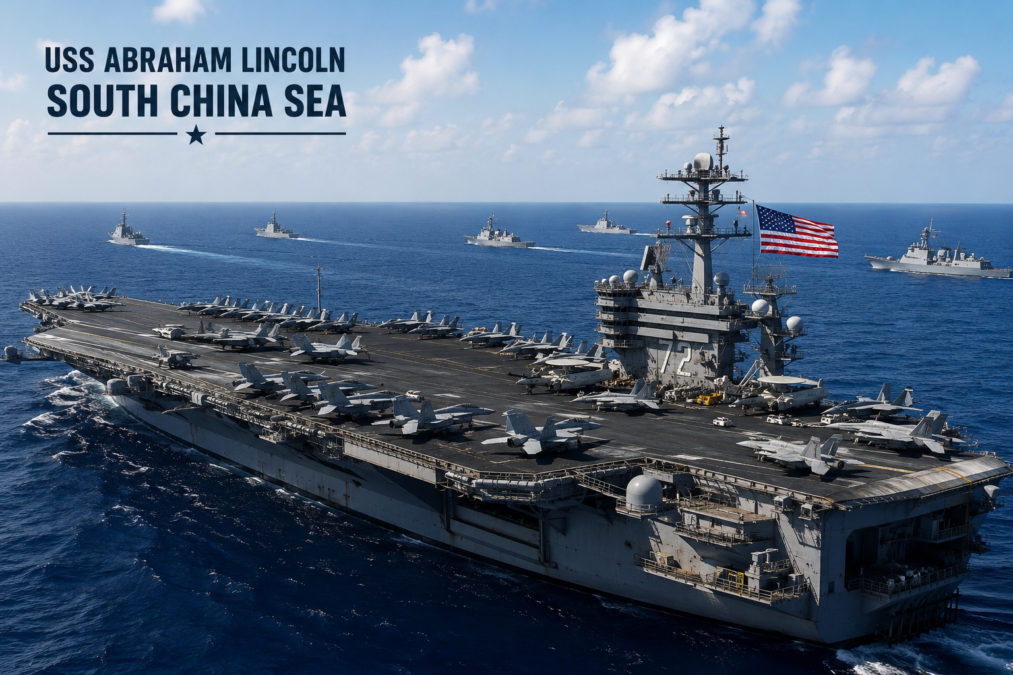

Introduction to USS Abraham Lincoln South China Sea
The USS Abraham Lincoln South China Sea story is an important part of understanding modern naval operations in the Indo-Pacific. The USS Abraham Lincoln (CVN-72) is a Nimitz-class nuclear-powered aircraft carrier and the flagship of Carrier Strike Group 3. Over the years, the carrier has operated in the South China Sea and other major waters of the Indo-Pacific as part of broader U.S. Navy missions.
The South China Sea is one of the world’s most important maritime regions. It connects major economies, supports busy shipping routes, and contains areas with overlapping territorial and maritime claims. Because of this, naval activity in the region receives considerable international attention.
When the USS Abraham Lincoln operates in or near the South China Sea, its activities can involve flight operations, maritime training, communications exercises, air-defense training, and cooperation with partner nations. These activities aren’t simply about the aircraft carrier itself. They are part of a much larger system involving ships, aircraft, sailors, commanders, and international partners.
The U.S. Navy has stated that its Indo-Pacific operations are designed to support regional security, strengthen partnerships, maintain readiness, and preserve freedom of navigation and overflight in accordance with international law.
Understanding the USS Abraham Lincoln South China Sea connection therefore requires looking at its history, military capabilities, missions, regional importance, and the wider diplomatic environment.
What Is the USS Abraham Lincoln?
The USS Abraham Lincoln is a Nimitz-class aircraft carrier named after the 16th president of the United States, Abraham Lincoln. Its official hull designation is CVN-72.
The letter and number combination also tells us something about the ship:
- CV identifies an aircraft carrier.
- N indicates that the carrier is nuclear-powered.
- 72 is the ship’s hull number.
An aircraft carrier of this class functions as a mobile airfield at sea. Instead of depending on a traditional land-based runway, the carrier can operate aircraft from its flight deck while sailing thousands of miles away from the United States.
The ship’s value isn’t limited to its size. A carrier can bring aviation, command-and-control capabilities, defensive systems, logistics, and a large crew into a maritime region.
The USS Abraham Lincoln normally operates as part of a carrier strike group rather than acting alone. This arrangement gives the carrier additional protection and allows the group to conduct complicated missions involving surface ships, aircraft, helicopters, and other supporting forces.
Why the South China Sea Matters
The South China Sea is a strategically important body of water in Southeast Asia. It lies between mainland Southeast Asia and the island chains stretching toward the Philippines, Taiwan, and Indonesia.
Several countries have maritime interests and competing claims in the region. These include China, the Philippines, Vietnam, Malaysia, Brunei, and Taiwan.
The sea is especially important because of its:
- Major international shipping routes
- Fishing resources
- Energy resources and exploration
- Strategic location
- Close connection to important Asian economies
- Military significance
Millions of people depend directly or indirectly on the sea for trade, fishing, transportation, and economic activity.
That makes stability especially valuable.
A military incident involving major naval forces could have consequences beyond the countries directly involved. It could affect commercial shipping, regional confidence, diplomatic relations, and international markets.
For that reason, the presence of large naval forces such as the USS Abraham Lincoln often attracts attention from governments, analysts, journalists, and security experts.
USS Abraham Lincoln South China Sea Operations
The USS Abraham Lincoln South China Sea connection has included significant exercises and routine operations.
One notable example occurred in January 2022, when the USS Abraham Lincoln Carrier Strike Group operated alongside the USS Carl Vinson Carrier Strike Group in the South China Sea. The U.S. Navy described the activities as dual-carrier operations conducted in international waters and in accordance with international law.
The exercises included several types of training:
- Air warfare exercises
- Anti-submarine warfare
- Maritime communications
- Replenishment at sea
- Cross-deck flight operations
- Maritime interdiction training
- Integrated maritime operations
These activities demonstrate why an aircraft carrier should be viewed as part of a larger naval network.
Two carrier strike groups operating together can practice complicated procedures that are difficult to perform during ordinary individual ship operations. Such training can improve coordination and readiness.
In 2022, the Abraham Lincoln Carrier Strike Group also operated in the South China Sea and Philippine Sea during a wider deployment. The U.S. Navy reported that the group conducted deterrence operations and exercises with Japan’s Maritime Self-Defense Force and other joint forces.
The Carrier Strike Group Behind the Ship
It’s easy to picture the USS Abraham Lincoln as one enormous ship sailing by itself. In reality, that’s not how a modern carrier strike group normally works.
A carrier strike group can include:
| Component | Main Role |
|---|---|
| Aircraft carrier | Main aviation and command platform |
| Carrier Air Wing | Provides aircraft and aviation capabilities |
| Guided-missile destroyers | Air defense, surface warfare, and escort duties |
| Cruiser or other major surface combatants | Command, defense, and combat capabilities |
| Logistics ships | Fuel, food, ammunition, and supplies |
| Helicopters | Maritime security, anti-submarine, rescue, and support missions |
The exact composition can change depending on the deployment and mission.
For example, the Abraham Lincoln Carrier Strike Group used in 2022 included Carrier Air Wing 9, Destroyer Squadron 21, the cruiser USS Mobile Bay, and several Arleigh Burke-class guided-missile destroyers.
This structure gives the carrier group greater flexibility.
In simple terms, the carrier is the heart of the formation, while the other ships and aircraft provide different layers of protection, information, logistics, and operational capability.
Aircraft Operating From USS Abraham Lincoln
One of the most impressive features of the USS Abraham Lincoln is its air wing.
Carrier Air Wing 9 has included a mixture of advanced aircraft. During recent Indo-Pacific operations, these have included:
- F-35C Lightning II
- F/A-18E/F Super Hornet
- EA-18G Growler
- E-2D Advanced Hawkeye
- MH-60S Seahawk
- MH-60R Seahawk
Each aircraft has a different job.
The F-35C is a carrier-capable stealth fighter designed for advanced sensing and combat missions. The F/A-18E/F Super Hornet is a versatile fighter and strike aircraft. The EA-18G Growler is designed for electronic warfare.
Meanwhile, the E-2D Advanced Hawkeye provides airborne early warning and command-and-control support.
Helicopters add another important capability. They can support anti-submarine warfare, search and rescue, logistics, and maritime security.
In August 2024, the Abraham Lincoln Carrier Strike Group participated in a major bilateral Multi-Large Deck Event with Italy’s Cavour Carrier Strike Group. U.S. Navy aircraft involved included F-35C Lightning II, F/A-18E/F Super Hornets, EA-18G Growlers, E-2D Hawkeyes, and MH-60 helicopters.
Why Aircraft Carrier Flight Operations Matter
Flight operations are one of the most demanding activities performed aboard an aircraft carrier.
Launching an aircraft from a moving ship requires careful coordination among pilots, deck crews, air traffic controllers, maintenance teams, and commanders.
The flight deck is a busy and dangerous environment. Aircraft move at high speed, deck crews work around powerful engines, and every operation must be carefully timed.
In the South China Sea, flight operations can serve several purposes.
They can help crews:
- Maintain aviation skills
- Practice day and night operations
- Test communication procedures
- Improve coordination
- Train pilots and deck crews
- Strengthen readiness
- Support wider maritime missions
The U.S. Navy has described carrier operations in the Indo-Pacific as part of maintaining maritime readiness and supporting regional security.
The bigger picture is important. Regular training helps sailors and pilots stay prepared without waiting for a crisis to occur.
USS Abraham Lincoln and the U.S. Seventh Fleet
The South China Sea falls within the enormous area of responsibility of the U.S. Seventh Fleet.
The Seventh Fleet is the U.S. Navy’s largest forward-deployed numbered fleet. According to the Navy, its area of operations covers more than 124 million square kilometers and extends across a huge portion of the Indo-Pacific.
The fleet works with numerous regional partners.
Its responsibilities can include:
- Maritime security
- Humanitarian assistance
- Search and rescue
- Joint military exercises
- Regional engagement
- Crisis response
- Maintaining readiness
This explains why the USS Abraham Lincoln can move between different parts of the Indo-Pacific during a deployment.
The South China Sea isn’t an isolated operating area. It’s connected to the Philippine Sea, East China Sea, Pacific Ocean, Indian Ocean approaches, and several strategically important waterways.
The Importance of Freedom of Navigation
One phrase often associated with U.S. naval activity in the South China Sea is freedom of navigation.
In general terms, freedom of navigation means that ships have rights and freedoms recognized under international law, subject to applicable legal rules.
The United States says its naval operations support a free and open Indo-Pacific and lawful maritime activity.
However, it’s important to distinguish routine naval operations from a specific freedom-of-navigation operation, commonly called a FONOP. Not every carrier deployment or exercise in the South China Sea is a FONOP.
A carrier strike group’s presence may involve training, deterrence, alliance cooperation, or general maritime operations.
This distinction helps readers avoid a common misunderstanding: a U.S. aircraft carrier operating in the South China Sea doesn’t automatically mean that it is conducting a freedom-of-navigation operation.
Relationship With Regional Allies
Modern naval strategy isn’t only about ships and weapons. Partnerships matter tremendously.
The USS Abraham Lincoln has operated with allies and partners during Indo-Pacific deployments.
Japan has been an important exercise partner. The Abraham Lincoln Carrier Strike Group participated in exercises with the Japan Maritime Self-Defense Force during its 2022 deployment.
The carrier group also conducted a major exercise with Italy’s Cavour carrier strike group in 2024.
That event was especially notable because it was described by the U.S. Navy as the first bilateral Multi-Large Deck Event between the U.S. and Italian navies in the Indo-Pacific.
These activities can improve interoperability.
Interoperability means different military forces can communicate, plan, and operate together effectively.
That’s crucial during emergencies. If countries already understand one another’s procedures, communication systems, and operational methods, they may be able to respond more effectively when unexpected events happen.
China and the Strategic Environment
The South China Sea is also important because of China’s growing military and maritime capabilities.
China has developed significant naval, air, coast guard, and maritime militia capabilities. It also maintains extensive facilities and infrastructure in parts of the South China Sea.
China views U.S. military operations in nearby waters through a different strategic lens from Washington.
This difference in perspective is one reason naval encounters in the region require careful management.
The United States argues that its operations support international law, freedom of navigation, and a free and open Indo-Pacific.
China has repeatedly criticized certain U.S. military activities near areas it considers strategically sensitive.
These competing positions create a complicated environment.
That doesn’t mean conflict is inevitable. In fact, professional military communication, established procedures, diplomacy, and responsible behavior at sea can help reduce risks.
Avoiding Misunderstandings at Sea
When major military ships operate close to one another, communication becomes extremely important.
Naval forces use established procedures to reduce the possibility of accidents or misunderstandings.
This matters because modern warships are extremely capable and can move quickly. Aircraft may also operate around them, adding another layer of complexity.
A small misunderstanding can become politically significant when it involves major powers.
Therefore, safety procedures, professional conduct, and communication are more than technical matters. They’re part of maintaining stability.
The goal isn’t simply to have powerful ships. The goal is to operate those ships responsibly.
The USS Abraham Lincoln’s 2024 Deployment
The Abraham Lincoln Carrier Strike Group had a particularly important deployment in 2024.
During that deployment, the group operated across the Indo-Pacific and later moved into the U.S. Central Command area.
The Pentagon announced in September 2024 that Secretary of Defense Lloyd Austin had directed the Abraham Lincoln Carrier Strike Group to remain in the U.S. Central Command theater during the Middle East crisis.
This development is useful for understanding modern carrier deployments.
An aircraft carrier isn’t permanently assigned to one sea. It can be redirected as strategic conditions change.
That’s one of its major advantages.
A carrier can move from one theater to another and provide aviation, command, and support capabilities without requiring a new airbase to be built.
Combat Operations During the 2024–2025 Deployment
The Abraham Lincoln’s later deployment also demonstrated that its mission wasn’t limited to exercises.
According to the U.S. Navy, Carrier Strike Group 3’s 2024 deployment included the first combat strikes using the Marine Corps F-35C Lightning II platform. The aircraft, assigned to VMFA-314, conducted strikes against Houthi weapons storage facilities in Yemen.
This is an important part of the ship’s recent history, but it should not be confused with its South China Sea activities.
The carrier group operated in different geographic theaters during its deployment.
This illustrates the flexibility of carrier strike groups: the same force can participate in training and deterrence in one region and then be redirected to respond to an emerging security crisis elsewhere.
USS Abraham Lincoln South China Sea in Recent Context
The USS Abraham Lincoln South China Sea topic also remains relevant because the carrier has continued to participate in Indo-Pacific operations.
A U.S. Navy photo record from December 31, 2025, shows the USS Abraham Lincoln conducting flight operations in the South China Sea. The Navy described the carrier strike group as conducting routine operations in the U.S. Seventh Fleet area of operations.
This is a useful reminder that South China Sea operations are not limited to a single historic deployment.
The carrier’s presence can be part of a continuing pattern of Indo-Pacific naval activity.
At the same time, individual operations should always be examined carefully. A photograph of a carrier in the South China Sea doesn’t by itself tell us the complete mission, political purpose, or operational details.
Reliable information from official military sources and established reporting is therefore especially important.
A Closer Look at Carrier Strike Group 3
Carrier Strike Group 3, commonly associated with the Abraham Lincoln, provides a framework for understanding the carrier’s wider role.
In 2025, the U.S. Navy reported a change of command for Carrier Strike Group 3 aboard the USS Abraham Lincoln. The Navy described the group as having an advanced air wing and integrated air-and-missile-defense capabilities.
The group can bring together:
- Carrier aviation
- Surface combatants
- Air-defense capabilities
- Electronic warfare
- Helicopter operations
- Command-and-control systems
- Logistics support
- Information warfare capabilities
This combination makes a carrier strike group more than a collection of ships.
It’s a highly coordinated military organization capable of conducting many different missions.
What Makes a Nimitz-Class Carrier Special?
The USS Abraham Lincoln belongs to the Nimitz class, one of the best-known aircraft carrier classes in the U.S. Navy.
Its nuclear propulsion gives it exceptional endurance compared with conventionally powered ships.
The carrier can remain at sea for extended periods while receiving supplies, maintenance support, and aircraft-related logistics.
Its large flight deck allows it to operate multiple aircraft types.
But the most important advantage is perhaps its ability to combine many capabilities in one mobile platform.
A carrier can:
- Support air operations
- Provide command facilities
- Host thousands of personnel
- Coordinate with other ships
- Support surveillance and reconnaissance
- Conduct training
- Assist in crisis response
- Strengthen deterrence
That’s why aircraft carriers continue to play an important role in American naval strategy.
Humanitarian and Non-Combat Roles
Although military strength is a major part of carrier operations, naval forces can also support humanitarian missions.
Large naval vessels can provide logistical support during disasters, depending on the situation.
They may assist with:
- Search and rescue
- Emergency transportation
- Medical support
- Disaster response
- Evacuation assistance
- Regional humanitarian operations
The Seventh Fleet has a history of participating in humanitarian and disaster-response activities.
This broader role is important because maritime security isn’t only about combat.
Stable sea lanes also support trade, food supplies, energy transportation, and economic development.
Economic Importance of the South China Sea
The strategic importance of the South China Sea extends far beyond military affairs.
The region is connected to some of the world’s busiest trade routes.
Commercial vessels carry:
- Electronics
- Energy products
- Food
- Machinery
- Raw materials
- Consumer goods
A disruption could increase shipping costs and create delays.
For Asian economies that depend heavily on international trade, maintaining stable maritime routes is particularly important.
That’s one reason governments closely monitor military activity in the region.
A peaceful and predictable maritime environment benefits everyone, including countries that don’t operate aircraft carriers.
Why the USS Abraham Lincoln Gets So Much Attention
Large aircraft carriers naturally attract global attention.
The USS Abraham Lincoln is especially notable because it represents a significant concentration of American naval power.
When it enters a strategically sensitive region, observers often ask:
- Why is the carrier there?
- What exercises are taking place?
- Which countries are participating?
- Is the deployment routine?
- What message does the presence send?
- How might regional governments respond?
Sometimes the answer is straightforward: the ship is conducting scheduled operations or training.
Other times, its presence may form part of a broader strategic deployment.
The key is to avoid exaggeration.
Not every carrier movement signals an imminent conflict.
In many cases, military forces operate precisely to maintain readiness and deterrence while avoiding actual conflict.
Common Misunderstandings About USS Abraham Lincoln South China Sea
There are several misconceptions surrounding the subject.
Misunderstanding: A Carrier Means War Is Coming
Not necessarily.
Aircraft carriers routinely conduct training and patrols during peacetime.
Misunderstanding: Every Operation Is a FONOP
That’s also incorrect.
Routine operations, exercises, and formal freedom-of-navigation operations are different activities.
Misunderstanding: The Carrier Operates Alone
It generally operates as part of a carrier strike group, supported by other ships and aircraft.
Misunderstanding: Presence Automatically Means Aggression
Military presence can serve several purposes, including deterrence, training, reassurance of partners, and readiness.
Understanding these distinctions creates a more balanced view.
The Role of Training and Readiness
Training is the foundation of effective naval operations.
A sailor may know how a system works, but repeated exercises help transform knowledge into practical skill.
The same is true for pilots, engineers, commanders, maintenance teams, and deck crews.
Training can involve:
- Emergency procedures
- Flight deck operations
- Air-defense drills
- Communication exercises
- Replenishment at sea
- Anti-submarine warfare
- Joint exercises
- Night operations
The U.S. Navy’s 2022 dual-carrier exercise in the South China Sea demonstrated how complex these activities can become when multiple carrier strike groups work together.
Technology and Modern Naval Warfare
The modern USS Abraham Lincoln is not simply a floating runway.
Its effectiveness depends heavily on technology.
Modern naval warfare involves:
- Sensors
- Radar
- Secure communications
- Electronic warfare
- Data networks
- Satellites
- Advanced aircraft
- Integrated air defenses
- Information warfare
The combination of these systems allows commanders to understand what is happening across a large area.
Information can be gathered, processed, shared, and used to support decisions.
This is why modern naval power is increasingly about information as much as physical weapons.
The Importance of Information Warfare
Information warfare has become an increasingly important part of military planning.
In 2025, the U.S. Navy noted that Carrier Strike Group 3 had implemented an Information Warfare Coordination Center aboard the USS Abraham Lincoln. The purpose was to bring together information-related capabilities aboard the ship.
This shows how naval operations are changing.
Future conflicts may involve cyber systems, electronic signals, communications networks, satellites, drones, and artificial intelligence alongside traditional aircraft and ships.
A carrier must therefore operate as an information center as well as a combat platform.
What the Future Could Mean for the South China Sea
The future of the South China Sea will probably remain closely connected to international trade, diplomacy, military readiness, and regional cooperation.
The presence of major naval forces will likely continue.
However, the most positive outcome is not conflict.
The best outcome is a stable environment where countries can:
- Trade safely
- Follow international law
- Resolve disagreements peacefully
- Communicate during crises
- Protect commercial shipping
- Cooperate during disasters
- Avoid unnecessary escalation
Strong military capabilities can contribute to deterrence, but diplomacy remains essential.
After all, the purpose of maintaining readiness should ultimately be to help preserve peace and stability.
Why Responsible Reporting Matters
Articles about military operations can easily become sensational.
Headlines sometimes make ordinary exercises sound like preparations for immediate war.
Readers should therefore look for reliable evidence.
Good sources include:
- Official Navy releases
- Department of Defense statements
- Statements from governments involved
- Established news organizations
- Academic research
- International law resources
It’s also important to separate confirmed information from speculation.
For example, knowing that the USS Abraham Lincoln conducted flight operations in the South China Sea is a factual claim when supported by an official Navy record. But claiming that the operation was intended to start a confrontation would require much stronger evidence.
Responsible reporting keeps these two things separate.
Key Facts at a Glance
| Topic | Key Information |
|---|---|
| Ship | USS Abraham Lincoln |
| Hull number | CVN-72 |
| Class | Nimitz-class aircraft carrier |
| Propulsion | Nuclear-powered |
| Main role | Aircraft carrier and command platform |
| Carrier group | Carrier Strike Group 3 |
| Major operating area | Indo-Pacific |
| South China Sea role | Training, flight operations, maritime operations, and regional presence |
| Major 2022 activity | Dual-carrier operations with USS Carl Vinson |
| Air wing | Carrier Air Wing 9 |
| Important aircraft | F-35C, F/A-18E/F, EA-18G, E-2D, MH-60 variants |
| Regional fleet | U.S. Seventh Fleet |
| Main strategic themes | Readiness, deterrence, partnerships, maritime security |
Final Thoughts on USS Abraham Lincoln South China Sea
The USS Abraham Lincoln South China Sea story is much broader than the image of a giant aircraft carrier sailing through disputed waters.
It represents a combination of naval power, aviation, training, diplomacy, international partnerships, maritime security, and strategic planning.
The USS Abraham Lincoln has operated in the South China Sea as part of wider U.S. Navy activities in the Indo-Pacific. In 2022, it participated in dual-carrier operations with the USS Carl Vinson, conducting advanced training in areas such as air warfare, anti-submarine warfare, communications, and replenishment. Later deployments demonstrated the carrier’s ability to move between theaters and respond to changing strategic requirements.
The South China Sea will likely remain one of the world’s most closely watched maritime regions. Its economic importance means that peace and stability there matter to countries far beyond Southeast Asia.
Ultimately, the USS Abraham Lincoln South China Sea topic is best understood through facts rather than sensational headlines. The carrier’s operations show how modern naval forces train, cooperate with partners, maintain readiness, and support broader strategic goals. With responsible leadership, clear communication, respect for international law, and continued diplomacy, the region can move toward a safer and more stable future.
Explore more insightful articles on All Vantage News and never miss an update.Contact Us.