
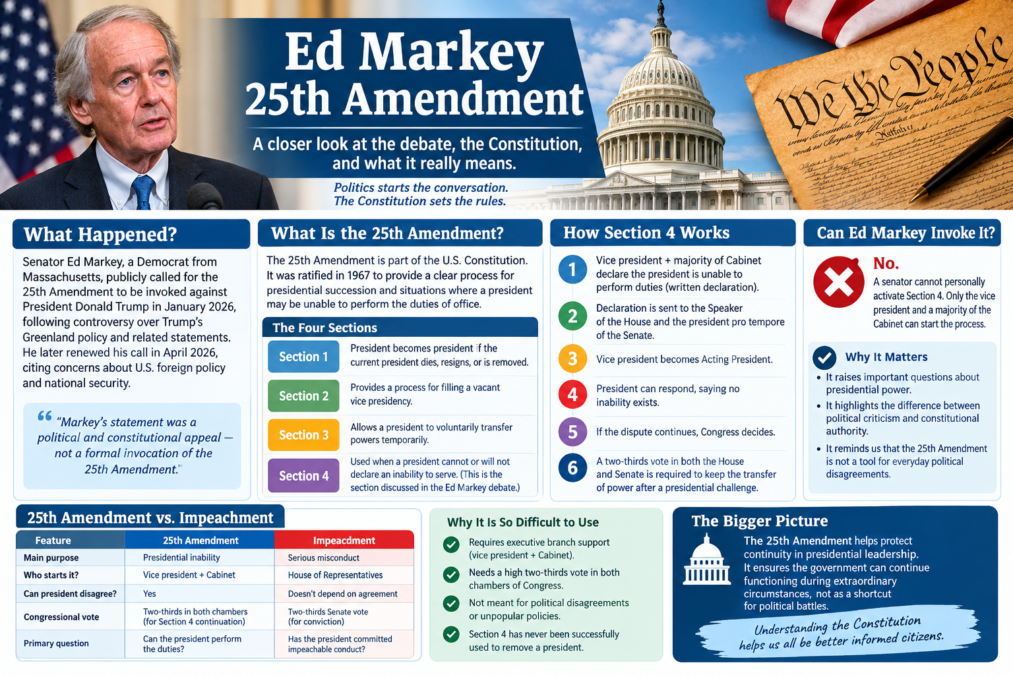

ed markey 25th amendment became a widely discussed political and constitutional topic in 2026 after Senator Ed Markey of Massachusetts publicly called for the use of the 25th Amendment against President Donald Trump. His statement came during a period of intense debate over Trump’s approach to Greenland, national security, foreign policy, and presidential decision-making.
At first glance, the phrase may sound simple. However, the 25th Amendment is one of the most complicated parts of the U.S. Constitution. It doesn’t give one senator the power to remove a president. Instead, Section 4 establishes a specific process involving the vice president, Cabinet, and Congress.
So, what exactly did Ed Markey mean? Why did he mention the 25th Amendment? Could it actually remove a president from office? And how is the amendment different from impeachment?
Let’s take a closer look.
Who Is Ed Markey?
Ed Markey, formally known as Edward J. Markey, is a Democratic senator from Massachusetts. He has served in Congress for decades and is known for his work on climate policy, technology, telecommunications, consumer protection, and national security.
Before becoming a senator, Markey served for many years in the U.S. House of Representatives. He later won election to the Senate and became one of the better-known Democratic voices on major national policy questions.
Over his career, Markey has often taken strong positions when he believes presidential actions could threaten democratic institutions, public safety, or national interests.
That background is important when understanding the ed markey 25th amendment story. His statement wasn’t a legal order or a congressional vote. It was a public political call for the constitutional process to be considered.
Why Did Ed Markey Call for the 25th Amendment?
The immediate controversy arose in January 2026 around President Donald Trump’s renewed efforts to obtain Greenland.
Trump’s position on Greenland had already created significant international and domestic discussion. Greenland is an autonomous territory within the Kingdom of Denmark, and the possibility of the United States attempting to acquire it raised questions about diplomacy, military power, NATO relationships, and international law.
The controversy intensified after reporting about a message Trump sent to Norwegian Prime Minister Jonas Gahr Støre. The message connected Trump’s position on Greenland with his frustration over not receiving the Nobel Peace Prize.
In response, Senator Markey posted a short message calling for the 25th Amendment to be invoked.
It was a brief statement, but it attracted considerable attention because the 25th Amendment is rarely discussed as a possible mechanism for removing a sitting president.
In other words, Markey wasn’t announcing that the president had already been removed. He was calling for the constitutional process to be considered.
What Is the 25th Amendment?
The 25th Amendment is part of the U.S. Constitution. It was ratified in 1967 following concerns about presidential succession and the possibility that a president might become unable to perform the duties of the office.
The amendment contains four sections.
| Section | Main Purpose |
|---|---|
| Section 1 | Establishes that the vice president becomes president if the president dies, resigns, or is removed |
| Section 2 | Provides a process for filling a vacant vice presidency |
| Section 3 | Allows a president to voluntarily transfer presidential powers temporarily |
| Section 4 | Provides a process for transferring power when a president is unable to perform presidential duties but cannot or will not declare that inability |
The fourth section is the part connected to the ed markey 25th amendment discussion.
It is also the most controversial section because it can be used without the president’s agreement.
Understanding Section 4 of the 25th Amendment
Section 4 was designed for situations in which a president cannot perform the duties of the office but does not voluntarily declare an inability to serve.
The process begins with the vice president and a majority of the principal officers of the executive departments.
They must send a written declaration to the Speaker of the House of Representatives and the president pro tempore of the Senate stating that the president is unable to discharge the powers and duties of the office.
Once that declaration is delivered, the vice president immediately becomes Acting President.
But that’s not necessarily the end of the matter.
The president can respond by declaring that no inability exists. If the vice president and Cabinet majority disagree and continue the declaration, Congress becomes involved.
This is where the process becomes especially difficult.
What Happens If the President Challenges the Decision?
If the president says that he or she is capable of performing the duties of office, the vice president and Cabinet majority have a limited period to respond.
If they continue to declare the president unable to serve, Congress must decide the issue.
To keep the vice president serving as Acting President, a two-thirds majority of both the House of Representatives and Senate is required.
That’s an extremely high threshold.
If Congress doesn’t reach that threshold, the president resumes presidential powers.
This means that simply mentioning the 25th Amendment doesn’t remove a president.
There are several constitutional steps, and each one matters.
Can Ed Markey Personally Invoke the 25th Amendment?
No.
This is one of the most important points about the ed markey 25th amendment discussion.
Senator Markey cannot personally activate Section 4.
A senator can call for the amendment to be used, criticize a president’s fitness for office, encourage Cabinet officials to act, or publicly discuss constitutional options. However, Section 4 gives the formal initiating authority to the vice president together with a majority of the principal executive officers.
Therefore, Markey’s statement was a political and constitutional appeal rather than an official invocation.
That’s a key distinction.
A senator saying “invoke the 25th Amendment” isn’t the same thing as the amendment actually being invoked.
Why Is the 25th Amendment Different From Impeachment?
People sometimes confuse the 25th Amendment with impeachment, but they’re not the same.
Impeachment is a congressional process. The House of Representatives can impeach a president by approving articles of impeachment. The Senate then holds a trial.
For removal after impeachment, the Senate must convict by a two-thirds vote of senators present.
The 25th Amendment follows a different path.
Its central question is whether the president is unable to perform the duties of the office.
Impeachment, by contrast, deals with serious misconduct and constitutional offenses under the impeachment framework.
Here’s a simple comparison:
| Issue | 25th Amendment | Impeachment |
|---|---|---|
| Main purpose | Presidential inability | Serious misconduct |
| Main constitutional actors | Vice president, Cabinet, Congress | House and Senate |
| Can president disagree? | Yes | Impeachment doesn’t depend on presidential agreement |
| Congressional supermajority | Two-thirds in both chambers for Section 4 continuation after a challenge | Two-thirds Senate vote for conviction |
| Primary question | Can the president perform the duties? | Has the president committed impeachable conduct? |
This difference is essential for understanding why the ed markey 25th amendment debate became so complicated.
Does the 25th Amendment Mean a President Is Mentally Ill?
Not necessarily.
Another common misunderstanding is that the 25th Amendment automatically means a president has a mental health condition.
That’s not what the amendment says.
The constitutional language focuses on whether the president is unable to discharge the powers and duties of the office.
Historically, the amendment was created largely because the country needed a clear procedure for presidential incapacity. A president could become unconscious, seriously ill, suffer a medical emergency, or otherwise become unable to perform the responsibilities of office.
That doesn’t mean every controversial statement or questionable political decision automatically qualifies.
Determining whether Section 4 should apply to a particular situation would involve constitutional, political, and practical judgments.
The Difference Between Poor Judgment and Incapacity
This distinction is especially important.
Presidents make controversial decisions. They can make mistakes, use harsh language, change policies, or take unpopular positions.
Those things alone don’t automatically mean a president is constitutionally unable to serve.
The 25th Amendment wasn’t written as a general “president is behaving badly” button.
That’s why legal and constitutional experts have historically treated Section 4 as an extraordinary mechanism.
For the ed markey 25th amendment discussion, this distinction matters greatly. Markey’s argument was rooted in his concern about presidential conduct and national security, but the actual constitutional process would require executive branch officials to make the formal determination of inability.
Has Section 4 Ever Been Used to Remove a President?
Section 4 has never successfully been used to permanently remove a president from office.
That’s a major historical fact.
Other sections of the 25th Amendment have been used. Presidents have voluntarily transferred presidential authority to their vice presidents during medical procedures.
For example, presidential powers have temporarily shifted when presidents underwent medical procedures requiring anesthesia.
But Section 4 is different.
It is an involuntary process in which the president can challenge the declaration.
Because of its extraordinary nature, it has never become a normal political tool.
Why the Ed Markey 25th Amendment Call Got Attention
The ed markey 25th amendment story attracted attention for several reasons.
First, Section 4 is rarely discussed as a realistic option.
Second, Markey is a sitting U.S. senator, giving his statement greater political weight than an ordinary social media comment.
Third, the statement came during an international dispute involving Greenland, Denmark, NATO, and possible military considerations.
Fourth, the public has become increasingly familiar with the 25th Amendment because it has appeared in political debates during several presidential administrations.
Finally, the statement raised a bigger constitutional question:
What should happen if lawmakers believe a president is unable to perform the duties of office but the president refuses to step aside?
That question goes far beyond one political party or one administration.
Ed Markey’s Broader Criticism of Trump
Markey’s January statement wasn’t the only time he criticized President Trump in 2026.
In April, Markey again called for Trump’s removal following Trump’s statements concerning Iran. Markey argued that Congress should act and specifically mentioned either impeachment or use of the 25th Amendment by the vice president and Cabinet.
This demonstrates that Markey’s concerns went beyond the Greenland controversy.
His broader criticism has focused on what he sees as dangerous presidential decisions, national security risks, and threats to democratic institutions.
At the same time, it’s important to distinguish Markey’s political position from an official constitutional determination.
A senator can advocate for a constitutional remedy. The Constitution determines who actually has the authority to initiate and complete that remedy.
What Would Happen If Section 4 Were Actually Invoked?
Imagine a hypothetical situation in which the vice president and a majority of Cabinet officials concluded that the president was unable to perform the duties of office.
The process would generally unfold like this:
- The vice president and Cabinet majority prepare a written declaration.
- The declaration is sent to congressional leaders.
- The vice president becomes Acting President.
- The president can challenge the declaration.
- The vice president and Cabinet can respond if they maintain their position.
- Congress then considers the dispute.
- A two-thirds vote in both the House and Senate would be needed to keep the president’s powers transferred after a presidential challenge.
This complicated structure reflects an important constitutional principle: removing presidential authority shouldn’t be easy.
The presidency is one of the most powerful offices in the world, so the Constitution establishes significant safeguards around presidential succession and incapacity.
Why the Vice President Is So Important
The vice president plays a central role under Section 4.
In the current debate, that means Vice President JD Vance would be an essential constitutional actor if Section 4 were ever formally considered against President Trump.
This is one reason Markey’s public call alone couldn’t change who controls the White House.
The vice president and Cabinet would have to take action.
Without that executive branch support, a senator’s demand remains a political statement rather than an operative constitutional process.
Why Congress Has the Final Word in a Dispute
Congress is given an important role because Section 4 can create a serious constitutional conflict.
Imagine a president says, “I am capable of serving,” while the vice president and Cabinet say the opposite.
Who decides?
Under Section 4, Congress ultimately gets the responsibility if the dispute continues.
The two-thirds requirement in both chambers creates a high barrier.
That’s intentional.
A president shouldn’t lose authority simply because a temporary political disagreement occurs between the White House and Congress.
At the same time, the Constitution needed a mechanism for a genuine situation in which a president could not perform the job.
Section 4 attempts to balance both concerns.
Why the Amendment Is Not an Ordinary Political Weapon
The 25th Amendment should not be viewed as a shortcut for removing a president because lawmakers dislike a policy.
Presidential policies are normally challenged through elections, legislation, court cases, congressional oversight, appropriations, war powers, impeachment, and other constitutional mechanisms.
The 25th Amendment has a more specific purpose.
It’s about presidential inability.
That’s why claims involving the amendment should be evaluated carefully.
Strong political disagreements don’t automatically establish constitutional incapacity.
And, frankly, that’s an important protection for the country.
Otherwise, every major political dispute could become an argument for removing a president through Section 4.
The Historical Importance of the 25th Amendment
The amendment was created after a period when the United States had seen how dangerous uncertainty around presidential succession could be.
President John F. Kennedy’s assassination in 1963 also highlighted questions surrounding presidential succession and the vice presidency.
The 25th Amendment was ratified in 1967.
It clarified what should happen when:
- A president dies.
- A president resigns.
- A president is removed.
- A vice presidency becomes vacant.
- A president voluntarily transfers power.
- A president becomes unable to perform presidential duties.
Before the amendment, some of these situations lacked clear constitutional procedures.
Today, the amendment provides a structured framework.
What the Ed Markey Debate Teaches Americans
The ed markey 25th amendment discussion provides a useful lesson about how the U.S. Constitution works.
It shows that constitutional language can be powerful, but it doesn’t mean every political statement immediately creates legal consequences.
It also demonstrates the difference between:
- Political criticism
- Constitutional authority
- Congressional action
- Executive branch action
- Judicial review
- Presidential succession
Understanding those differences can help readers avoid misleading claims online.
Social media posts can make complicated constitutional matters sound very simple. The real process, however, is much more detailed.
Common Questions About Ed Markey and the 25th Amendment
Did Ed Markey officially remove Trump?
No. Markey did not remove Trump from office. He publicly called for invoking the 25th Amendment, but a senator cannot personally activate Section 4.
Which part of the amendment is relevant?
Section 4 is the provision generally discussed when a president is believed to be unable to perform presidential duties without voluntarily declaring an inability.
Can Congress alone invoke Section 4?
No. The formal process begins with the vice president and a majority of the principal officers of the executive departments.
Can the president challenge Section 4?
Yes. The president can declare that no inability exists, which can lead to a dispute requiring Congress to decide.
Has Section 4 ever removed a president?
No. Section 4 has never been successfully used to permanently remove a president.
Is the 25th Amendment the same as impeachment?
No. Impeachment is a congressional process focused on presidential misconduct. Section 4 addresses presidential inability to perform the duties of office.
Why Accurate Information Matters
Constitutional issues can become highly emotional, particularly when they involve a sitting president.
That’s exactly why readers should separate facts from political commentary.
A headline saying that a senator “invoked the 25th Amendment” can create the impression that a legal removal process has already started. In reality, there is a significant difference between calling for invocation and formally invoking Section 4.
The distinction is small in wording but enormous in constitutional meaning.
For anyone following the ed markey 25th amendment debate, understanding that difference is essential.
The Bigger Picture for American Democracy
The 25th Amendment exists to protect continuity in presidential leadership.
Its purpose isn’t simply to punish a president. Instead, it provides a constitutional safety mechanism for extraordinary circumstances.
The debate surrounding Markey’s comments also highlights an important feature of American democracy: elected officials can publicly disagree about how constitutional powers should be used.
One senator may believe a president presents a serious danger. Another may disagree completely.
The Constitution provides different mechanisms for resolving those disputes.
Elections provide one answer. Congress provides another. Courts provide another. And the 25th Amendment provides a narrowly structured option for presidential incapacity.
The strength of the system comes partly from the fact that no single politician controls all of these mechanisms.
Final Thoughts on Ed Markey 25th Amendment
The ed markey 25th amendment controversy is ultimately about much more than one senator’s social media statement. It raises important questions about presidential power, constitutional safeguards, national security, and the meaning of presidential incapacity.
Senator Ed Markey publicly urged the use of the 25th Amendment against President Donald Trump during the January 2026 controversy surrounding Greenland and later renewed his call for Trump’s removal in April. But his statement itself did not invoke the amendment or remove the president.
Under Section 4, the formal process requires action by the vice president and a majority of the Cabinet, followed by congressional involvement if the president contests the decision. A two-thirds vote in both the House and Senate would be required to sustain the transfer of power after such a challenge.
That high threshold reflects the seriousness of the issue.
Ultimately, the ed markey 25th amendment discussion offers readers a valuable opportunity to understand one of the U.S. Constitution’s most important but least-used provisions. Whatever one’s political views may be, learning how the constitutional process actually works can lead to a more informed and responsible public debate.
Ed Markey 25th Amendment: A Deeper Look at Constitutional Power
The ed markey 25th amendment discussion has raised important questions about presidential authority, constitutional responsibility, and the limits of political power. Senator Ed Markey’s public calls for action against President Donald Trump brought renewed attention to a constitutional amendment that many Americans know by name but may not fully understand.
The 25th Amendment isn’t designed to settle ordinary political disagreements. Instead, it provides a framework for dealing with presidential succession and situations in which a president may be unable to perform the responsibilities of the office.
To understand the debate properly, it’s helpful to look beyond political headlines and examine the constitutional structure, historical background, and practical challenges surrounding Section 4.
The Constitutional Question Behind Ed Markey’s Argument
At the center of the ed markey 25th amendment debate is a basic constitutional question: when should presidential inability become serious enough to justify transferring presidential powers?
This isn’t always an easy question to answer.
A president may face criticism for decisions involving foreign affairs, economic policy, military action, or domestic issues. Political opponents may strongly disagree with those decisions. However, disagreement by itself doesn’t establish constitutional inability.
Section 4 requires a much more serious determination.
The process is intended for circumstances in which the president is unable to discharge the powers and duties of the office. That could involve a severe physical condition, unconsciousness, or another situation that prevents the president from carrying out presidential responsibilities.
This distinction is important because the amendment protects both presidential authority and the country’s ability to respond to genuine incapacity.
Why the Vice President Has a Central Role
One of the most interesting features of Section 4 is the important position given to the vice president.
The vice president isn’t simply a backup leader who waits for a president to die or resign. Under the 25th Amendment, the vice president can become Acting President when the Section 4 process is triggered.
However, the vice president doesn’t normally act alone.
The vice president must work with a majority of the principal officers of the executive departments.
That requirement creates a major constitutional safeguard.
It means that one individual can’t simply declare a president unable to serve and take control of the presidency.
Instead, the Constitution requires agreement between the vice president and a majority of the Cabinet-level officials described in the amendment.
The Role of Cabinet Officials
Cabinet members are another important part of the Section 4 process.
The principal officers of executive departments are generally the officials leading the major departments of the federal government.
If the vice president and a majority of those officers believe that a president is unable to perform presidential duties, they can send a written declaration to congressional leaders.
That declaration is what starts the formal Section 4 procedure.
This is very different from a senator making a public statement.
Therefore, when discussing the ed markey 25th amendment, readers should remember that Markey’s position and the formal constitutional process are two separate things.
Why a Written Declaration Matters
The Constitution specifically requires a written declaration.
This may sound like a technical detail, but it’s important.
The process can’t simply begin because officials privately discuss whether the president is capable of serving. A formal written declaration must be delivered to the appropriate congressional leaders.
This creates a record of the decision.
It also makes the process more transparent and accountable.
In a constitutional democracy, major transfers of presidential authority shouldn’t happen through rumors or informal conversations. There needs to be a clear constitutional procedure.
What Happens to the President’s Power?
Once the required declaration is delivered, the vice president immediately assumes the role of Acting President.
This doesn’t mean the president is permanently removed from office.
That’s another important distinction.
The president remains president unless the constitutional process results in a permanent change under the relevant provisions.
The vice president temporarily exercises presidential powers as Acting President.
This arrangement allows the government to continue functioning even when there is a dispute about the president’s ability to serve.
Why the President Can Object
The Constitution also gives the president an opportunity to respond.
The president can send a written declaration to the Speaker of the House and the president pro tempore of the Senate stating that no inability exists.
This is a powerful constitutional protection.
Without it, the vice president and Cabinet could potentially take control of presidential powers without giving the president a way to challenge their decision.
The amendment therefore creates a balance between presidential independence and constitutional safeguards.
The Four-Day Period and Congressional Decision
If the vice president and Cabinet majority disagree with the president’s declaration and continue to assert that the president is unable to serve, they can send another declaration to Congress.
Congress then has to address the matter.
Under the amendment, Congress has a limited period to make its decision.
If Congress is not in session, it must assemble within a specified period.
To keep presidential powers transferred to the vice president, a two-thirds majority of both the House and Senate is required.
That’s a demanding standard.
It means that a simple majority isn’t enough.
Why the Two-Thirds Requirement Matters
The two-thirds requirement is one of the strongest safeguards in Section 4.
Imagine a situation where political parties are divided almost evenly.
A simple majority could potentially change who exercises presidential authority. But the Constitution requires much broader agreement if the president challenges the declaration.
This makes Section 4 difficult to use as a normal political tool.
The system requires substantial support before presidential authority can remain transferred against the president’s wishes.
That’s intentional.
The presidency represents the entire country, not just one political party.
Could the 25th Amendment Be Used Because of Unpopular Policies?
Generally, an unpopular policy isn’t enough.
Presidents regularly make decisions that millions of Americans oppose.
Some decisions can be highly controversial without meaning that the president is unable to perform the duties of office.
This is why the ed markey 25th amendment debate needs to be understood within its constitutional context.
A disagreement over foreign policy, immigration, taxation, climate policy, military strategy, or trade doesn’t automatically create a Section 4 situation.
The amendment is concerned with presidential inability, not ordinary political disagreement.
Presidential Conduct and Constitutional Standards
The debate becomes more complicated when presidential conduct is involved.
A president may make statements or decisions that critics consider dangerous or irresponsible.
Political leaders can argue that such behavior demonstrates poor judgment.
But constitutional inability has a specific meaning.
Determining whether conduct crosses that line would involve difficult legal and political questions.
That’s why statements from lawmakers should not be treated as final constitutional judgments.
The Difference Between Political Responsibility and Constitutional Authority
Senators and representatives have an important role in American democracy.
They can investigate the executive branch, conduct hearings, pass legislation, control federal spending, and pursue impeachment.
They can also use their public platforms to criticize presidential decisions.
But political influence doesn’t always equal constitutional authority.
This is particularly relevant to the ed markey 25th amendment issue.
Markey can publicly argue that the 25th Amendment should be considered, but he doesn’t have the constitutional power to invoke Section 4 by himself.
The Constitution determines which officials have that authority.
Could Markey’s Statement Influence Other Officials?
Although Markey can’t personally invoke Section 4, public statements from lawmakers can still have political influence.
A senator’s criticism may:
- Increase public attention.
- Encourage congressional debate.
- Pressure administration officials.
- Generate media coverage.
- Encourage other lawmakers to express their positions.
- Lead voters to examine presidential conduct more closely.
Political pressure can therefore matter even when it doesn’t directly activate a constitutional process.
This is one reason why the ed markey 25th amendment phrase became part of a larger national conversation.
Why the Public Should Read the Constitution Carefully
Political headlines often simplify complicated constitutional issues.
A headline might say that a senator “wants to invoke the 25th Amendment.” A reader unfamiliar with the amendment might assume the senator can immediately begin the removal process.
That’s not how Section 4 works.
Understanding the actual text helps separate political rhetoric from constitutional procedure.
For students, journalists, voters, and anyone interested in U.S. government, this is an excellent reminder that primary constitutional sources are often more useful than short social media posts.
The 25th Amendment and Presidential Elections
Another important question is whether the 25th Amendment can be used to decide who should be president based on political popularity.
The answer is no.
Presidential elections are governed by a different constitutional process.
If voters choose a president, that president receives the constitutional authority associated with the office.
The 25th Amendment doesn’t provide a way for political opponents to simply overturn an election because they disagree with the result.
Section 4 is designed around presidential inability.
This distinction helps protect the democratic process.
Why Presidential Succession Needs Clear Rules
Imagine the United States had no clear rules for presidential succession.
If a president became seriously ill or unconscious, the country could face uncertainty.
Who would make military decisions?
Who would communicate with foreign governments?
Who would sign legislation?
Who would respond to a national emergency?
The 25th Amendment helps answer these questions.
It ensures that presidential powers can continue to be exercised even during extraordinary circumstances.
That’s one of the amendment’s most important contributions to American government.
Historical Lessons From Presidential Health Crises
Presidential health has always been an important issue in American history.
Several presidents experienced serious medical problems while serving in office.
In earlier periods, however, the Constitution didn’t provide today’s detailed procedures for presidential incapacity.
This created uncertainty.
The 25th Amendment helped address that problem.
Its existence means that modern America has a clearer constitutional process for dealing with situations in which presidential powers need to be temporarily transferred.
Why Section 3 Is Different From Section 4
The 25th Amendment contains two different provisions dealing with presidential inability.
Section 3 is voluntary.
Under Section 3, the president can inform Congress that the president is unable to perform presidential duties. The vice president then becomes Acting President temporarily.
Section 4 is involuntary.
It can be used when the president doesn’t declare an inability but the vice president and Cabinet believe the president cannot perform the duties of office.
This difference is essential.
Section 3 has been used by presidents during temporary medical procedures.
Section 4 has never been successfully used to permanently transfer presidential power against a president’s wishes.
Why the Amendment Was Not Written for Everyday Politics
The framers of the amendment understood that presidential power needed strong protections.
If every major political controversy could trigger Section 4, presidential government could become unstable.
Imagine a new administration facing opposition from Congress. If disagreement alone were enough to trigger Section 4, political parties could constantly threaten presidential authority.
That would undermine the purpose of elections.
Therefore, the amendment requires a much stronger constitutional basis.
Ed Markey’s Role as a Senator
Senator Markey’s position is best understood as part of his broader political and constitutional criticism of the Trump administration.
He has used public statements to argue that certain presidential actions threaten American interests.
Whether people agree with Markey or disagree with him, his role as a senator allows him to participate in national debates about constitutional government.
However, the Constitution still establishes the formal boundaries of his authority.
That distinction is central to understanding the ed markey 25th amendment discussion.
How the Senate Fits Into the Process
The Senate has a major role if a Section 4 dispute reaches Congress.
The Senate is one of the two chambers that must approve continued transfer of presidential power by a two-thirds vote.
This means senators would have to consider the evidence and constitutional arguments.
A political party couldn’t simply rely on a narrow majority.
The requirement for two-thirds support encourages broader agreement.
How the House of Representatives Fits Into the Process
The House also has to approve continued transfer of presidential powers by a two-thirds vote.
This creates a second major constitutional check.
Both chambers must reach the required threshold.
The House and Senate have different memberships and political dynamics, so securing two-thirds support in both would be extremely difficult.
That’s another reason Section 4 is considered an extraordinary constitutional mechanism.
Could Courts Become Involved?
The 25th Amendment primarily establishes a process involving the executive branch and Congress.
However, constitutional disputes can sometimes raise legal questions that may eventually reach the courts.
The precise scope of judicial involvement in a particular Section 4 dispute could depend on the facts and legal claims involved.
This is another reason experts caution against treating the amendment as a simple political button.
Constitutional law can become complicated very quickly.
Why the Topic Continues to Matter
The ed markey 25th amendment discussion is likely to remain relevant because questions about presidential power don’t disappear when one political controversy ends.
Americans continue to debate:
- Presidential authority
- Executive power
- National security
- Congressional oversight
- Presidential health
- Constitutional limits
- Democratic institutions
- Separation of powers
Understanding the 25th Amendment gives citizens a useful foundation for evaluating these issues.
What Readers Should Remember
There are several key lessons from the debate.
First, Ed Markey’s call for the 25th Amendment was a political and constitutional argument, not an automatic invocation.
Second, Section 4 involves the vice president and Cabinet, not one senator acting alone.
Third, a president can challenge a Section 4 declaration.
Fourth, Congress plays an important role if the dispute continues.
Fifth, a two-thirds vote in both chambers is required to sustain the transfer of power after a presidential challenge.
Sixth, the 25th Amendment is different from impeachment.
Finally, presidential inability and political disagreement are not automatically the same thing.
A Simple Example of How Section 4 Works
Consider a fictional example.
Suppose a president suffers a serious medical emergency and becomes unable to communicate.
The vice president and a majority of Cabinet officials determine that the president cannot perform the duties of office.
They submit the required written declaration to Congress.
The vice president becomes Acting President.
Later, the president recovers and says that the president is capable of serving.
If the vice president and Cabinet disagree, Congress must resolve the dispute under the constitutional process.
This hypothetical example demonstrates why Section 4 exists.
It’s not primarily about political disagreements. It’s about ensuring that the government continues functioning when presidential incapacity creates a serious constitutional problem.
The Importance of Constitutional Stability
A strong democracy depends on predictable rules.
Presidential power shouldn’t change simply because political emotions become intense.
The 25th Amendment provides a structured process for extraordinary circumstances.
The ed markey 25th amendment debate therefore highlights a broader lesson: constitutional systems work best when citizens understand both their powers and their limitations.
Political leaders can make strong arguments.
Journalists can report controversies.
Citizens can protest or disagree.
But constitutional authority ultimately depends on the rules established by the Constitution.
Final Perspective on Ed Markey 25th Amendment
The ed markey 25th amendment debate has brought an important constitutional provision back into public discussion. Senator Ed Markey’s calls for action against President Donald Trump reflect his political concerns about presidential conduct and national security, but those calls should not be confused with the formal invocation of Section 4.
The 25th Amendment establishes a carefully designed process involving the vice president, Cabinet officials, and Congress. It was created to protect the continuity of presidential government during extraordinary circumstances, especially when a president may be unable to perform the duties of office.
For readers, the most important lesson is simple: political criticism and constitutional action aren’t the same thing.
Understanding that difference makes it easier to follow major political stories without being misled by headlines or oversimplified social media posts. As debates over presidential power continue, the ed markey 25th amendment topic remains a useful example of how the U.S. Constitution balances presidential authority, congressional responsibility, and the need for stable democratic government.
Explore more insightful articles on All Vantage News and never miss an update.Contact Us.