
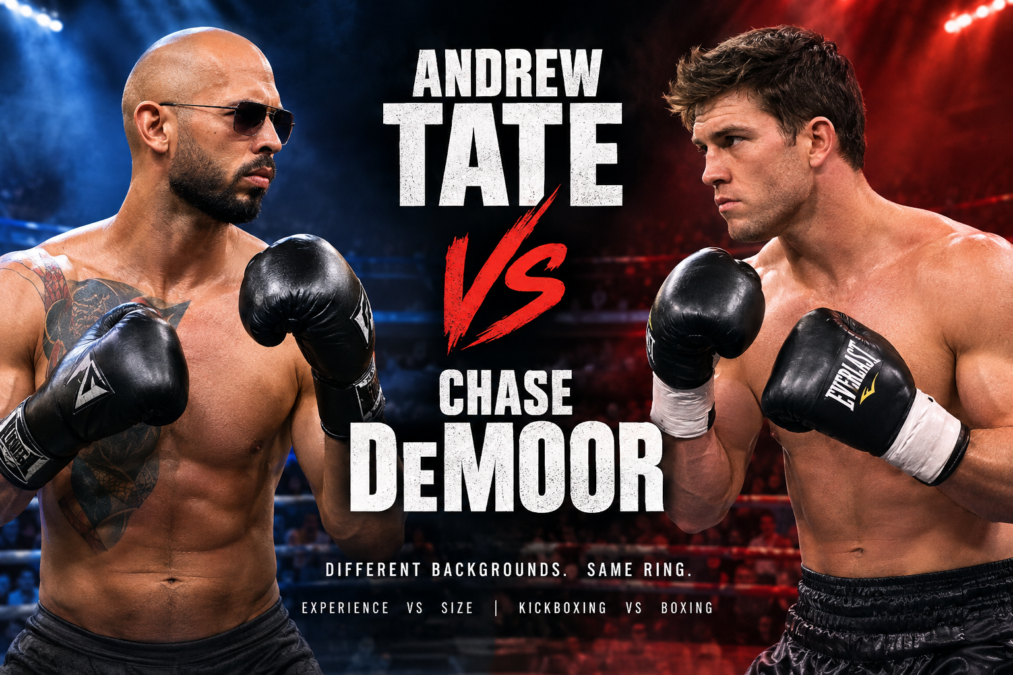

The phrase andrew tate vs chase demoor has attracted attention from boxing fans, social-media followers, and people interested in celebrity combat sports. Both names have built large audiences in very different ways, and a matchup between them naturally creates a lot of discussion.
Andrew Tate is a former professional kickboxer who became widely known through social media and online business content. Chase DeMoor, meanwhile, is a reality television personality and professional boxer who has developed his own presence in combat sports. Putting these two personalities together creates an interesting question: how would their different experiences, physical attributes, fighting styles, and levels of competition compare inside a boxing ring?
At first glance, the matchup might look like a simple battle between two famous personalities. However, boxing is more complicated than popularity. Footwork, timing, conditioning, defense, reach, accuracy, ring experience, and mental preparation all matter.
This article takes a balanced look at andrew tate vs chase demoor, focusing on their backgrounds, fighting experience, potential strengths, possible weaknesses, and why the matchup has generated so much interest.
Who Is Andrew Tate?
Andrew Tate is a British-American internet personality and former professional kickboxer. Before becoming internationally famous online, he competed in kickboxing and built a reputation around combat sports.
His background in kickboxing is important when discussing a potential boxing contest. Kickboxing and boxing share several fundamentals, including punching, movement, distance control, and conditioning. However, they aren’t identical sports.
In boxing, fighters can’t use kicks, and the defensive and offensive systems are built almost entirely around punches. This means a kickboxer must make adjustments when moving into a boxing-only environment.
Tate’s combat-sports background gives him an important advantage in terms of familiarity with competition. He’s experienced the pressure of fighting another trained athlete, preparing for a contest, managing adrenaline, and working within a competitive ruleset.
His public image has also made him one of the most recognizable personalities associated with combat sports and social media.
Who Is Chase DeMoor?
Chase DeMoor is an American reality television personality and boxer. He became known to a wider audience through reality television before developing a stronger connection with boxing.
DeMoor’s physical presence is one of the first things people notice when discussing him as a fighter. His size and athletic build can be significant factors in a boxing matchup.
Unlike a casual celebrity stepping into the ring for entertainment, DeMoor has pursued boxing more seriously and has competed in boxing events. That experience matters because actual competition teaches lessons that can’t be learned simply by watching boxing videos or training in a gym.
A fighter learns how to remain calm while being attacked, how to maintain technique when tired, and how to respond when an opponent changes strategy.
That’s why andrew tate vs chase demoor is an intriguing matchup on paper.
andrew tate vs chase demoor: Why Fans Are Interested
Several factors make this matchup attractive to combat-sports fans.
First, both men already have large audiences. A fight involving either personality would receive considerable attention, but putting them against each other creates an entirely different level of curiosity.
Second, they bring different backgrounds to the ring.
Andrew Tate has a long history connected with kickboxing, while Chase DeMoor has built more recent experience around boxing. Their approaches to combat sports therefore come from somewhat different paths.
Third, their personalities create a strong promotional story.
Modern combat sports often rely on personalities as much as athletic competition. Fighters promote events through interviews, social media, press conferences, and public appearances. When two recognizable personalities meet, the promotional side can become almost as interesting as the sporting side.
Still, the actual contest would ultimately be decided by what happens inside the ring.
Comparing Their Combat-Sports Backgrounds
A useful way to understand andrew tate vs chase demoor is to compare the experience each fighter brings.
| Factor | Andrew Tate | Chase DeMoor |
|---|---|---|
| Combat-sports background | Kickboxing | Boxing |
| Public profile | Large social-media following | Reality TV and social-media following |
| Striking experience | Extensive kickboxing background | Boxing-focused competition |
| Boxing experience | Has combat experience but kickboxing differs from boxing | Focused on boxing competition |
| Physical size | Generally smaller than DeMoor | Larger physical frame |
| Main potential advantage | Experience and striking knowledge | Size, reach, and boxing specialization |
| Main question | How effectively would kickboxing skills transfer to boxing? | How would he handle Tate’s experience and movement? |
This comparison doesn’t automatically tell us who would win.
In boxing, styles can produce surprising results. A physically larger fighter can struggle against a smaller opponent with better movement. On the other hand, speed and technique can become difficult to maintain when facing a much bigger athlete.
That’s what makes the matchup worth analyzing rather than simply choosing a winner based on appearance.
The Importance of Size in Boxing
Size could be one of the biggest talking points in andrew tate vs chase demoor.
When two fighters have a substantial difference in size, the larger fighter can potentially benefit from greater reach, physical strength, and punching power. A bigger boxer may also be able to make an opponent work harder when fighting at close range.
However, bigger doesn’t automatically mean better.
Larger fighters can sometimes have difficulty dealing with fast opponents who constantly change angles. A smaller fighter may attempt to enter and exit quickly rather than standing directly in front of the larger opponent.
This is where technique becomes crucial.
If Tate were able to use movement effectively, he could potentially make DeMoor miss and force him to reset repeatedly. If DeMoor were able to control distance with his reach and pressure, he could make the contest physically demanding for Tate.
So, size would matter, but it wouldn’t tell the entire story.
Andrew Tate’s Potential Advantages
Tate could bring several useful qualities into a boxing matchup.
Combat Experience
One of his clearest advantages is his history in competitive kickboxing. Fighting experience can help an athlete understand pressure in a way that ordinary training doesn’t.
Striking Knowledge
Tate has spent significant time studying striking. Although kickboxing and boxing are different, many fundamental punching concepts overlap.
Movement
A fighter with a striking background may be comfortable moving around an opponent, changing distance, and looking for openings.
Mental Familiarity With Competition
Being accustomed to combat competition can help a fighter remain composed. That’s especially important when an opponent is trying to create pressure.
However, these advantages shouldn’t be overstated. A boxing match requires boxing-specific preparation.
Chase DeMoor’s Potential Advantages
DeMoor also has several characteristics that could make him a difficult opponent.
Size
His larger physical frame could be an important factor.
Boxing-Specific Training
Because DeMoor has pursued boxing, his preparation can be tailored specifically to the sport’s rules and demands.
Reach and Distance
A larger boxer can potentially keep a smaller opponent at the end of his punches and prevent comfortable entries.
Physical Pressure
If DeMoor can use his size effectively, he could make Tate work harder throughout the fight.
The key would be converting physical advantages into effective boxing strategy. Simply being bigger isn’t enough. The fighter has to know how to use that size.
How Their Fighting Styles Could Clash
The most interesting part of andrew tate vs chase demoor may be the contrast between their styles.
Imagine a traditional tactical battle.
One fighter wants to move, create angles, and attack openings. The other wants to establish distance, apply pressure, and make the smaller fighter uncomfortable.
That’s where boxing becomes a chess match.
If Tate spends too much time moving backward, DeMoor could potentially control the center of the ring. If DeMoor becomes too aggressive, Tate might find opportunities to counter.
Timing would therefore be extremely important.
A fighter doesn’t necessarily need to throw the most punches. Sometimes the smartest strategy is to wait for an opponent to make a mistake.
Boxing Experience vs Kickboxing Experience
This is perhaps the most important technical question surrounding the matchup.
Kickboxing provides a broad striking education. Fighters learn combinations, movement, defense, conditioning, and timing while also dealing with kicks and other attacks.
Boxing is narrower but extremely specialized.
A boxer spends years learning how to use the jab, slip punches, roll under hooks, move within punching range, and create openings using only the hands.
That distinction matters.
A skilled kickboxer doesn’t automatically become an elite boxer. Likewise, a boxer doesn’t automatically become an elite kickboxer.
Therefore, if andrew tate vs chase demoor happened under boxing rules, Tate’s kickboxing experience would be useful, but he’d still need to adapt his skills to the specific demands of boxing.
What Could Happen During the Early Rounds?
The opening rounds could be especially important.
Tate might use movement and quick combinations to test DeMoor’s reactions. DeMoor could attempt to establish his jab and physical presence.
Neither fighter would necessarily want to reveal everything immediately.
A smart opening strategy could involve:
- Testing the opponent’s range
- Establishing a jab
- Watching defensive reactions
- Avoiding unnecessary exchanges
- Managing energy
- Looking for weaknesses
- Controlling the center of the ring
The first few minutes could provide clues about which fighter’s strategy is working.
If DeMoor consistently lands from long range, Tate could have trouble getting inside.
If Tate repeatedly avoids clean punches and counters effectively, DeMoor might need to change his approach.
What Could Happen in the Later Rounds?
Conditioning could become increasingly important as the contest continues.
Boxing requires repeated bursts of high-intensity activity. Fighters must punch, defend, move, and think while becoming increasingly tired.
This is where preparation shows.
A fighter with strong conditioning can continue using proper technique late in a fight. A tired fighter may begin dropping his hands, standing too upright, or throwing wide punches.
If the fight reached the later rounds, tactical discipline could become just as important as physical strength.
That’s another reason predictions about andrew tate vs chase demoor shouldn’t rely only on their appearances or social-media reputations.
The Mental Side of the Matchup
Boxing isn’t only physical.
Confidence, patience, concentration, and emotional control can influence a fight significantly.
Both Tate and DeMoor have experience dealing with public attention. That could help them handle the spotlight surrounding a major event.
However, a boxing ring creates a different kind of pressure.
There are no comfortable social-media posts when an opponent is standing directly in front of you. Every mistake can have an immediate consequence.
The ability to remain calm after getting hit can be extremely valuable.
A fighter who becomes frustrated may abandon the game plan. A fighter who remains patient can wait for opportunities.
Promotion Could Be Almost as Big as the Fight
One reason andrew tate vs chase demoor generates interest is the promotional potential.
Modern boxing has changed significantly. Fighters aren’t marketed only through traditional sports media anymore.
Social platforms can build an event months before fight night.
Possible promotional elements could include:
- Press conferences
- Interviews
- Training videos
- Face-offs
- Social-media debates
- Fight predictions
- Behind-the-scenes footage
- Fan reactions
With two recognizable personalities involved, the conversation could spread well beyond traditional boxing audiences.
That attention can be positive when it encourages more people to learn about the sport.
Why Fans Should Separate Promotion From Reality
It’s important to remember that fight promotion is designed to create excitement.
Statements made during promotional campaigns aren’t always reliable descriptions of athletic ability. Fighters may use confidence, humor, criticism, or bold predictions to attract attention.
That’s normal in combat-sports promotion.
Readers should therefore separate promotional claims from independently verifiable facts.
A good approach is to examine:
- Official fight records
- Verified event information
- Rules
- Weight classes
- Professional experience
- Recent performances
- Training background
This creates a more reliable picture than social-media arguments alone.
Possible Strengths and Weaknesses
Here’s a simplified breakdown.
| Area | Potential Edge |
|---|---|
| Kickboxing experience | Andrew Tate |
| Boxing specialization | Chase DeMoor |
| Physical size | Chase DeMoor |
| Combat-sports familiarity | Andrew Tate |
| Reach potential | Chase DeMoor |
| Movement and striking background | Andrew Tate |
| Publicity | Both |
| Overall outcome | Impossible to determine without the actual contest |
The word potential is important here.
A strength only matters if a fighter can use it effectively.
A tall fighter might have reach but fail to use the jab. A smaller fighter might have speed but struggle to get inside.
That’s why real competition is ultimately the best test.
Training Would Change the Equation
If a matchup were officially scheduled, preparation could dramatically influence the outcome.
Both fighters would have to build a training camp around the opponent.
Tate could focus on:
- Boxing-specific defense
- Distance management
- Counterpunching
- Fighting a larger opponent
- Ring movement
- Conditioning
DeMoor could focus on:
- Cutting off the ring
- Maintaining long-range control
- Using the jab
- Defending counters
- Managing energy
- Preventing excessive movement
The better camp wouldn’t necessarily belong to the fighter with the bigger name.
It would belong to the fighter who prepares most effectively for the specific opponent.
Rules Would Matter
Another major factor is the ruleset.
A boxing match could have different conditions depending on the event. Round length, number of rounds, glove requirements, weight class, and other regulations can affect strategy.
A contest under boxing rules would favor boxing-specific techniques.
A kickboxing contest would create a completely different tactical environment.
Therefore, any serious discussion of andrew tate vs chase demoor should always clarify what kind of fight is being discussed.
Without that information, predictions can become misleading.
Why Celebrity Boxing Continues to Grow
Celebrity and crossover boxing has become a major part of modern combat-sports entertainment.
These events attract people who might not normally watch traditional boxing.
That can have advantages.
New viewers may become interested in:
- Boxing history
- Professional fighters
- Training
- Fitness
- Sportsmanship
- Combat-sports technique
At the same time, crossover fights are sometimes criticized when entertainment becomes more important than sporting competition.
The best events can combine both.
A compelling matchup should entertain viewers while still respecting the athletic demands of boxing.
How Fans Can Judge the Matchup Fairly
Rather than relying on personal loyalty to one fighter, fans can use a simple checklist.
Look at Experience
Who has competed more often, and under what rules?
Examine Physical Differences
How significant are the differences in height, weight, and reach?
Study Recent Form
How have the fighters looked in their most recent contests?
Consider Style
Does one fighter’s style naturally create problems for the other?
Consider Conditioning
Who appears better prepared for the expected duration of the contest?
Check the Rules
The rules can dramatically change which skills matter most.
This approach creates a more thoughtful discussion around andrew tate vs chase demoor.
The Bigger Picture Behind the Rivalry
At its heart, the interest in this matchup isn’t only about two individuals.
It’s also about how modern combat sports have changed.
Today, an athlete can build a worldwide audience through social media before becoming a household name through traditional sports coverage.
Reality television can create another route to fame. Online communities can then amplify both personalities.
As a result, combat sports now exist at the intersection of athletics, entertainment, media, and digital culture.
That makes matchups involving recognizable personalities especially powerful from a promotional perspective.
Final Thoughts on andrew tate vs chase demoor
The discussion surrounding andrew tate vs chase demoor brings together two very different combat-sports stories. Andrew Tate has a significant kickboxing background and extensive experience with striking competition, while Chase DeMoor brings a larger physical frame and a boxing-focused path.
There are clear questions on both sides. How effectively would Tate’s kickboxing experience transfer into a boxing-only contest? Could DeMoor use his size and boxing skills to control the fight? Would movement overcome physical strength, or would size and pressure eventually become decisive?
Those questions make the matchup interesting, but they also show why predicting a winner with certainty isn’t wise without knowing the exact rules, weight, training camps, and current form of both fighters.
In the end, andrew tate vs chase demoor is best understood as a potential clash between experience, physicality, personality, and boxing technique. Whatever happens around such a matchup, the most valuable lesson remains simple: combat sports are decided in the ring, where preparation, discipline, skill, and composure matter far more than online arguments.
andrew tate vs chase demoor: A Deeper Fight Analysis
The conversation around andrew tate vs chase demoor becomes even more interesting when we look beyond fame and social media. A real boxing contest depends on details that aren’t always obvious to casual viewers. Distance, rhythm, timing, stamina, punch selection, and defensive habits can all change the direction of a fight.
Both athletes would enter a potential matchup with different experiences and physical characteristics. That contrast is exactly what makes the hypothetical contest so fascinating.
Rather than focusing only on who is more famous, it’s better to examine how their potential strategies could work against each other.
The Importance of the Jab
The jab is one of the most useful punches in boxing.
It can be used to attack, defend, measure distance, disrupt rhythm, and prepare stronger punches. A fighter doesn’t always need to throw powerful punches to control an opponent.
For a potential andrew tate vs chase demoor matchup, the jab could be especially important because of the physical differences between the fighters.
A larger fighter can use a jab to keep a smaller opponent outside punching range. Meanwhile, a smaller fighter can use his own jab to enter safely and create opportunities for combinations.
The fighter who controls the jab may also control the pace of the contest.
Footwork Could Become a Major Factor
Footwork is often overlooked by people who don’t regularly watch boxing.
A fighter’s feet determine where he can attack and how quickly he can escape danger.
Good footwork can help a boxer:
- Create angles
- Avoid straight punches
- Enter punching range
- Exit after combinations
- Control the center of the ring
- Force an opponent toward the ropes
For Tate, movement could potentially be an important tool against a physically larger opponent.
For DeMoor, cutting off the ring could be equally important. Instead of chasing a moving opponent, a smart fighter tries to predict where that opponent will go.
That’s a major difference.
Chasing wastes energy. Cutting off the ring saves it.
Power vs Speed
Another classic boxing question is whether power can overcome speed.
A larger fighter may have an advantage in punching force, while a smaller fighter may have quicker movement and faster combinations.
But speed isn’t useful if the punches don’t land.
Likewise, power isn’t useful if a fighter can’t create opportunities to use it.
In andrew tate vs chase demoor, the battle between speed and physicality could become one of the central themes.
If Tate can move effectively while landing clean punches, his speed could frustrate DeMoor.
If DeMoor can limit that movement, his physical advantages could become increasingly important.
The Role of Counterpunching
Counterpunching is the art of attacking immediately after an opponent creates an opening.
A fighter may deliberately allow an opponent to attack before responding.
For example, if one fighter throws a jab and leaves his hand low afterward, the opponent may respond with a straight punch or hook.
Counterpunching requires:
- Excellent timing
- Awareness
- Patience
- Defensive skill
- Quick reactions
A counterpuncher doesn’t need to throw constantly. Instead, the goal is often to make the opponent pay for mistakes.
That could make counterpunching particularly valuable in a matchup involving two fighters with contrasting physical characteristics.
Conditioning Could Decide the Second Half
Boxing looks simple from the outside, but maintaining a high level of performance is exhausting.
A fighter must constantly make decisions while moving, punching, defending, and absorbing physical contact.
As fatigue develops, technique can deteriorate.
Hands may drop. Footwork can become slower. Punches may lose accuracy. Breathing can become harder to control.
For that reason, conditioning could play a major role in andrew tate vs chase demoor.
The fighter who maintains discipline when tired may have a significant advantage over the opponent who becomes frustrated or careless.
Fighting on the Inside
Close-range fighting creates another interesting tactical question.
A larger fighter often wants to use reach and distance. A smaller opponent may want to get inside that reach.
Once fighters are close, long punches become harder to use effectively.
Inside fighting can involve:
- Short hooks
- Uppercuts
- Body punches
- Clinch work
- Shoulder positioning
- Head movement
If Tate could consistently get close without taking significant punishment, he might reduce some of DeMoor’s reach advantage.
On the other hand, DeMoor could attempt to use his size to make close-range exchanges physically difficult.
Body Attacks Could Matter
Many casual fans focus almost entirely on head punches.
Experienced boxers understand the importance of attacking the body.
A body punch can slow an opponent’s movement and make later rounds more difficult. Even when a body shot doesn’t immediately hurt, repeated attacks can affect stamina.
A fighter may also lower his hands after taking body punches, creating openings for head shots.
Therefore, body work could become an important part of either fighter’s strategy.
The Psychological Battle
The psychological side of andrew tate vs chase demoor shouldn’t be ignored.
Combat athletes need confidence, but confidence must be controlled.
Too little confidence can lead to hesitation.
Too much confidence can lead to unnecessary risks.
A fighter needs to remain focused even when the crowd is loud, an opponent is talking, or the fight isn’t going according to plan.
The ability to follow a strategy under pressure is one of the qualities that separates experienced competitors from inexperienced athletes.
What If the Fight Becomes a Slow Contest?
Not every boxing match becomes a wild exchange.
Sometimes both fighters spend significant time studying each other.
A tactical contest might involve:
- Long-range jabs
- Limited combinations
- Defensive movement
- Frequent resets
- Careful counterpunching
Some fans prefer explosive fights, while others enjoy tactical contests.
If Tate and DeMoor were cautious early, the fight could become increasingly interesting as each fighter collected information about the other’s habits.
The second half could then look very different from the opening rounds.
What If One Fighter Applies Constant Pressure?
Pressure can completely change a fight.
A pressure fighter doesn’t necessarily need to throw punches constantly. Instead, the goal is to make the opponent uncomfortable by limiting available space.
DeMoor could potentially use physical size and forward movement to apply pressure.
Tate could respond by using angles, lateral movement, and quick combinations.
The key question would be whether the pressure produces clean punches or simply causes the larger fighter to waste energy chasing.
That’s why effective pressure and reckless aggression are two different things.
The Importance of Ring Intelligence
Ring intelligence means understanding what is happening during a fight and adjusting accordingly.
A fighter may enter the ring with a detailed plan, but opponents rarely cooperate.
Perhaps the jab isn’t working.
Maybe the opponent is faster than expected.
Maybe one fighter discovers that the body is easier to attack than the head.
The ability to make adjustments can become decisive.
A strong game plan is useful, but adaptability is often just as valuable.
Experience Doesn’t Guarantee Victory
It’s tempting to assume that the more experienced fighter will automatically win.
That’s not always true.
Combat sports contain countless examples of athletes losing despite having more experience.
Physical differences, style matchups, injuries, preparation, age, timing, and individual performance can all affect the result.
This is why andrew tate vs chase demoor shouldn’t be treated as a guaranteed victory for either side.
Experience is an advantage, not a prediction.
Why Weight Class Matters
Weight class exists for a reason.
Large differences in body weight can affect punching power, stamina, speed, and physical strength.
If two fighters compete, their official weight and rules would provide important context.
A matchup between athletes of different sizes can become much more complicated if the heavier fighter has a significant advantage.
For a proper analysis, fans should always look at the official event information rather than relying on photographs or social-media claims.
Training Camp Strategy
A serious fight camp normally focuses on the specific opponent.
If Tate were preparing for DeMoor, his team could spend considerable time studying:
- DeMoor’s jab
- Defensive habits
- Movement
- Combination patterns
- Reaction to pressure
- Body positioning
DeMoor’s camp could conduct similar analysis of Tate.
Video study can reveal habits that aren’t obvious during casual viewing.
A fighter might repeatedly drop a hand after throwing a particular punch or move in the same direction after an attack.
Small details can become important at a high level.
Nutrition and Recovery
Training is only one part of preparation.
Recovery also matters.
A fighter needs adequate rest, proper nutrition, hydration, and a carefully managed training schedule.
Too much training without enough recovery can reduce performance.
Modern combat athletes often work with coaches, strength-and-conditioning specialists, nutrition professionals, and other members of a training team.
The goal is to reach fight night healthy and prepared rather than exhausted from training.
The Role of Coaching
A fighter may have tremendous natural ability, but good coaching can help turn that ability into a practical strategy.
During training, coaches can identify weaknesses and develop drills to correct them.
During a fight, a corner can provide instructions between rounds.
Those instructions can be especially valuable when a fighter is tired.
A coach might tell a boxer to:
- Stop chasing
- Increase the jab
- Move away from the power hand
- Attack the body
- Change distance
- Slow the pace
- Protect the lead
Small adjustments can have a large effect.
How Fans Can Avoid Misleading Predictions
Online discussions can become emotional very quickly.
One fan may argue that one fighter is unbeatable. Another may insist the opposite.
A better approach is to examine evidence.
Before believing a prediction, ask:
What is the source?
Is the claim supported by an official record?
Are the fighters competing under the same rules being discussed?
Is the information current?
Is the person making the prediction selling something?
These questions can help readers distinguish analysis from entertainment.
Social Media and the Modern Fight Business
Social media has transformed how fighters build audiences.
A fighter can now communicate directly with millions of followers without relying entirely on traditional sports networks.
This creates enormous promotional opportunities.
A single interview or viral clip can generate international attention.
For a matchup such as andrew tate vs chase demoor, online discussion could potentially reach people who have little previous interest in boxing.
That can be beneficial for the sport when the attention encourages people to learn about boxing more seriously.
Respecting the Sport
Even when a fight is promoted as entertainment, boxing remains a physically demanding sport.
Professional fighters spend years developing their skills.
They train repeatedly to improve technique, conditioning, timing, and defense.
Fans can enjoy rivalries and predictions while still respecting the athletes involved.
That’s especially important online, where discussions can sometimes become unnecessarily hostile.
Healthy competition is more enjoyable when fans can debate without turning every disagreement into a personal attack.
Could the Matchup Produce an Upset?
Absolutely.
Upsets are one reason sports remain exciting.
A fighter may appear to have every physical advantage and still lose because the opponent has a better strategy.
Likewise, an underdog may discover an unexpected opening and change the entire contest.
In andrew tate vs chase demoor, an upset could potentially come from:
- Unexpected speed
- Superior conditioning
- Effective counterpunching
- A successful game plan
- Better distance management
- An opponent making tactical mistakes
This is why boxing can’t be reduced to simple mathematics.
The Most Important Unknowns
Without a specific, officially confirmed contest and complete fight details, several questions remain important.
These include:
| Question | Why It Matters |
|---|---|
| What weight would they fight at? | Weight affects physical performance |
| How many rounds? | Changes conditioning strategy |
| What gloves and rules? | Influences tactics |
| When would the fight happen? | Current form matters |
| What training camps would they use? | Preparation can change performance |
| What would the official records be at that time? | Provides competitive context |
| How would their styles interact? | Style often determines matchup dynamics |
These unknowns make overly confident predictions unreliable.
What This Matchup Represents
Beyond the individual fighters, andrew tate vs chase demoor represents a broader trend in modern sports.
Athletes and entertainers can now cross into different areas of popular culture.
Reality television personalities can enter combat sports. Former fighters can become major online personalities. Social-media audiences can turn a potential matchup into a global discussion.
This doesn’t replace traditional boxing.
Instead, it creates another layer around the sport.
The challenge is making sure entertainment doesn’t completely overshadow athletic achievement.
Final Perspective
A potential andrew tate vs chase demoor matchup is interesting because neither fighter can be judged through a single characteristic.
Tate’s combat-sports history provides valuable experience, but kickboxing isn’t identical to boxing. DeMoor’s larger physical frame and boxing-focused development could provide important advantages, but size alone doesn’t guarantee success.
Speed, timing, footwork, conditioning, tactics, preparation, and mental control would all matter.
Most importantly, fans should wait for verified information before treating predictions as facts. Fight sports are unpredictable, and that’s part of what makes them so compelling.
Ultimately, andrew tate vs chase demoor is a matchup that invites debate because it combines contrasting backgrounds, physical differences, combat-sports experience, and modern celebrity culture. Whether discussed as a sporting contest or a major entertainment event, the most useful analysis is the kind that stays grounded in verifiable facts, respects both athletes, and remembers that the ring—not social media—provides the final answer.
Explore more insightful articles on All Vantage News and never miss an update.Contact Us.