
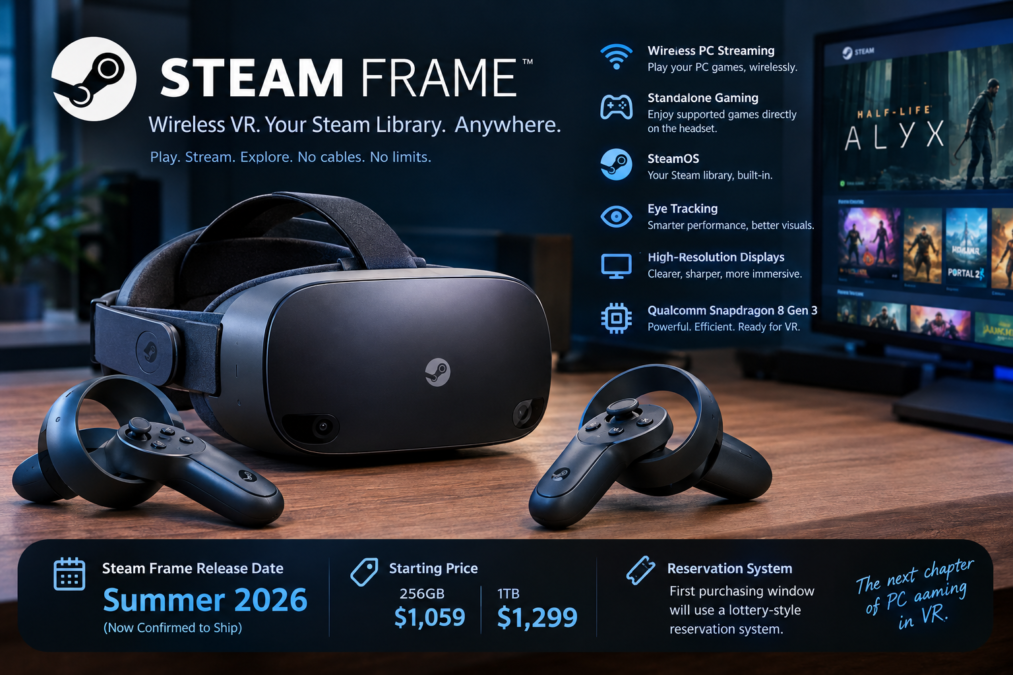

The steam frame release date has been one of the most discussed questions among PC and VR gaming fans. Valve’s Steam Frame is a new wireless VR headset designed to bring Steam gaming into a more flexible and immersive format. Unlike traditional PC VR headsets, it’s designed to work both as a standalone device and as a wireless way to stream games from a more powerful computer. Valve officially announced the Steam Frame alongside the Steam Machine and Steam Controller in 2025.
At first, Valve planned to launch the Steam Frame in early 2026. However, memory and storage shortages affected the company’s schedule and pricing plans. In June 2026, Valve confirmed that the Steam Frame would ship during summer 2026, although it still didn’t provide a specific day at that point.
Update: Valve has now officially announced the Steam Frame launch and pricing. The headset starts at $1,059 for the 256GB version, while the 1TB model starts at $1,299. Valve is using a lottery-style reservation system for the first purchasing window rather than simply giving everyone a first-come, first-served checkout.
What Is Steam Frame?
Steam Frame is Valve’s latest attempt to expand PC gaming into wireless virtual reality. It isn’t simply another headset that requires a powerful gaming computer connected by a cable. Instead, Valve has designed it around wireless gaming, standalone capabilities, and access to a large Steam library.
The official Steam product page describes Steam Frame as a streaming-first wireless VR headset and controller system capable of handling a user’s Steam library.
This approach makes the product particularly interesting because gamers can use it in different ways.
For example, a player could:
- Stream demanding PC games to the headset.
- Play supported games directly on the device.
- Enjoy VR games without a traditional wired connection.
- Use virtual displays for regular PC-style activities.
- Experience immersive VR content.
- Take advantage of Steam’s existing gaming ecosystem.
That flexibility is one of the biggest reasons people have been searching for the steam frame release date.
Why the steam frame release date Matters
Valve has a strong history in gaming hardware. The Steam Deck helped make PC gaming more portable, while the original Valve Index became an important product for PC VR enthusiasts.
The Steam Frame is different because Valve appears to be trying to combine several ideas into one product.
It aims to provide the freedom of wireless VR while still connecting users to the much larger power of a gaming PC when necessary. That means the headset doesn’t have to depend entirely on mobile hardware.
For gamers, this could be a big deal.
A standalone VR headset usually has to balance graphics quality, battery life, heat, and processing power. A gaming PC, on the other hand, can provide much greater performance but traditionally requires a physical connection. Steam Frame tries to bridge these two worlds.
In other words, Valve is betting that wireless PC streaming plus standalone gaming can offer a better overall experience.
From Early 2026 Plans to the Actual Launch
When Valve first announced Steam Frame, the company indicated that it was targeting an early 2026 release. That created a lot of excitement because Valve had been away from the VR hardware market for several years.
However, things didn’t go exactly according to the original plan.
In February 2026, Valve explained that widespread shortages involving memory and storage components had forced it to reassess its plans for both Steam Frame and Steam Machine. The company had originally wanted to provide more specific release and pricing information but needed to reconsider the schedule because of changing hardware costs and supply conditions.
Later, in June, Valve confirmed that Steam Frame would ship during summer 2026. That was an important step because it changed the discussion from whether the headset would arrive in 2026 to when consumers could actually get one.
Eventually, Valve moved from a broad launch window to an actual purchasing plan.
Steam Frame Release Date and Availability
The current launch information gives consumers a much clearer picture than the earlier announcements.
Valve has announced the Steam Frame at two storage levels:
| Model | Storage | Starting Price |
|---|---|---|
| Steam Frame | 256GB | $1,059 |
| Steam Frame | 1TB | $1,299 |
The first purchasing process is not a normal instant checkout. Valve is using a reservation lottery system intended to manage demand and reduce the impact of resellers. According to current reports, interested buyers can enter the reservation period, with selected customers receiving an opportunity to purchase.
This approach is important because Valve has experienced strong demand for its hardware products before. A reservation system can help the company control limited initial inventory while giving more customers a fair opportunity.
So, if you’re following the steam frame release date, don’t just look for a simple launch-day purchase button. Availability may depend on the reservation process and regional stock.
Steam Frame Design and Hardware
Steam Frame has been designed as a modern wireless VR system rather than a traditional headset that simply connects to a gaming PC.
One of its major hardware features is a Qualcomm Snapdragon 8 Gen 3 processor. The headset also includes 16GB of RAM, which gives it considerably more computing capability than many lightweight mobile devices. Current reporting also highlights its high-resolution displays, eye tracking, pancake lenses, and wireless connectivity.
The hardware is built around several important technologies.
High-Resolution Displays
The headset uses displays designed to provide a detailed VR image. High resolution matters because VR places screens extremely close to the user’s eyes.
If the resolution is too low, users may notice distracting pixels or a screen-door effect. Higher resolution can make virtual environments appear cleaner and more natural.
Eye Tracking
Eye tracking is another major feature.
Instead of treating every part of the virtual image equally, the system can identify where the user is looking. This can support a technique called foveated rendering.
The idea is simple:
- The area you’re looking at receives more graphical attention.
- Areas outside your direct focus can use fewer resources.
- The system can potentially improve performance without making the entire image look low quality.
This is particularly useful for a mobile-style VR device where processing power and battery life matter.
Wireless Gaming
Wireless operation is one of Steam Frame’s biggest attractions.
Valve has designed the headset to stream games from a PC without requiring the player to remain physically connected by a traditional cable. Reports also indicate support for a dedicated 6GHz wireless adapter.
That means users can potentially enjoy demanding PC games while moving around more freely.
And let’s be honest, removing a cable from VR can make a surprisingly big difference.
Standalone Gaming on Steam Frame
One of the most interesting parts of the Steam Frame concept is that it doesn’t rely entirely on PC streaming.
The Snapdragon processor allows the headset to run certain software locally. This means compatible games and applications can operate directly on the device.
Of course, there are limits.
A compact headset can’t realistically provide the same raw performance as a powerful desktop gaming PC. Instead, Valve appears to be using a combination of native gaming and streaming.
This creates two main gaming options:
Standalone mode:
The headset runs supported content locally.
Streaming mode:
A powerful computer handles the demanding work and sends the game to the headset wirelessly.
This hybrid approach could make Steam Frame more useful than a headset designed for only one of these methods.
Half-Life: Alyx and Steam Frame
One of the biggest technical achievements associated with Steam Frame is Valve’s work on Half-Life: Alyx.
Valve has ported the acclaimed VR game to ARM64 so that it can run natively on Steam Frame. The game is included with the headset, making it an especially important part of the product’s launch strategy.
This is significant because Half-Life: Alyx was originally designed as a high-quality PC VR experience.
Getting it to run on a compact wireless device requires extensive optimization. Valve reportedly worked on Vulkan drivers and SteamVR improvements to make the experience possible on the headset’s hardware.
For buyers, this means the Steam Frame isn’t arriving without a major showcase title.
Instead, Valve has a recognizable VR game ready to demonstrate what the hardware can do.
Why Valve Delayed the Steam Frame
The road to the final steam frame release date wasn’t completely smooth.
Hardware development is complicated, and component availability can change quickly. In 2026, memory and storage costs became a major concern for technology companies. Valve acknowledged that these market conditions affected its plans.
The company had initially hoped to make Steam Frame more affordable than the Valve Index, which launched at $999. However, rising component costs made that target harder to achieve. The final starting price is now $1,059, slightly above the original Index’s launch price.
The delay therefore wasn’t simply about software development.
It was also connected to the wider hardware market.
Valve had to balance:
- Component availability
- Memory costs
- Storage costs
- Manufacturing
- Performance
- Consumer pricing
- Launch inventory
That’s a tough balancing act, especially for a company trying to introduce a completely new hardware product.
What Makes Steam Frame Different?
The VR market already includes products from major companies, so Valve needs a clear reason for gamers to choose Steam Frame.
Its strongest advantage may be its connection to Steam.
Steam already has a massive PC gaming ecosystem. Millions of players have libraries filled with games, and many PC gamers don’t want to purchase the same title again simply to use a new device.
Steam Frame is designed around that existing library.
That could make the headset appealing to people who already spend a lot of time gaming on PC.
Another important advantage is its ability to combine standalone and PC-streamed gaming.
Rather than choosing between the two, Valve is offering both approaches.
That doesn’t guarantee success, of course, but it’s a smart idea.
Steam Frame Specifications and Performance
The steam frame release date has attracted attention not only because of Valve’s reputation but also because of the technology inside the headset. Steam Frame is designed to deliver a flexible VR experience without making users depend on a permanent cable connection.
The headset combines a mobile processor, wireless communication, eye tracking, high-resolution displays, and SteamOS. Together, these features are intended to create a smooth experience for both standalone and streamed gaming.
Some of the important hardware features include:
- Qualcomm Snapdragon 8 Gen 3 processor
- 16GB of memory
- High-resolution VR displays
- Pancake-style lenses
- Eye tracking
- Wireless PC game streaming
- Built-in storage options
- SteamOS-based software
- Motion controllers
- Support for Steam games
The exact experience will depend on the game being played. A simple VR title can be handled differently from a demanding PC game streamed from a powerful desktop.
That’s where Steam Frame becomes particularly interesting. Instead of forcing every game to run directly on the headset, Valve has created a system that can use the strength of a gaming PC when needed.
Steam Frame Storage Options
Storage is an important consideration for modern gaming devices. VR games can be large, and players often want to keep several titles installed.
Valve has announced two Steam Frame storage configurations:
| Feature | 256GB Model | 1TB Model |
|---|---|---|
| Internal Storage | 256GB | 1TB |
| Starting Price | $1,059 | $1,299 |
| Intended User | Moderate library | Large game library |
| Main Benefit | Lower entry price | More room for games |
The 256GB model may be enough for users who mostly stream games from a PC. On the other hand, people who want to install more standalone titles may prefer the 1TB version.
Storage needs can vary quite a bit. A user who mainly uses Steam Frame as a wireless PC VR headset won’t necessarily need as much internal storage as someone who wants to download many games directly to the device.
Steam Frame Controllers and Interaction
A VR headset is only part of the experience. Controllers are equally important because they allow players to interact with virtual environments.
Steam Frame’s controllers are designed around the same general philosophy as the headset: wireless freedom and natural interaction.
Good VR controllers need to accomplish several things at once. They should feel comfortable, respond quickly, and provide accurate movement tracking.
For gaming, this can affect everything from picking up an object to aiming a weapon or controlling a virtual tool.
Valve has already gained experience developing VR controllers through the Valve Index. That experience gives the company a useful foundation for its newer hardware.
The goal isn’t simply to make controllers that work. They need to feel responsive enough that players don’t constantly think about the technology.
When everything works properly, the controls should fade into the background.
SteamOS and the Steam Frame Experience
Steam Frame is part of Valve’s wider move toward SteamOS-powered hardware.
SteamOS has become an important part of Valve’s hardware strategy because it gives the company more control over the software environment. Instead of relying on a traditional Windows desktop experience, Valve can optimize its software for gaming hardware.
This could provide several benefits.
Simple Access to Steam
Steam users already understand the Steam interface. Bringing familiar features to Steam Frame could make the headset easier for existing PC gamers to understand.
Better Hardware Optimization
A focused operating system can help Valve optimize performance for the specific hardware inside Steam Frame.
Gaming-Focused Interface
VR requires an interface that works naturally in three-dimensional space. A gaming-focused operating system can help Valve design menus and settings specifically for that environment.
Wireless PC Integration
The software also plays an important role when games are streamed from a computer. The headset needs to communicate quickly with the host PC while keeping latency as low as possible.
After all, nobody wants to swing a virtual sword and see the movement happen a moment later.
How PC Streaming Works on Steam Frame
One of Steam Frame’s strongest features is wireless PC streaming.
In a traditional PC VR setup, the headset may be connected directly to the computer with a cable. This can provide reliable data transfer, but the cable can become annoying during movement.
Steam Frame takes a different approach.
The gaming PC performs the demanding processing. The resulting video is transmitted wirelessly to the headset, while the player’s movements and controller inputs are sent back to the computer.
The process can be simplified like this:
Gaming PC → Wireless network → Steam Frame → Player
Then the player’s movements travel in the opposite direction:
Player → Steam Frame sensors/controllers → Wireless network → Gaming PC
The entire process must happen very quickly.
If the connection is poor, users may experience delays, image quality problems, or interruptions. Therefore, the quality of the wireless network can have a major effect on the overall experience.
Steam Frame vs Traditional PC VR Headsets
Steam Frame is entering a market that already has several types of VR hardware.
Traditional PC VR headsets often provide excellent performance but may require cables or external equipment. Standalone headsets offer more freedom but have limitations caused by their mobile hardware.
Steam Frame attempts to sit between these two categories.
| Category | Traditional PC VR | Standalone VR | Steam Frame |
|---|---|---|---|
| Wireless Use | Sometimes | Yes | Yes |
| PC Streaming | Common | Available on some devices | Major focus |
| Standalone Capability | Limited | Strong | Yes |
| Large PC Library | Strong | Varies | Strong focus |
| Cable-Free Experience | Limited | Strong | Strong |
| Portable Use | Limited | Strong | Designed for flexibility |
This comparison shows why the product has created so much interest.
It’s not necessarily trying to replace every existing VR headset. Instead, Valve is building a system around the idea that users should be able to move between standalone and PC-powered experiences.
Steam Frame and Half-Life: Alyx
Few games are as closely associated with PC VR as Half-Life: Alyx.
Valve developed the game as a major VR title, and it became one of the best-known examples of what high-quality VR gaming could achieve.
The fact that Valve has worked to bring Half-Life: Alyx to Steam Frame is therefore significant.
The game has been adapted for ARM64 hardware, allowing it to run natively on Steam Frame rather than requiring a gaming PC for the same experience. Valve has also worked on the underlying software and graphics technology needed to make this possible.
This demonstrates an important point.
Valve isn’t treating Steam Frame as merely a screen for PC games. The company is also working to make demanding experiences run directly on the headset.
That could encourage developers to consider optimized versions of more PC games in the future.
Can Steam Frame Run PC Games Without a Gaming PC?
This is one of the most important questions surrounding the product.
The short answer is: some games can run directly on Steam Frame, while demanding PC games can be streamed from a computer.
The headset’s standalone capabilities don’t mean every PC game will suddenly run locally.
PC games can have very different hardware requirements. A lightweight game may be suitable for the headset, while a graphically demanding modern title may need the processing power of a desktop computer.
Valve’s approach gives users more choices.
If a game supports the headset directly, it can potentially run locally. If it doesn’t, PC streaming can provide another path.
That’s a practical solution because it avoids expecting a compact VR headset to perform exactly like a high-end gaming desktop.
Steam Frame Price and Value
Price is another major part of the steam frame release date discussion.
The announced starting prices are:
- 256GB Steam Frame: $1,059
- 1TB Steam Frame: $1,299
These prices put Steam Frame into the premium VR category.
For casual users, the cost may seem high. But serious PC VR players may judge the product differently because they’re paying for a combination of features rather than simply a display.
The value equation includes:
- Wireless PC VR
- Standalone gaming
- SteamOS
- Eye tracking
- High-resolution displays
- Powerful mobile hardware
- Steam ecosystem integration
- VR controllers
- Access to PC game streaming
Whether the price feels reasonable will ultimately depend on how well these features work together in everyday use.
Who Should Consider Steam Frame?
Steam Frame appears to be aimed primarily at people who already enjoy PC gaming or VR.
It could be particularly interesting for:
PC Gamers
Players with a large Steam library may appreciate the ability to access their games through a VR-focused device.
VR Enthusiasts
People who already understand VR and want a more flexible wireless experience may find the hybrid design appealing.
Steam Users
Existing Steam users may find the software ecosystem more familiar than moving to a completely different gaming platform.
Technology Enthusiasts
People who enjoy trying new hardware may be interested in Valve’s approach to standalone ARM gaming and wireless PC streaming.
However, Steam Frame may not be the ideal first purchase for someone who has never used VR and simply wants an inexpensive introduction.
Potential Advantages of Steam Frame
There are several reasons why the product could become important in the VR market.
Wireless freedom is perhaps the most obvious advantage. Removing the physical cable can make room-scale VR more comfortable.
Hybrid gaming is another major strength. Users aren’t limited to either standalone or PC streaming.
Steam integration could also be valuable. PC gamers already have years of purchases and saved content connected to their Steam accounts.
Valve’s VR experience shouldn’t be overlooked either. The company has worked on VR hardware and software for years, giving it useful knowledge about tracking, controllers, interfaces, and game development.
Finally, Half-Life: Alyx provides a strong demonstration of what Valve wants Steam Frame to achieve.
Potential Limitations to Keep in Mind
No technology is perfect, and Steam Frame has some limitations that buyers should consider.
Premium Price
The starting price is considerably higher than many mainstream standalone VR products.
Wireless Network Dependence
PC streaming relies on a strong wireless connection. Network performance can influence latency and image quality.
Battery Considerations
Like other wireless headsets, Steam Frame has to balance performance with battery life.
Limited Standalone Performance
Although the headset can run native software, it won’t have the same raw graphics power as a high-end gaming PC.
Game Compatibility
Not every PC game will automatically provide an ideal standalone VR experience. Developers may need to optimize software for the platform.
These aren’t necessarily deal-breakers. They’re simply factors buyers should understand before making a decision.
Steam Frame Release Date: What Buyers Should Know
The story of the steam frame release date shows how hardware launches can change during development.
Valve initially targeted an earlier release window but later adjusted its schedule because of hardware supply and cost challenges. The company then moved toward a summer 2026 shipping target before announcing the actual purchasing and reservation process.
This is a useful reminder that an announced launch window isn’t always the same as guaranteed availability in every country.
Regional availability can also differ.
Potential buyers should therefore check Valve’s official Steam hardware information for their region rather than relying only on social media posts or old articles.
It’s also wise to pay attention to:
- Reservation announcements
- Shipping information
- Regional pricing
- Available storage models
- System requirements
- Controller information
- Software updates
- Official compatibility information
Doing a little research before purchasing can save money and prevent disappointment.
Final Thoughts on Steam Frame Release Date
The steam frame release date represents an important moment for Valve and the wider VR gaming industry. Steam Frame combines standalone hardware, wireless PC streaming, SteamOS, eye tracking, modern VR optics, and access to the Steam gaming ecosystem.
Its premium pricing means it won’t necessarily appeal to everyone. Still, the concept is ambitious. By allowing users to move between locally running software and PC-powered streaming, Valve is trying to remove some of the traditional barriers between standalone VR and PC VR.
With Half-Life: Alyx demonstrating the possibilities of native VR gaming on the hardware, Steam Frame could become an interesting platform for both players and developers.
Ultimately, the success of Steam Frame won’t be determined by specifications alone. Comfort, battery life, software support, wireless performance, game compatibility, and real-world reliability will matter just as much.
For now, gamers interested in the steam frame release date have plenty of reasons to keep watching Valve’s official announcements as the platform develops and becomes more widely available.
Explore more insightful articles on All Vantage News and never miss an update.Contact Us.