
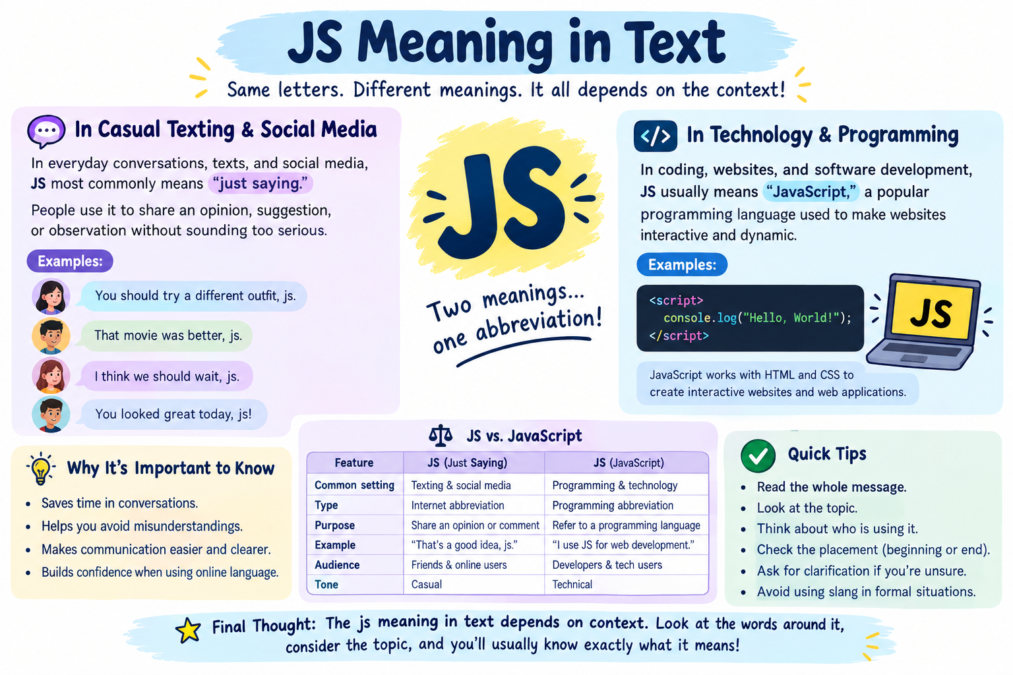

The js meaning in text can be confusing because this short abbreviation can have different meanings depending on where and how it’s used. In casual messages, social media comments, online chats, and texting, “JS” often means “just saying.” However, in technology and programming, “JS” commonly refers to JavaScript, a popular programming language used to make websites interactive.
Understanding the correct meaning is usually easy when you look at the surrounding words. For example, someone might write, “I’m not angry, js,” where JS means “just saying.” On the other hand, a developer might say, “I wrote this feature in JS,” where JS clearly means JavaScript.
This guide explains the js meaning in text in simple language. It covers its common definitions, examples, uses in conversations, social media meanings, and the difference between casual and technical contexts.
What Does JS Mean in Text?
The most common js meaning in text is “just saying.”
People use “JS” as a short way to add a comment or opinion without making it sound too serious. It can appear at the end of a sentence, especially in informal conversations.
For example:
- “You could try a different outfit, js.”
- “I think that movie was better, js.”
- “You should probably leave early, js.”
- “That was a pretty good idea, js.”
In these examples, “js” means “just saying.” The person is usually giving an opinion or observation and wants to make it clear that they aren’t necessarily demanding that the other person agree.
That said, context matters. The same two letters can mean something completely different in another setting.
JS Meaning in Text on Social Media
Social media has made abbreviations extremely common. People often use short expressions because they allow them to communicate quickly.
On platforms such as social networks, messaging apps, forums, and online communities, JS may be used as “just saying.”
For example:
“That restaurant is overrated, js.”
Here, the writer is expressing an opinion. The “js” makes the statement feel more casual.
Another example could be:
“You looked better with the old hairstyle, js.”
This sentence can sound blunt. Adding “js” suggests that the person is sharing an opinion rather than trying to start an argument.
However, tone still depends on the situation. Sometimes “just saying” can sound polite, while in other situations it can sound sarcastic or slightly critical.
Why Do People Use JS Instead of Just Saying?
Online communication is often fast-paced. People don’t always want to type complete phrases, especially when chatting with friends.
Using “JS” can save time and make a message feel informal.
There are several reasons someone might use it:
- Speed: It takes only two letters to type.
- Casual tone: It fits naturally into friendly conversations.
- Informal expression: It can make an opinion sound less formal.
- Internet culture: Online users commonly shorten words and phrases.
- Character limits: Short expressions can be useful where space is limited.
Think of it as digital shorthand. Just as people write “LOL,” “BTW,” or “IDK,” they may write “JS” when they mean “just saying.”
JS Meaning in Text With Examples
Examples are one of the easiest ways to understand abbreviations.
Here are some common examples of js meaning in text:
| Text Message | Meaning of JS | Explanation |
|---|---|---|
| “That color suits you, js.” | Just saying | A casual opinion |
| “I think we should wait, js.” | Just saying | The person is sharing a thought |
| “You should watch that show, js.” | Just saying | A friendly suggestion |
| “That wasn’t very funny, js.” | Just saying | A personal opinion |
| “JS, don’t take it personally.” | Just saying | The speaker wants to reduce tension |
| “I was js asking.” | Just asking / Just saying, depending on context | Meaning depends on the conversation |
The last example shows why context is important. Abbreviations can sometimes be interpreted in more than one way.
JS Can Also Mean JavaScript
Here’s where things get interesting. In technology, JS usually means JavaScript, not “just saying.”
JavaScript is a programming language widely used to create interactive websites and web applications.
A developer might write:
“This website uses HTML, CSS, and JS.”
In this case:
- HTML structures the webpage.
- CSS controls its appearance.
- JS adds behavior and interaction.
For example, JavaScript can help a webpage respond when someone clicks a button, fills out a form, opens a menu, or interacts with a web application.
So, if you see “JS” in a programming article, coding tutorial, software discussion, or developer conversation, it probably means JavaScript.
How Context Helps You Understand JS
Context is the most important clue when interpreting short abbreviations.
Consider these two sentences:
“JS, I think you’re right.”
Here, JS most likely means “just saying.”
Now consider:
“I’m learning JS for web development.”
Here, JS almost certainly means JavaScript.
The surrounding words provide the answer.
When you see an abbreviation, ask yourself:
- Is this a personal conversation?
- Is the person discussing social media?
- Is the topic related to computers?
- Is the sentence talking about programming?
- Does the abbreviation appear at the beginning or end of a casual statement?
These clues can help you avoid misunderstanding.
JS in Casual Conversations
In everyday texting, people tend to use abbreviations freely. Friends may use “JS” while discussing school, work, entertainment, fashion, sports, or personal opinions.
For example:
Person A: “Do you like my new shoes?”
Person B: “They’re not really my style, js.”
Here, “js” means “just saying.”
It can soften a statement, although it doesn’t automatically make a comment kind. If the statement itself is harsh, the abbreviation won’t completely remove its impact.
Another example:
Person A: “Should I apply for this job?”
Person B: “You should definitely try, js.”
The writer is simply adding an opinion.
Is JS Always Polite?
Not necessarily.
“Just saying” can be friendly, neutral, or sarcastic depending on the speaker’s tone.
For example:
“You might want to check the instructions first, js.”
This could be helpful advice.
But:
“Maybe learn how to drive before buying that car, js.”
This may sound insulting or sarcastic.
Therefore, understanding the js meaning in text isn’t only about knowing the words. You also need to understand the tone and situation.
Written messages don’t include facial expressions or voice tone, so a short abbreviation can sometimes be interpreted differently by different people.
JS Meaning in Text and Internet Slang
Internet slang changes quickly. New abbreviations appear, while older expressions become less popular.
Some common online abbreviations include:
- LOL — Laughing out loud
- BRB — Be right back
- BTW — By the way
- IDK — I don’t know
- IMO — In my opinion
- TBH — To be honest
- FYI — For your information
- JS — Just saying, in many casual contexts
These expressions make digital communication shorter and faster.
However, slang isn’t always appropriate. A professional email, formal report, or business document usually shouldn’t contain casual abbreviations unless the situation specifically calls for them.
JS Meaning in Text vs. JavaScript
One of the biggest sources of confusion is that JS has two very common meanings.
| Feature | JS as “Just Saying” | JS as “JavaScript” |
|---|---|---|
| Common setting | Texting and social media | Programming and technology |
| Type | Internet abbreviation | Programming abbreviation |
| Purpose | Express an opinion or comment | Refer to a programming language |
| Example | “That was a bad idea, js.” | “I code in JS.” |
| Audience | Friends and online users | Developers and technology users |
| Tone | Casual | Technical |
The surrounding context usually makes the intended meaning clear.
How to Respond When Someone Uses JS
If someone sends you a message containing “JS,” you generally don’t need to ask what it means if the context is obvious.
For example:
“I think you should call her, js.”
You can understand that the person probably means “just saying.”
If the context isn’t clear, asking a simple question is perfectly fine:
“Do you mean just saying?”
There’s no harm in checking. In fact, clarification can prevent misunderstandings.
If you’re discussing coding and someone says:
“The JS needs fixing.”
They probably mean JavaScript.
Common Mistakes When Understanding JS
Short abbreviations can create confusion, especially for people who aren’t familiar with internet slang.
One common mistake is assuming that every “JS” means JavaScript. In a casual text message, that interpretation would often make no sense.
Another mistake is assuming that every “JS” means “just saying.” In a programming discussion, that would also be incorrect.
Here are some mistakes to avoid:
- Don’t interpret abbreviations without checking the context.
- Don’t assume online slang has only one meaning.
- Don’t use casual slang in every type of communication.
- Don’t assume “JS” automatically makes a statement polite.
- Don’t confuse “JS” with other similar abbreviations.
A little attention to context goes a long way.
When Should You Use JS in Texting?
If you’re chatting casually with friends, using “JS” can be perfectly natural.
You might use it when:
- Sharing a personal opinion
- Making a casual suggestion
- Adding a small observation
- Explaining that you’re not trying to argue
- Keeping a conversation short
For example:
“I think you should take the earlier bus, js.”
However, you should consider your audience. A teacher, employer, customer, or professional contact may prefer complete words instead of internet abbreviations.
In formal communication, writing “just saying” is usually clearer.
When Should You Avoid JS?
Although abbreviations are useful, they aren’t suitable for every situation.
Avoid using “JS” when writing:
- Formal emails
- Academic assignments
- Official applications
- Business proposals
- Professional reports
- Legal documents
- Important customer communications
Instead of:
“You should review the document, js.”
A professional version would be:
“I recommend reviewing the document before submitting it.”
The second sentence is clearer and more professional.
Understanding the Tone Behind JS
Language isn’t only about dictionary definitions. Tone matters, too.
When someone writes “js,” they may be trying to communicate:
- “This is only my opinion.”
- “I’m not trying to argue.”
- “I’m simply pointing something out.”
- “Take it or leave it.”
- “I’m being honest with you.”
Still, readers can interpret the same sentence differently.
For example:
“Your presentation was too long, js.”
One person may read this as friendly feedback. Another might consider it rude.
That’s why the relationship between the speakers matters.
A close friend may use “js” casually, while the same wording from a stranger might feel more critical.
JS Meaning in Text for Students
Students often encounter abbreviations through group chats, social media, gaming communities, and messaging apps.
Knowing common internet language can make online communication easier.
If a classmate says:
“That homework was difficult, js.”
The likely meaning is:
“That homework was difficult, just saying.”
However, students should also understand when slang is appropriate.
A school assignment should normally use standard English. Internet abbreviations can make formal writing look careless or informal.
So, it’s useful to know both styles:
Casual:
“JS, that test was hard.”
Formal:
“I found the test challenging.”
Both communicate an idea, but they suit different situations.
JS Meaning in Text for Parents and Teachers
Parents and teachers may occasionally see “JS” in messages from younger people and wonder what it means.
In a casual conversation, it commonly means “just saying.” Understanding common texting language can help adults communicate more easily with students and children.
However, abbreviations constantly change. A phrase that is popular today may become less common later.
The best approach isn’t to memorize every abbreviation. Instead, focus on the context and ask when necessary.
A simple question such as “What does JS mean here?” can quickly solve the problem.
JS in Technology and Web Development
When talking about websites, software, or programming, JS almost always refers to JavaScript.
JavaScript works alongside technologies such as HTML and CSS.
A simple way to understand their roles is:
- HTML: Builds the structure.
- CSS: Designs the appearance.
- JavaScript: Adds behavior and interaction.
For example, a webpage may use JavaScript to show a message after a user clicks a button.
JavaScript is also used in modern web applications, server-side development, automation, games, and many other software projects.
Therefore, the meaning of JS changes dramatically between casual texting and technology.
Why Context Is More Important Than the Abbreviation
Imagine seeing this message:
“I need to learn JS.”
Without context, you might not know exactly what the person means.
If they’re talking about web development, JS means JavaScript.
If they’re chatting about an opinion, it could mean something else, although the sentence would be less typical.
Now consider:
“That outfit looks great, JS.”
This clearly sounds like casual internet language rather than programming.
The lesson is simple: don’t read abbreviations in isolation.
Look at the complete sentence and the conversation around it.
Helpful Tips for Understanding Internet Abbreviations
If you’re new to online slang, don’t worry. It becomes easier with practice.
Here are a few useful tips:
- Read the whole message. The surrounding words often reveal the meaning.
- Consider the topic. Technology terms usually have technical meanings.
- Think about the speaker. Friends may use slang more often than professionals.
- Look at placement. “JS” at the end of an opinion may mean “just saying.”
- Ask for clarification. When in doubt, simply ask.
- Avoid overusing slang. Clear communication is more important than sounding trendy.
These habits can help you understand not only JS but many other online abbreviations.
Is JS a Good Abbreviation to Use?
There isn’t a single answer.
For casual messaging, “JS” can be convenient and understandable. It can make a conversation feel relaxed and quick.
For formal communication, it’s better to write the complete phrase.
The same principle applies to many texting abbreviations. They aren’t necessarily bad English; they’re simply designed for a different communication environment.
The key is knowing your audience.
A message to a friend and an email to a manager don’t need to sound the same.
Final Thoughts on JS Meaning in Text
The js meaning in text most commonly refers to “just saying” when used in casual chats, texting, and social media. It can be used to introduce or soften an opinion, observation, or suggestion. However, context is essential because JS is also a widely used abbreviation for JavaScript in technology and programming.
Understanding the difference is simple when you pay attention to the conversation. If someone is discussing opinions, friends, or social media, “just saying” is often the intended meaning. If they’re discussing websites, coding, or software, JS almost certainly means JavaScript.
Ultimately, the best way to understand js meaning in text is to look at the words around it, consider the topic, and think about who is using the abbreviation. With a little practice, you’ll quickly recognize which meaning fits the conversation.
How JS Is Used at the End of a Text
One of the most common places to see “JS” in a casual message is at the end of a sentence. When used this way, it often means “just saying.”
For example:
“I think you should talk to him, js.”
The person isn’t necessarily giving an order. Instead, they’re sharing their thoughts and leaving the final decision to you.
Another example is:
“That restaurant isn’t as good as people say, js.”
The writer is simply expressing an opinion. In everyday conversation, this can be a quick way to say what you think without making the discussion sound too serious.
Still, tone matters. A short message can sometimes sound different from what the writer intended. That’s why it’s helpful to consider the entire conversation rather than focusing on the abbreviation alone.
JS Meaning in Text When Giving Advice
People sometimes use JS when offering advice. It can make the suggestion feel less forceful.
For instance:
“You should save some money for emergencies, js.”
The person is sharing advice, but they’re not necessarily demanding that you follow it.
Similarly:
“Maybe you should check your email again, js.”
This can mean that the speaker noticed something and wants to mention it casually.
In this situation, js meaning in text is closely connected with the idea of sharing an observation. It’s almost like saying, “I’m only mentioning this because I thought you should know.”
JS and Friendly Conversations
Texting between friends is usually relaxed. People often use abbreviations, slang, emojis, and shortened expressions.
“JS” can fit naturally into these conversations.
For example:
Friend A: “Should I buy this jacket?”
Friend B: “It looks nice, js.”
Here, the person is giving a quick opinion.
Another conversation might look like this:
Friend A: “I might watch a movie tonight.”
Friend B: “You should watch that new comedy, js.”
Again, the abbreviation keeps the conversation informal.
Of course, close friends may understand each other’s tone more easily than strangers do. That’s one reason internet slang is especially common among people who already know each other.
Can JS Have Different Meanings?
Yes. Abbreviations don’t always have one fixed meaning.
Depending on the situation, JS can refer to:
- Just saying in casual texting
- JavaScript in programming
- Initials for a person’s name
- A name, username, brand, group, or organization in certain contexts
- Other specialized meanings within particular communities
This is why dictionaries of internet slang can’t always give you the complete answer.
Context is king.
If you’re reading a message about someone’s opinion, “just saying” makes sense. If you’re reading a coding tutorial, “JavaScript” is almost certainly the intended meaning.
JS Meaning in Text Messages and Chat Apps
Messaging apps encourage short and quick communication. Whether someone is chatting with a friend or participating in a group conversation, abbreviations can make typing easier.
A person may write:
“JS, I don’t think that’s a good idea.”
This means:
“Just saying, I don’t think that’s a good idea.”
Another example:
“You could ask her directly, js.”
Here, the speaker is offering a suggestion.
People may also combine JS with other texting abbreviations:
“TBH, I don’t like it, js.”
Here, TBH means “to be honest,” while js means “just saying.”
Combining abbreviations is common in informal online conversations, although it can make messages harder for new users to understand.
How Teenagers and Young Adults Use JS
Younger internet users often become familiar with slang through social media, online games, messaging platforms, and group chats.
They may use abbreviations without even thinking about them.
For example:
- “That song is actually good, js.”
- “You should try it, js.”
- “I’m not saying it’s bad, js.”
- “JS, I think you’re overthinking it.”
These messages are generally casual rather than formal.
However, slang trends change quickly. An abbreviation that seems popular today might become less common in the future. That’s perfectly normal for online language.
Language evolves as people find faster and more creative ways to communicate.
How JS Can Change the Tone of a Sentence
The phrase “just saying” can affect the tone of a message.
Compare these two sentences:
“You should study more.”
and:
“You should study more, js.”
The first statement sounds direct. The second sounds more like a personal observation.
But this doesn’t mean “js” always makes a sentence friendly. For example:
“Your idea makes no sense, js.”
That still sounds harsh.
So, while js meaning in text can sometimes soften an opinion, it doesn’t magically make every statement polite.
Good communication depends on the words, situation, relationship, and overall tone.
JS Meaning in Text During Arguments
Interestingly, people sometimes use “js” during disagreements.
Someone might say:
“I’m not trying to argue. I think you should look at the facts, js.”
Here, “just saying” may be used to show that the person wants to make a point without creating a bigger argument.
However, it can also have a sarcastic tone.
For example:
“Maybe you should read the instructions next time, js.”
Depending on the situation, this could sound like criticism.
When you’re unsure about someone’s intention, don’t jump to conclusions. Ask for clarification instead.
Is JS the Same as Just Saying?
In casual texting, yes, JS commonly stands for “just saying.”
The abbreviation simply removes most of the letters from the phrase.
Just saying → JS
This type of shortening is called an abbreviation or texting shorthand.
Similar examples include:
Just kidding → JK
Be right back → BRB
I don’t know → IDK
By the way → BTW
In my opinion → IMO
These shortened forms are designed mainly for informal communication.
JS Meaning in Text and Formal English
It’s important to understand the difference between texting English and formal English.
Texting often uses:
- Abbreviations
- Slang
- Emojis
- Short sentences
- Informal expressions
Formal English usually uses:
- Complete words
- Clear sentence structures
- Professional vocabulary
- Proper punctuation
- A more respectful tone
For example, in a friendly chat:
“That plan might not work, js.”
In a professional message:
“I don’t think this plan will work as expected.”
The second version is more suitable for workplace communication.
Neither style is automatically better. They simply serve different purposes.
How Writers Can Use JS Correctly
If you’re writing an article, blog post, social media caption, or online guide about texting language, it’s useful to explain the abbreviation clearly the first time you mention it.
For example:
“In casual conversations, JS often means ‘just saying.’”
After explaining it, you can use the abbreviation when appropriate.
This approach helps readers who may not already know the term.
For SEO content, clarity is especially important. A reader searching for js meaning in text usually wants a direct explanation first. Supporting information, examples, and comparisons can then provide additional value.
Why People Search for JS Meaning in Text
People may search for this phrase because they have received a message containing “JS” and aren’t sure what it means.
For example, someone might receive:
“That’s not what I would’ve done, js.”
If they’ve never encountered the abbreviation before, they may wonder whether it has a special meaning.
A quick search can explain that it commonly means “just saying.”
People may also search because they saw “JS” on social media, in a comment, or in an online discussion.
Others may encounter JS in a completely different environment, such as a programming course, where it means JavaScript.
The same abbreviation can therefore attract searches from both casual internet users and technology learners.
JS Meaning in Text for Online Communication
Clear communication is important even when you’re using slang.
Before sending a message containing JS, consider whether the other person is likely to understand it.
If you’re talking with someone who frequently uses internet slang, “JS” probably won’t cause confusion.
If you’re speaking with someone who doesn’t use texting abbreviations, writing “just saying” may be better.
For example:
Informal:
“I think you should wait, js.”
Clearer version:
“I think you should wait. I’m just saying.”
The second version takes a little longer to type but removes possible confusion.
Understanding JS Without Overthinking It
Sometimes people spend too much time trying to decode an abbreviation when the surrounding sentence already provides the answer.
Suppose you see:
“That movie was boring, js.”
There’s no programming discussion. It’s simply an opinion.
So, “just saying” is the obvious interpretation.
On the other hand:
“JS can manipulate webpage elements.”
This is clearly about programming, so JS means JavaScript.
The best approach is straightforward:
Read the sentence. Check the topic. Understand the context.
That’s usually all you need.
Examples of JS in Different Situations
Here are some examples showing how the intended meaning can change:
| Example | Likely Meaning | Context |
|---|---|---|
| “That wasn’t very nice, js.” | Just saying | Casual conversation |
| “JS, you should get some rest.” | Just saying | Friendly advice |
| “I’m learning JS this semester.” | JavaScript | Education |
| “The website was built using JS.” | JavaScript | Web development |
| “JS, I think you’re right.” | Just saying | Personal conversation |
| “Can you fix the JS error?” | JavaScript | Programming |
This table demonstrates why context should always be considered.
The Difference Between JS and Similar Texting Terms
Several internet expressions can look similar because they are short and informal.
For example, JK means “just kidding,” while JS commonly means “just saying.”
Consider the difference:
“I hate your new haircut, JK.”
This means the speaker is joking.
Now:
“I prefer your old haircut, JS.”
This means the speaker is expressing an opinion.
The difference may seem small, but the intended message can change significantly.
Understanding these distinctions can make online communication much easier.
JS Meaning in Text: A Simple Rule to Remember
If you’re trying to remember the most common casual meaning, use this simple rule:
JS + casual opinion = probably “just saying.”
For example:
“You should try the other restaurant, js.”
But:
JS + programming discussion = probably “JavaScript.”
For example:
“I’m working on a JS project.”
This simple rule won’t solve every possible situation, but it works well in many everyday conversations.
Final Explanation of JS Meaning in Text
The js meaning in text depends heavily on context. In casual messages, social media posts, and friendly conversations, JS commonly means “just saying.” People use it when sharing an opinion, observation, suggestion, or comment in an informal way.
In technology, however, JS usually means JavaScript, the programming language used to create interactive websites and applications.
The good news is that you don’t have to memorize every possible meaning. Just look at the words around the abbreviation and consider the topic being discussed. If it’s a personal conversation, “just saying” is often the right answer. If it’s a coding or web-development conversation, “JavaScript” is usually the answer.
So, whenever you come across js meaning in text, remember one simple idea: context gives the abbreviation its meaning. Once you understand that, JS becomes a lot less confusing and much easier to recognize.
Explore more insightful articles on All Vantage News and never miss an update.Contact Us.