
STFU meaning is a common search query among people who see this abbreviation in text messages, social media posts, comments, gaming chats, and online conversations. If you have come across STFU and wondered what it means, you’re not alone. Internet slang changes quickly, and new abbreviations can sometimes feel confusing.
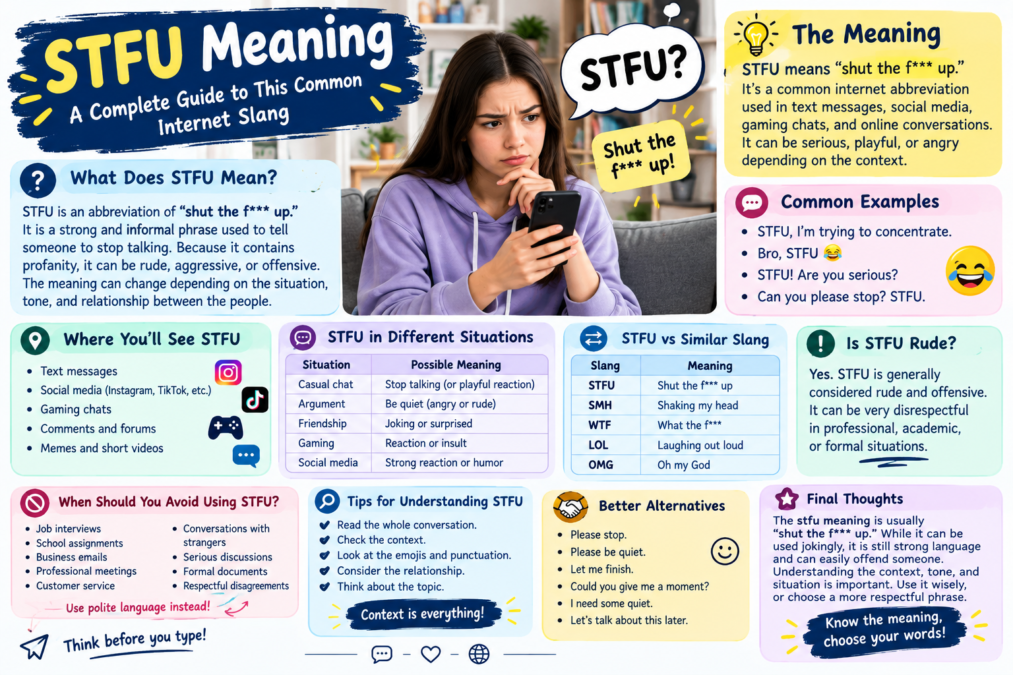
STFU is an abbreviation of “shut the f* up.”** It is a very informal phrase that tells someone to stop talking or be quiet. However, its meaning can change depending on the situation, relationship between the speakers, and tone of the conversation.
Because the phrase contains a strong swear word, STFU can sound rude, angry, aggressive, or offensive. In some friendly conversations, people may use it jokingly to show surprise or disbelief. Even then, it’s important to understand the context before using it.
This guide explains the stfu meaning, where it comes from, how people use it online, what it means in different situations, and why you should be careful when using it.
What Is the STFU Meaning?
The basic stfu meaning is “shut the f* up.”**
It is usually used when someone wants another person to stop talking. The expression is much stronger than simply saying “be quiet.” Because of the profanity involved, it can be considered offensive in many situations.
For example:
- “STFU, I’m trying to concentrate.”
- “Bro, STFU 😂”
- “STFU! Are you serious?”
- “Can you please stop? STFU.”
The meaning isn’t always exactly the same. A person might use STFU because they’re angry, or they might use it as a joke with a close friend.
The surrounding conversation is important. Without context, it can be difficult to know whether STFU is meant seriously or humorously.
What Does STFU Stand For?
STFU stands for “shut the f* up.”**
The abbreviation removes the need to type the complete phrase. Like many internet abbreviations, it became popular because typing a few letters is faster and easier than writing a longer sentence.
Here is a simple breakdown:
| Letter | Word |
|---|---|
| S | Shut |
| T | The |
| F | A strong profanity |
| U | Up |
The F represents a profanity, which is why STFU is considered vulgar or offensive language.
It’s worth remembering that abbreviations don’t always make a rude phrase less rude. Writing STFU instead of the full phrase may make it look shorter, but the underlying message remains strong.
Why Do People Use STFU Online?
People use STFU for several different reasons. The most obvious reason is to tell someone to stop talking. However, online communication has made the abbreviation more flexible.
Someone might use STFU when they are:
- Angry with another person
- Annoyed by repeated messages
- Joking with a close friend
- Shocked by surprising news
- Reacting to something unbelievable
- Trying to be humorous
- Participating in a casual gaming chat
For example, imagine a friend tells you that they just won a huge prize. You might see another friend reply:
“STFU! No way!”
In this situation, the person may not literally be telling their friend to stop talking. Instead, STFU could express surprise or disbelief.
That’s one reason internet slang can be tricky. The same abbreviation can carry different emotions depending on the context.
STFU Meaning in Text Messages
In text messages, STFU is often used in casual conversations between friends.
For example:
Person A: “I just finished the whole pizza myself.”
Person B: “STFU 😂”
Here, Person B may be joking rather than seriously asking Person A to stop talking.
But consider a different conversation:
Person A: “You never listen to me.”
Person B: “STFU and leave me alone.”
This version sounds angry and hostile.
So, while the words are the same, the meaning and emotional effect can be very different.
When reading STFU in a text message, look at the other words, punctuation, emojis, and previous messages. They can provide clues about the speaker’s intention.
STFU Meaning on Social Media
On social media platforms, STFU can appear in comments, direct messages, posts, captions, and replies.
People may use it when reacting to:
- Funny videos
- Unexpected news
- Celebrity updates
- Arguments
- Memes
- Sports results
- Gaming clips
- Surprising announcements
For example, someone might comment:
“STFU, this actually happened?”
This could express shock rather than anger.
However, STFU can also be used aggressively during online arguments. Someone may write it to insult another person or silence their opinion.
Because social media conversations often involve strangers, using STFU can easily create conflict. A phrase that seems funny to one person may feel disrespectful to another.
STFU Meaning in Gaming Chats
Gaming communities frequently use short abbreviations because players need to communicate quickly.
During a game, you might see:
- STFU
- GG
- LOL
- AFK
- BRB
- IDK
- OMG
- WTH
STFU can appear when players are joking, arguing, or reacting to an unexpected event.
For example:
“STFU, you actually beat the boss!”
A player could use this as a surprised reaction.
On the other hand, someone might use STFU aggressively toward another player. In that situation, it can contribute to toxic behavior.
Good gaming communication doesn’t require insulting other players. Even when a game gets competitive, respectful language can make the experience more enjoyable for everyone.
Is STFU Rude?
Yes, STFU is generally considered rude and offensive because it contains profanity and directly tells another person to be silent.
The level of offense depends on the situation.
For example, a close friend may understand:
“STFU 😂”
as a joke.
But saying STFU to a teacher, manager, customer, stranger, or older person could be viewed as extremely disrespectful.
Before using it, consider:
- Who are you talking to?
- How well do you know the person?
- Is the conversation serious or playful?
- Could the person misunderstand your intention?
- Is the setting professional or casual?
When in doubt, choose a more polite phrase.
STFU as a Joke
One of the most interesting parts of internet slang is that people sometimes use rude words in a playful way.
Friends who know each other well may use STFU to show excitement, disbelief, or amusement.
For example:
Friend: “I met my favorite actor today!”
You: “STFU! Seriously?”
Here, the speaker may not actually want the friend to stop talking. Instead, the phrase communicates something like:
“Wow! I can’t believe that happened!”
Emojis can also change the tone. A laughing emoji, shocked emoji, or crying emoji may suggest that the person is joking.
Still, jokes don’t always work as expected. Written messages don’t include facial expressions or voice tone, so another person may interpret the words differently.
STFU and Anger
STFU can be much more serious when used during an argument.
For example:
“STFU. I don’t want to hear another word.”
This message clearly communicates anger and a desire for the other person to stop speaking.
Using STFU in an argument can make the situation worse. Instead of solving the problem, it may make the other person feel attacked.
If the goal is to end a difficult conversation, more respectful alternatives are usually better:
- “Please stop.”
- “I need some space.”
- “Let’s talk about this later.”
- “Please give me a moment.”
- “I don’t want to continue this conversation.”
These phrases communicate boundaries without using offensive language.
Difference Between STFU and Be Quiet
STFU and “be quiet” can have a similar basic purpose, but their tone is very different.
| Expression | General Tone | Suitable for Formal Situations? |
|---|---|---|
| STFU | Very rude or aggressive | No |
| Shut up | Rude or informal | Usually no |
| Be quiet | Direct but less offensive | Sometimes |
| Please be quiet | Polite | Yes |
| Could you lower your voice? | Respectful | Yes |
| Please stop talking for a moment | Polite and clear | Yes |
The important lesson is that word choice matters. Two phrases can have a similar basic meaning but create completely different reactions.
STFU Meaning Compared With Similar Slang
Internet users have many abbreviations for different emotions and situations. Some may look similar but have completely different meanings.
| Slang | Meaning | Common Use |
|---|---|---|
| STFU | Shut the f*** up | Telling someone to be quiet or showing strong surprise |
| SMH | Shaking my head | Disappointment or disbelief |
| LOL | Laughing out loud | Showing amusement |
| OMG | Oh my God | Surprise or excitement |
| IDK | I don’t know | Showing uncertainty |
| BTW | By the way | Introducing additional information |
| WTF | What the f*** | Strong surprise, anger, or confusion |
Learning these abbreviations can make online conversations easier to understand.
When Should You Avoid Using STFU?
There are many situations where STFU should be avoided.
You should generally not use it in:
- Job interviews
- School assignments
- Business emails
- Professional meetings
- Customer service conversations
- Formal letters
- Academic writing
- Conversations with people you don’t know well
- Serious discussions
- Respectful disagreements
For example, writing “STFU” in an email to your manager would be highly inappropriate.
Even in casual conversations, think twice before using it if you’re not sure how the other person will react.
Is STFU Appropriate for Children?
Parents, teachers, and guardians may want to explain the meaning of STFU when children encounter it online.
The most useful approach is to explain that it is profanity-based slang and is generally considered disrespectful.
Children may see STFU in:
- Online games
- YouTube comments
- Social media
- Group chats
- Memes
- Text messages
Rather than simply saying that the abbreviation is “bad,” it can be helpful to explain why context and respectful communication matter.
Children should understand that online messages can affect real people. A short comment may seem harmless, but it can hurt someone’s feelings or start an argument.
How to Respond When Someone Says STFU
If someone sends you STFU, don’t automatically assume they are angry.
First, consider the context.
If it is clearly a joke between friends, you may respond humorously.
If the person appears angry, a calm response can prevent the situation from becoming worse.
Possible responses include:
- “Okay, let’s calm down.”
- “If you’re upset, we can talk later.”
- “I don’t want to argue.”
- “Let’s keep the conversation respectful.”
- “What exactly is bothering you?”
If someone repeatedly uses offensive language toward you, it’s reasonable to stop responding or leave the conversation.
STFU in Memes and Internet Culture
Internet culture has made abbreviations such as STFU widely recognizable. Memes often use strong expressions for dramatic or humorous effect.
A meme might use STFU to represent:
- Shock
- Excitement
- Disbelief
- Humor
- Frustration
- Sarcasm
For instance, a meme about an unbelievable sports result might include STFU as a dramatic reaction.
However, memes often exaggerate language. Something that looks funny in a meme may not be appropriate in real-life communication.
Understanding the difference between entertainment and everyday communication is important.
Why Context Matters for STFU Meaning
Context is one of the most important parts of understanding stfu meaning.
Consider these two examples:
“STFU 😂 I can’t believe you did that!”
and
“STFU right now.”
The first might be playful. The second sounds much more aggressive.
Other clues can include:
- Emojis
- Capital letters
- Punctuation
- Previous messages
- Relationship between the speakers
- Subject of the conversation
- Platform being used
When you see an unfamiliar abbreviation, don’t judge its meaning from the letters alone. Read the surrounding conversation.
Formal Alternatives to STFU
If your goal is simply to ask someone to stop talking, there are many better alternatives.
For polite situations, you can say:
- “Please be quiet.”
- “Could you please lower your voice?”
- “I’d appreciate some quiet.”
- “Please let me finish.”
- “Could we have a moment of silence?”
- “Please allow me to finish speaking.”
For casual but respectful conversations:
- “Hold on a second.”
- “Give me a minute.”
- “Let me finish.”
- “Can we pause for a moment?”
These alternatives are more suitable when you want to communicate clearly without causing unnecessary offense.
Common Mistakes When Understanding STFU
People sometimes misunderstand STFU because online language doesn’t always follow traditional rules.
One common mistake is assuming that STFU always means the speaker is angry. That’s not necessarily true. Friends may use it playfully.
Another mistake is thinking that an abbreviation is automatically appropriate because it’s short. It isn’t.
A third mistake is using STFU with someone who doesn’t know your sense of humor. The message could easily be taken as an insult.
The safest approach is to consider the relationship and situation before using strong slang.
STFU in Online Communication Today
Internet language continues to change. New abbreviations, phrases, memes, and expressions appear regularly.
STFU remains recognizable in many online communities, especially in informal conversations.
However, modern communication also emphasizes digital responsibility. People are increasingly aware that online words can have real-world consequences.
A good rule is simple:
Think before you type.
If a phrase could unnecessarily hurt, insult, or anger someone, consider whether there’s a better way to express yourself.
That’s especially important when communicating with strangers or in public online spaces.
Frequently Asked Questions About STFU Meaning
What does STFU mean in texting?
In texting, STFU stands for “shut the f* up.”** It is usually used to tell someone to be quiet, but friends sometimes use it jokingly to express surprise or disbelief.
Is STFU a bad word?
STFU contains profanity, so it is generally considered vulgar or offensive language. Its seriousness depends on the context, but it isn’t appropriate for most formal situations.
Can STFU be used as a joke?
Yes. Friends sometimes use STFU jokingly to express shock, excitement, or disbelief. However, the other person may not understand the intended humor.
Is STFU appropriate at work?
Generally, no. STFU is too informal and offensive for professional communication. Use polite alternatives such as “Please let me finish” or “Could we discuss this calmly?”
What does STFU mean on social media?
On social media, STFU can mean “shut the f*** up.” Depending on context, it may be serious, humorous, sarcastic, or an expression of disbelief.
Is STFU the same as “be quiet”?
They have a similar basic purpose, but STFU is much stronger and more offensive. “Be quiet” is considerably more neutral.
Why do people type STFU instead of the full phrase?
People use abbreviations because they’re quick and convenient. Online communities often shorten common phrases to make communication faster.
Final Thoughts on STFU Meaning
Understanding stfu meaning is useful because this abbreviation appears in text messages, social media, gaming communities, memes, and other online conversations. STFU stands for “shut the f* up”** and is normally used to tell someone to stop talking. However, friends may sometimes use it jokingly to express surprise, excitement, or disbelief.
The most important thing is context. The same abbreviation can sound playful in one conversation and extremely rude in another. Because STFU contains profanity, it should be avoided in professional, academic, and other formal settings.
When communicating online, a little care goes a long way. If you understand the stfu meaning, you can recognize what others are saying while also choosing more respectful language when you respond.
STFU Meaning Part 2: More Examples, Context, and Online Uses
Understanding stfu meaning becomes easier when we look at real conversations and different online situations. STFU is a popular internet abbreviation, but its tone isn’t always the same. Sometimes it can sound angry and insulting, while other times friends use it as a playful reaction to surprising news.
In Part 1, we discussed the basic meaning of STFU and why it is considered strong language. In this second part, we’ll explore how people use STFU in texting, social media, gaming, memes, friendships, arguments, and other digital conversations.
STFU Meaning in Casual Conversations
The stfu meaning in a casual conversation usually relates to telling someone to stop talking. However, close friends may use the abbreviation without intending to cause serious offense.
For example:
Friend A: “I just watched the entire series in one night.”
Friend B: “STFU 😂”
Here, Friend B may simply be expressing surprise.
Another example is:
Person A: “Guess what? I got tickets for the concert!”
Person B: “STFU! Seriously?”
Again, the phrase may be used as an excited reaction rather than a literal command.
This shows why context matters so much. Internet slang often carries emotion beyond its literal definition.
STFU Meaning When Someone Is Angry
When STFU appears during an argument, its tone is usually much more serious.
For example:
“STFU. I’m tired of arguing.”
In this case, the speaker is clearly angry or frustrated.
Another example might be:
“STFU and listen to me.”
This sounds commanding and disrespectful. It can quickly make an argument worse.
If you’re involved in a disagreement, it’s usually better to use calm language. Saying “Please let me finish” communicates the same basic idea without adding unnecessary hostility.
STFU Meaning Between Friends
Close friends sometimes use strong slang with each other because they understand one another’s sense of humor.
For example:
Friend: “I forgot your birthday again.”
You: “STFU 😂 You owe me dinner!”
The relationship and laughing emoji suggest that the message could be playful.
However, not every friendship works this way. Some people don’t like profanity, even when it’s intended as a joke.
So, before using STFU with a friend, consider their personality and your normal communication style.
STFU Meaning in Text Messages
Texting is one of the most common places where STFU appears.
People may type it because it is short and easy. Instead of writing the entire phrase, they simply use four letters.
Common examples include:
- “STFU, no way!”
- “Bro STFU 😂”
- “STFU I’m crying.”
- “Can you STFU for a second?”
- “STFU, that’s unbelievable!”
The exact emotion depends on the surrounding message.
An emoji can also change how the message feels. Laughing emojis may make a phrase seem playful, while angry punctuation can make it sound aggressive.
STFU Meaning on TikTok and Short-Video Platforms
Short-video platforms have helped internet slang spread quickly. Users often see abbreviations in comments, captions, replies, and private messages.
STFU may appear as a reaction to:
- A funny video
- An unexpected reveal
- A celebrity announcement
- A surprising talent
- A shocking story
- A dramatic plot twist
- A funny mistake
For example, someone watching an unbelievable video might comment:
“STFU, this is actually real?”
In this context, the writer may be showing disbelief rather than directly insulting the creator.
Still, because comments are public, it’s wise to be careful with strong language.
STFU Meaning in Instagram Comments
Instagram users may also use STFU in comments and direct messages.
A person might write:
“STFU this outfit is amazing!”
The person isn’t necessarily asking anyone to become silent. Instead, they may be using exaggerated slang to show excitement.
Another person could write:
“STFU and stop commenting here.”
That version is clearly hostile.
Therefore, stfu meaning can range from playful surprise to direct aggression depending on the conversation.
STFU Meaning in Gaming
Gaming chats are another place where short slang terms are common.
Players often need to communicate quickly while focusing on the game. As a result, abbreviations can become part of normal gaming language.
STFU might be used when:
- A player makes an unbelievable move
- Someone keeps talking during a match
- Friends tease one another
- Players argue
- Someone makes a surprising claim
For example:
“STFU, you actually won!”
This could be a surprised reaction between friends.
But if one player repeatedly tells another player STFU during an argument, the phrase becomes toxic and disrespectful.
Good gaming communities work best when players can compete without constantly attacking one another.
STFU Meaning in Memes
Memes often use dramatic language to make a reaction seem funnier.
STFU may appear in memes about:
- Relationships
- School
- Sports
- Movies
- Music
- Gaming
- Celebrities
- Everyday problems
For example, a meme could show someone hearing unexpected news with the text:
“STFU! You did what?”
The exaggerated language is part of the humor.
Memes shouldn’t always be interpreted literally. Online culture often uses dramatic words to create a strong emotional reaction.
How Tone Changes the STFU Meaning
Tone is one of the most important factors when understanding STFU.
Compare these messages:
“STFU 😂😂”
and
“STFU.”
The first may be playful because of the laughing emojis. The second can sound much more serious.
Now consider:
“STFU!!!”
The capital letters and multiple exclamation marks may suggest anger or excitement.
Here are some examples:
| Message | Possible Tone |
|---|---|
| “STFU 😂” | Playful |
| “STFU lol” | Humorous |
| “STFU! No way!” | Shock or excitement |
| “STFU.” | Serious or angry |
| “STFU!!!” | Strong emotion |
| “Can you STFU?” | Direct and rude |
These aren’t fixed rules. The same message can still be understood differently by different people.
STFU vs Shut Up
Many people wonder whether STFU is simply another way to say “shut up.”
The basic idea is similar, but STFU is much stronger because it contains profanity.
“Shut up” can already sound rude, depending on how it’s said. STFU usually carries an even harsher tone.
For example:
“Shut up, you’re making me laugh.”
could be playful between friends.
But:
“STFU right now.”
sounds considerably more aggressive.
When communicating with people you don’t know well, polite language is the safer choice.
STFU vs STG
STFU and STG look somewhat similar, but they have completely different meanings.
STFU = “shut the f*** up”
STG = “swear to God”
For example:
“STG I didn’t do it.”
means the person is strongly insisting that they are telling the truth.
Mixing up these abbreviations can create confusion, so it’s useful to learn them separately.
STFU vs SMH
STFU and SMH are also different.
STFU is a strong expression telling someone to stop talking or reacting strongly to something.
SMH means “shaking my head.”
SMH usually expresses disappointment, disbelief, frustration, or embarrassment.
Example:
“He forgot his keys again. SMH.”
This doesn’t tell anyone to be quiet.
Understanding these differences can help readers interpret online messages more accurately.
STFU and Digital Etiquette
Digital communication requires good judgment. Unlike face-to-face conversations, text messages don’t always show facial expressions or voice tone.
A joke can therefore be misunderstood.
For example, you may type:
“STFU 😂 I’m just joking.”
Your friend may understand it immediately.
But if you send the same message to a stranger, they may believe you’re insulting them.
Good digital etiquette means thinking about how your words may affect others.
Before sending strong slang, ask yourself:
- Could this message be misunderstood?
- Do I know the person well?
- Is this a serious conversation?
- Am I communicating in a professional setting?
- Could a more respectful phrase work better?
A few extra seconds of thought can prevent unnecessary arguments.
How Parents and Teachers Can Explain STFU
Young people may encounter STFU while using the internet. Parents and teachers can explain its meaning without making the discussion complicated.
A simple explanation is:
“STFU is an abbreviation for a rude phrase that tells someone to stop talking. It contains profanity, so it isn’t suitable for formal or respectful communication.”
It’s also useful to explain that seeing slang online doesn’t mean someone should copy it.
Children can learn to:
- Ask about unfamiliar words
- Avoid offensive language
- Report serious online harassment
- Leave unhealthy conversations
- Communicate respectfully
- Think before posting
Internet vocabulary changes quickly, but good communication skills remain valuable.
What to Say Instead of STFU
There are many respectful alternatives to STFU.
Depending on the situation, you can say:
- “Please stop.”
- “Please be quiet.”
- “Let me finish.”
- “Could you give me a moment?”
- “Please lower your voice.”
- “I need some quiet.”
- “Let’s talk about this later.”
- “Can we pause this conversation?”
These expressions are especially useful at school, work, or in formal situations.
When STFU Can Cause Problems
Using STFU carelessly can lead to misunderstandings.
For example, imagine someone writes STFU to a stranger during an online argument. The stranger may feel insulted and respond with more aggressive language.
This can create a cycle:
Insult → Anger → Argument → More insults
The conversation becomes less productive.
Instead, respectful communication can create a different pattern:
Concern → Calm response → Discussion → Solution
That’s why understanding slang isn’t just about knowing definitions. It’s also about understanding social situations.
STFU in Professional Communication
Professional communication requires a different standard from casual texting.
You should avoid STFU in:
- Emails
- Reports
- Business messages
- Job applications
- Meetings
- Customer support
- School assignments
- Official documents
Even if you are angry, professional communication should remain clear and respectful.
Instead of:
“STFU, you’re wrong.”
a professional response could be:
“I understand your point, but I disagree.”
That simple change can completely improve the conversation.
How to Understand STFU From Context
When you see STFU online, don’t immediately assume the worst.
Read the entire conversation.
Look for:
The relationship: Are the people close friends or strangers?
The topic: Are they joking or arguing?
The emojis: Do they suggest laughter or anger?
The punctuation: Are there many exclamation marks?
The previous messages: What happened before STFU was written?
These clues can help you understand the intended meaning.
Common Questions About STFU Meaning
What is the full form of STFU?
STFU stands for “shut the f* up.”** It is an informal abbreviation containing profanity.
Is STFU offensive?
Yes. It is generally considered offensive because it contains a strong swear word and can be used as an insult.
Can STFU be friendly?
Sometimes. Close friends may use it jokingly to express surprise or excitement. Context is important.
Is STFU suitable for school?
Generally, no. Students should use respectful language in school communication and assignments.
Can STFU mean something positive?
The abbreviation itself isn’t a positive phrase, but people can use it as an exaggerated reaction to exciting or surprising information.
Should I use STFU with strangers?
It’s better to avoid it. A stranger may interpret it as an aggressive insult.
What is a polite alternative to STFU?
“Please be quiet,” “Please stop,” or “Let me finish” are much more respectful alternatives.
Final Thoughts on STFU Meaning
The stfu meaning is generally “shut the f* up,”** a strong and informal expression used to tell someone to stop talking. Online, however, people sometimes use STFU jokingly to show surprise, disbelief, excitement, or amusement.
The most important lesson is context. A phrase between close friends may have a very different meaning from the same phrase during an argument or professional conversation. Because STFU contains profanity, it’s best avoided in formal and respectful settings.
Internet slang can be fun and useful to understand, but good communication is about more than knowing abbreviations. By understanding the stfu meaning and recognizing its tone, you can read online conversations more accurately and choose better words when communicating with others.
Explore more insightful articles on All Vantage News and never miss an update.Contact Us.