
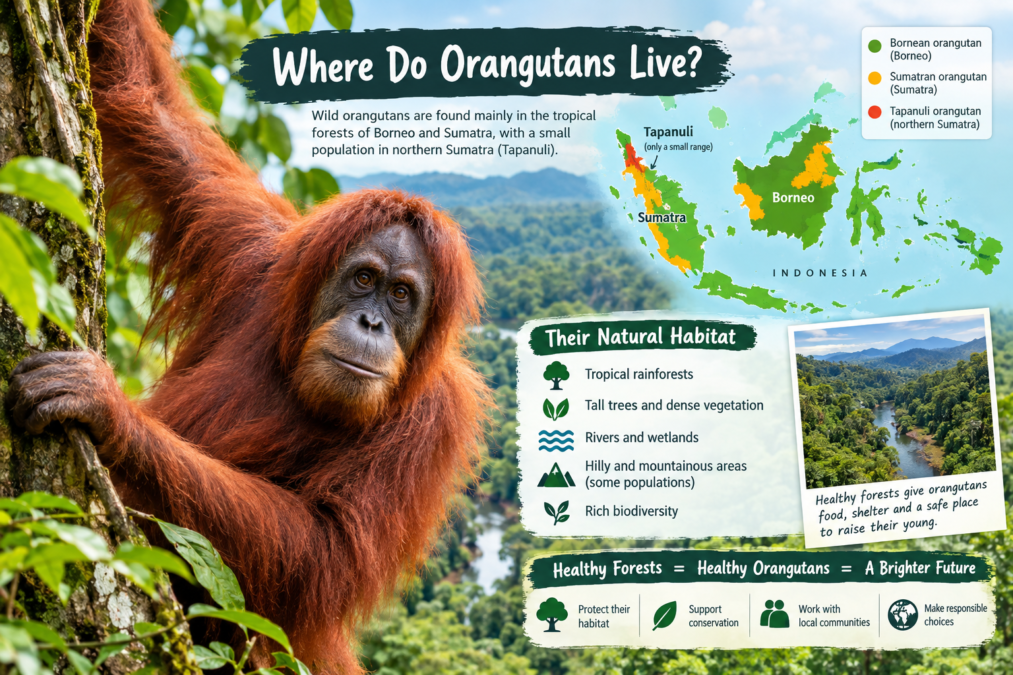

When people ask where do orangutans live, the answer takes us deep into the tropical forests of Southeast Asia. Orangutans are remarkable great apes known for their reddish-orange hair, long arms, intelligent behavior, and strong connection to forest life. Today, wild orangutans are found naturally on only two major islands: Borneo and Sumatra. A third species, the Tapanuli orangutan, has an extremely small natural range in northern Sumatra.
These great apes spend much of their lives high among the trees. Their forest homes provide food, shelter, nesting materials, and safe places for mothers to raise their young. Unfortunately, these habitats are under pressure from deforestation, farming, roads, fires, mining, and other human activities.
Understanding where do orangutans live is important because their location tells us a lot about what they need to survive. It also helps conservation groups, governments, scientists, and local communities protect the forests that remain.
The Natural Range of Orangutans
Wild orangutans have a very limited geographic range compared with many other large mammals. They once lived across a much wider part of Southeast Asia, but their distribution has become much smaller over thousands of years.
Today, orangutans are naturally found in:
- Borneo
- Sumatra
- A small region of northern Sumatra inhabited by the Tapanuli orangutan
Borneo is shared by several countries, while Sumatra is part of Indonesia. Most wild orangutan populations are now concentrated in protected forests and other areas where suitable habitat remains.
Their restricted range makes orangutans especially vulnerable to habitat loss. If a large forest disappears, there may not be another nearby forest large enough to support the same population.
Where Do Orangutans Live in Borneo?
Borneo is one of the most important homes for orangutans. The island contains enormous tropical forests, wetlands, rivers, and other ecosystems that can support these intelligent apes.
The Bornean orangutan lives mainly in Indonesian Borneo, known as Kalimantan, as well as parts of Malaysian Borneo. Their populations can be found in different forest landscapes, including lowland forests, swamp forests, and areas with other suitable vegetation.
Bornean orangutans spend a great deal of time in trees. Their long arms and strong hands help them move through branches while searching for fruit, leaves, bark, insects, and other foods.
Some important orangutan habitats in Borneo include:
- Lowland tropical rainforests
- Peat swamp forests
- Riverine forest areas
- Mountain and hill forests
- Protected forest reserves
- National parks and wildlife conservation areas
Borneo’s forests aren’t all the same. Different areas provide different foods and nesting opportunities. Orangutans are adaptable, but they still depend heavily on healthy forest ecosystems.
Where Do Orangutans Live in Sumatra?
Sumatra is another major home of wild orangutans. The island’s forests support the Sumatran orangutan, which is generally found in northern parts of the island.
Compared with Bornean orangutans, Sumatran orangutans have a smaller natural range. They are strongly associated with tropical forests where fruit trees and other useful plants are available.
Sumatra has experienced extensive deforestation over the years. Forests have been converted for agriculture, plantations, roads, settlements, and other uses. As a result, many orangutan populations have become isolated from one another.
This fragmentation can be dangerous. Orangutans need enough connected forest to move, find food, reproduce, and maintain healthy populations. When forests are divided into small pieces, traveling between areas becomes much harder.
Where Do Tapanuli Orangutans Live?
The Tapanuli orangutan is the most recently recognized orangutan species. It has one of the smallest geographic ranges of any great ape.
Tapanuli orangutans live in the Batang Toru forest ecosystem in North Sumatra, Indonesia. Their habitat includes hilly and mountainous forest landscapes.
This population is especially important because it is very small and isolated. Every part of its remaining habitat matters.
The Tapanuli orangutan’s restricted distribution shows why the question where do orangutans live isn’t simply about naming an island. Scientists also need to understand the exact forests, elevations, food sources, and environmental conditions that allow each population to survive.
What Kind of Habitat Do Orangutans Need?
Knowing where do orangutans live also means understanding what makes a habitat suitable for them. Orangutans aren’t simply looking for any patch of green vegetation. They need forests that can provide food, nesting materials, shelter, and opportunities to move safely.
A healthy orangutan habitat usually contains:
| Habitat feature | Why it matters |
|---|---|
| Tall trees | Provide food, shelter, and travel routes |
| Fruit trees | Supply an important source of energy |
| Dense vegetation | Offers protection and nesting materials |
| Forest connections | Help orangutans move between feeding areas |
| Rivers and wetlands | Support the wider forest ecosystem |
| Large forest areas | Provide space for feeding and reproduction |
| Natural plant diversity | Gives orangutans different foods throughout the year |
Orangutans are especially dependent on mature forests. Large trees can provide fruit and strong branches for their nests. A forest with many different plant species can also offer food when one particular fruit isn’t available.
Why Orangutans Spend So Much Time in Trees
One of the most interesting things about orangutans is their mostly tree-based lifestyle. Their bodies are remarkably suited to life above the ground.
Their long arms allow them to reach branches and fruit that would be difficult for many animals to access. Their hands and feet are adapted for gripping. They can carefully climb, swing, stretch, and balance among branches.
Orangutans also build sleeping nests in trees. Usually, an orangutan makes a fresh nest from branches and leaves before resting. Mothers may also build nests where they can stay with their young.
Living in trees offers several advantages:
- It provides access to fruit and leaves.
- It gives orangutans places to rest.
- It helps them avoid some dangers on the forest floor.
- It provides nesting locations.
- It allows them to travel across parts of the forest canopy.
That said, orangutans aren’t completely unable to live on the ground. They can descend when necessary, but their natural lifestyle is strongly connected to the forest canopy.
What Do Orangutans Eat in Their Forest Homes?
Food availability is one of the biggest reasons orangutans need healthy forests. They are primarily fruit eaters, although their diet is much more varied than fruit alone.
Depending on the season and location, orangutans may eat:
- Figs
- Wild fruits
- Young leaves
- Shoots
- Bark
- Seeds
- Flowers
- Honey
- Insects
- Other small food items
Fruit can be especially important when it is abundant. During periods when fruit is scarce, orangutans may rely more heavily on leaves, bark, insects, and other available foods.
This seasonal flexibility helps them survive in changing forest conditions. However, it doesn’t mean that damaged forests are equally good for them. A heavily degraded forest may have fewer large fruit trees and fewer safe nesting sites.
How Climate Affects Orangutan Habitats
Orangutans live in tropical regions where temperatures are generally warm throughout the year. Rainfall is also an important part of their environment.
Tropical forests depend on regular rainfall to support plants and maintain complex ecosystems. These forests produce the fruits, leaves, and other foods that orangutans depend on.
Climate also affects fruiting patterns. When weather conditions change, the availability of certain foods can change as well.
Long periods of drought, unusually intense fires, and other environmental disturbances can place additional pressure on forest ecosystems.
A healthy forest has natural ways of responding to many environmental changes. But when climate stress is combined with deforestation and habitat fragmentation, wildlife can face a much harder challenge.
Orangutan Habitat and Forest Layers
A tropical rainforest isn’t just one environment. It’s made up of several layers, from the forest floor to the highest canopy.
Orangutans are particularly associated with the upper parts of the forest because these areas provide food and pathways between trees.
The main forest layers include:
Forest floor: This is the lowest layer, covered with fallen leaves, plants, roots, and other material.
Understory: Smaller trees, shrubs, and plants grow beneath the main canopy.
Canopy: The canopy is formed by the crowns of many trees. It is extremely important to orangutans.
Emergent layer: The tallest trees rise above much of the canopy and receive strong sunlight.
Orangutans can use different levels of the forest depending on what they’re doing. For example, they may climb higher to reach food or use strong branches for resting and nesting.
Where Do Orangutans Live Compared With Other Great Apes?
Orangutans have a very different geographic distribution from chimpanzees, bonobos, and gorillas.
Chimpanzees, bonobos, and gorillas are native to Africa. Orangutans are the only great apes naturally found in Asia today.
This makes orangutans especially interesting from an evolutionary and ecological perspective.
| Great ape | Natural region |
|---|---|
| Bornean orangutan | Borneo |
| Sumatran orangutan | Sumatra |
| Tapanuli orangutan | Northern Sumatra |
| Chimpanzee | Tropical Africa |
| Bonobo | Democratic Republic of the Congo |
| Gorilla | Central and western parts of Africa |
The geographic separation between orangutans and African great apes reflects a very long evolutionary history.
Why Orangutans Don’t Live Across All of Asia Today
If orangutans are Asian great apes, some readers naturally wonder why they aren’t found throughout Southeast Asia.
The answer involves a combination of ancient environmental changes and more recent human pressures.
In the distant past, orangutan relatives had a much wider distribution across Asia. Over time, changing climates, changing forests, and human expansion reduced their range.
As forests disappeared or became fragmented, orangutan populations became increasingly restricted to areas where suitable tropical forest remained.
Human development has accelerated this process in more recent history. Agriculture, roads, logging, settlements, plantations, and fires can all change forest landscapes.
Today, protecting remaining forests is therefore essential to maintaining orangutan populations.
The Impact of Deforestation on Orangutan Homes
Deforestation is one of the greatest threats to orangutan habitat.
When forests are cleared, orangutans can lose access to:
- Food-producing trees
- Nesting locations
- Safe travel routes
- Mating opportunities
- Shelter
- Connected populations
The problem isn’t only the complete removal of a forest. Fragmentation can be almost as important.
Imagine a large forest as a huge neighborhood connected by roads and pathways. If the pathways are suddenly removed and the neighborhood is divided into tiny sections, movement becomes difficult. Orangutans face a similar problem when continuous forest is broken into isolated patches.
Fragmentation can also increase the chance of human-wildlife conflict because orangutans may enter farms or other developed areas while searching for food.
Why Forest Fires Are Dangerous for Orangutans
Forest fires can cause severe damage to tropical ecosystems. Large fires can destroy trees, reduce food availability, and force wildlife to leave familiar habitats.
Peatlands are particularly important in parts of Borneo and Sumatra. When peat forests are drained and degraded, they can become more vulnerable to fire.
For orangutans, a major fire can mean the loss of an entire area that once provided food and shelter.
After a fire, forests may take years or even decades to recover, depending on the severity of the damage and local environmental conditions.
Protecting forests from destructive fires is therefore an important part of orangutan conservation.
How Orangutans Adapt to Life in the Forest
Orangutans have several physical and behavioral adaptations that help them live successfully in tropical forests.
Their adaptations include:
- Long arms for reaching branches
- Strong hands and feet for gripping
- Excellent climbing abilities
- Flexible movement through trees
- Strong problem-solving skills
- Ability to remember food locations
- Nest-building behavior
- Flexible diets
Their intelligence is particularly impressive. Orangutans can learn from experience and solve problems in creative ways.
For example, they can remember where useful food sources are located and may use objects in their environment to help access food.
These skills show how closely their behavior is connected to the forest environment.
Do Orangutans Live Alone or in Groups?
Unlike some other primates, orangutans are generally less social and spend much of their time alone. Adult males often have large areas of activity, while females usually spend considerable time with their young.
Mother orangutan relationships are especially important. Young orangutans depend heavily on their mothers for food, protection, and learning.
A young orangutan can spend many years learning how to survive. It must learn which foods are safe, where food can be found, how to build nests, and how to move through the forest.
Because reproduction is relatively slow, losing adult females or their habitat can have serious effects on population growth.
How Far Can Orangutans Travel?
The distance an orangutan travels can vary depending on food availability, sex, age, habitat quality, and other factors.
An orangutan living in a productive forest may find plenty of food within its familiar range. When food is scarce, however, it may need to travel farther.
This is another reason why connected forests matter.
A large, continuous forest gives orangutans more choices. A small isolated forest patch may not contain enough food throughout the year.
Maintaining wildlife corridors and connected habitats can therefore help orangutans move between suitable areas.
Protected Areas That Help Orangutans
Conservation areas play a major role in protecting orangutan habitat. National parks, wildlife reserves, forest conservation zones, and other protected areas can provide safer places for populations to survive.
Some important orangutan landscapes include forests associated with:
- Gunung Leuser
- Tanjung Puting
- Sebangau
- Kutai
- Bukit Tigapuluh
- Batang Toru
Protection doesn’t mean simply drawing a line around a forest. Effective conservation also requires monitoring, law enforcement, habitat restoration, scientific research, and cooperation with nearby communities.
In other words, conservation works best when people and wildlife are considered together.
The Role of Local Communities in Orangutan Conservation
People living near orangutan habitats can play an important role in protecting forests.
Local communities understand their surrounding landscapes and often have valuable knowledge about forests, plants, wildlife, and seasonal changes.
Conservation projects can support both wildlife and people by encouraging sustainable land use and reducing activities that destroy critical habitat.
Successful conservation may involve:
- Environmental education
- Sustainable farming
- Forest restoration
- Responsible tourism
- Wildlife monitoring
- Community-based conservation
- Support for alternative livelihoods
This approach offers hope because protecting orangutans doesn’t have to mean ignoring human needs. With thoughtful planning, communities and wildlife can benefit together.
Why Orangutan Habitat Matters to the Whole Forest
Protecting orangutan habitat has benefits beyond orangutans themselves.
Tropical forests support countless plants, insects, birds, reptiles, mammals, fungi, and microorganisms. When a forest is protected for orangutans, many other species may also gain protection.
Orangutans can also contribute to forest ecology through their feeding habits. By eating fruit and moving through the forest, they can help disperse seeds.
In simple terms, an orangutan can eat a fruit in one part of the forest and later leave the seeds somewhere else. Some of those seeds may grow into new plants.
So, protecting orangutans can also help protect the natural processes that keep forests healthy.
What Happens When Orangutans Lose Their Habitat?
Habitat loss can affect orangutans in many ways.
First, they may lose access to food. This can lead them to travel farther or enter agricultural areas.
Second, habitat loss can separate populations. When groups become isolated, there are fewer opportunities for animals from different populations to meet and reproduce.
Third, habitat destruction can increase stress and human-wildlife conflict.
Finally, a small population in a damaged forest can become more vulnerable to future disasters such as fires, disease outbreaks, or extreme weather.
That’s why habitat protection is often more effective than trying to solve problems after populations have already collapsed.
Orangutans in Rehabilitation Centers
Not every orangutan lives in the wild. Some are cared for in rehabilitation centers because they were rescued from illegal wildlife trade, habitat destruction, or other dangerous situations.
Rehabilitation programs may provide:
- Veterinary care
- Nutrition
- Safe forested environments
- Climbing opportunities
- Behavioral training
- Social learning
- Preparation for possible release
The ultimate goal of many rehabilitation efforts is to return suitable orangutans to safe natural habitats.
However, rehabilitation isn’t a replacement for protecting wild forests. A rescued animal needs a suitable forest to return to.
How People Can Help Protect Orangutan Habitats
People around the world can contribute to orangutan conservation, even if they live thousands of kilometers away from Borneo or Sumatra.
Simple actions can make a difference when many people take them together.
People can:
- Learn about endangered wildlife.
- Support reputable conservation organizations.
- Avoid products connected to illegal wildlife trade.
- Reduce unnecessary waste.
- Choose responsibly produced products when possible.
- Share accurate conservation information.
- Support responsible tourism.
- Encourage protection of tropical forests.
Education is especially powerful. The more people understand where do orangutans live and why their forests matter, the easier it becomes to build public support for conservation.
The Future of Orangutan Habitats
The future of orangutans depends heavily on the future of tropical forests in Borneo and Sumatra.
There are serious challenges, but there are also reasons for optimism. Protected areas, habitat restoration, scientific research, wildlife rescue programs, and community conservation projects are helping protect important orangutan landscapes.
Restoring damaged forests can also create new opportunities for wildlife. Young forests may not immediately provide everything an orangutan needs, but careful restoration can gradually improve habitat quality.
Technology is helping too. Scientists and conservationists can use camera traps, satellite imagery, GPS tracking, field surveys, and other tools to understand where orangutans are living and how their habitats are changing.
The combination of science, local knowledge, government action, and public support gives conservation a stronger foundation.
A Quick Guide to Where Orangutans Live
Here is a simple summary for readers who want the key information at a glance:
| Question | Answer |
|---|---|
| Where do orangutans live? | Mainly on the islands of Borneo and Sumatra |
| Which species lives in Borneo? | Bornean orangutan |
| Which species live in Sumatra? | Sumatran and Tapanuli orangutans |
| What habitat do they prefer? | Tropical forests |
| Do they spend much time in trees? | Yes |
| What do they mainly eat? | Fruit, leaves, bark, seeds, and other forest foods |
| Why is habitat important? | It provides food, shelter, nesting sites, and space |
| What is a major threat? | Habitat loss and fragmentation |
| Can forests be restored? | Yes, although recovery can take many years |
| Can people help? | Yes, through responsible choices and conservation support |
Frequently Asked Questions About Where Do Orangutans Live
Where do orangutans live naturally?
Orangutans naturally live in Southeast Asia, primarily on the islands of Borneo and Sumatra. Each species has its own specific geographic range.
Do orangutans live in Africa?
No. Orangutans are native to Asia. Gorillas, chimpanzees, and bonobos are the great apes naturally found in Africa.
Do orangutans live in rainforests?
Yes. Tropical rainforests are extremely important orangutan habitats. They provide fruit, leaves, nesting materials, and tree pathways.
Do orangutans live on trees?
Orangutans spend much of their lives in trees. They climb through the canopy, find food among branches, and build nests for sleeping.
Where does the Tapanuli orangutan live?
The Tapanuli orangutan has a very restricted range in the Batang Toru forest ecosystem of North Sumatra, Indonesia.
Are orangutans found throughout Indonesia?
No. Although Indonesia contains major orangutan populations, wild orangutans don’t live throughout the country. Their natural range is concentrated in specific forest regions, especially on Sumatra and Indonesian Borneo.
Why are orangutans losing their homes?
Deforestation, forest fragmentation, fires, agriculture, plantations, infrastructure development, and other human pressures can reduce and divide orangutan habitat.
Can orangutans survive outside forests?
They may temporarily use modified landscapes, but healthy forests are essential to their long-term survival. Their food, nesting, movement, and reproduction are strongly connected to forest ecosystems.
Final Thoughts on Where Do Orangutans Live
The question where do orangutans live has a simple geographic answer but a much deeper ecological story. Wild orangutans are found mainly in the tropical forests of Borneo and Sumatra, with the Tapanuli orangutan occupying a particularly small area in northern Sumatra. These forests aren’t merely places where orangutans happen to live. They are complete ecosystems that provide food, shelter, nesting sites, movement routes, and opportunities for future generations.
Protecting these forests is one of the most important steps toward securing the future of orangutans. By conserving connected habitats, restoring damaged forests, supporting local communities, and reducing destructive activities, people can give these intelligent great apes a better chance to thrive.
Ultimately, understanding where do orangutans live helps us understand what they need—and protecting those natural homes gives orangutans and countless other forest species a brighter future.
Where Do Orangutans Live? — Part 2
Orangutan Forests Are More Than Just Trees
When we explore where do orangutans live, it’s important to remember that their habitat is a complete living system, not simply a collection of trees. Tropical forests in Borneo and Sumatra contain thousands of plants, insects, birds, reptiles, and mammals that interact with one another every day.
For orangutans, this complex environment provides nearly everything they need. Fruit trees offer food, tall branches provide travel routes, and thick vegetation supplies material for sleeping nests. Even small changes in the forest can affect how easily an orangutan can find food or move from one area to another.
The forest also changes with the seasons. Some trees produce fruit at different times, meaning orangutans must remember where useful food sources are located. Their intelligence and excellent memory help them respond to these changes.
Where Do Orangutans Live During Different Seasons?
Orangutans don’t migrate long distances like some birds or mammals. Instead, they generally remain within their established forest ranges and adjust their movements according to food availability.
During periods when fruit is plentiful, an orangutan may spend more time in areas containing productive fruit trees. When food becomes harder to find, it may travel farther through the forest.
This seasonal movement explains why large, connected forests are so valuable.
A forest might look large on a map, but if roads, farms, or cleared land divide it into small sections, orangutans may not be able to use the entire landscape safely.
Borneo Provides Different Types of Orangutan Habitat
Borneo is a huge island with many different landscapes. Orangutans don’t live in just one type of forest there.
Some populations use lowland rainforest, while others occur in swampy or hilly environments. Each habitat has its own mixture of trees, plants, water sources, and seasonal conditions.
Lowland forests can be especially productive because they may contain many fruit-producing trees. Swamp forests, including peat forests, can also provide important habitat.
However, not every forest is equally suitable. A healthy natural forest with mature trees usually offers far more resources than a heavily disturbed landscape.
Sumatra’s Forests Are Vital for Orangutans
Sumatra contains some of the most important remaining orangutan habitats in the world. Its northern forests support Sumatran orangutans, while the Tapanuli orangutan occupies a much smaller area.
These forests are biologically rich and contain many species besides orangutans. They also include mountains, valleys, rivers, and dense tropical vegetation.
Sadly, habitat fragmentation has become a serious concern in parts of Sumatra. When forest areas become separated, orangutans may find it difficult to travel between them.
Conservation efforts therefore focus not only on protecting existing forests but also on maintaining connections between important habitats.
Why Connected Forests Matter
Imagine walking through a neighborhood where every road suddenly ends. Even if many houses remain, reaching them becomes difficult.
Orangutans experience something similar when forests become fragmented.
Connected forests allow them to:
- Search for food over a larger area.
- Find suitable nesting trees.
- Move between feeding locations.
- Maintain contact with other populations.
- Escape areas affected by fires or other disturbances.
- Give young orangutans opportunities to establish their own ranges.
Forest corridors can sometimes help connect isolated habitats. These corridors may consist of natural vegetation preserved between larger forest blocks.
Orangutan Mothers Need Safe Forests
Female orangutans and their young have a particularly strong need for safe, productive habitat.
Young orangutans spend years learning from their mothers. During this time, they develop the skills needed to survive independently.
A young orangutan learns things such as:
- Which fruits are safe to eat.
- Where food can be found.
- How to move through branches.
- How to build sleeping nests.
- How to respond to dangers.
- How to recognize useful parts of the forest.
This long learning period means that habitat loss can have effects that last for many years.
If a mother can’t find enough food, raising a healthy young orangutan becomes more difficult. That’s why protecting female orangutans and their habitat is particularly important.
Where Do Orangutans Live Near Rivers?
Rivers and streams can be important features of orangutan landscapes. Tropical forests often develop around waterways, creating areas with rich vegetation.
Orangutans may encounter rivers while traveling through their habitat, although they aren’t primarily aquatic animals.
River systems can also help shape the wider forest ecosystem by providing water and influencing vegetation.
However, waterways can sometimes become barriers when forests are heavily altered. Roads, settlements, agriculture, and other development along rivers can divide natural habitat.
Protecting riverine forests can therefore benefit many wildlife species at the same time.
How Human Development Changes Orangutan Habitat
Human development is one of the biggest reasons orangutan habitat has changed.
Forests may be cleared or altered for:
- Agriculture
- Plantations
- Roads
- Mining
- Housing
- Industrial development
- Logging
- Infrastructure
Development doesn’t always remove every tree. Sometimes a forest remains but becomes surrounded by roads and cleared land.
This creates an increasingly isolated habitat. An orangutan might still have trees to climb, but the available forest may no longer be large enough to provide all the resources it needs.
Orangutans and Agricultural Areas
When natural forests disappear, orangutans can sometimes enter agricultural areas while searching for food.
This can create difficult situations for both people and wildlife.
Farmers depend on their crops for income and food. Orangutans depend on the forest for survival. If an orangutan damages crops, people may see it as a problem animal, even though the underlying issue may be habitat loss.
Conservation programs can help reduce these conflicts by protecting forests, improving land-use planning, and helping communities respond safely when orangutans appear near farms.
The goal is not to blame communities. Instead, the focus should be on finding practical solutions that protect both livelihoods and wildlife.
The Importance of Responsible Forest Management
Forest management decisions can have a major influence on where do orangutans live in the future.
Responsible planning can help preserve important habitats while allowing people to use land for their needs.
Useful approaches include:
- Protecting high-value wildlife habitats.
- Keeping important forest corridors intact.
- Restoring damaged forest.
- Reducing illegal logging.
- Preventing destructive fires.
- Planning roads carefully.
- Supporting sustainable agriculture.
- Involving local communities in conservation decisions.
Good management takes time and cooperation, but it can create a healthier balance between human development and wildlife protection.
Can Orangutans Live in Restored Forests?
Yes, forest restoration can help improve orangutan habitat, although it isn’t an instant solution.
A newly planted area doesn’t immediately become a mature rainforest. Trees need years to grow, and the wider ecosystem needs time to develop.
As forests recover, they can gradually provide:
- Shade
- Food plants
- Nesting trees
- Wildlife corridors
- Protection for other species
- Better connections between forest fragments
Restoration is particularly useful when it connects existing forests.
A restored corridor between two large forest areas can potentially provide an important route for wildlife.
The Role of Scientists in Understanding Orangutan Habitats
Scientists study orangutans in many ways. Field researchers observe their behavior, track movements, examine population numbers, and study their food sources.
Modern technology has made this work even more useful.
Researchers may use:
- GPS tracking devices
- Camera traps
- Satellite images
- Forest surveys
- Acoustic monitoring
- Population studies
- Genetic research
These methods help scientists understand where orangutans are found and how their populations are changing.
The information can then guide conservation planning.
Why Mapping Orangutan Populations Matters
Knowing exactly where orangutans live is essential for protecting them.
Suppose conservation workers know that a particular forest contains an important orangutan population. They can use that information when planning protected areas or restoration projects.
Mapping can help identify:
- Important populations
- Isolated forest patches
- Wildlife corridors
- Areas affected by deforestation
- Suitable restoration locations
- Regions where human-wildlife conflict occurs
This makes conservation more targeted and effective.
Orangutans as Signs of Forest Health
Orangutans can also tell us something about the condition of a forest.
Because they depend on many forest resources, a healthy orangutan population generally requires a functioning ecosystem.
When orangutans disappear from an area, scientists may investigate whether habitat quality, food availability, hunting, human activity, or other factors have changed.
Protecting orangutans can therefore encourage protection of the broader forest community.
What Makes Orangutan Conservation Difficult?
Protecting orangutans isn’t always easy.
Their habitats can be enormous, remote, and difficult to monitor. Forest boundaries may cross different administrative areas. Conservation programs also need funding, trained workers, scientific information, and community cooperation.
Another challenge is balancing conservation with human needs.
People living near forests need land, jobs, food, housing, and transportation. Conservation becomes stronger when these needs are included in planning rather than ignored.
That’s why modern conservation increasingly focuses on cooperation.
Hope for the Future
Although orangutans face serious threats, their story isn’t only about loss.
Many people are working to protect their habitats. Governments, scientists, conservation groups, local communities, educators, and responsible businesses can all contribute.
Protected forests continue to provide safe habitat. Restoration projects can improve damaged landscapes. Public awareness is growing, and scientific research continues to reveal more about these fascinating animals.
Every protected forest matters.
Every restored habitat matters.
And every informed person can contribute to a better future.
Frequently Asked Questions
Where do orangutans live in the wild?
Wild orangutans live naturally on Borneo and Sumatra. Their individual species have different ranges within these islands.
Do orangutans live in jungles?
Yes. Orangutans are strongly associated with tropical forests, often called jungles in everyday language.
Do orangutans live in mountains?
Some populations can live in hilly and mountainous forests. The Tapanuli orangutan, for example, occupies a mountainous forest environment in North Sumatra.
Do orangutans live together in large groups?
Generally, orangutans are more solitary than many other primates. Mothers and young spend significant time together, while adults often have more independent lifestyles.
Why are Borneo and Sumatra important?
These islands contain the last major natural habitats of wild orangutans. Protecting their forests is essential for the survival of the species.
Final Thoughts
Understanding where do orangutans live means looking beyond a simple map. These great apes depend on complex tropical forests that provide food, nesting places, movement routes, and protection. Borneo and Sumatra remain their most important natural homes, but those habitats need continued protection.
Explore more insightful articles on All Vantage News and never miss an update.Contact Us.