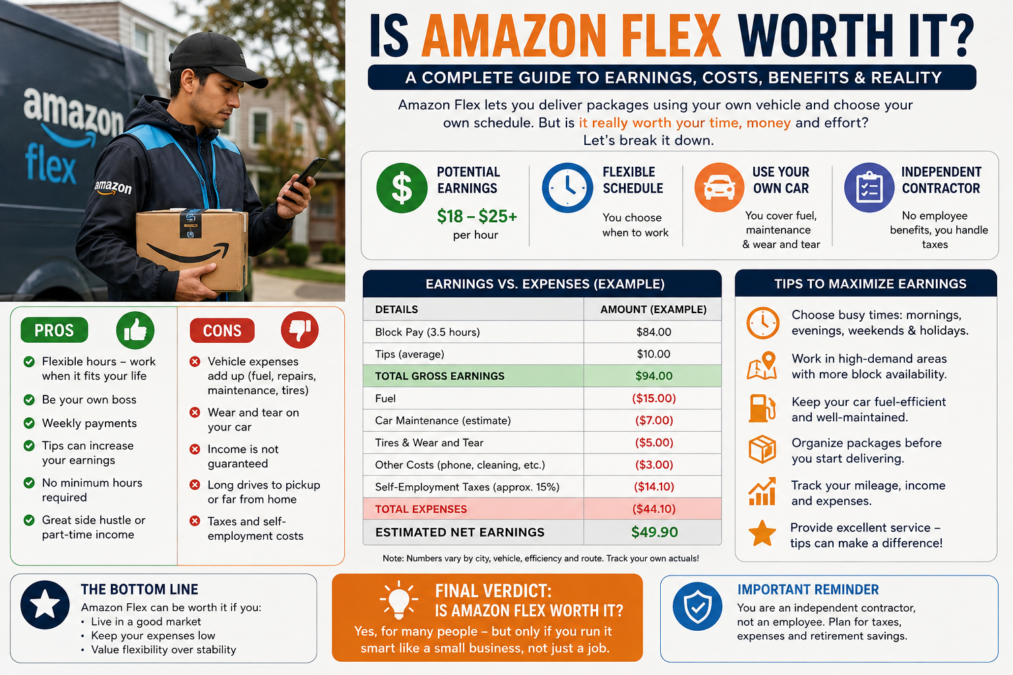

is amazon flex worth it is a common question among people looking for flexible ways to earn extra money. Amazon Flex allows delivery partners to use their own vehicles to deliver packages and choose available delivery blocks through the Amazon Flex app. According to Amazon, most U.S. delivery partners earn between $18 and $25 per hour, although actual earnings depend on location, tips, delivery time, and other factors.
At first glance, the idea sounds pretty appealing. You choose a block, pick up packages, follow the delivery route, and get paid. There isn’t a traditional fixed schedule, and Amazon says there is no minimum number of deliveries required to remain active.
But there’s more to the story.
Because Amazon Flex drivers generally use their own vehicles as independent contractors, the advertised earnings aren’t the same as take-home profit. Fuel, vehicle maintenance, tires, depreciation, insurance, taxes, and unpaid driving time can all affect the real value of a delivery block.
So, is amazon flex worth it?
The honest answer is: it can be worth it for the right person and in the right market, but it isn’t automatically profitable for everyone.
This guide explains how Amazon Flex works, what drivers can potentially earn, which expenses matter, who may benefit most, and how to calculate whether a particular block is actually worthwhile.
What is Amazon Flex?
Amazon Flex is a delivery program that allows independent delivery partners to deliver packages using their own vehicles. Amazon says the program has operated since 2015 and is designed to give delivery partners flexibility over when, where, and how often they work.
The basic idea is simple:
- Open the Amazon Flex app.
- Look for available delivery blocks.
- Review the offered earnings and estimated time.
- Reserve a block that fits your schedule.
- Travel to the designated pickup location.
- Collect and organize packages.
- Follow the delivery route.
- Complete the deliveries.
- Finish the block and receive payment.
Amazon describes delivery blocks as scheduled periods for completing a group of deliveries. Offers show information such as expected earnings and estimated duration.
This structure makes Flex different from a conventional hourly job.
Instead of being told to work from 9 a.m. to 5 p.m., you can select blocks that fit around other responsibilities when those blocks are available.
That flexibility is one of the biggest reasons people ask, is amazon flex worth it.
How Amazon Flex works
Amazon Flex is relatively straightforward once a driver understands the process.
Reserve a delivery block
A block is a scheduled period during which you’re expected to make deliveries.
Amazon’s Flex information says offers can show the expected earnings, starting time, delivery type, and estimated duration.
For example, a hypothetical offer might look something like:
| Example Block | Details |
|---|---|
| Duration | 3 hours |
| Advertised pay | $72 |
| Start time | 4:00 p.m. |
| Estimated finish | 7:00 p.m. |
| Delivery area | Depends on station and route |
The numbers above are only an example, not a guaranteed current offer.
Pick up packages
After arriving at the appropriate station, the driver receives packages associated with the route.
The app helps organize the delivery process and provides navigation assistance.
Amazon says its routing system considers factors such as package count, delivery locations, traffic, and historical weather patterns when designing routes.
Deliver the packages
The driver follows the route and delivers packages to customers.
Depending on the type of block, deliveries may include standard Amazon packages or other delivery categories.
Amazon’s FAQ also describes Amazon Now blocks, which can be shorter than one hour and involve local deliveries from Amazon Now pickup locations.
Complete the block
After completing the route, the driver finishes the block through the app.
Amazon says most delivery partners complete their blocks early, although individual experiences can vary considerably depending on route, traffic, apartment access, package volume, weather, and other conditions.
is amazon flex worth it for part-time workers?
For many people, this is where Amazon Flex can make the most sense.
Someone with another job might use Flex for a few blocks each week instead of trying to replace their primary income.
For example, a person could potentially use delivery work to help with:
- Car payments
- Grocery expenses
- Utility bills
- Savings
- Holiday spending
- Emergency funds
- Personal projects
- Debt payments
The flexibility can be particularly useful for people whose schedules change from week to week.
Amazon itself highlights situations such as parents working around school hours and professionals supplementing their income.
However, flexibility shouldn’t be confused with guaranteed availability.
A person may want to work five blocks but find that suitable offers aren’t available at the times they need.
Therefore, availability in your particular area matters enormously.
Understanding Amazon Flex pay
Amazon currently says that most U.S. delivery partners earn between $18 and $25 per hour, while its hiring page similarly states that most drivers earn $18–$25 per hour. Amazon also explains that actual earnings can vary based on location, tips, delivery time, and other factors.
This is useful information, but it shouldn’t be interpreted as guaranteed net income.
Suppose a driver sees an offer that appears to provide $75 for a three-hour block.
At first, the calculation looks simple:
$75 ÷ 3 hours = $25 per hour
But what happens if the driver spends additional time:
- Driving to the station
- Driving home after the route
- Refueling
- Cleaning the vehicle
- Organizing packages
- Waiting at a station
- Dealing with difficult deliveries
The effective hourly rate can be lower.
That’s why experienced gig workers usually calculate net earnings, not just advertised earnings.
Gross pay versus real profit
This is perhaps the most important part of answering is amazon flex worth it.
Gross pay is the amount you’re offered.
Profit is what’s left after legitimate business expenses.
Consider a hypothetical example.
A driver accepts a block paying $78.
The block takes three hours.
The driver also spends 30 minutes driving home afterward.
The total work-related time becomes 3.5 hours.
If the driver spends $18 on fuel and other vehicle costs attributable to the work, the calculation changes.
Simple example
Advertised payment: $78
Estimated vehicle-related costs: $18
Remaining amount: $60
Total time: 3.5 hours
Effective amount before taxes: approximately $17.14 per hour
This is only an illustration. Actual costs vary by vehicle, route, fuel prices, traffic, and driving habits.
The lesson is simple:
Don’t judge a Flex block only by the number shown in the app.
Vehicle expenses can change everything
Your car is one of the biggest factors in determining whether Amazon Flex is worthwhile.
A fuel-efficient vehicle may make delivery work more attractive than a large vehicle with high fuel consumption.
But fuel isn’t the only expense.
Consider:
- Gasoline
- Oil changes
- Tires
- Brakes
- Repairs
- Maintenance
- Depreciation
- Insurance
- Car washing
- Registration
- Unexpected mechanical problems
Vehicle depreciation can be especially easy to overlook.
Every additional business mile adds wear to the vehicle.
A delivery route might feel profitable today while contributing to costs that appear months later.
That’s why serious drivers should track mileage and vehicle expenses from the beginning.
Mileage and tax considerations
For U.S. drivers, mileage can have an important tax connection.
The IRS publishes a standard mileage rate for business use. For July 1 through December 31, 2026, the business mileage rate is 76 cents per mile. For January 1 through June 30, 2026, it was 72.5 cents per mile.
However, this rate should not simply be treated as cash that a driver receives.
It’s a tax deduction methodology for qualifying business mileage, subject to IRS rules.
The IRS also says gig workers should maintain records of income and expenses and may be able to deduct qualifying business expenses.
This makes recordkeeping extremely important.
Drivers should consider keeping records of:
- Business mileage
- Delivery income
- Fuel receipts
- Maintenance
- Parking expenses
- Tolls
- Other qualifying business expenses
Tax rules can be complicated, so drivers with significant gig income may benefit from consulting a qualified tax professional.
Taxes are an important part of the calculation
Another reason is amazon flex worth it isn’t a simple yes-or-no question is taxation.
Gig economy income is generally taxable.
The IRS says gig workers must report income even when they don’t receive a particular information return such as a Form 1099.
For independent contractors, tax may not be withheld automatically like it is from many traditional employee paychecks.
The IRS explains that self-employed gig workers may need to make estimated tax payments and file the appropriate self-employment forms.
The good news is that qualifying business expenses can potentially reduce taxable income.
The important thing is to keep accurate records.
Don’t wait until tax season and then try to remember every mile driven six months earlier.
That approach can become a headache.
Benefits of Amazon Flex
There are several reasons people find Amazon Flex attractive.
Flexible scheduling
The biggest advantage is flexibility.
Amazon says delivery partners can choose available blocks that fit their schedules.
This can work well for people who don’t want a traditional fixed schedule.
Upfront block information
Amazon says drivers can see expected earnings and estimated duration before selecting a block.
That makes planning easier.
Independent work
Drivers generally work independently rather than sitting in an office or traditional workplace.
Some people genuinely enjoy this freedom.
Potential for supplemental income
Flex can provide an additional income stream for people who already have other work.
No traditional minimum delivery requirement
Amazon says there is no minimum delivery requirement to remain active.
That can make the program more flexible for occasional workers.
Rewards and discounts
Amazon’s Flex program also has a rewards system. Its FAQ explains that drivers can earn points by completing blocks and deliveries, with higher reward levels offering additional benefits.
Challenges of Amazon Flex
Of course, there are downsides.
A realistic article shouldn’t pretend otherwise.
Vehicle wear
Your car is doing the work, so it experiences the wear.
Fuel costs
Long routes can consume substantial fuel.
Route uncertainty
Even when a block has a scheduled duration, actual conditions can vary.
Package volume
Some routes may involve many packages or challenging delivery locations.
Parking problems
Urban areas and apartment complexes can make deliveries slower.
Weather
Rain, snow, heat, and storms can affect driving conditions.
Taxes
Independent contractors have additional tax responsibilities.
Income variability
The availability and attractiveness of blocks can differ by location and time.
These factors are why two drivers can have completely different opinions about Flex.
One person may love it.
Another may decide it’s not worth the mileage.
Both experiences can be genuine.
is amazon flex worth it for people with fuel-efficient cars?
Vehicle efficiency can make a meaningful difference.
Suppose two drivers receive the same $75 block.
Driver A uses a highly fuel-efficient car.
Driver B uses a vehicle that consumes significantly more fuel.
If both travel the same distance, Driver B spends more money just to complete the same work.
Over dozens of blocks, that difference can become significant.
However, fuel efficiency isn’t the only consideration.
A fuel-efficient car with expensive maintenance can still create high costs.
A reliable vehicle with reasonable fuel consumption may be the better overall choice.
The key is to calculate total operating costs.
is amazon flex worth it for a high-mileage route?
High-mileage routes deserve extra attention.
Imagine two hypothetical blocks:
| Factor | Block A | Block B |
|---|---|---|
| Advertised pay | $72 | $72 |
| Block time | 3 hours | 3 hours |
| Total driving | 35 miles | 90 miles |
| Fuel use | Lower | Higher |
| Vehicle wear | Lower | Higher |
| Potential net value | Higher | Lower |
The advertised pay is identical.
But the economics aren’t.
This is why mileage is an important factor when evaluating delivery work.
A driver who ignores mileage may overestimate profitability.
Apartment deliveries and difficult locations
Not every delivery location is equally easy.
A route containing houses with simple driveways may be completed efficiently.
Another route could include:
- Large apartment complexes
- Gated communities
- High-rise buildings
- Difficult parking
- Long walks
- Businesses with restricted hours
- Security gates
- Confusing addresses
These conditions can increase delivery time.
That matters because the value of a block depends partly on how efficiently it can be completed.
A route that looks excellent on paper may be less attractive if every stop requires several minutes of extra work.
Weather and seasonal demand
Delivery demand can change throughout the year.
Busy shopping periods may create more delivery activity.
Amazon Flex drivers have reported increased activity around major shopping events, although individual markets differ. A 2024 Business Insider report described one Flex driver’s experience of increased block availability and package volume around Prime Day.
However, busy periods can bring both opportunities and challenges.
More packages can mean:
- More available blocks
- Potentially stronger offers
- More driving
- More packages per route
- Greater time pressure
In other words, busy doesn’t automatically mean better.
Amazon Flex safety considerations
Safety should never be ignored.
Amazon says it provides safety resources such as reflective vests, vehicle magnets, and headlamps and has introduced additional safety features. Amazon also states that delivery partners are not required to complete a delivery if they feel unsafe.
Drivers should always consider:
- Weather conditions
- Traffic
- Parking safety
- Poorly lit areas
- Aggressive animals
- Unsafe buildings
- Personal security
No delivery is worth taking an unnecessary safety risk.
If a situation feels dangerous, the appropriate response is to follow Amazon’s safety procedures rather than trying to prove toughness.
Insurance considerations
Because Flex drivers use their own vehicles, insurance is an important issue.
Amazon’s U.S. requirements state that drivers need personal auto insurance meeting local requirements.
Drivers should understand what their own insurance policy covers when the vehicle is being used for delivery work.
Don’t assume that personal insurance automatically covers every business use.
Before starting, check:
- Your policy
- Local requirements
- Amazon’s current requirements
- Any applicable delivery coverage
- Deductibles
- Coverage limits
Insurance rules can differ by location, so current local information matters.
Who may find Amazon Flex worthwhile?
Amazon Flex may be a good fit for someone who:
- Wants flexible side income
- Already owns a reliable vehicle
- Has relatively low vehicle operating costs
- Lives near active delivery stations
- Enjoys driving
- Can work during desirable delivery periods
- Is comfortable working independently
- Can track expenses carefully
- Understands contractor tax responsibilities
For such a person, Flex can be a useful side hustle.
Who may not find Amazon Flex worthwhile?
It may be less attractive for someone who:
- Has a vehicle with very high fuel costs
- Has expensive car repairs
- Drives very long distances to reach the station
- Needs guaranteed weekly income
- Dislikes driving
- Doesn’t want contractor tax responsibilities
- Has limited access to desirable blocks
- Is uncomfortable with delivery work
In these cases, a traditional hourly job or another type of side work may provide better economics.
How to calculate your real Amazon Flex hourly rate
Here’s a simple method.
Step one: Record gross earnings
Write down the amount paid for each block.
Step two: Record total work time
Include:
- Travel to the station
- Pickup time
- Delivery time
- Necessary post-route driving
Step three: Track business mileage
Keep accurate records.
Step four: Estimate vehicle costs
Consider fuel and other operating expenses.
Step five: Account for taxes
Set aside an appropriate amount based on your tax situation.
Step six: Calculate the result
A simple formula is:
Net earnings ÷ total work hours = effective hourly rate
This number is much more useful than the advertised block rate.
Example of a realistic calculation
Imagine a hypothetical driver receives:
Block payment: $84
Total work-related time: 4 hours
Fuel and estimated vehicle operating costs: $22
That leaves:
$84 − $22 = $62
Then:
$62 ÷ 4 = $15.50 per hour before taxes
Again, this is only an example.
A different driver might have a shorter route, a more efficient vehicle, or a higher-paying block and therefore achieve a much better result.
That’s precisely why personal tracking matters.
Ways to improve your Flex profitability
If you decide to try Amazon Flex, there are several ways to make the experience more efficient.
Track every block
Don’t rely on memory.
Record:
- Pay
- Hours
- Mileage
- Fuel
- Problems
- Route difficulty
Learn your local stations
Some stations may consistently produce routes that work better for you.
Understand your vehicle
Know your approximate operating cost per mile.
Avoid unnecessary driving
Extra miles reduce profitability.
Keep your car organized
An organized vehicle can make package sorting faster.
Protect your time
Don’t spend excessive unpaid time preparing for a block.
Monitor your actual results
After several weeks, review the numbers.
That’s when you’ll have real evidence about whether the work suits you.
Technology and the Amazon Flex app
Technology is central to Flex.
The app helps drivers:
- Find blocks
- Review offers
- Navigate routes
- Manage deliveries
- Track work
- Access rewards
- Receive important information
Amazon says its navigation tools can display features such as speed limits, road closure alerts, and live traffic information.
A reliable smartphone and strong mobile connectivity are therefore important.
Drivers should also keep their phone charged.
A dead phone during a delivery route can turn a manageable day into a stressful one.
Customer service and delivery professionalism
Even though Flex drivers work independently, professionalism still matters.
Drivers should:
- Follow delivery instructions
- Treat customers respectfully
- Protect packages
- Follow safety procedures
- Avoid careless driving
- Keep communication professional
A delivery driver’s behavior can affect the customer experience.
The job may be independent, but it still involves representing a major delivery service.
How Amazon Flex compares with a traditional job
The difference becomes clearer when you compare the two.
| Factor | Amazon Flex | Traditional Hourly Job |
|---|---|---|
| Schedule | Flexible blocks | Usually fixed |
| Vehicle | Often your own | Usually employer-provided or not needed |
| Taxes | Contractor responsibilities | Often payroll withholding |
| Benefits | Limited compared with employees | May include benefits |
| Income | Can vary | Usually more predictable |
| Expenses | Driver carries vehicle costs | Employer usually carries work equipment |
| Independence | High | Lower |
| Availability | Depends on market | Usually scheduled |
Neither option is automatically better.
It depends on what you value.
If flexibility is your priority, Flex may have an advantage.
If stability and benefits are more important, traditional employment may be stronger.
is amazon flex worth it as a full-time income?
This question deserves caution.
Amazon itself describes Flex as a way to earn extra money and says most drivers earn $18–$25 per hour in the U.S.
That doesn’t mean every driver can consistently work enough hours to earn a full-time income.
The availability of blocks can vary by market.
Additionally, full-time driving means:
- More vehicle wear
- More fuel
- More maintenance
- More taxes
- More exposure to traffic
- More dependence on the platform
For these reasons, people considering Flex as a primary income source should carefully analyze their local block availability and actual net earnings before relying on it.
is amazon flex worth it for students?
Students may find flexible delivery work attractive if their schedule, location, age, vehicle, and local program availability meet the requirements.
Flex can potentially fit around:
- Classes
- Study time
- Weekend schedules
- School breaks
- Other part-time work
But students should consider whether driving time takes away from education.
A side hustle is useful only if it doesn’t create larger problems elsewhere.
is amazon flex worth it for parents?
Parents may value flexible blocks because traditional jobs can have rigid schedules.
Amazon specifically points to parents who may work around school hours as an example of people who can benefit from Flex’s flexibility.
Still, parents should account for:
- Childcare
- Fuel
- Travel time
- Evening schedules
- Family responsibilities
A block that looks profitable may not be worthwhile if it requires paying for additional childcare.
Final verdict: is amazon flex worth it?
So, is amazon flex worth it?
For the right driver, yes, it can be.
Amazon Flex offers genuine flexibility, upfront block information, the ability to use your own vehicle, and the potential to earn supplemental income. Amazon currently says most U.S. delivery partners earn $18–$25 per hour, although actual results vary.
But the advertised amount isn’t the whole story.
Your real earnings depend on:
- Fuel
- Mileage
- Vehicle maintenance
- Depreciation
- Insurance
- Taxes
- Route difficulty
- Unpaid travel
- Block availability
- Your local market
The smartest approach is to test the program carefully, track every mile and dollar, and calculate your net hourly rate rather than focusing only on gross pay.
If you have a reliable, reasonably efficient vehicle, live near a busy Flex market, enjoy independent driving, and want flexible side income, Amazon Flex may be a useful opportunity.
If your vehicle is expensive to operate, block availability is poor, or you need predictable wages and employee benefits, it may not be the best choice.
Ultimately, is amazon flex worth it depends less on the headline hourly figure and more on what remains in your pocket after the real costs of doing the work are counted. With careful planning, accurate records, and realistic expectations, you can make a much more informed decision about whether Amazon Flex deserves a place in your income strategy.
Explore more insightful articles on All Vantage News and never miss an update.Contact Us.