

If you’ve ever typed “humerous” and wondered whether it’s the correct spelling, you’re certainly not alone. This small spelling question can cause a surprising amount of confusion because humerous, humorous, and humerus look and sound quite similar. However, they aren’t interchangeable.
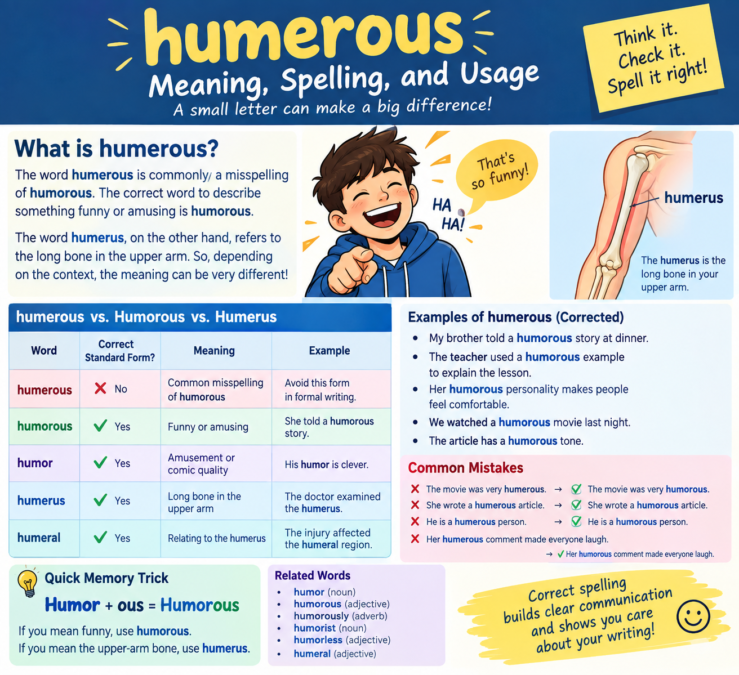
In standard modern English, humerous is generally considered a misspelling of humorous when the intended meaning is “funny” or “amusing.” The standard adjective is humorous, which comes from the word “humor.” The separate word humerus refers to the long bone in the upper arm.
Understanding this difference is useful for students, bloggers, writers, teachers, professionals, and anyone who wants to improve their English spelling. After all, one little letter can change whether a word looks polished or mistaken.
What Does humerous Mean?
The first thing to understand about humerous is that it isn’t normally used as a standard English adjective meaning funny. When people search for “humerous meaning,” they usually intend to ask about humorous.
Humorous means:
- Funny
- Amusing
- Entertaining
- Playful
- Causing laughter
- Connected with humor
For example:
The teacher gave a humorous example during the lesson.
Here, “humorous” tells us that the example was funny or amusing.
Another example is:
She wrote a humorous story about school life.
The story may contain jokes, funny situations, clever observations, or playful language.
According to language references, humerous is generally identified as a misspelling of humorous, rather than a separate standard word with its own everyday meaning.
So, if your goal is to say that something is funny, the word you want is humorous.
humerous vs. Humorous: The Basic Difference
The easiest way to understand the issue is to compare the spellings directly.
| Word | Correct Standard Form? | Meaning | Example |
|---|---|---|---|
| humerous | Generally no | Common misspelling of humorous | Avoid this form in formal writing |
| humorous | Yes | Funny or amusing | She told a humorous story |
| humor | Yes | Amusement or comic quality | His humor is clever |
| humerus | Yes | Long bone in the upper arm | The doctor examined the humerus |
| humeral | Yes | Relating to the humerus | The injury affected the humeral region |
This table shows why the confusion happens. Humorous and humerus are both real words, while humerous is commonly produced when writers mix their spellings.
A simple rule can save you from the mistake:
Funny or amusing → humorous
Upper-arm bone → humerus
That’s it. Piece of cake!
Why Do People Write humerous Instead of Humorous?
There are several reasons people make this spelling mistake.
Similar-looking words
Compare these:
- humorous
- humerous
- humerus
They look remarkably similar at first glance. When someone is typing quickly, the wrong vowel can easily sneak in.
Pronunciation can be confusing
English spelling doesn’t always perfectly match pronunciation. The middle sounds in humorous can be less noticeable when spoken naturally. As a result, someone may know the word perfectly well but still spell it incorrectly.
The word humerus adds confusion
The humerus is a real anatomical term. It is the long bone extending through the upper arm.
Because humerus is a familiar scientific word to many people, its spelling can become mixed with the spelling of humorous.
That creates the incorrect form humerous.
Fast typing
Let’s be honest: when people type quickly, little errors happen. A missing letter here, a swapped vowel there, and suddenly a perfectly familiar word looks strange.
That’s why proofreading remains important, especially for professional articles, school assignments, websites, and business communication.
The Correct Spelling: Humorous
When you mean funny or amusing, the correct spelling is:
H-U-M-O-R-O-U-S
A helpful way to remember it is to start with the base word:
humor + ous = humorous
The connection is straightforward:
humor → humorous
For example:
- He has a good humor.
- He has a humorous personality.
- She wrote a humorous article.
- The movie contains several humorous scenes.
The extra “o” is important.
Writing humerous removes that connection and creates a spelling that standard English doesn’t normally accept for this meaning.
What Is the Meaning of Humorous?
Humorous is an adjective. It describes something that contains or expresses humor.
It can describe many different things.
Humorous people
A humorous person often makes others smile or laugh through jokes, observations, stories, or playful comments.
Example:
Ahmed is a humorous person who can make his friends laugh during difficult moments.
Humorous stories
A humorous story contains funny events, clever dialogue, or amusing situations.
Example:
The writer created a humorous story about a student trying to avoid homework.
Humorous conversations
A conversation can be humorous when people use playful comments or jokes.
Example:
Their humorous conversation made the long journey more enjoyable.
Humorous writing
Writers sometimes use humor to make serious or complicated subjects easier to understand.
For example, an educational article might use a light joke while explaining a difficult idea.
That approach can make information feel less intimidating.
humerous and the Word Humerus
One of the biggest reasons people confuse humerous with another word is the anatomical term humerus.
The humerus is the long bone of the upper arm. It connects the shoulder area with the elbow.
This is completely different from humorous.
Consider these two sentences:
The doctor examined the patient’s humerus.
This sentence is about anatomy.
Now compare:
The doctor made a humorous comment.
This sentence is about something funny.
The difference is only a few letters, but the meanings couldn’t be more different.
A useful memory trick is:
humerus = bone
humorous = funny
Once you connect each spelling with its meaning, the confusion becomes much easier to avoid.
How to Use Humorous Correctly in Sentences
Learning a spelling is one thing. Using it naturally is another.
Here are several examples.
Everyday examples
My brother told a humorous story at dinner.
The teacher used a humorous example to explain the lesson.
Her humorous personality makes people feel comfortable.
We watched a humorous movie last night.
The article has a humorous tone.
His humorous comment made everyone smile.
The children enjoyed the humorous cartoon.
She has a humorous way of explaining difficult subjects.
Notice that humorous always describes something.
It can describe:
- A person
- A story
- A comment
- A movie
- An article
- A conversation
- A speech
- A situation
- A personality
- A writing style
Humorous and Its Related Words
Knowing related words can make vocabulary much easier.
| Word | Part of Speech | Meaning |
|---|---|---|
| Humor | Noun | Amusement or the quality of being funny |
| Humorous | Adjective | Funny or amusing |
| Humorously | Adverb | In a humorous way |
| Humorist | Noun | A person known for creating or using humor |
| Humorless | Adjective | Lacking humor |
| Humerus | Noun | The long bone in the upper arm |
| Humeral | Adjective | Relating to the humerus |
For example:
His humor is clever.
His writing is humorous.
She humorously described the situation.
The humorist wrote several popular essays.
These words are connected, but they don’t perform the same grammatical job.
The Difference Between Humor and Humorous
This is another useful distinction.
Humor is generally a noun.
Humorous is an adjective.
Look at these examples:
Her humor is easy to understand.
Here, “humor” is the thing being discussed.
Now:
Her stories are humorous.
Here, “humorous” describes the stories.
The relationship can be remembered like this:
humor = the quality
humorous = describing something with that quality
This simple grammar rule can make your writing much clearer.
Common Examples of the humerous Mistake
Because humerous looks believable, it can appear in many types of informal writing.
Here are some incorrect and corrected examples.
Example about a movie
❌ The movie was very humerous.
✅ The movie was very humorous.
Example about an article
❌ She wrote a humerous article.
✅ She wrote a humorous article.
Example about a person
❌ He is a humerous person.
✅ He is a humorous person.
Example about a comment
❌ Her humerous comment made everyone laugh.
✅ Her humorous comment made everyone laugh.
Example about a story
❌ It was a humerous story.
✅ It was a humorous story.
The pattern is consistent: if you mean funny or amusing, use humorous.
Why Correct Spelling Matters in Professional Writing
A spelling error might seem tiny, but it can affect how readers perceive an article.
Imagine reading a professional website and seeing the same spelling mistake several times. You might start wondering whether the rest of the information has been carefully checked.
That doesn’t mean one spelling mistake makes an article unreliable. Everyone makes mistakes. Still, careful editing helps create a stronger impression.
Correct spelling is particularly important in:
- School assignments
- University work
- Blog posts
- News articles
- Business emails
- Reports
- Website pages
- Product descriptions
- Professional documents
- Educational material
If you’re publishing content online, proofreading is even more useful because mistakes can remain visible to readers for a long time.
A Simple Trick to Remember Humorous
Here’s a very easy memory method.
Don’t try to remember humorous as a completely separate word.
Instead, build it from the word humor:
HUMOR + OUS = HUMOROUS
Now compare it with the incorrect form:
HUMER + OUS = HUMEROUS
The second form breaks the connection with humor.
So whenever you hesitate, stop for a second and ask:
“Am I talking about something funny?”
If the answer is yes, think:
humor → humorous
This trick is especially helpful for students and people who frequently write English as a second language.
Humorous in Formal and Informal Writing
The word humorous works well in both formal and informal contexts.
Formal example
The report presents a humorous but informative discussion of modern workplace communication.
Informal example
My friend has a humorous way of telling stories.
Academic example
The author uses humorous examples to make the subject easier for young readers to understand.
Professional example
The presentation included several humorous moments while maintaining a professional tone.
This flexibility makes humorous a useful vocabulary word.
However, writers should consider their audience. A joke that works with friends may not be appropriate in a formal report.
In other words, humor is powerful, but timing matters.
How Humorous Writing Can Improve Communication
Humor isn’t only about making people laugh. Used carefully, it can help communication.
A humorous example can make a difficult idea easier to remember.
For instance, imagine a teacher explaining a complicated grammar rule. A dry explanation might lose students’ attention. A funny example may help them remember the rule.
Humor can also:
- Make writing more engaging
- Reduce tension
- Keep readers interested
- Make examples memorable
- Create a friendly tone
- Help explain everyday situations
- Make educational content feel approachable
Of course, humor should be used responsibly. What one person finds funny might not work for another audience.
That’s why good writers balance humor with clarity and respect.
Humorous Does Not Always Mean Extremely Funny
Another important point is that humorous doesn’t necessarily mean “hilarious.”
Something can be humorous without making people laugh loudly.
For example:
The speaker made a humorous observation about daily life.
This could mean the observation was mildly amusing.
Other words can express stronger levels of amusement:
- Funny
- Amusing
- Witty
- Comic
- Entertaining
- Hilarious
- Hysterical
However, these words don’t always mean exactly the same thing.
A humorous remark might simply make someone smile.
A hilarious joke, on the other hand, suggests a much stronger reaction.
Good writers choose the word that fits the situation.
Common Spelling Tips for English Learners
English can be tricky because pronunciation and spelling don’t always match perfectly. If you’re learning English, don’t feel discouraged by words such as humorous.
Here are some useful habits.
Learn the root word
Instead of memorizing random letters, connect the adjective to its base word.
humor → humorous
Read regularly
Reading books, articles, newspapers, and reliable websites exposes you to correct spelling naturally.
Write the word repeatedly
Writing a difficult word several times can help build memory.
Proofread slowly
Don’t rely completely on spell-checking software. Read your writing carefully.
Use a dictionary when uncertain
If a word looks unusual, checking a trusted dictionary can quickly resolve the question.
Learn confusing word pairs
Words such as humorous, humerous, and humerus become easier once you understand their differences.
A Quick Practice Exercise
Try completing these sentences.
The comedian gave a ______ performance.
Answer: humorous
The doctor examined the patient’s ______.
Answer: humerus
The author used a ______ tone throughout the story.
Answer: humorous
His ______ made the conversation more enjoyable.
Answer: humor
This exercise highlights the difference between the words.
More practice
Choose the correct word:
- She wrote a humorous story.
- The patient fractured his humerus.
- His humor made everyone comfortable.
- The speaker gave a humorous presentation.
- The doctor discussed the humeral injury.
Once you’ve seen these patterns several times, the correct spelling becomes much easier to remember.
Is humerous Ever Acceptable?
In normal modern English writing, if you intend to mean “funny” or “amusing,” you should use humorous, not humerous.
Some references may record humerous as a misspelling rather than a standard word.
Therefore, writers should avoid using humerous in formal documents, educational writing, professional communication, or published articles when they mean “humorous.”
If you encounter humerous somewhere online, the writer probably intended humorous.
That’s the practical answer.
Humorous in British and American English
There can also be confusion because British and American English sometimes spell words differently.
American English commonly uses:
humor
British English commonly uses:
humour
The adjective forms are:
American English: humorous
British English: humorous
So even though the noun can change from humor to humour, you shouldn’t create humerous from either spelling.
The key point remains the same: humorous is the standard adjective when you mean funny or amusing.
How to Proofread for the humerous Mistake
If you’ve written a long article, you don’t need to read every sentence ten times.
Instead, use a targeted check.
Search your document for:
humerous
If you find it, ask whether you intended to write humorous.
If you are describing something funny, replace it with:
humorous
If you’re discussing the upper-arm bone, check whether you actually meant:
humerus
This simple search can save time and catch a surprisingly common spelling error.
For bloggers and website owners, it’s particularly useful before publishing an article.
Why the Difference Is Worth Learning
At first glance, the difference between humerous and humorous may seem insignificant. Yet learning small distinctions like this can steadily improve English writing.
Vocabulary isn’t built in one giant leap. It grows through small discoveries.
Today, you might learn:
humor → humorous
Tomorrow, you might learn another confusing pair. Over time, these small improvements add up.
Strong writing is often the result of paying attention to details that other people overlook.
And, frankly, that’s a pretty useful habit.
Final Tips for Remembering humerous
Before finishing your writing, keep these points in mind:
- humerous is generally a misspelling when intended to mean funny.
- humorous is the standard adjective meaning funny or amusing.
- humor is the related noun.
- humerus is the long bone in the upper arm.
- humeral relates to the humerus.
- Remember humor + ous = humorous.
- Proofread the word carefully before publishing.
- Don’t rely only on pronunciation to determine spelling.
The most useful rule is very simple:
If you mean funny, use “humorous.” If you mean the upper-arm bone, use “humerus.”
Conclusion: Understanding humerous Clearly
The word humerous creates confusion because it sits between two familiar-looking words: humorous, meaning funny or amusing, and humerus, the anatomical name for the upper-arm bone. In standard modern English, humerous is generally treated as a misspelling rather than the correct adjective for describing something funny.
Fortunately, the solution is easy to remember. Connect humorous with humor, and connect humerus with the arm bone. This small distinction can make your schoolwork, articles, emails, and professional writing more accurate and polished.
So, the next time you see humerous, pause and check what you mean. If you’re talking about something funny, the correct spelling is humorous. Learning that simple difference will help you use humerous correctly—or, more precisely, recognize when humerous should be replaced by humorous.
humerous in Everyday English and Modern Writing
The spelling humerous often appears when people are trying to write the word humorous. This is understandable because English contains many words that look almost identical but have completely different meanings.
For readers and writers, recognizing these differences is an important part of developing strong language skills. A small spelling mistake can sometimes change the meaning of a sentence, while in other cases it can simply make the writing look less polished.
When someone writes humerous while describing a funny person, story, video, comment, or situation, the intended word is normally humorous.
For example:
The article has a humorous style.
This means the article contains light, funny, or amusing elements.
On the other hand, if someone is discussing the human body, the word humerus may be the correct choice.
The humerus is located in the upper arm.
The difference becomes much easier once the words are connected to their meanings.
Understanding humerous Through Context
Context is one of the most useful tools for understanding confusing words.
Imagine reading this sentence:
The comedian gave a humerous performance.
The context tells us that the writer is talking about a comedian and a performance. Therefore, the intended word is almost certainly humorous.
Now consider:
The X-ray showed damage to the humerous.
Here, the context is medical. The intended word is likely humerus, although the spelling is incorrect.
This shows why context matters.
When you see an unfamiliar spelling, ask:
- What is the sentence talking about?
- Is it describing something funny?
- Is it discussing anatomy?
- Is it being used as a noun or adjective?
- Does the spelling match the intended meaning?
These questions can help identify errors quickly.
humerous and Online Content
The internet has made spelling especially important.
Millions of people read blogs, articles, social media posts, product descriptions, and educational pages every day. Because content is published quickly, small spelling mistakes can sometimes slip through.
A search for humerous may therefore produce pages where the writer actually intended humorous.
This doesn’t necessarily mean the entire article is poor. A writer can make one spelling mistake while providing useful information. Still, repeated errors can make readers less confident in the content.
For online writers, a final editing process is always worthwhile.
Before publishing, check:
- Spelling
- Grammar
- Sentence structure
- Headings
- Word choice
- Punctuation
- Repeated phrases
- Incorrect terminology
A few extra minutes of editing can make a big difference.
How Search Engines Handle humerous
People often type words incorrectly into search engines. Search engines can frequently understand what users intended and may display results for the correctly spelled term.
For example, someone searching for:
humerous meaning
may actually be looking for:
humorous meaning
This happens with many common spelling mistakes.
However, writers shouldn’t intentionally copy an incorrect spelling simply because people search for it. Good content should explain the mistake naturally and provide the correct spelling.
A useful approach is to mention the commonly searched form while clearly explaining the standard word.
For example:
People sometimes search for “humerous” when they mean “humorous,” which means funny or amusing.
This gives readers the information they need without reinforcing the spelling error.
humerous in Educational Writing
Students frequently encounter confusing words while writing assignments.
Suppose a student writes:
Shakespeare used humerous characters in his play.
The intended meaning is clear, but the spelling should be:
Shakespeare used humorous characters in his play.
Teachers may correct this because spelling is part of effective written communication.
Students can avoid similar mistakes by creating personal vocabulary lists.
A vocabulary list might include:
| Confusing Form | Correct Word | Meaning |
|---|---|---|
| humerous | humorous | Funny or amusing |
| humerous | humerus | Upper-arm bone, depending on intended meaning |
| seperate | separate | Apart |
| definately | definitely | Certainly |
| recieve | receive | To get |
| occured | occurred | Happened |
Keeping track of repeated mistakes can help learners improve much faster.
The Role of Pronunciation
Pronunciation can sometimes contribute to spelling mistakes.
When people hear a word, they may try to reproduce its sounds using familiar spelling patterns. English doesn’t always make this easy.
For example, a learner might hear humorous and remember a pronunciation that leads them toward humerous.
This is why learning both pronunciation and written form is useful.
When learning a difficult word, try these steps:
- Hear the word.
- Say the word.
- Look at the spelling.
- Write the word.
- Use it in a sentence.
- Review it later.
This creates several memory connections instead of relying on pronunciation alone.
Humorous Writing Versus Serious Writing
A humorous style can make writing more enjoyable, but it isn’t suitable for every subject.
A children’s story might benefit from plenty of humor.
A technical safety manual may need a much more direct style.
A personal blog can use playful language.
A legal document normally requires precise and formal wording.
The important thing is balance.
Humor can make information easier to approach, but clarity should always come first.
For example, an educational article might say:
Learning English spelling can sometimes feel like trying to organize a drawer full of tangled headphones!
This is a humorous comparison. It makes the writing lighter without distracting too much from the subject.
How Writers Create a Humorous Tone
A humorous tone can be created in many ways.
Clever comparisons
Writers may compare two unrelated things in an unexpected way.
My old laptop works like a tired turtle carrying a suitcase.
Playful descriptions
A simple situation can become amusing through creative wording.
The alarm clock rang with the confidence of someone who had never experienced Monday morning.
Unexpected endings
A sentence can lead readers toward one expectation and then provide a surprising conclusion.
Light exaggeration
Writers sometimes exaggerate harmless situations for comic effect.
Wordplay
Puns and double meanings can create humor when used appropriately.
The key is to make humor support the message instead of overwhelming it.
Why People Search for Words Like humerous
Spelling searches are extremely common.
People may search for a word because:
- They heard it but don’t know how to spell it.
- They saw an unfamiliar spelling online.
- They are writing an assignment.
- They are preparing an article.
- They want to check a dictionary definition.
- They are learning English.
- They want to know whether two words are different.
- They are correcting an old document.
Search behavior like this is completely normal.
In fact, looking up a questionable spelling is a good writing habit. Instead of guessing, you verify the word.
humerous and Content Quality
For bloggers and content creators, understanding spelling errors is especially useful.
Imagine an article explaining comedy but repeatedly using humerous instead of humorous. Readers may notice the problem quickly.
A stronger article would explain the distinction and consistently use the correct terminology.
Quality content usually combines:
- Accurate information
- Clear explanations
- Correct spelling
- Helpful examples
- Logical organization
- Easy-to-read language
- Useful headings
- Natural sentence flow
The goal isn’t simply to fill a page with words. The goal is to answer the reader’s question clearly.
A Practical Editing Method
If you’re unsure about humerous, here’s a quick editing method.
First, identify the meaning
Ask what you’re trying to say.
If you’re describing something funny, think humorous.
If you’re discussing the upper-arm bone, think humerus.
Next, check the spelling
Look at the word carefully rather than relying on how it sounds.
Then, check the surrounding sentence
Make sure the word fits grammatically.
Finally, read the sentence aloud
Sometimes an awkward or incorrect word becomes easier to notice when spoken.
This four-step process works for many difficult English words.
Examples From Different Writing Situations
Blog writing
The blogger uses a humorous style to explain everyday technology.
School writing
The author includes humorous moments to keep young readers interested.
Business communication
The speaker used a humorous example during the presentation.
Social media
His humorous post received many positive reactions.
Entertainment writing
The movie combines adventure with humorous scenes.
Educational content
A humorous example can help students remember a difficult concept.
In every example, humorous is the correct word when the meaning is funny or amusing.
humerous and Humerus in Medical Language
The word humerus deserves special attention because it looks so similar.
The humerus is one of the major bones of the upper limb. It extends from the shoulder toward the elbow.
The upper end connects with structures around the shoulder, while the lower end participates in the elbow joint.
Medical terms related to this bone include humeral, such as:
- Humeral fracture
- Humeral shaft
- Humeral head
- Humeral region
These terms have nothing to do with humor or comedy.
So, when reading medical information, don’t confuse humerus with humorous.
One is anatomical.
The other is descriptive.
Simple, right?
Improving Vocabulary Through Word Families
One effective way to improve English is to learn words in families.
For example:
humor
↓
humorous
↓
humorously
↓
humorist
Learning words this way can be easier than memorizing isolated vocabulary.
A learner can then create sentences:
I enjoy his humor.
His writing is humorous.
She described the event humorously.
The author is a well-known humorist.
This approach builds vocabulary while also improving grammar.
Mistakes Are Part of Language Learning
It’s important to remember that spelling mistakes are normal.
People who speak English fluently can still misspell words. Writers, students, professionals, and even experienced editors occasionally make errors.
The goal isn’t perfection from the first attempt.
The goal is improvement.
If you’ve written humerous before, don’t worry. Now you know the distinction.
Next time, simply remember:
Funny = humorous
Upper-arm bone = humerus
That small correction can become a permanent improvement in your vocabulary.
A Short Guide for Writers
When preparing an article, use this quick checklist:
- Check whether humerous is intentional.
- If you mean funny, change it to humorous.
- If you’re discussing anatomy, check whether humerus is intended.
- Review related words such as humor and humeral.
- Use a trusted dictionary if you’re uncertain.
- Proofread the complete article before publishing.
- Don’t depend entirely on automatic spell-checking.
These habits can make your writing more accurate and professional.
Final Thoughts on humerous
The spelling humerous is a useful example of why English can sometimes be confusing. It resembles both humorous and humerus, but these words serve different purposes.
When describing something funny, amusing, or entertaining, the standard word is humorous. When discussing the long bone in the upper arm, the correct term is humerus.
Once this distinction is understood, the confusion becomes much easier to avoid. Whether you’re a student, blogger, content writer, teacher, or casual English learner, paying attention to these small differences can gradually make your writing clearer and more confident.
Most importantly, don’t be afraid of difficult spellings. Check them, learn them, use them, and move forward. When humerous appears in your writing and you mean something funny, remember the correct form: humorous.
Explore more insightful articles on All Vantage News and never miss an update.Contact Us.