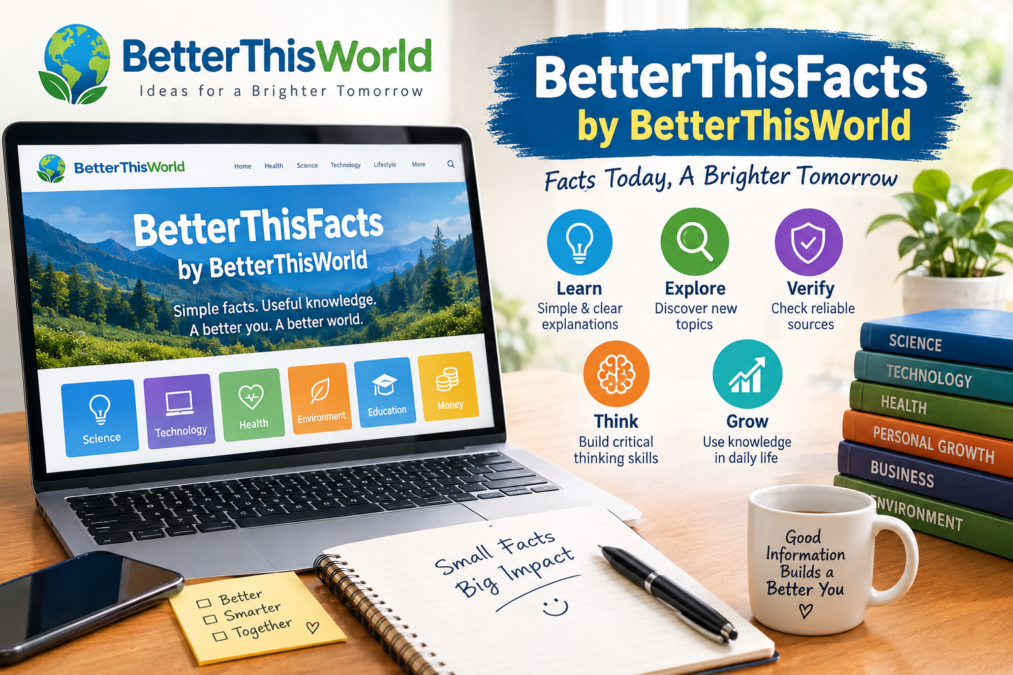

betterthisfacts by betterthisworld is a search phrase used for content associated with BetterThisWorld and its information-focused articles. Current pages on BetterThisWorld describe BetterThisFacts as a way of presenting useful information, facts, explanations, and practical ideas in an accessible format. Some pages emphasize short, easy-to-understand facts, while others connect the concept with broader subjects such as personal development, technology, health, money, science, and everyday life.
In today’s online world, finding information isn’t difficult. Finding useful and trustworthy information can be much harder. A single search can produce hundreds of pages, social-media posts, videos, advertisements, opinions, and AI-generated articles. As a result, readers increasingly want content that is simple to understand but still encourages careful thinking.
That idea helps explain the interest in betterthisfacts by betterthisworld.
Rather than viewing the phrase as only a keyword, it can be understood as an information-content concept associated with BetterThisWorld. However, readers should remember that the word “facts” in a website or section name doesn’t automatically prove that every individual statement has been independently verified. Important claims should still be checked against primary or authoritative sources.
What Is BetterThisFacts by BetterThisWorld?
betterthisfacts by betterthisworld refers to information-oriented content associated with BetterThisWorld. The site’s published material describes BetterThisFacts as a source of concise and practical knowledge designed to make information easier for readers to understand. One BetterThisWorld article says the project aims to provide factual summaries, context, sources, and useful next steps while avoiding unnecessary opinion.
The concept is fairly straightforward.
Instead of presenting complicated information in a way that feels like a textbook, BetterThisFacts-style content attempts to break subjects into smaller pieces. A reader can then understand an idea without having to spend hours going through technical material.
Topics mentioned across current BetterThisWorld pages include areas such as:
- Science
- Technology
- Health
- Environment
- Education
- Productivity
- Money
- Business
- Personal development
- Everyday knowledge
The exact range can change over time because online publishing platforms regularly add, remove, or reorganize content.
That’s worth remembering when researching betterthisfacts by betterthisworld. A page published several months ago may describe the project differently from a newer page.
Why BetterThisFacts Was Created
The basic idea behind BetterThisFacts is connected to a common problem: information overload.
People have access to more information than ever before. Search engines can answer questions in seconds, but the huge amount of available material creates a new challenge.
Which information should a reader trust?
Which claims need more research?
Which statements are facts, and which are opinions?
BetterThisWorld’s own material presents BetterThisFacts as an effort to make useful information easier to access and understand. Its pages describe a focus on clear explanations and research-based information.
This approach can be helpful because readers don’t always need a long academic paper to understand a basic concept. Sometimes they need a short explanation that points them toward better sources.
In other words, good informational content can act like a map.
It doesn’t necessarily replace the original destination, but it can help readers figure out where to go next.
How BetterThisFacts Presents Information
One of the main ideas connected with betterthisfacts by betterthisworld is simplicity.
People often avoid useful information when it is filled with complicated vocabulary, long paragraphs, or unnecessary technical details. A concise explanation can make the same topic much more approachable.
For example, an effective information page might follow a simple structure:
- Introduce the subject.
- Explain the central idea.
- Provide relevant facts.
- Add useful context.
- Mention limitations where necessary.
- Suggest additional research when appropriate.
This format is particularly useful for beginners.
A student researching a topic, a casual reader looking for a quick explanation, or someone trying to understand an unfamiliar subject can all benefit from straightforward writing.
However, simplicity shouldn’t mean oversimplification.
That’s the tricky part.
A good article needs to make information easy to understand without removing important context.
Topics Associated With BetterThisFacts
Current BetterThisWorld pages associate BetterThisFacts with a broad range of subjects. These topics reflect everyday questions as well as areas that require more detailed research.
Science and General Knowledge
Science-related information can help readers understand the world around them.
Articles in this area may discuss discoveries, natural processes, scientific concepts, space, animals, or environmental subjects.
For scientific topics, source quality is especially important. Scientific claims should ideally be supported by research papers, universities, government agencies, professional organizations, or other credible institutions.
Technology
Technology changes quickly.
A useful technology article can explain new tools, digital trends, software, devices, artificial intelligence, cybersecurity, or online services.
Because technology develops so rapidly, readers should always check publication dates. Information that was accurate two years ago may no longer apply today.
Health and Wellness
Health is another area where readers should be especially careful.
General educational information can be useful, but medical decisions shouldn’t be based on a short online article alone.
Reliable health information should ideally be compared with sources such as government health agencies, medical institutions, professional organizations, and qualified healthcare providers.
Money and Business
Financial topics often attract readers because people want practical ways to understand saving, investing, business, careers, and personal finance.
Yet financial information also requires caution.
A general explanation of budgeting is very different from personalized investment advice. Readers should consider their own circumstances and verify important financial claims through reliable sources.
Personal Development
BetterThisWorld also publishes material related to habits, productivity, motivation, and self-improvement.
This type of content can offer practical ideas such as planning tasks, improving routines, managing time, and developing useful habits.
The key is to treat these suggestions as tools rather than guarantees.
No single productivity technique works perfectly for everybody.
BetterThisFacts and the Importance of Fact-Checking
The word “facts” creates an important responsibility.
Whenever a platform presents information as factual, readers naturally expect accuracy. That’s why fact-checking matters.
BetterThisWorld pages state that BetterThisFacts-related material aims to use research, data, and reliable sources. One current page specifically says its approach includes peer-reviewed studies, government data, and authoritative reports, while another describes verification and corrections as part of its stated process.
Those are useful claims about the site’s intended approach, but readers shouldn’t stop there.
The strongest way to evaluate a factual statement is to examine its underlying evidence.
For example, if an article says that a scientific study found something, look for:
- The study itself
- The researchers
- The publication date
- The journal
- The sample size
- The research method
- Any limitations
- Independent research on the same question
This approach is useful for every information website, not just betterthisfacts by betterthisworld.
BetterThisFacts by BetterThisWorld and Source Transparency
Source transparency is one of the most important parts of trustworthy online publishing.
A strong informational page should make it reasonably clear where important claims come from.
That might mean linking to:
- Government reports
- Academic studies
- Official statistics
- University research
- Professional organizations
- Original interviews
- Official company documents
A source also needs context.
For example, a statistic without a date may be misleading. A study involving 50 people shouldn’t automatically be presented as proof about an entire population. And a preliminary research result shouldn’t be described as an established scientific fact.
BetterThisWorld’s BetterThisFacts pages emphasize sources and verification, which is a positive principle.
Still, readers should examine the citations themselves.
That’s not distrust. It’s good research.
How to Use BetterThisFacts Responsibly
The most useful way to approach betterthisfacts by betterthisworld is as an information starting point.
Suppose you find an interesting claim in an article.
Don’t immediately accept it or reject it.
Instead, use a simple process.
Read the complete claim
Don’t judge a statement from its headline alone.
Sometimes a headline sounds stronger than the explanation underneath it.
Check the date
Information changes.
This is especially important for:
- Technology
- Medicine
- Business
- Laws
- Policies
- Current events
- Scientific research
Find the original source
If an article refers to a study, report, or statistic, try to find the original material.
Compare independent sources
One website can make a mistake.
Several independent high-quality sources can provide a stronger picture.
Separate fact from advice
A statement such as “research found X” is different from “you should do X.”
The first is a factual claim. The second is advice.
Consider the limitations
Even reliable research has limitations.
A thoughtful reader asks not only, “What does this study show?” but also, “What doesn’t it show?”
The Difference Between Information and Proof
This distinction is essential when discussing betterthisfacts by betterthisworld.
An article can provide useful information without being the final proof of every statement it contains.
Think of online articles as layers.
The first layer gives you an overview.
The second layer gives you supporting sources.
The third layer is the original evidence.
For example:
Article → cited report → original research
When the topic is important, moving closer to the original evidence makes your understanding stronger.
This approach is especially useful for health, finance, science, law, and other areas where incorrect information can have serious consequences.
What Makes an Informational Article Useful?
A useful article doesn’t simply contain many facts.
It needs to answer the reader’s actual question.
Good informational content usually has several characteristics.
| Quality | What It Means |
|---|---|
| Accuracy | Claims should be supported by reliable evidence |
| Clarity | Readers can understand the explanation |
| Relevance | Information directly addresses the topic |
| Context | Facts aren’t presented in isolation |
| Transparency | Sources and limitations are visible |
| Timeliness | Important information is reasonably current |
| Practical value | Readers can understand what the information means |
| Balance | Facts are separated from opinion |
| Accessibility | The language is suitable for the intended audience |
These qualities can help readers evaluate betterthisfacts by betterthisworld as well as other informational websites.
BetterThisFacts as a Learning Tool
Short-form information can be surprisingly useful for learning.
A reader might discover a new subject through one short fact and then become interested in learning more.
For example, a short article about space could encourage someone to explore astronomy.
A technology fact could lead a student toward computer science.
A business explanation could encourage someone to learn about entrepreneurship.
This creates a simple learning cycle:
Discover → Question → Research → Understand → Apply
The first step is curiosity.
And curiosity is powerful.
You don’t need to know everything before starting. Sometimes one interesting fact is enough to open the door to an entirely new subject.
How BetterThisFacts Can Help With Everyday Knowledge
Not every useful fact needs to solve a major problem.
Some information simply helps people understand everyday life.
For instance, readers may want to learn about:
- Household practices
- Digital safety
- Productivity
- Basic financial concepts
- Environmental issues
- Communication
- Education
- Technology
- General science
- Lifestyle choices
The value of this type of content is convenience.
Instead of searching through several difficult sources to understand a simple question, a reader can begin with a concise explanation and continue researching if the topic becomes more important.
The Role of Critical Thinking
Information is most valuable when readers think about it.
Critical thinking means asking questions rather than accepting every statement automatically.
When reading betterthisfacts by betterthisworld, readers can ask:
- What is the evidence?
- Where did this information come from?
- Is the source current?
- Is the claim supported by more than one source?
- Does the article distinguish facts from opinions?
- Are there important limitations?
- Could the information have changed?
- Is the conclusion stronger than the evidence?
These questions don’t make learning harder.
They make learning better.
Why Online Readers Should Be Careful With Repeated Claims
A common internet problem is repetition.
One website publishes a claim.
Another website copies it.
A third website rewrites it.
Soon, five or ten pages appear to confirm the same statement.
But they may all be relying on the same original claim.
This is why the number of websites repeating something isn’t necessarily proof that it’s true.
Source independence matters.
If ten pages all cite the same original study, the real evidence is still that study.
This is a valuable lesson for anyone researching betterthisfacts by betterthisworld or any other online information source.
Different Descriptions of BetterThisFacts Online
Another important issue is that search results don’t describe BetterThisFacts in exactly the same way.
The official BetterThisWorld material presents BetterThisFacts as an information-focused project involving facts, summaries, research, and practical knowledge.
Other websites describe it more broadly as a self-improvement resource, a general knowledge hub, or a practical information platform.
There are also pages online that question how clearly the concept is defined and point out that different sites use similar wording when describing it.
This difference is worth mentioning because it shows why readers should check the original BetterThisWorld pages rather than relying only on third-party descriptions.
In plain English, don’t let a random search result do all the thinking for you.
BetterThisFacts and the Value of Simple Language
One strength of short informational content is accessibility.
Complex topics can be intimidating.
A reader may understand a difficult subject more easily when the writer:
- Uses short paragraphs
- Explains unfamiliar terms
- Provides examples
- Uses clear headings
- Avoids unnecessary jargon
- Summarizes key points
- Links to deeper information
Grade-level writing can be especially useful for general audiences.
Clear writing isn’t “less intelligent.” In fact, explaining a complicated subject simply can require considerable skill.
How Students Can Use BetterThisFacts
Students can use short factual articles as starting points for research.
For example, a student might:
- Read a short explanation.
- Identify unfamiliar terms.
- Find the original sources.
- Compare information from different organizations.
- Take notes.
- Build a more detailed report.
This is better than copying an online paragraph and treating it as research.
Educational work should involve understanding, not just collecting sentences.
How Writers Can Learn From the BetterThisFacts Concept
Content writers can also learn from the concept behind betterthisfacts by betterthisworld.
A strong information article should have a clear purpose.
Before writing, the author should ask:
What does the reader actually want to know?
Then the writer can organize the article around that question.
Useful techniques include:
- Start with a direct explanation.
- Use descriptive headings.
- Put important facts near the beginning.
- Explain technical terms.
- Include relevant examples.
- Avoid unnecessary repetition.
- Use trustworthy sources.
- Update outdated information.
- Admit uncertainty when evidence is limited.
These principles apply to blogs, educational websites, news articles, and business content.
What BetterThisFacts Should Not Replace
Even a useful information website has limits.
Readers shouldn’t treat general online articles as replacements for qualified professionals when making important decisions.
For example:
Medical decisions
Use qualified healthcare professionals and reliable medical sources.
Legal questions
Consult appropriate legal professionals and official legal resources.
Financial decisions
Consider qualified financial guidance and authoritative financial information.
Academic research
Use original studies, academic databases, libraries, and educational institutions.
Breaking news
Check current reporting from established news organizations and official sources.
The purpose of general information is to improve understanding, not eliminate the need for professional judgment.
A Practical Checklist for Evaluating BetterThisFacts Content
Before relying heavily on an article, readers can use this quick checklist.
Source: Who published it?
Date: When was it published or updated?
Evidence: Does it provide supporting material?
Original source: Can the underlying evidence be found?
Language: Does it clearly separate fact from opinion?
Context: Are important limitations explained?
Independence: Are multiple sources genuinely independent?
Purpose: Is the page educational, promotional, entertainment-focused, or something else?
Currency: Could the information have changed?
This checklist takes only a few minutes and can dramatically improve online research habits.
The Broader Idea Behind BetterThisWorld
The broader BetterThisWorld concept is connected with self-improvement and useful knowledge. Current BetterThisWorld pages discuss areas including habits, productivity, money, technology, and practical life information.
That creates an interesting relationship between information and personal development.
Information by itself doesn’t automatically change someone’s life.
Application is what makes knowledge useful.
Knowing how budgeting works is different from creating a budget.
Reading about productivity is different from changing a daily routine.
Learning about cybersecurity is different from enabling stronger account protection.
So the real value of informational content often comes from what readers do after learning something.
BetterThisFacts by BetterThisWorld in the Modern Information Age
The internet has changed the way people learn.
Years ago, people often depended on books, newspapers, television, teachers, and libraries for general information.
Today, information is available almost instantly.
That’s a huge advantage, but it comes with a responsibility.
More information doesn’t automatically mean better information.
Readers need digital literacy.
They need to know how to:
- Search effectively
- Compare sources
- Recognize unsupported claims
- Check dates
- Identify original evidence
- Understand uncertainty
- Avoid misleading headlines
- Distinguish opinion from fact
This is why the concept behind betterthisfacts by betterthisworld fits into a much larger conversation about responsible information consumption.
Frequently Asked Questions About BetterThisFacts by BetterThisWorld
What does BetterThisFacts by BetterThisWorld mean?
It refers to information and fact-oriented content associated with BetterThisWorld. Current BetterThisWorld pages describe it as a way of presenting useful facts, explanations, research, and practical information in accessible formats.
Is BetterThisFacts a fact-checking organization?
The available BetterThisWorld material presents BetterThisFacts as a factual information initiative. However, readers shouldn’t automatically interpret the name as proof of independent accreditation or professional fact-checking status. Important claims should be checked against authoritative sources.
What topics does BetterThisFacts cover?
Current material associates BetterThisFacts with subjects including science, technology, health, environment, education, productivity, money, business, and general knowledge.
Is BetterThisFacts useful for students?
It can be useful as a starting point for learning. Students should still consult original research, academic sources, books, and reliable educational institutions when preparing formal assignments.
Can readers trust every fact they find online?
No website should be treated as automatically infallible. Readers should examine sources, dates, evidence, and context before relying on important claims.
Why are there different descriptions of BetterThisFacts online?
Different websites use the term in different ways, while BetterThisWorld’s own pages provide the most direct description of its intended role.
Is BetterThisFacts only about trivia?
No. Current BetterThisWorld material presents it more broadly as information and knowledge content, rather than simply a collection of fun trivia.
Final Thoughts on BetterThisFacts by BetterThisWorld
The internet has made knowledge easier to access than ever before, but it has also made it harder to separate useful information from unsupported claims. That is the larger context in which betterthisfacts by betterthisworld should be understood.
BetterThisWorld’s current material presents BetterThisFacts as an information-focused concept designed to make facts, explanations, research, and practical knowledge easier for readers to understand. Its published pages connect the content with areas such as science, technology, health, productivity, money, education, and everyday knowledge.
At the same time, responsible readers shouldn’t assume that a website name alone guarantees the accuracy of every individual claim. Checking original sources, publication dates, evidence, and context remains essential.
Ultimately, the strongest benefit of betterthisfacts by betterthisworld is the idea of making useful information accessible while encouraging readers to learn, question, compare, and think critically. In a world full of information, that’s a valuable habit: don’t simply collect facts—understand them, verify them, and use them wisely.
How BetterThisFacts Can Support Everyday Learning
BetterThisFacts by BetterThisWorld can be useful for people who enjoy learning small pieces of information in an easy format. Instead of reading a very long academic paper, readers may prefer short explanations that introduce a topic and encourage them to explore it further.
This type of content can be especially helpful when someone wants to understand a new subject before doing deeper research. For example, a reader might discover information about science, technology, health, the environment, education, or general knowledge and then search for reliable sources to learn more.
The key point is that bite-sized information should be treated as a starting point rather than the final answer.
The Importance of Checking Sources
Online information can spread quickly, but speed doesn’t always mean accuracy. A fact may be copied from one website to another without proper verification.
For this reason, readers should look for:
- The original source of a claim
- Government or educational sources when appropriate
- Peer-reviewed research for scientific subjects
- Dates showing when information was published or updated
- Clear explanations of evidence
- Corrections when mistakes are discovered
- Different reliable sources discussing the same subject
BetterThisWorld’s own descriptions of BetterThisFacts emphasize research, source checking, context, and awareness of uncertainty. These are useful principles for anyone publishing or consuming informational content.
BetterThisFacts and Critical Thinking
Good informational websites can do more than provide facts. They can also encourage readers to think carefully about what they see online.
Critical thinking means asking simple questions such as:
- Where did this information come from?
- Is there evidence supporting the claim?
- Is the source trustworthy?
- Is the information current?
- Could the statement be missing important context?
- Do other reliable sources agree?
- Is the article presenting fact, interpretation, or opinion?
These questions are valuable because even a professional-looking website can contain incomplete or outdated information.
Why Context Matters
A fact without context can sometimes create a misleading impression.
For example, a statistic may appear impressive when shown alone, but its meaning can change when the reader learns about the sample size, time period, location, or research method.
BetterThisFacts-style informational content can be more useful when it explains not only what happened but also why it matters and what the available evidence shows.
Context helps readers develop a more complete understanding instead of remembering only one isolated statement.
Using BetterThisFacts for Research
Students, bloggers, writers, and general readers can use information hubs as an initial research step.
A practical research process can look like this:
| Research Step | What to Do |
|---|---|
| Discover | Find an introductory article about the subject |
| Understand | Read the basic explanation |
| Verify | Check the original or authoritative sources |
| Compare | Look at information from multiple reliable sources |
| Organize | Record important facts and references |
| Write | Create your own explanation using verified information |
This approach can make online research more organized and responsible.
BetterThisFacts for Content Writers
Content writers can also benefit from this type of information resource. A writer may use an introductory article to understand a topic before investigating stronger primary sources.
However, writers shouldn’t simply copy facts from another website. Instead, they should verify important information and create original explanations.
A strong writing process includes:
- Researching the topic
- Finding primary sources
- Checking dates
- Confirming names and figures
- Comparing reliable references
- Adding useful context
- Writing in original language
- Reviewing the article before publication
This approach supports accuracy while also making the final article more valuable to readers.
The Difference Between Information and Evidence
One important lesson for online readers is that an article containing a statement doesn’t automatically make that statement proven.
There is a difference between:
Information: A website says something happened.
Evidence: Reliable documentation supports the statement.
Verified conclusion: Multiple trustworthy sources or strong evidence support the interpretation.
Understanding this difference can prevent readers from accepting every online claim immediately.
Why Readers Should Watch for Updates
Information can change over time. New research can replace older findings, companies can change their products, policies can be updated, and scientific understanding can develop.
This means an article published several years ago may not completely represent the situation today.
BetterThisWorld’s descriptions of BetterThisFacts mention updates, corrections, and attention to changing information. For readers, checking the publication or update date is therefore an important habit.
BetterThisFacts in the Modern Information Age
The internet gives people access to an enormous amount of information. At the same time, it can be difficult to determine which information deserves trust.
This creates a growing need for clear educational content.
Information platforms can help by presenting complicated subjects in simple language. Yet readers still have an important role. They should remain curious, compare sources, and avoid treating a single webpage as unquestionable authority.
That combination—accessible information plus responsible verification—can make online learning much more useful.
Common Mistakes Readers Should Avoid
When exploring BetterThisFacts or similar websites, readers should avoid several common mistakes.
Accepting Every Claim Immediately
Even if an article looks professional, important claims should be checked when accuracy matters.
Ignoring Publication Dates
Old information can sometimes remain online long after circumstances have changed.
Confusing Opinions With Facts
An article may contain explanations or interpretations alongside factual information. Readers should recognize the difference.
Relying on One Website
Using multiple trustworthy sources provides a broader picture and can reveal errors or missing context.
Sharing Information Without Checking It
Before sharing an interesting claim on social media, readers should consider whether the original source supports it.
BetterThisFacts and Responsible Online Sharing
Interesting facts are often shared quickly because they are easy to understand and remember. However, a short statement can lose important context when copied onto social media.
Responsible sharing means checking the original article and, when necessary, following its references.
This is particularly important for subjects involving health, finance, law, science, public safety, or other areas where incorrect information can have real consequences.
A Simple Checklist for Better Online Research
Before trusting an online fact, ask:
- Is the source clearly identified?
- Is the article dated?
- Does it explain where the information came from?
- Are important claims supported by evidence?
- Can the information be confirmed elsewhere?
- Is the wording factual or overly sensational?
- Does the article acknowledge uncertainty?
- Has newer information changed the subject?
These simple questions can improve research habits without requiring advanced academic skills.
Final Thoughts on BetterThisFacts by BetterThisWorld
BetterThisFacts by BetterThisWorld can be understood as an information-focused concept built around accessible facts, educational explanations, and research-oriented content. BetterThisWorld’s own descriptions emphasize verification, sources, context, and responsible presentation, while other websites use similar wording to describe related or separate information platforms.
Because online descriptions are not always identical, readers should pay attention to the specific website they are visiting and verify important claims through reliable sources.
The most valuable lesson is simple: use online facts to learn, but use evidence to verify.
When readers combine curiosity with careful research, they can gain knowledge while avoiding many common problems caused by misinformation, outdated claims, and missing context.
Explore more insightful articles on All Vantage News and never miss an update.Contact Us.